
Guide
What is a Transportation Discrepancy Report in Foreign Military Sales?
A Transportation Discrepancy Report records a shipment lost or damaged by a carrier in the , and a U.S. representative files it, never the purchaser. It supports a U.S. claim against the carrier, and any proceeds go to the purchaser's account at the Defense Finance and Accounting Service - Indianapolis, limited to the carrier's liability. Claims on third-party billing shipments, and against carriers a contracted, are filed by the purchaser or its with the carrier.
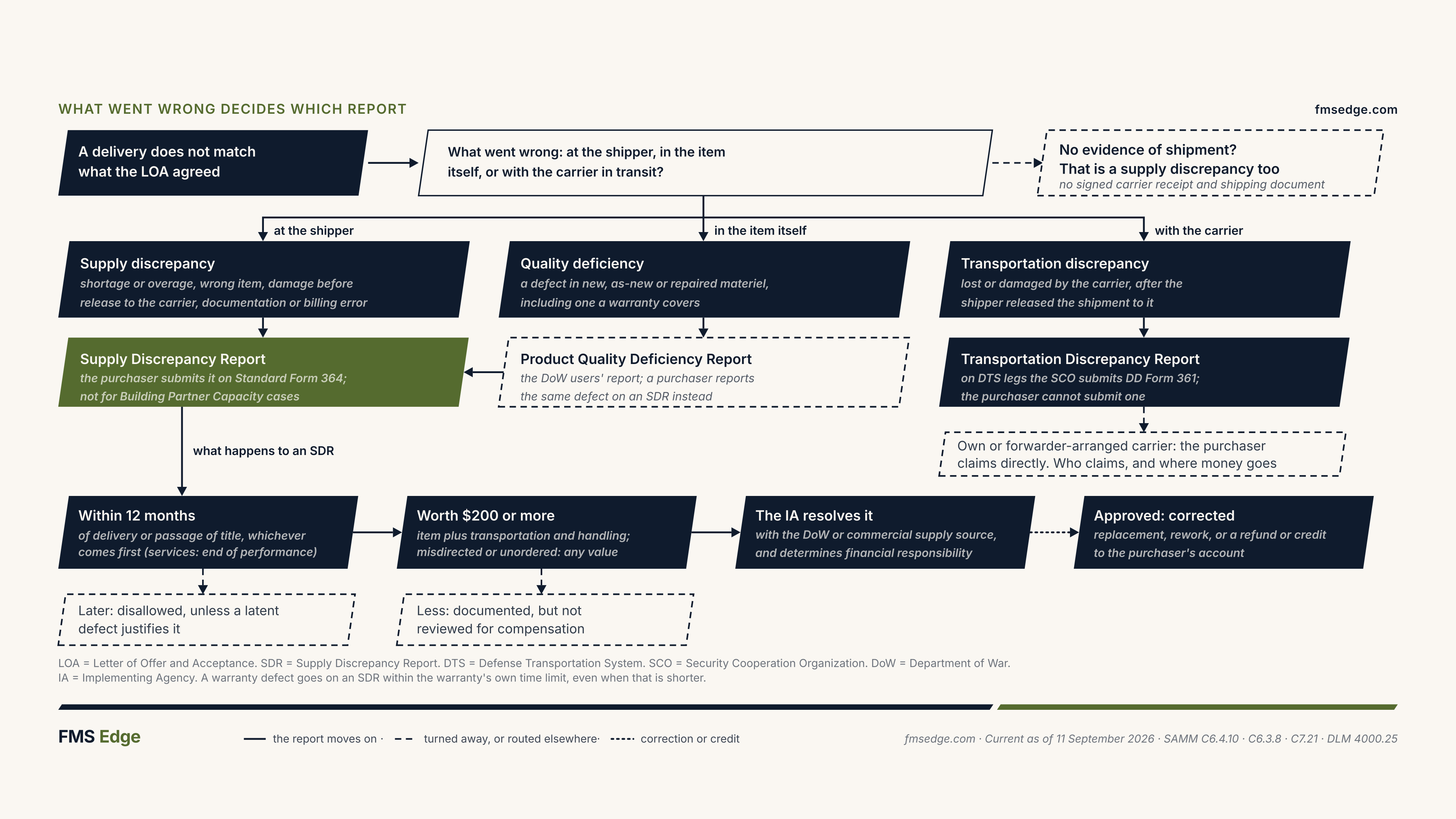
Which report a delivery problem needs depends on what went wrong. A shortage, a wrong item, damage before release to the carrier, a quality defect or a billing error goes on a Supply Discrepancy Report within 12 months of delivery or passage of title. Loss or damage caused by the carrier goes on a Transportation Discrepancy Report, which a U.S. representative files.
What is a Transportation Discrepancy Report?
Transportation Discrepancy Reports () apply only to materiel that is lost or damaged while being transported in the . The is not one of the categories of reporting discrepancies afforded to international partners. The procedures are used to document carrier performance and are not intended as a reimbursement option for international partners [SAMM ].
Transportation discrepancies occur when there is loss or damage to an item that can be attributed to the carrier (e.g., loss of a crate or package or a hole put through a container by a forklift during loading). These types of discrepancies are usually easy to detect by a visual inspection of the containers or by ensuring the number of items received matches the carrier’s bill of lading for the number of items shipped. If a container was damaged when the carrier picked it up from the shipping activity, the damage should also be reflected on the bill of lading.
Transportation discrepancies are normally filed by the shipper against the carrier. The will report these discrepancies to the Department of War (DoW) shipping activity with a letter or memorandum. The shipping activity will use these reports to initiate tracers or damage claims with the inland carrier using the DD Form 361, Transportation Discrepancy Report, process [SAMM ]. If non-receipt is suspected, customers should submit a [SAMM ].
Transportation discrepancy reporting procedures apply to any shipment made within the . The Defense Transportation Regulation's table of who submits the covers 2, for deliveries to DoW and U.S. Government () activities and contractors in the , and 5, 7, 8 and 9. The works a by exception for any code the table does not list, and procedures do not apply to 4 and E shipments, which do not involve the []. For overseas shipments, when the carrier is , the purchaser should contact the , the defense attaché, or the closest U.S. representative. That individual then submits a to the United States Army Transportation Command () [SAMM , ]. For a supply discrepancy, the purchaser submits an using Standard Form (SF) 364, and the resolves the and determines financial responsibility [SAMM , ]. The procedures also apply to materiel shipped to non-DoW consignees within the (e.g., freight forwarders, customer country embassies, or carrier facilities identified in responses) and Building Partner Capacity () shipments under a when the arranges the prepaid transportation via the .
When the shipment is prepaid to the ( 5 or H) different procedures apply. Prepaid shipments to these destinations, regardless of the funding source, involve a contractual relationship between a DoW/ shipping activity and the inland carrier. The customer (the consignee) is not a party to that contract; therefore, they cannot submit claims or tracing requests directly to the carrier. Also, as a non-DoW/ entity, the customer cannot submit [SAMM , ]. For these reasons, the or the country representative will report these discrepancies to the DoW shipping activity with a letter or memorandum. The shipping activity will use the to initiate tracers or damage claims with the inland carrier. Any proceeds from these claims are forwarded by the to the purchaser’s account at the Defense Finance and Accounting Service - Indianapolis () [SAMM ].
Some claims are outside what the can submit. Claims on third-party billing shipments, and claims against carriers that an contracted, must be filed by the purchaser or its directly with the carrier [SAMM ].
For any shipment processed through an , the purchaser should direct tracer requests to its before it addresses any inquiry to DoW [SAMM ]. If the 's records still show the item as not received, the purchaser directs the to open a formal tracer action with the inland carrier. That applies where the shipment was released under a commercial bill of lading or third-party billing procedures. The carrier should then provide proof of delivery; otherwise the must make a claim against the carrier on the purchaser's behalf [SAMM ].
If the shipment went to the inland carrier under some method of prepaid transportation, the should send the shipping activity a formal request. That request lets the shipping activity get proof of delivery from the carrier or submit a claim against it for lost or damaged goods. If materiel has been misdirected, the may be contacted for help redirecting it to its correct destination [SAMM ].
Under the Defense Transportation Regulation, transportation officers and receiving officers will document and submit a on every transportation discrepancy in a shipment received at their activity, and for deliveries the performs the receiving officer's functions. and shipment discrepancies are reported regardless of value [].
Submission of a serves to initiate a tracer for missing shipments and/or to report mishandling by the carrier. It does not itself provide financial compensation to the customer; it establishes the official record for the claim against the carrier [SAMM ]. For a supply discrepancy, the customer submits an on SF 364, and the resolves it and determines financial responsibility [SAMM , ]. For a stock item shipped through the , an approved for non-receipt or shortage is financed where U.S. action or inaction prevented satisfaction from the carrier [SAMM ].
Since Section 5.1 of the standard terms and conditions disclaims any liability for loss or damage after passage of title, the serves as a means for the to file claims against the commercial carrier and collect damages up to the carrier’s limited liability [SAMM , ].
The customer will receive neither replacement materiel nor credit for the full value of the loss. customers who are unwilling to accept this risk should consider purchasing commercial insurance for their shipments [SAMM , ]. Further guidance on can be found in 4500.9-R Part II, Chapter 210 [SAMM ].
To make the claim against the carrier for lost or damaged materiel stronger, the , representing the purchaser, should provide all the information the asks for and as much supporting documentation as possible. That documentation includes bills of lading, the delivery receipt, photographs, the carrier's inspection report, the government inspection report, an actual repair cost estimate, signed and dated statements from the personnel who discovered the damage, and similar records [SAMM ].
Try the tool: Discrepancy report or claim?
References
SAMM
- SAMM C6.4.10: Supply Discrepancies.
- SAMM C6.4.10.4: Supply Discrepancy Report Responses.
- SAMM C6.T4: Methods of Financing Approved Supply Discrepancy Reports
- SAMM C7.10.1
- SAMM C7.21: Transportation Discrepancies.
- SAMM C7.21.1: Claims That Cannot be Submitted by the United States Government.
- SAMM C7.21.2: Claims That Can Be Submitted by the United States Government.
- SAMM C7.21.3.3
- SAMM C7.21.3.1
- SAMM C7.21.4.1: Key Supporting Documentation.
Public authorities
- DTR 4500.9-R: Defense Transportation Regulation, DTR 4500.9-R
Related
Foreign Military Sales (FMS)
The part of U.S. security assistance, authorized by the Arms Export Control Act (AECA), in which eligible foreign governments and international organizations buy defense articles, services and training from the U.S. Government under formal government-to-government agreements.
The articles come either from Department of War stocks or from new procurement under contracts the Department manages [22 U.S.C. 2761, 22 U.S.C. 2762]. A sale is FMS whatever the source of the purchaser's financing.
FMS Edge glossary, as of 10 October 2026
Glossary entry →Open the manual’s entry → (opens in new tab)
Defense Transportation System (DTS)
The part of the worldwide transportation infrastructure that supports Department of War transportation needs in peace and war, made up of military (organic) and commercial resources that are organic to the Department, under contract to it or controlled by it [SAMM C7.6.1].
It takes in organic and commercial aircraft and ships, commercial small-package services under Department contract, and U.S. military air and ocean terminals in and outside the United States.
FMS Edge glossary, as of 10 October 2026
Glossary entry →Open the manual’s entry → (opens in new tab)
Freight Forwarder
A commercial import/export company registered with the Department of State, Bureau of Political-Military Affairs, Directorate of Defense Trade Controls and under contract to the Foreign Military Sales customer which arranges transportation of materiel from a point specified in the Letter of Offer and Acceptance to the final destination.
SAMM Glossary, as of 12 September 2026
Glossary entry →Open the manual’s entry → (opens in new tab)
Continental United States (CONUS)
U.S. territory, including the adjacent territorial waters, located within the North American continent between Canada and Mexico. Does not include Hawaii or Alaska.
SAMM Glossary, as of 12 September 2026
Glossary entry →Open the manual’s entry → (opens in new tab)
Supply Discrepancy Report (SDR)
A process for international customers to file a complaint with the DoD for product loss, quality deficiencies, damage, and various other problems associated with the delivery of material under the Foreign Military Sales program.
SAMM Glossary, as of 12 September 2026
Glossary entry →Open the manual’s entry → (opens in new tab)
Security Cooperation
Activities by which the Department of War encourages and enables international partners to cooperate with the United States toward strategic objectives, spanning every interaction with foreign defense and security establishments and every security assistance program the Department administers.
Under chapter 16 of Title 10, their purposes are to develop allied and friendly security capabilities for self-defense and multinational operations, to give U.S. forces peacetime and contingency access, and to build relationships promoting specific U.S. security interests [10 U.S.C. 301(7)].
FMS Edge glossary, as of 10 October 2026
Glossary entry →Open the manual’s entry → (opens in new tab)
DTS: Defense Transportation System
SAMM Acronyms, as of 12 September 2026
Delivery Term Code (DTC)
A single-character logistics code that shows how far, from the source of supply to the final destination, the Department of War is responsible for transporting a shipment; it does not set the mode of transportation or how the movement is financed [SAMM C7.4.1].
FMS Edge glossary, as of 10 October 2026
Glossary entry →Open the manual’s entry → (opens in new tab)
CONUS: Continental United States
SAMM Acronyms, as of 12 September 2026
DTC: Delivery Term Code
SAMM Acronyms, as of 12 September 2026
Implementing Agency (IA)
The military department or defense agency responsible for the execution of military assistance programs. With respect to FMS, the military department or defense agency assigned responsibility by the Defense Security Cooperation Agency to prepare an LOA and to implement an FMS case. The implementing agency is responsible for the overall management of the actions that will result in delivery of the materials or services set forth in the LOA that was accepted by a foreign country or international organization.
SAMM Glossary, as of 12 September 2026
Glossary entry →Open the manual’s entry → (opens in new tab)
FMS: Foreign Military Sale
SAMM Acronyms, as of 12 September 2026
Security Cooperation Organization (SCO)
A Department of Defense element that is part of the United States Diplomatic mission located in a foreign country to carry out security assistance and security cooperation management functions under the supervision and coordination authority of the senior defense official/defense attaché.
SAMM Glossary, as of 12 September 2026
Glossary entry →Open the manual’s entry → (opens in new tab)
U.S. Army Transportation Command
The U.S. Army command, formerly the Military Surface Deployment and Distribution Command (SDDC), that is the Army service component command of U.S. Transportation Command (USTRANSCOM) and a major subordinate command of Army Materiel Command.
Its assets form part of the Defense Transportation System (DTS), and it processes claims against ocean carriers for transportation the Department of War furnishes or contracts [SAMM C7.6.2.1, C7.21.2].
FMS Edge glossary, as of 10 October 2026
SDR: Supply Discrepancy Report
SAMM Acronyms, as of 12 September 2026
Notice of Availability (NOA)
Notice, on DD Form 1348-5, from a shipping activity to a Foreign Military Sales (FMS) purchaser or its freight forwarder that materiel is ready for shipment, in time for the recipient to prepare for receipt and respond with delivery instructions.
The Notice of Availability (NOA) goes to the appropriate address in the Military Assistance Program Address Directory (MAPAD) and coordinates the release of materiel requiring special receipt, export processing or special storage procedures [SAMM C7.11.1].
FMS Edge glossary, as of 10 October 2026
Glossary entry →Open the manual’s entry → (opens in new tab)
Letter of Offer and Acceptance (LOA)
The legal instrument that lists the defense articles and services, including training, that the U.S. Government transfers to a foreign country or international organization, with their estimated costs and the terms and conditions. The benefitting partner does not sign a Building Partner Capacity (BPC) LOA.
The Letter of Offer and Acceptance (LOA) is the instrument the U.S. Government uses to sell under the Arms Export Control Act (AECA); signed LOAs and their later Amendments and Modifications are also called Foreign Military Sales (FMS) cases [SAMM C5.6.1].
FMS Edge glossary, as of 10 October 2026
Glossary entry →Open the manual’s entry → (opens in new tab)
LOA: Letter of Offer and Acceptance
SAMM Acronyms, as of 12 September 2026
DFAS-IN: Defense Finance and Accounting Service - Indianapolis
SAMM Acronyms, as of 12 September 2026
SCO: Security Cooperation Organization
SAMM Acronyms, as of 12 September 2026
SAMM C7.21: Transportation Discrepancies.
“When a discrepancy occurs in-transit, U.S. Military Groups (MILGPs) must submit a Defense Department (DD) Form 361 “Transportation Discrepancy Report (TDR)” for Defense Transportation System (DTS)-routed Foreign Military Sales (FMS) and grant aid deliveries. The purchaser cannot submit a TDR. TDR procedures are found in Defense Transportation Regulation (DTR) 4500.9-R., Part 2, Chapter 210 “Transportation Discrepancy Reports (TDR).” A TDR …”
Security Assistance Management Manual, as of 26 October 2026
SAMM C7.21.2: Claims That Can Be Submitted by the United States Government.
“For DoW-furnished or contracted transportation, DoW is responsible for submitting claims against carriers. United States Army Transportation Command (ARTRANS) processes claims against ocean carriers, Air Mobility Command (AMC) processes claims against air carriers, and DoW shipping activities submit claims against inland CONUS carriers. The ARTRANS initiates its claims in response to TDR packages submitted by MILGPs in the purchaser’s country. …”
Security Assistance Management Manual, as of 26 October 2026
SAMM C6.4.10: Supply Discrepancies.
“The USG makes every effort to provide the correct defense article or service in the quantity and quality shown in the LOA. In the event of a discrepancy, the purchaser submits an SDR using Standard Form (SF) 364. Instructions for SF 364 completion, DoW processing timeframes, and responsibilities are located in the Defense Logistics Management (DLM) 4000.25, Defense Logistics Management …”
Security Assistance Management Manual, as of 26 October 2026
SAMM C6.4.10.4: Supply Discrepancy Report Responses.
“The IA, in conjunction with the DoW or commercial supply source, resolves SDRs and determines financial responsibility. The IA designates a single point of contact for SDR corrective action. Only this point of contact and DSCA are authorized to accept and convey USG liability or originate a commitment for corrective action. Commitments to the purchaser for U.S. financing of discrepancies …”
Security Assistance Management Manual, as of 26 October 2026
SAMM C7.21.1: Claims That Cannot be Submitted by the United States Government.
“Claims against carriers or third-party billing shipments and FMS freight forwarder-contracted carriers must be filed by purchasers or their FMS freight forwarders directly with the carriers.”
Security Assistance Management Manual, as of 11 September 2026
SAMM C7.21.3.1
“For all shipments processed through FMS freight forwarders, purchasers should direct tracer requests to their FMS freight forwarders before addressing any inquiries to DoW.”
Security Assistance Management Manual, as of 26 October 2026
SAMM C7.21.3.3
“If the FMS freight forwarder's records still show non-receipt, the purchaser directs the FMS freight forwarder to start a formal tracer action with the inland carrier if the shipment was released under a Commercial Bill of Lading (CBL) or third-party billing procedures. The carrier should provide proof of delivery, or the FMS freight forwarder must make a claim against the …”
Security Assistance Management Manual, as of 11 September 2026
SAMM C6.T4: Methods of Financing Approved Supply Discrepancy Reports
“Table C6.T4. Methods of Financing Approved Supply Discrepancy Reports Nature of Discrepancy Source of Supply (SoS) Foreign Military Sales (FMS) Funds 1 (Admin, Packing Crating & Handling, Transportation) United States Government Funds/Appropriations (Defense Working Capital Fund, Procurement Appropriation, Operation & Maintenance, Research, Development, Test & Evaluation) Damage, Defect, or Other Deficiency Procurement2 Generally not applicable except where U.S. action or …”
Security Assistance Management Manual, as of 26 October 2026
SAMM C7.10.1
“Title of Foreign Military Sales (FMS) shipments transfers to the purchaser at the point of origin unless otherwise specified in the Letter of Offer and Acceptance (LOA). The DoW is not responsible for any loss or damage that occurs in transit or after passage of title. If a purchaser does not want to self-insure a shipment, the purchaser should obtain …”
Security Assistance Management Manual, as of 26 October 2026
SAMM C7.21.4.1: Key Supporting Documentation.
“In order to strengthen the claim against the carrier for lost or damaged material, the MILGP in representing the purchaser should provide as much supporting documentation as possible, in addition to providing all requested information on the TDR. This supporting documentation includes BLs, delivery receipt, photographs, carrier’s inspection report, government inspection report, actual repair cost estimate, signed and dated statements …”
Security Assistance Management Manual, as of 26 October 2026