
Guide
How are hazardous materials shipped in a Foreign Military Sale?
Hazardous materiel bought through moves under the U.S. Department of Transportation's hazardous materials regulations in every mode, whether the shipper is a government activity or a contractor, and must also be certified to the international code for the mode it travels by. The original shipper prepares it for the whole journey. Explosives need an EX-Number before they move by commercial conveyance in the United States, and a purchaser moving them itself applies for its own.
For ordinary cargo the purchaser's chosen method drives the typical path. Classified, sensitive or arms, ammunition and explosives (AA&E) cargo moving internationally needs a Transportation Plan, approved and accepted in writing before anything moves, and the plan decides the path.
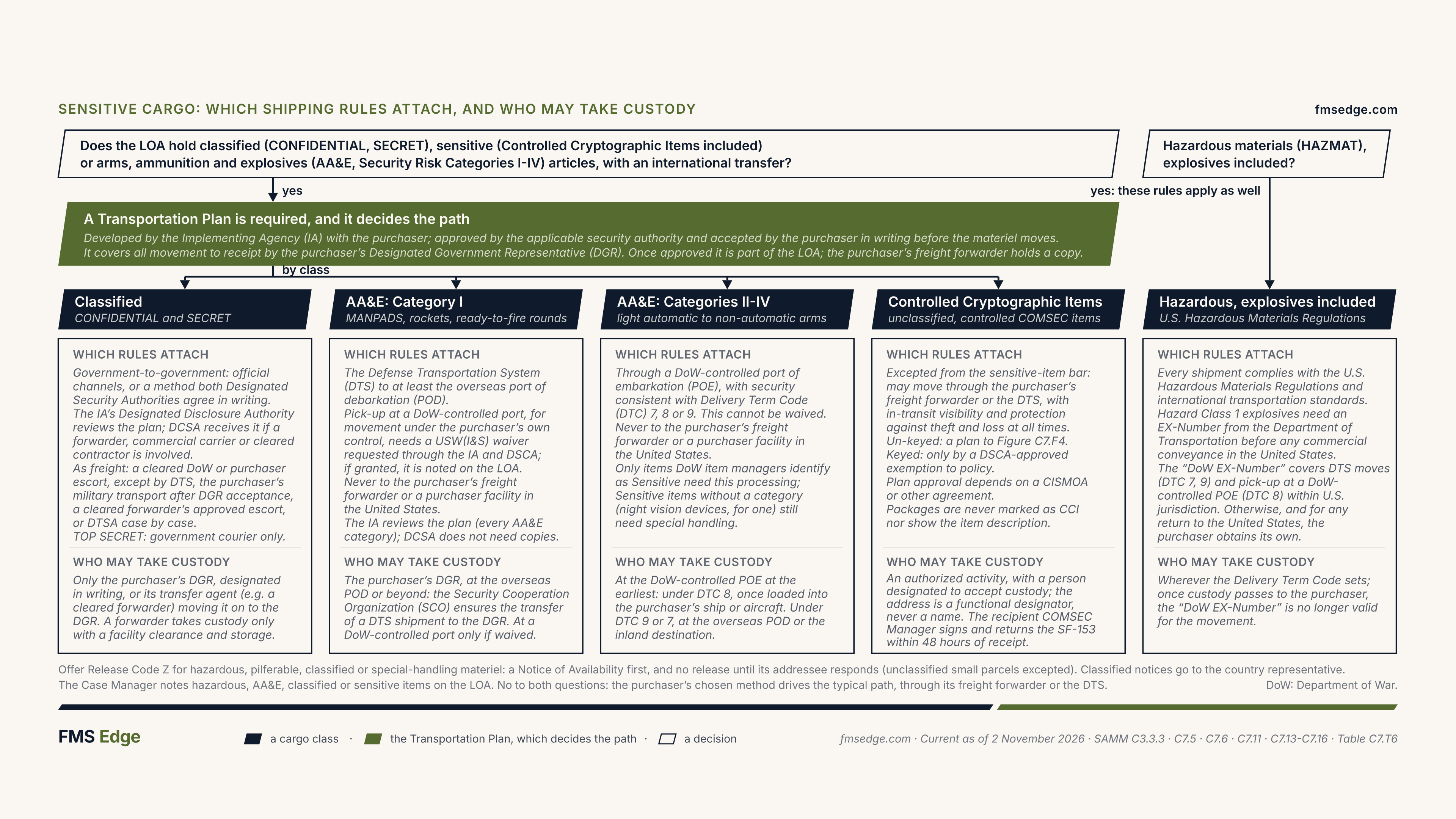
How are hazardous materials shipped in a Foreign Military Sale?
Hazardous materials bought through move under the U.S. Hazardous Materials Regulations and international transportation standards. An article containing Hazard Class 1 explosives also needs an EX-Number from the Department of Transportation’s Pipeline and Hazardous Materials Safety Administration before it moves by commercial conveyance in the United States [SAMM ].
Some of the materiel that customers purchase through the Department of War (DoW) is hazardous under the Code of Federal Regulations (CFR). The U.S. Department of Transportation () publishes the hazardous material () regulations under Title 49, Parts 100 to 199 of the Code of Federal Regulations (49 CFR 100-199). shipments must comply with the applicable provisions of 49 CFR, Subchapter C, the Hazardous Materials Regulations, and international transportation standards [SAMM ].
DoW personnel, military, civilian and contractor, will comply with 49 CFR unless otherwise authorized, and those who certify on shipping papers by any mode of transportation, military or commercial, must, except for technical specialists, successfully complete an initial classroom certification course from a DoW-approved school []. The defines dangerous goods (hazardous materiel) as those materials that are capable of posing an unreasonable risk to health, safety, and property when transported in commerce. Such materiel includes petroleum products, aerosols, compressed gases, paints, and cleaning compounds. These materials are identified alphabetically, by proper shipping name, in the hazardous materials Table, 49 CFR 172.101. This table covers the transportation of in all modes: highway, rail, water, and air. It makes no difference whether the shipment comes from a DoW or commercial shipper or whether the carrier is a contracted commercial surface or air carrier or a military carrier. It also makes no difference if the movement of the is strictly domestic or international.
It is the originating shipper’s responsibility to prepare the shipment for transportation to the ultimate destination.
DoW or contractor personnel who fail to comply with transportation rules may be liable for civil and criminal personal liability penalties []. Failure to adequately package and label dangerous goods, and/or failure to properly provide accurate shipping documents, results in frustrated cargo that cannot clear customs and leave the U.S. If a receives such a shipment, the DoW is still responsible for resolving the discrepancy.
In addition to having to conform to the requirements of 49 CFR, hazardous materiel shipments must be certified to the International Maritime Dangerous Goods Code () if the materiel is being transported by ship. If it is being transported by either commercial cargo aircraft or passenger aircraft, it must be certified to the International Air Transport Association () Dangerous Goods Regulations or International Civil Aviation Organization (ICAO) Technical Instructions for the Safe Transport of Dangerous Goods by Air [SAMM ] []. Military air shipments must meet the requirements of Air Force Manual 24-604, Preparing Hazardous Materials for Military Air Shipments [].
Every Hazard Class 1 (HC1) article has a unique EX-Number issued by the 's Pipeline and Hazardous Materials Safety Administration (PHMSA), and the EX-Number must be in place before the article moves by commercial conveyance within the United States. As the Hazardous Materials Regulations require, each EX-Number gives the article's United Nations () identification number, its assigned hazard class and division and its proper shipping name. An EX-Number can be filed for each HC1 article, or for a group of articles that share a identification number, hazard classification and packaging instructions, rather than shipment by shipment. Most EX-Numbers also carry the specific packaging or container requirements for the HC1 material, and if alternative packaging is used, a specific EX-Number for that packaging must be obtained from PHMSA [SAMM ].
No EX-Number is required for small arms cartridges for rifles, pistols or shotguns with inert projectiles or blank ammunition, at no more than .50 caliber or 8 gauges, if the manufacturer has assigned them hazardous classification code 1.4S. The manufacturer may assign code 1.4S to “Cartridges, small arms” that meet the criteria of 49 CFR 173.56(h) [SAMM ].
The purchaser must first apply to PHMSA for an EX-Number, following the process in Section C7.16.4, before it or its moves HC1 materiel commercially within the United States, and before any HC1 materiel comes back into the United States, for any purpose, such as repair, modification, upgrade, testing or training exercises. The DoW will provide the documents needed. Any exemption from that application process is called a Special Permit and must be obtained from PHMSA [SAMM ].
Controlled substances
Controlled substances, such as morphine and other drugs, must be moved under 21 U.S.C. 951 et seq., the Controlled Substances Import and Export Act. Before export, the obtains import authorizations from the purchaser, as 21 U.S.C. 953(a)(3) and 953(e)(1) provide, submits the documentation to the Drug Enforcement Administration () of the Department of Justice, and requests export permits for the controlled substance. Once a permit is approved, its number, its expiration date and the port of export should be furnished to Defense Logistics Agency () Troop Support, formerly the Defense Supply Center Philadelphia [SAMM ].
Try the tool: Delivery Term Code picker
References
SAMM
- SAMM C7.16: Movements of Explosive Materiel by Commercial Conveyance.
- SAMM C7.18.1
- SAMM C7.16.1: Use of EX-Numbers.
- SAMM C7.16.3: EX-Numbers issued to Foreign Military Sales Purchasers.
Public authorities
- DTR 4500.9-R: Defense Transportation Regulation, DTR 4500.9-R
Facts referenced
- Largest caliber of small arms cartridges (inert projectiles or blank ammunition) that need no EX-Number when the manufacturer has assigned code 1.4S: .50 caliber (as of 11 September 2026; SAMM C7.16.1)
- Shotgun gauge limit for small arms cartridges (inert projectiles or blank ammunition) that need no EX-Number when the manufacturer has assigned code 1.4S: 8 gauges (as of 11 September 2026; SAMM C7.16.1)
Related
Foreign Military Sales (FMS)
The part of U.S. security assistance, authorized by the Arms Export Control Act (AECA), in which eligible foreign governments and international organizations buy defense articles, services and training from the U.S. Government under formal government-to-government agreements.
The articles come either from Department of War stocks or from new procurement under contracts the Department manages [22 U.S.C. 2761, 22 U.S.C. 2762]. A sale is FMS whatever the source of the purchaser's financing.
FMS Edge glossary, as of 10 October 2026
Glossary entry →Open the manual’s entry → (opens in new tab)
USDOT: U.S. Department of Transportation
Freight Forwarder
A commercial import/export company registered with the Department of State, Bureau of Political-Military Affairs, Directorate of Defense Trade Controls and under contract to the Foreign Military Sales customer which arranges transportation of materiel from a point specified in the Letter of Offer and Acceptance to the final destination.
SAMM Glossary, as of 12 September 2026
Glossary entry →Open the manual’s entry → (opens in new tab)
IMDGC: International Maritime Dangerous Goods Code
IATA: International Air Transport Association
FMS: Foreign Military Sale
SAMM Acronyms, as of 12 September 2026
Implementing Agency (IA)
The military department or defense agency responsible for the execution of military assistance programs. With respect to FMS, the military department or defense agency assigned responsibility by the Defense Security Cooperation Agency to prepare an LOA and to implement an FMS case. The implementing agency is responsible for the overall management of the actions that will result in delivery of the materials or services set forth in the LOA that was accepted by a foreign country or international organization.
SAMM Glossary, as of 12 September 2026
Glossary entry →Open the manual’s entry → (opens in new tab)
Defense Logistics Agency
The Department of War agency that is the item manager for consumable, stock-funded secondary items. Its supply centers work with the military departments to fill Foreign Military Sales (FMS) requisitions, process supply discrepancy reports and repair and return items, and close cases when supply is complete, and it prepares FMS cases for cataloging services and excess defense articles [SAMM C1.3.2.6.2.3.2].
FMS Edge glossary, as of 10 October 2026
SAMM C7.16: Movements of Explosive Materiel by Commercial Conveyance.
“Shipments of hazardous materials (HAZMAT) must comply with the applicable provisions of 49 C.F.R. Subchapter C “U.S. Hazardous Materials Regulations (HMR),” and international transportation standards. The U.S. Department of Transportation’s Pipeline and Hazardous Materials Safety Administration (DOT/PHMSA) regulates commercial conveyance of HAZMAT in the U.S. DOT/PMHSA issues authorizations, known as EX-Numbers, which are required for commercial conveyance of all HAZMAT …”
Security Assistance Management Manual, as of 26 October 2026
SAMM C7.16.1: Use of EX-Numbers.
“A unique DOT/PHMSA-issued EX-Number is associated with every HC1 article and must be assigned before the article can be moved by commercial conveyance in the United States. As required by the HMR, each EX-Number provides an article’s assigned Hazard Class and Division, proper shipping name, and United Nations (UN) identification number. An EX-Number can be filed for each HC1 article, …”
Security Assistance Management Manual, as of 11 September 2026
SAMM C7.16.3: EX-Numbers issued to Foreign Military Sales Purchasers.
“Any commercial movement by the purchaser or its FMS freight forwarder of FMS HC1 materiel within the United States or the return of any HC1 materiel to the United States for any reason, such as repair, modification, upgrade, testing, or training exercises, requires that the purchaser first apply to DOT/PHMSA for an EX-Number following the process detailed under Section C7.16.4. …”
Security Assistance Management Manual, as of 26 October 2026
SAMM C7.18.1
“Transportation of controlled substances, such as morphine and other drugs, must be handled in accordance with the Controlled Substances Import and Export Act (21 U.S.C. 951 et seq). Prior to export, the Implementing Agency obtains import authorizations from the purchaser (21 U.S.C. 953(a)(3) and (21 U.S.C. 953(e)(1)) and submits the documentation to the Department of Justice’s Drug Enforcement Administration (DoJ …”
Security Assistance Management Manual, as of 11 September 2026