
Guide
How is Building Partner Capacity materiel delivered to the partner?
Building Partner Capacity materiel moves through the , or by vendor-provided transportation when a policy exception pre-approves it, and the keeps oversight of the transportation process. In the partner country the , another U.S. Government employee or, for unclassified materiel only, a designee inventories the materiel jointly with the partner's representative before title is transferred on a signed document. Only the partner unit named in the congressional notification may receive it, and delivery should, to the maximum extent practical, follow within 120 days of receipt by the U.S. Government.
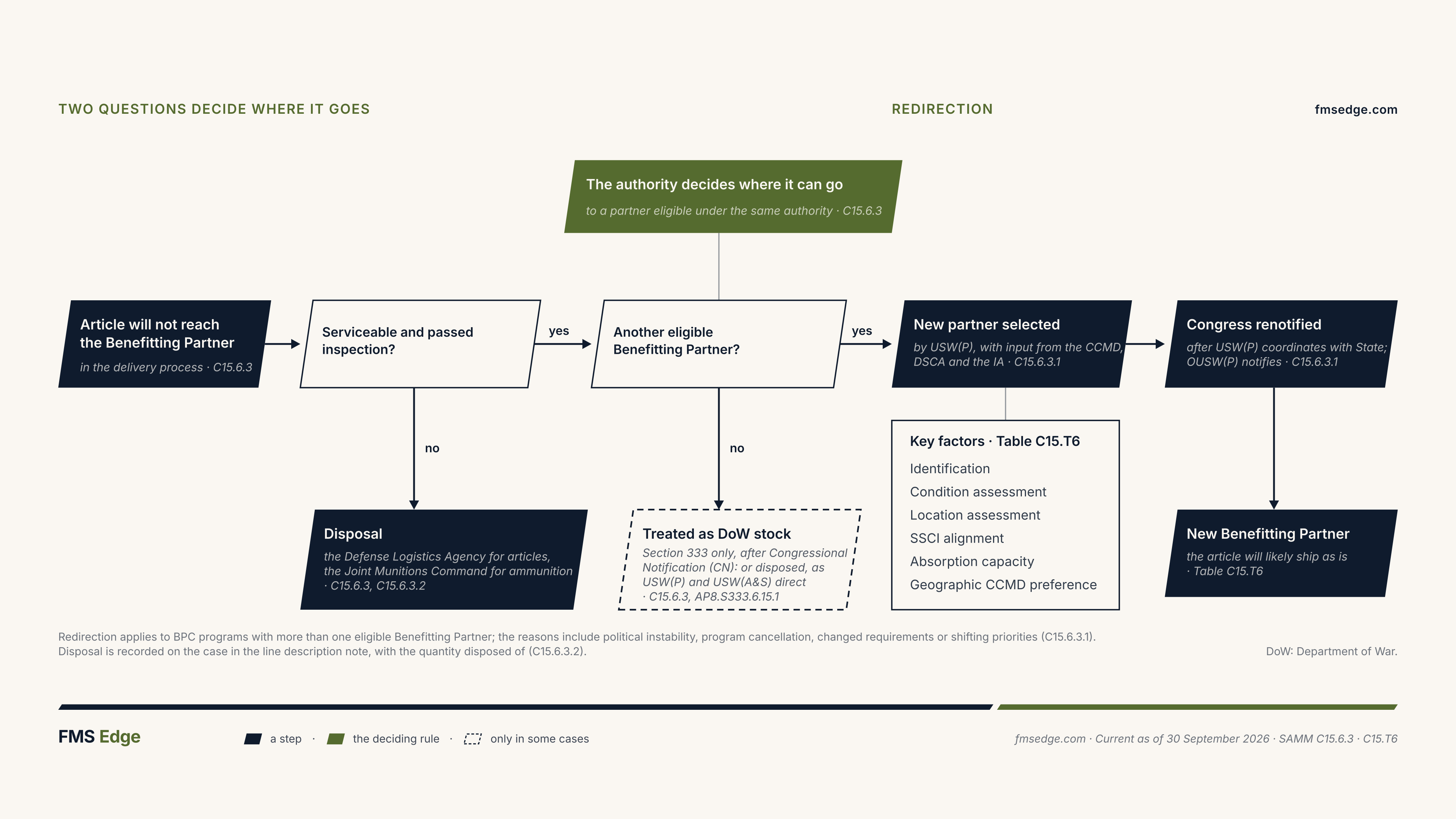
When a Building Partner Capacity article in the delivery process will not reach its Benefitting Partner, one that is unserviceable or fails inspection goes to disposal. A serviceable one can be redirected only to another Benefitting Partner eligible under the same authority, after Congress is renotified.
How is Building Partner Capacity materiel delivered to the partner?
Materiel shipments made as part of Building Partner Capacity () Letters of Offer and Acceptance () follow different rules than materiel shipments made under a . A case is not signed by the Benefitting Partner, so its terms and notes do not create a legally binding commitment from that partner [SAMM ]. defense articles travel to the Benefitting Partner as materiel owned by the U.S. Government () and are delivered to the , another employee or a designee in the partner's territory. The will keep title and custody until the Benefitting Partner is ready to receive the equipment, and the articles will remain -owned until they pass through the partner's customs and are physically transferred to the partner [SAMM ]. The or another employee will conduct a joint inventory with the Benefitting Partner representative. The will have that representative sign the document that records the title transfer and will provide a copy to the [SAMM , ].
All materiel transferred under a must move through the , unless vendor-provided transportation is pre-approved by policy exception [SAMM , ].
The keeps oversight of the transportation process and helps resolve any transportation issues that arise [SAMM ].
Equipment and materiel from a vendor in the can be consolidated at a (JCP). The JCP is meant for small items that have to be collected from several vendors, so that transportation and delivery coordination run more efficiently. It is not typically used for large items that may be better sent straight from the vendors. The JCP does not take weapons, ammunition or certain kinds of hazardous materiel. may consult program managers at the before shipping if they have questions on JCP use. When the JCP is used, Delivery Term Codes () 2 and 7 will be shown on the equipment lines of the case, with associated notes [SAMM ].
's Office of International Operations () works with the JCP team to give the (the U.S. Military Group, or , in some countries) current timelines. () also coordinates each shipment at least 30 days ahead, to arrange transportation and to confirm the delivery address or Address Code (), the , the required delivery date and any special delivery requirements. Any exception to that timeline must be coordinated by , the , the and the JCP. The coordination will give the , another employee or a designee proper time to prepare the transfer of the equipment [SAMM ].
The current year's transportation case will support both the consolidation of equipment and materiel and the onward movement of equipment to the Benefitting Partner. that request funds from that case will calculate and track their estimated transportation costs so that they ask for adequate resources, and the executing the case will ensure that enough funds are available [SAMM ].
The will coordinate shipment delivery timelines using the Benefitting Partner's entry in the Department of War (DoW) Foreign Clearance Guide (), a restricted-access site. As part of that coordination, documents must match each article line on the case (Section C15.3.5). The will also coordinate with the to make sure the items are ready to be received. It will include the and the Country Portfolio Director (), Regional Portfolio Director (RPD) or Global Portfolio Director (GPD) in (/GCD) [SAMM ].
Once the Benefitting Partner is ready to take the delivery, the , another employee (or, for unclassified materiel only, a designee) and the partner's representative will jointly inventory the materiel against the shipper's manifest while it is still in the 's custody. The will report any materiel that is suspected to be missing to the , to verify that it was not included in a later delivery. Initial equipment testing is provided as part of the initial operator training. The will also advise the Benefitting Partner that it has only a limited window of time to notify the if equipment is not working as intended [SAMM ].
Equipment, services and training may be transferred only to the Benefitting Partner unit included in the Congressional Notification (). A unit that was not specifically listed on the may not receive any equipment, services or training [SAMM ].
The will give the and the , RPD or GPD in (/GCD) a copy of the signed document by uploading it, within the or the Management Suite (), to the shipment's Shipment Control Number (SCN) if one is used. When an SCN is used, it also appears on other reports for easy cross-reference [SAMM ].
References
SAMM
- SAMM C15.1.3: Department of War Building Partner Capacity Cases.
- SAMM C15.5.6.4: Retention of Title Before Transfer and Receipt of Materiel.
- SAMM C15.5.6.5: Title Transfer.
- SAMM C7.9.1.2: Policy Requirements.
- SAMM C15.5.1.2: Transportation.
- SAMM C15.5.6.2.1.1.2: Joint Consolidation Point.
- SAMM C15.5.6.2.3.2: Advance Notice of Delivery and the Department of War Foreign Clearance Guide.
- SAMM C15.5.6.5.1: Joint Inventory for Transfer and Receipt of Materiel.
- SAMM C15.5.6.5.4: Title Transfer to the Congressionally Notified Unit.
- SAMM C15.5.6.5.5.1: Shipment Control Numbers and Title Transfer Document Reporting.
- SAMM C15.3.6.1: Delivery to the Benefitting Partner.
Facts referenced
- Days after receipt by the USG within which BPC defense articles should, to the maximum extent practical, be delivered to the Benefitting Partner: 120 days (as of 5 October 2026; SAMM C15.3.6.1)
- Minimum lead time before a Building Partner Capacity shipment from the Joint Consolidation Point at which DSCA (IOPS) coordinates it: 30 days (as of 5 October 2026; SAMM C15.5.6.2.1.1.2)
Related
Defense Transportation System (DTS)
The part of the worldwide transportation infrastructure that supports Department of War transportation needs in peace and war, made up of military (organic) and commercial resources that are organic to the Department, under contract to it or controlled by it [SAMM C7.6.1].
It takes in organic and commercial aircraft and ships, commercial small-package services under Department contract, and U.S. military air and ocean terminals in and outside the United States.
FMS Edge glossary, as of 10 October 2026
Glossary entry →Open the manual’s entry → (opens in new tab)
Implementing Agency (IA)
The military department or defense agency responsible for the execution of military assistance programs. With respect to FMS, the military department or defense agency assigned responsibility by the Defense Security Cooperation Agency to prepare an LOA and to implement an FMS case. The implementing agency is responsible for the overall management of the actions that will result in delivery of the materials or services set forth in the LOA that was accepted by a foreign country or international organization.
SAMM Glossary, as of 12 September 2026
Glossary entry →Open the manual’s entry → (opens in new tab)
Security Cooperation Organization (SCO)
A Department of Defense element that is part of the United States Diplomatic mission located in a foreign country to carry out security assistance and security cooperation management functions under the supervision and coordination authority of the senior defense official/defense attaché.
SAMM Glossary, as of 12 September 2026
Glossary entry →Open the manual’s entry → (opens in new tab)
Transfer and Receipt
A document which transfers title and custody of Building Partner Capacity defense articles and services from the USG representative in-country to the Benefitting Country. The document is dated and co-signed by both parties.
SAMM Glossary, as of 12 September 2026
Glossary entry →Open the manual’s entry → (opens in new tab)
LOA: Letter of Offer and Acceptance
SAMM Acronyms, as of 12 September 2026
Foreign Military Sales (FMS)
The part of U.S. security assistance, authorized by the Arms Export Control Act (AECA), in which eligible foreign governments and international organizations buy defense articles, services and training from the U.S. Government under formal government-to-government agreements.
The articles come either from Department of War stocks or from new procurement under contracts the Department manages [22 U.S.C. 2761, 22 U.S.C. 2762]. A sale is FMS whatever the source of the purchaser's financing.
FMS Edge glossary, as of 10 October 2026
Glossary entry →Open the manual’s entry → (opens in new tab)
SCO: Security Cooperation Organization
SAMM Acronyms, as of 12 September 2026
Continental United States (CONUS)
U.S. territory, including the adjacent territorial waters, located within the North American continent between Canada and Mexico. Does not include Hawaii or Alaska.
SAMM Glossary, as of 12 September 2026
Glossary entry →Open the manual’s entry → (opens in new tab)
Joint Consolidation Point (Building Partner Capacity (BPC))
The DSCA-recognized location in the Continental United States where defense articles on BPC cases are consolidated, as required, prior to transfer.
SAMM Glossary, as of 12 September 2026
Glossary entry →Open the manual’s entry → (opens in new tab)
Defense Security Cooperation Agency (DSCA)
The Department of War agency that directs, administers and provides guidance to the Department's components and its representatives at U.S. missions for the execution of the security cooperation programs for which it is responsible [SAMM C1.3.2.2]. The agency also provides financial and technical assistance, arranges the transfer of defense materiel, training and services to international partners, and promotes military-to-military contacts.
FMS Edge glossary, as of 10 October 2026
Glossary entry →Open the manual’s entry → (opens in new tab)
DTC: Delivery Term Code
SAMM Acronyms, as of 12 September 2026
DSCA: Defense Security Cooperation Agency
SAMM Acronyms, as of 12 September 2026
Glossary entry →Defense Security Cooperation Agency (DSCA) →
Military Assistance Program (MAP)
That portion of the United States Security Assistance program authorized by the Foreign Assistance Act of 1961, as amended, which once provided defense articles and services to recipients on a nonreimbursable (grant) basis. Funding for MAP was consolidated under the Foreign Military Financing program beginning in Fiscal Year 1990.
SAMM Glossary, as of 12 September 2026
Glossary entry →Open the manual’s entry → (opens in new tab)
Port of Debarkation (POD)
A military or commercial air or ocean port at which materiel is offloaded. Also referred to as the Port of Discharge.
SAMM Glossary, as of 12 September 2026
Glossary entry →Open the manual’s entry → (opens in new tab)
Military Department (MILDEP)
One of the departments within the DoD created by the National Security Act of 1947, as amended. The Military Departments are: the Department of the Air Force, the Department of the Army, and the Department of the Navy.
SAMM Glossary, as of 12 September 2026
Glossary entry →Open the manual’s entry → (opens in new tab)
Security Cooperation Information Portal (SCIP)
A web-based tool, managed by the Defense Security Cooperation Agency (DSCA), that gives international purchasers, their agents such as freight forwarders, and authorized U.S. Government personnel information on Foreign Military Sales (FMS) cases and other security cooperation programs.
It covers case, line, requisition and supply data, supply transactions and end-use monitoring information, drawn from the Defense Security Assistance Management System (DSAMS) and the Military Departments' case execution systems.
FMS Edge glossary, as of 10 October 2026
Glossary entry →Open the manual’s entry → (opens in new tab)
Security Cooperation
Activities by which the Department of War encourages and enables international partners to cooperate with the United States toward strategic objectives, spanning every interaction with foreign defense and security establishments and every security assistance program the Department administers.
Under chapter 16 of Title 10, their purposes are to develop allied and friendly security capabilities for self-defense and multinational operations, to give U.S. forces peacetime and contingency access, and to build relationships promoting specific U.S. security interests [10 U.S.C. 301(7)].
FMS Edge glossary, as of 10 October 2026
Glossary entry →Open the manual’s entry → (opens in new tab)
SCIP: Security Cooperation Information Portal
SAMM Acronyms, as of 12 September 2026
Glossary entry →Security Cooperation Information Portal (SCIP) →
SAMM C15.1.3: Department of War Building Partner Capacity Cases.
“The DoW utilizes BPC cases to provide defense articles, services, and training to partners, and to facilitate the DoW’s ability to meet other statutory requirements such as reporting, AM&E, and audit readiness. Unlike Foreign Military Sales (FMS) cases which are funded with partner national funds or Foreign Military Financing (FMF) funds and signed by the partner, BPC cases are only …”
Security Assistance Management Manual, as of 5 October 2026
SAMM C15.5.6.4: Retention of Title Before Transfer and Receipt of Materiel.
“The MILGP will retain title and custody of the equipment until the Benefitting Partner is ready to receive the equipment. BPC defense articles and defense services are transported to the Benefitting Partner as USG-owned materiel and delivered to the MILGP, another USG employee, or designee in the Benefitting Partner’s territory. The defense articles will remain USG-owned materiel until they pass …”
Security Assistance Management Manual, as of 5 October 2026
SAMM C15.5.6.5: Title Transfer.
“Items are considered delivered when the materiel and title is transferred to a representative of the Benefitting Partner. The MILGP will conduct a joint inventory, prepare the Transfer and Receipt document, have the document signed by the Benefitting Partner representative, and provide a copy to the IA along with the signed document and attachments. The MILGP is encouraged to hold …”
Security Assistance Management Manual, as of 5 October 2026
SAMM C15.5.6.5.1: Joint Inventory for Transfer and Receipt of Materiel.
“When the Benefitting Partner is ready to receive the delivery, the MILGP, another USG employee (or a designee only in the case of unclassified materiel), and the Benefitting Partner representative will conduct a joint materiel inventory using the shipper’s manifest while the materiel remains in the custody of the MILGP. The MILGP will inform the IA of any materiel suspected …”
Security Assistance Management Manual, as of 5 October 2026
SAMM C7.9.1.2: Policy Requirements.
“DSCA, in support of the U.S. maritime industry, requires 100 percent of applicable cargo to be carried by U.S. Flag vessels unless a Determination of Non-Availability (DNA) is granted by DSCA, in coordination with MARAD. These rules apply to materiel procured with grant funding provided under the Arms Export Control Act (AECA) and the Foreign Assistance Act (FAA) of 1961, …”
Security Assistance Management Manual, as of 26 October 2026
SAMM C15.5.1.2: Transportation.
“Materiel is transported using the Defense Transportation System (DTS) or vendor-provided transportation when pre-approved by policy exception. The IA retains oversight of the transportation process and assists with resolution of transportation issues that may arise.”
Security Assistance Management Manual, as of 5 October 2026
SAMM C15.5.6.2.1.1.2: Joint Consolidation Point.
“Equipment and materiel from a continental United States (CONUS) vendor can be consolidated at a JCP. The intent of a JCP is for small items that need to be collected from various vendors to enhance the efficiency of transportation and delivery coordination. The JCP is not typically used for large items that may be more appropriately sent directly from the …”
Security Assistance Management Manual, as of 5 October 2026
SAMM C15.5.6.2.3.2: Advance Notice of Delivery and the Department of War Foreign Clearance Guide.
“The IA will coordinate the shipment delivery timelines based on the Benefitting Partner specific DoW Foreign Clearance Guide (FCG) (restricted access site) entry. As part of coordination, documents must match each article line on a BPC case (see Section C15.3.5.). The IA will coordinate with the MILGP to ensure items is ready to be received and include USG RA and …”
Security Assistance Management Manual, as of 5 October 2026
SAMM C15.5.6.5.4: Title Transfer to the Congressionally Notified Unit.
“Equipment, services, and training may only be transferred to the Benefitting Partner unit that was included in the Congressional Notification (CN). No equipment, services, or training may be received by a unit that was not specifically listed on the CN.”
Security Assistance Management Manual, as of 5 October 2026
SAMM C15.5.6.5.5.1: Shipment Control Numbers and Title Transfer Document Reporting.
“The MILGP will provide a copy of the signed Transfer and Receipt document to DSCA (IOPS/GCD) GPD, RPD, or CPD and IA, by uploading the document(s) to the respective SCN (if used) within SCIP/SCMS. If used, the SCN will appear on other SCIP reports for easy cross-reference.”
Security Assistance Management Manual, as of 5 October 2026