
Guide
What is end-use monitoring in Foreign Military Sales?
End-use monitoring is how the U.S. Government verifies that defense articles transferred to partners are used, protected and kept as the transfer agreement requires. Every purchaser agrees to it in the ; the program is called Golden Sentry.
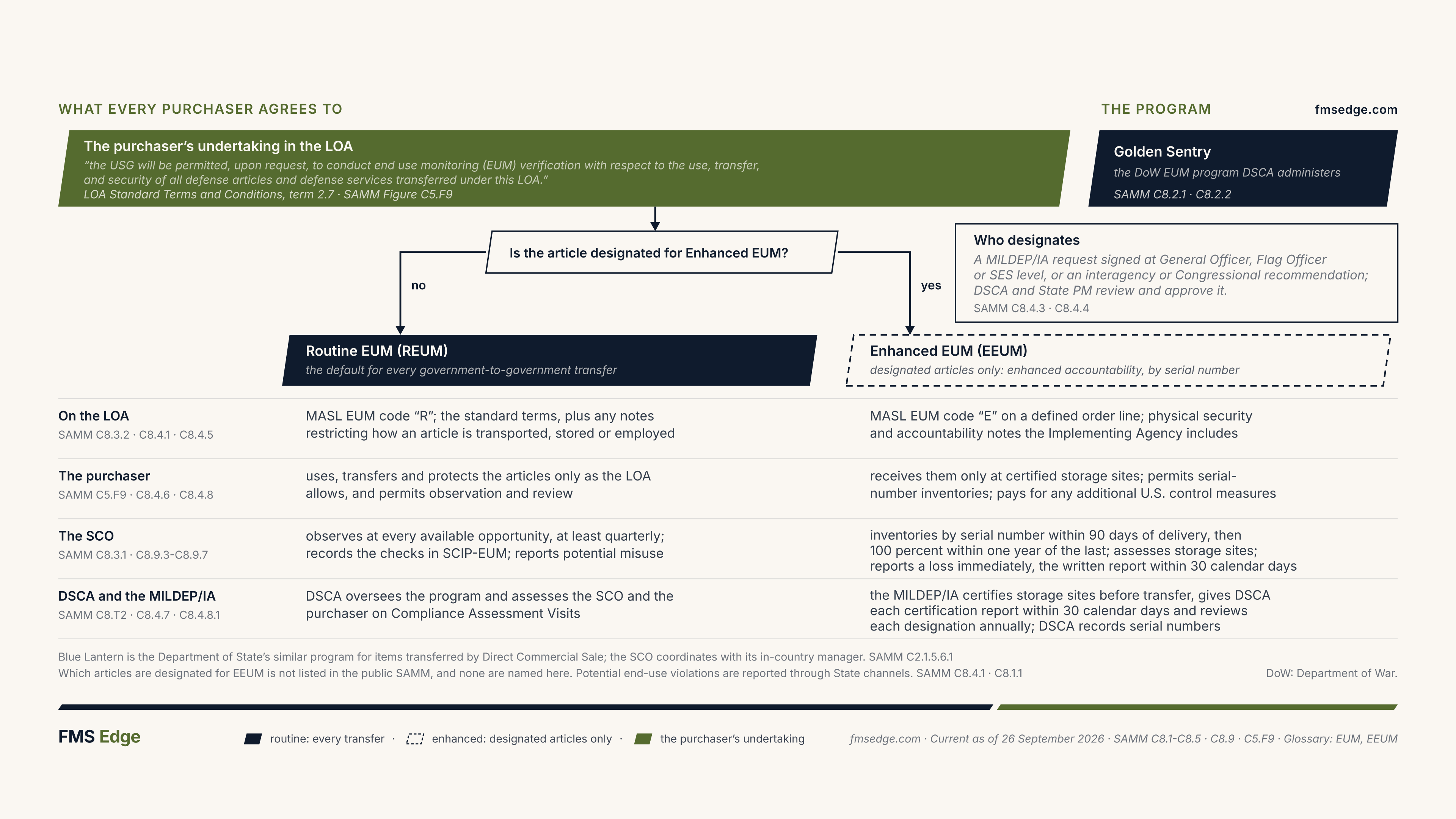
Every purchaser agrees in the LOA that the U.S. Government may verify how the articles it buys are used, transferred and secured. Golden Sentry, the Department of War end-use monitoring program DSCA administers, carries out that verification. Which articles are designated for Enhanced End-Use Monitoring is not listed in the public SAMM, and none are named here.
What is end-use monitoring in Foreign Military Sales?
End-use monitoring is what the U.S. Government does to make sure that defense articles and services it transfers to foreign partners under or cooperation authorities are monitored and used as their Letters of Offer and Acceptance and other transfer agreements specify. Both the monitoring and the use must also meet what the or the Foreign Assistance Act of 1961 requires.
Section 40A, , requires the President to establish an end-use monitoring () program. The program's purpose is to improve accountability with respect to defense articles sold, leased, or exported under the or the , as amended []. The Director, , has been delegated authority by the Secretary of War and Under Secretary of War for Policy (USW(P)) to administer the Department of War (DoW) program, known as Golden Sentry, to comply with Section 40A of the [SAMM ].
The program is designed to provide reasonable assurances that the recipient of U.S. defense articles is complying with the requirements imposed by the U.S. Government () regarding the transfer, use, and protection of U.S.-origin defense articles and technology in the possession of international partners [SAMM ].
The decision to transfer or not hinges to a great extent on the recipient’s willingness to comply with the following three conditions:
1. Transfer: Will not transfer title or possession to anyone who is not an officer, employee, or agent of the purchaser unless given prior consent to do so by the ;
2. Use: Will not use defense articles for purposes other than those authorized by the ;
3. Protection: Will furnish substantially the same degree of security or protection that the would provide for the same article or information received.
In addition, the recipient must permit verification of the security measures and end use by representatives of the , typically the members of the [SAMM , ].
These conditions are reflected in the standard terms and conditions of every [SAMM ]. reviews and other government-to-government agreements to ensure they include the appropriate notes, provisos and transfer conditions [SAMM ].
Monitoring the use of U.S.-origin items is a joint responsibility of the receiving partner country or international organization (e.g., the North Atlantic Treaty Organization) and the . representatives have full responsibility for monitoring defense articles until title is transferred to the partner. The partner country or international organization assumes monitoring responsibility based on the terms under which the transfer is made, including any restrictions on physical security and accountability. representatives retain a continuing responsibility under Golden Sentry to assist in verifying the appropriate end use and security of U.S.-origin defense articles and defense services sold or otherwise transferred on a government-to-government basis [SAMM ].
Verification is authorized under the Standard Terms and Conditions (Paragraph 2.7) [SAMM ].
Table C8.T2 sets out the Golden Sentry responsibilities of , the Military Departments () and Implementing Agencies (), the Combatant Commands (), the and the Defense University (). An , for this purpose, includes a or a U.S. diplomatic mission with responsibilities, and trains the workforce in . The and , the and each maintain a Golden Sentry primary point of contact (), and each designates its primary in writing [SAMM ].
There are two levels of : routine and enhanced [SAMM , ].
Unless an article is designated for enhanced monitoring, Routine () is required for all defense articles and services provided through government-to-government programs. Every must conduct observations at least quarterly and record them in the database of the . should perform these checks in conjunction with other duties, using opportunities such as visits to partner installations, interaction with other embassy personnel, or any other readily available source of information [SAMM ].
has developed a Summary Report in the database to assist in conducting checks. The report lists specific categories of defense articles exported via , including, but not limited to, the following: battle tanks, armored combat vehicles, artillery systems, fixed and rotary wing aircraft, unmanned aerial systems, warships and military vessels, missiles and missile systems, military vehicles, bombs, crew served and individual weapons, and other systems. To assist in documenting routine checks, has developed a standardized template in the SCIP-EUM database [SAMM ].
Title to defense articles that are leased or loaned remains with the , as detailed in the terms of respective transfer document supporting the lease or loan; however, requirements still apply while the leased or loaned articles or information is under the possession or control of the international partner.
Some defense articles normally subject to routine are transferred with notes that restrict how they may be transported, stored or employed. should know these restrictions and watch for any sign or report that they are not being complied with [SAMM ].
Enhanced () is a designation mechanism that provides greater U.S. Government oversight and more thorough assessment of partner compliance with the transfer conditions of and other government-to-government transfer agreements. -designated defense articles require enhanced accountability, including physical security assessments of partner storage sites and inventories by serial number [SAMM ].
and the Department of State Bureau of Political-Military Affairs ( PM) must review and approve a or , interagency or congressional recommendation to designate a for [SAMM ]. -designated defense articles transferred through must be sold on defined order lines using an -coded designator and include physical security and accountability notes [SAMM ].
Some requirements are mandated by Congress for a particular country. Under Section 1228 of the National Defense Authorization Act for Fiscal Year 2008, the President shall implement a policy to control the export and transfer of defense articles into Iraq, including a registration and monitoring system. No defense articles may be provided to the Government of Iraq or any other group, organization, citizen, or resident of Iraq until the President certifies to the specified congressional committees that the registration and monitoring system has been established. That system shall include the registration of the serial numbers of all small arms and a program of end-use monitoring of all lethal defense articles [].
Golden Sentry, the Department of War program, includes in-country visits of three types [SAMM ]:
- Focused Verification Assessments (FEVA)
- Compliance Assessment Visits (), or Virtual Compliance Assessments (VCA)
- Familiarization and Assistance Visits ()
Potential end-use violations
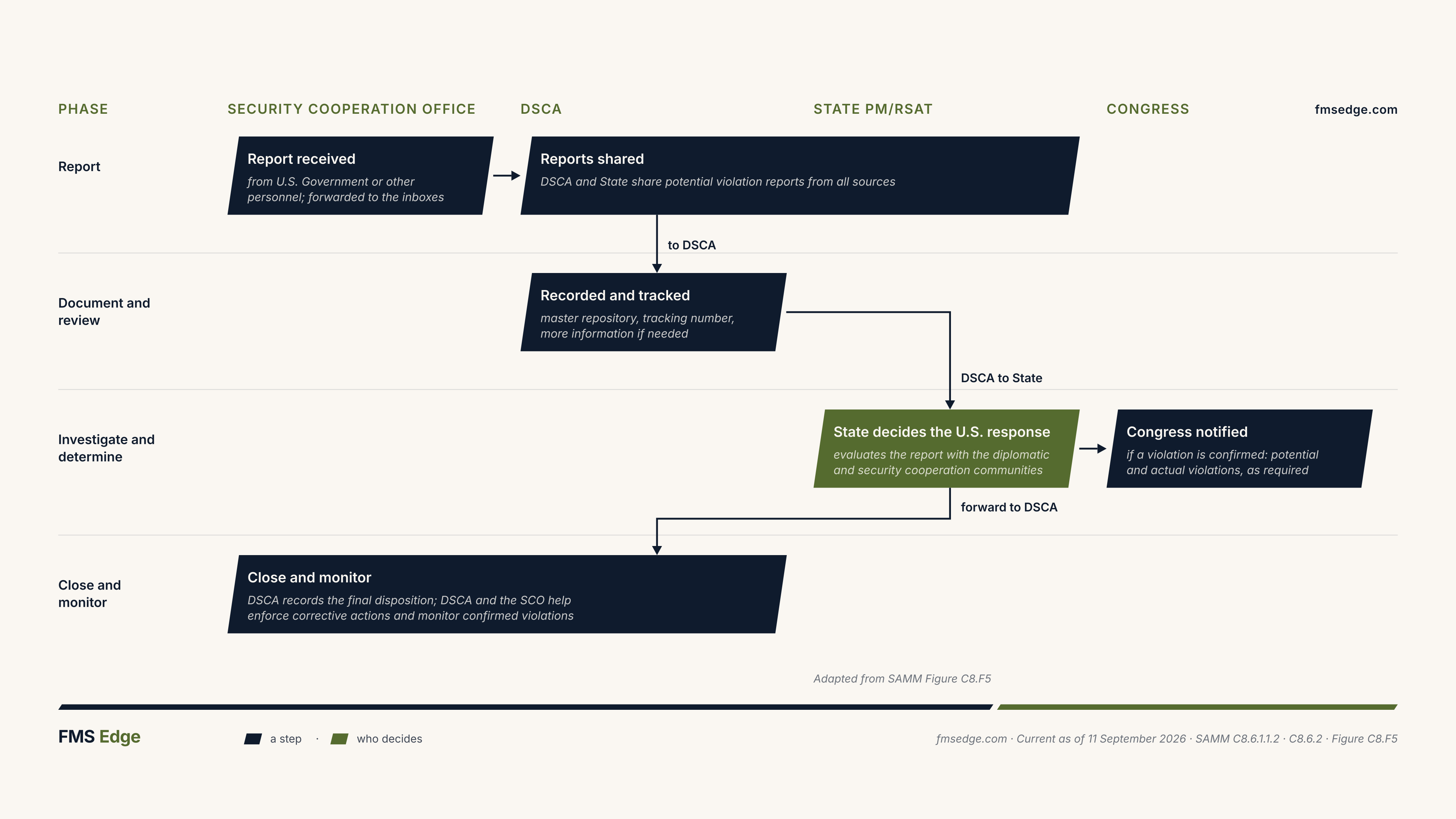
All DoW personnel must report any suspected end-use violation of U.S.-provided defense articles to the U.S. Government [SAMM ]. The Department of State, PM/RSAT, is the primary U.S. Government authority for responding to reports of potential end-use violations: it conducts the investigations and determines the actions, if any, that the U.S. Government takes to address the findings [SAMM ]. The and support : both help to collect additional information on a potential violation, and both assist in enforcing the consequences determines for a confirmed one. also maintains a master repository of reported potential end-use violations and assigns each report an incident tracking number [SAMM , ].
A potential end-use violation is reported to the security cooperation office or straight to the violation inboxes, and the Defense Security Cooperation Agency records it. State's Office of Regional Security and Arms Transfers investigates, decides the U.S. response and, if a violation is confirmed, notifies Congress. Adapted from SAMM Figure C8.F5.
must be alert for, and report, all potential unauthorized end use, including the reverse engineering of information provided during or in-country training, to the , (/GEX/) and [SAMM ]. A report should give the recipient country and the United States the information to determine whether a partner’s generally sound processes failed because of unusual circumstances, because security and accountability procedures were not given sufficient priority, or because the country’s interests are diverging from those of the United States [SAMM ].
The forwards any potential violation it uncovers during an enhanced or routine check to the appropriate Potential Violation email inboxes at the DoW and at , together with the reports it receives from other personnel, whether they are U.S. Government personnel or not [SAMM ].
(/GEX/) monitors and manages the DoW Potential Violation email inbox, both the classified and the unclassified one. It makes sure that the and the proper at the know of every potential violation reported in their Area of Responsibility (). It assesses each report for completeness and credibility and, when necessary, collects or obtains more information [SAMM ].
receives reports of potential end-use violations and investigates them. In coordination with the diplomatic and communities, it decides what action, if any, the U.S. Government takes on the findings in the investigation reports. It keeps the DoW informed of the status of its investigations and of other information about potential end-use violations, and it reports findings to Congress as necessary [SAMM ].
References
SAMM
- SAMM C8.2.1: End Use Monitoring Legislative Requirement.
- SAMM C8.1.1
- SAMM C8.T2: Department of War End Use Monitoring Responsibilities
- SAMM C8.2.3: End Use Monitoring Responsibilities.
- SAMM C5.F9: Letter of Offer and Acceptance Standard Terms and Conditions
- SAMM C8.4.1: Definition.
- SAMM C8.3.1.1: Routine End Use Monitoring in the Security Cooperation Information Portal.
- SAMM C8.4.4: Criteria for Recommending Enhanced End Use Monitoring Designation.
- SAMM C8.6.1: Reporting Potential End Use Violations.
- SAMM C8.6.2: State Bureau of Political Military Affairs/Office of Regional Security and Arms Transfers.
- SAMM C8.6.1.1.1: United States Military Group.
- SAMM C8.6.1.1.2: Defense Security Cooperation Agency (Office of International Operations, Global Execution Directorate, End Use Monitoring).
- SAMM C8.9.13: Reporting of Potential End Use Violations.
- SAMM C8.9.13.1: Potential End Use Violation Reporting Requirements.
- SAMM C8.3.1: Routine End Use Monitoring.
- SAMM C8.3.2: Articles or Services Requiring Additional Controls on End Use.
- SAMM C8.5.1: End Use Monitoring Visit Guidance.
Public authorities
- AECA §40A: Arms Export Control Act of 1976, as amended, §40A (22 U.S.C. §2785)
- SecWar memo, 7 Nov 2025: Secretary of War memorandum, 7 November 2025, "Unifying the Department's Arms Transfer and Security Cooperation Enterprise to Improve Efficiency and Enable Burden-Sharing"
- DoW release, 10 Feb 2026: Department of War release, 10 February 2026, "Department of War Finalizes Realignment of the Defense Security Cooperation Agency and the Defense Technology Security Administration"
- §1228, P.L. 110-181: National Defense Authorization Act for Fiscal Year 2008, Pub. L. 110-181, div. A, title XII, §1228, Tracking and monitoring of defense articles provided to the Government of Iraq and other individuals and groups in Iraq
Related
Letter of Offer and Acceptance (LOA)
The legal instrument that lists the defense articles and services, including training, that the U.S. Government transfers to a foreign country or international organization, with their estimated costs and the terms and conditions. The benefitting partner does not sign a Building Partner Capacity (BPC) LOA.
The Letter of Offer and Acceptance (LOA) is the instrument the U.S. Government uses to sell under the Arms Export Control Act (AECA); signed LOAs and their later Amendments and Modifications are also called Foreign Military Sales (FMS) cases [SAMM C5.6.1].
FMS Edge glossary, as of 10 October 2026
Glossary entry →Open the manual’s entry → (opens in new tab)
Security Assistance (SA)
A group of programs authorized by federal statutes by which the United States provides defense articles, military training, and other defense-related services by grant, lease, loan, credit, or cash sales in furtherance of national policies and objectives, and those that are funded and authorized through the Department of State to be administered by Department of Defense/Defense Security Cooperation Agency, which are considered part of security cooperation.
SAMM Glossary, as of 12 September 2026
Glossary entry →Open the manual’s entry → (opens in new tab)
Arms Export Control Act (AECA)
The basic U.S. law providing the authority and general rules for the conduct of Foreign Military Sales and commercial sales of defense articles, defense services, and training. The Arms Export Control Act (AECA) came into existence with the passage of the Foreign Military Sales Act (FMSA) of 1968. An amendment in the International Security Assistance and AECA of 1976 changed the name of FMSA to the AECA.
SAMM Glossary, as of 12 September 2026
Glossary entry →Open the manual’s entry → (opens in new tab)
EUM: End Use Monitoring
SAMM Acronyms, as of 12 September 2026
AECA: Arms Export Control Act
SAMM Acronyms, as of 12 September 2026
Foreign Assistance Act (FAA) of 1961
The basic U.S. law, as amended, that authorizes the government's grant foreign assistance programs and sets the general rules for carrying them out, military assistance such as International Military Education and Training (IMET) among them.
FMS Edge glossary, as of 10 October 2026
Glossary entry →Open the manual’s entry → (opens in new tab)
Defense Security Cooperation Agency (DSCA)
The Department of War agency that directs, administers and provides guidance to the Department's components and its representatives at U.S. missions for the execution of the security cooperation programs for which it is responsible [SAMM C1.3.2.2]. The agency also provides financial and technical assistance, arranges the transfer of defense materiel, training and services to international partners, and promotes military-to-military contacts.
FMS Edge glossary, as of 10 October 2026
Glossary entry →Open the manual’s entry → (opens in new tab)
DSCA: Defense Security Cooperation Agency
SAMM Acronyms, as of 12 September 2026
Glossary entry →Defense Security Cooperation Agency (DSCA) →
Technology Security
The comprehensive framework of policies, practices, and procedures designed to protect U.S. military and dual-use technologies from unauthorized access, transfer, or exploitation by adversaries.
SAMM Glossary, as of 26 October 2026
Security Cooperation Organization (SCO)
A Department of Defense element that is part of the United States Diplomatic mission located in a foreign country to carry out security assistance and security cooperation management functions under the supervision and coordination authority of the senior defense official/defense attaché.
SAMM Glossary, as of 12 September 2026
Glossary entry →Open the manual’s entry → (opens in new tab)
LOA: Letter of Offer and Acceptance
SAMM Acronyms, as of 12 September 2026
SAMM: Security Assistance Management Manual
SAMM Acronyms, as of 12 September 2026
Glossary entry →Security Assistance Management Manual (SAMM) →
Military Department (MILDEP)
One of the departments within the DoD created by the National Security Act of 1947, as amended. The Military Departments are: the Department of the Air Force, the Department of the Army, and the Department of the Navy.
SAMM Glossary, as of 12 September 2026
Glossary entry →Open the manual’s entry → (opens in new tab)
Implementing Agency (IA)
The military department or defense agency responsible for the execution of military assistance programs. With respect to FMS, the military department or defense agency assigned responsibility by the Defense Security Cooperation Agency to prepare an LOA and to implement an FMS case. The implementing agency is responsible for the overall management of the actions that will result in delivery of the materials or services set forth in the LOA that was accepted by a foreign country or international organization.
SAMM Glossary, as of 12 September 2026
Glossary entry →Open the manual’s entry → (opens in new tab)
Combatant Command (CCMD)
A unified or specified command with a broad continuing mission under a single commander established and so designated by the President, through the Secretary of Defense and with the advice and assistance of the Chairman of the Joint Chiefs of Staff. Also called CCMD.
SAMM Glossary, as of 12 September 2026
Glossary entry →Open the manual’s entry → (opens in new tab)
SCO: Security Cooperation Organization
SAMM Acronyms, as of 12 September 2026
Security Cooperation
Activities by which the Department of War encourages and enables international partners to cooperate with the United States toward strategic objectives, spanning every interaction with foreign defense and security establishments and every security assistance program the Department administers.
Under chapter 16 of Title 10, their purposes are to develop allied and friendly security capabilities for self-defense and multinational operations, to give U.S. forces peacetime and contingency access, and to build relationships promoting specific U.S. security interests [10 U.S.C. 301(7)].
FMS Edge glossary, as of 10 October 2026
Glossary entry →Open the manual’s entry → (opens in new tab)
Defense Attaché Office (DAO)
A DoD organization assigned to a U.S. diplomatic mission overseas for the purposes of overt gathering of military information, representing the U.S. DoD in the conduct of military liaison activities, and performing as a component of the U.S. country team. Several DAO's have been designated by the President as being responsible for security assistance functions in a host country.
SAMM Glossary, as of 12 September 2026
Glossary entry →Open the manual’s entry → (opens in new tab)
Security Cooperation Information Portal (SCIP)
A web-based tool, managed by the Defense Security Cooperation Agency (DSCA), that gives international purchasers, their agents such as freight forwarders, and authorized U.S. Government personnel information on Foreign Military Sales (FMS) cases and other security cooperation programs.
It covers case, line, requisition and supply data, supply transactions and end-use monitoring information, drawn from the Defense Security Assistance Management System (DSAMS) and the Military Departments' case execution systems.
FMS Edge glossary, as of 10 October 2026
Glossary entry →Open the manual’s entry → (opens in new tab)
Foreign Military Sales (FMS)
The part of U.S. security assistance, authorized by the Arms Export Control Act (AECA), in which eligible foreign governments and international organizations buy defense articles, services and training from the U.S. Government under formal government-to-government agreements.
The articles come either from Department of War stocks or from new procurement under contracts the Department manages [22 U.S.C. 2761, 22 U.S.C. 2762]. A sale is FMS whatever the source of the purchaser's financing.
FMS Edge glossary, as of 10 October 2026
Glossary entry →Open the manual’s entry → (opens in new tab)
SCIP: Security Cooperation Information Portal
SAMM Acronyms, as of 12 September 2026
Glossary entry →Security Cooperation Information Portal (SCIP) →
FMS: Foreign Military Sale
SAMM Acronyms, as of 12 September 2026
Defense Article (Foreign Assistance Act; Arms Export Control Act, not including commercial sales subject to the International Traffic in Arms Regulation)
Any weapon, weapon system, munition, aircraft, vessel or other implement of war, together with the property, equipment, tooling, components and parts used to furnish military assistance or sales or to make, maintain or use such items; the International Traffic in Arms Regulations (ITAR) define the term separately for commercial exports.
Section 47 of the Arms Export Control Act (AECA) defines the term, and the U.S. Munitions List designates the specific items that fall within it [SAMM C4.4] [22 U.S.C. 2794].
FMS Edge glossary, as of 10 October 2026
Glossary entry →Open the manual’s entry → (opens in new tab)
Military Articles And Services List (MASL)
A catalogue of materiel, services, and training used in the planning and programming of International Military Education and Training (IMET), and Foreign Military Sales (FMS). Separate MASLs are maintained for IMET and FMS training that provides data on course identification, course availability, price, and duration of training.
SAMM Glossary, as of 12 September 2026
Glossary entry →Open the manual’s entry → (opens in new tab)
End Use Monitoring (EUM)
Mandated by Section 40A of the Arms Export Control Act (AECA) (22 U.S.C. 2785), activities undertaken by the U.S. Government to ensure that defense articles and defense services transferred to foreign partners under security assistance/cooperation authorities are monitored and used according to the terms and conditions specified in Letters of Offer and Acceptance and other transfer agreements, and as required by the AECA or the Foreign Assistance Act of 1961.
SAMM Glossary, as of 12 September 2026
Glossary entry →Open the manual’s entry → (opens in new tab)
Continental United States (CONUS)
U.S. territory, including the adjacent territorial waters, located within the North American continent between Canada and Mexico. Does not include Hawaii or Alaska.
SAMM Glossary, as of 12 September 2026
Glossary entry →Open the manual’s entry → (opens in new tab)
State (PM/RSAT): Department of State Bureau of Political-Military Affairs, Office of Regional Security and Arms Transfers
SAMM Acronyms, as of 12 September 2026
Arms Export Control Act of 1976, as amended, §40A (22 U.S.C. §2785)
AECA §40A · Statute
SAMM C8.2.1: End Use Monitoring Legislative Requirement.
“Arms Export Control Act (AECA), Section 40A (22 U.S.C 2785) requires the President to establish an End Use Monitoring (EUM) program to improve accountability with respect to defense articles sold, leased, or exported under the AECA or Foreign Assistance Act (FAA). The Director of DSCA has the delegated authority from the Secretary of War (SECWAR) and Under Secretary of War …”
Security Assistance Management Manual, as of 11 September 2026
SAMM C8.1.1
“End Use Monitoring (EUM) is the process of verifying that defense articles and services transferred from the U.S. to our partners are being used, stored, and disposed of in accordance with the terms and conditions of the transfer agreements. It is a critical and mandatory component of U.S. security cooperation policy, helping to ensure defense articles and services are used …”
Security Assistance Management Manual, as of 11 September 2026
SAMM C8.3.1: Routine End Use Monitoring.
“Unless designated otherwise, Routine End Use Monitoring (REUM) is required for all defense articles and services provided via government-to-government programs. MILGP personnel are required to observe and report to the Combatant Command (CCMD), DSCA, and Department of State (State) any potential misuse or unapproved transfer of U.S.-provided defense articles. MILGP personnel should perform REUM observations at every available opportunity in …”
Security Assistance Management Manual, as of 26 October 2026
SAMM C8.T2: Department of War End Use Monitoring Responsibilities
“Table C8.T2. Department of War End Use Monitoring Responsibilities Organization Responsibility DSCA (IOPS/GEX/EUM) Manage and provide oversight to the DoW's Golden Sentry EUM program and provide subject matter expertise for all EUM-related issues. Develop and promulgate EUM policy guidance within DoW and the interagency. Draft and submit an annual report to Congress through the Department of State (State) describing the …”
Security Assistance Management Manual, as of 26 October 2026
SAMM C8.2.3: End Use Monitoring Responsibilities.
“Monitoring the use of U.S.-provided defense articles is a joint responsibility of the partners and the USG, to include the MILDEPs, the CCMDs, and the MILGPs. USG representatives have full responsibility for defense articles until title is transferred to the partner. The partner assumes this responsibility for transferred defense articles based on the terms under which the transfers are made, …”
Security Assistance Management Manual, as of 26 October 2026
SAMM C5.F9: Letter of Offer and Acceptance Standard Terms and Conditions
“… 2.7. Pursuant to Foreign Assistance Act (FAA) of 1961, Section 505, as amended (22 U.S.C. 2314), and section 40A of the AECA AECA, Section 40A (22 U.S.C. 2785), the USG will be permitted, upon request, to conduct end use monitoring (EUM) verification with respect to the use, transfer, and security of all defense articles and defense services transferred under this …”
Security Assistance Management Manual, as of 11 September 2026
SAMM C8.4.1: Definition.
“Enhanced End Use Monitoring (EEUM) is a designation mechanism that provides greater USG oversight and more robust assessment of partner compliance with the transfer conditions of Letters of Offer and Acceptance (LOAs) and other government-to-government (G2G) transfer agreements. Defense articles are designated EEUM based on criteria established in Section C8.4.4. EEUM-designated defense articles require enhanced accountability, which include physical security …”
Security Assistance Management Manual, as of 26 September 2026
SAMM C8.3.1.1: Routine End Use Monitoring in the Security Cooperation Information Portal.
“To assist MILGPs in conducting REUM checks, DSCA has developed a Foreign Military Sales (FMS) REUM Summary Report located in the SCIP-EUM database under the Queries/Reports menu. This report provides a list of specific categories of defense articles exported via FMS that includes, but is not limited to: battle tanks, armored combat vehicles, artillery systems, fixed and rotary wing aircraft, …”
Security Assistance Management Manual, as of 26 October 2026
SAMM C8.3.2: Articles or Services Requiring Additional Controls on End Use.
“There are instances in which defense articles normally subject to REUM are transferred with notes restricting the conditions under which they may be transported, stored, or employed. MILGPs should be aware of these restrictions and alert to indications or reports that suggest failure to comply.”
Security Assistance Management Manual, as of 26 October 2026
SAMM C8.4.4: Criteria for Recommending Enhanced End Use Monitoring Designation.
“DSCA and State PM shall review and approve a MILDEP/IA, Interagency, or Congressional recommendation to designate a defense article for EEUM. A MILDEP/IA recommendation may be justified due to a MILDEP/IA’s need for: (1) EEUM to serve a prerequisite requirement for the MILDEP/IA’s conditional transfer approval during the release review process; (2) DoW personnel to periodically verify a partner’s compliance …”
Security Assistance Management Manual, as of 11 September 2026
National Defense Authorization Act for Fiscal Year 2008, Pub. L. 110-181, div. A, title XII, §1228, Tracking and monitoring of defense articles provided to the Government of Iraq and other individuals and groups in Iraq
§1228, P.L. 110-181 · Statute
SAMM C8.5.1: End Use Monitoring Visit Guidance.
“The Golden Sentry End Use Monitoring (EUM) program includes in-country visits. There are three types of EUM visits. Familiarization and Assistance Visits (FAV) Compliance Assessment Visits (CAV) or Virtual Compliance Assessments (VCA) Focused EUM Verification Assessments (FEVA)”
Security Assistance Management Manual, as of 11 September 2026
SAMM C8.6.1: Reporting Potential End Use Violations.
“The President is obligated, pursuant to the Arms Export Control Act, Section 3(c)(2) (22 U.S.C. 2753(c)(2)), to report end use violations to Congress. Department of State (State), with input from DoW, is the lead agency responsible for reporting end use violations. All DoW personnel must report any suspected end use violations of U.S.-provided defense articles, including unauthorized access, unauthorized transfers, …”
Security Assistance Management Manual, as of 26 October 2026
SAMM C8.6.2: State Bureau of Political Military Affairs/Office of Regional Security and Arms Transfers.
“Department of State, Bureau of Political-Military Affairs, Office of Regional Security and Arms Transfers (State (PM/RSAT)) serves as the primary USG authority for responding to reports of potential end use violations, communicating to DoW the State investigation status of and other information related to potential end use violations. Receives potential end use violations and conducts investigations. In coordination with the …”
Security Assistance Management Manual, as of 11 September 2026
SAMM C8.6.1.1.1: United States Military Group.
“Forwards reports received from other USG or non-USG personnel as well as any potential violations uncovered during Enhanced or Routine EUM checks to the appropriate DoW and State EUM Potential Violation email inboxes. Assists in collecting or obtaining additional information related to a potential EUM violation. Assists in the enforcement and application of consequences, as determined by the State Department, …”
Security Assistance Management Manual, as of 26 October 2026
SAMM C8.6.1.1.2: Defense Security Cooperation Agency (Office of International Operations, Global Execution Directorate, End Use Monitoring).
“DSCA (Office of International Operations, Global Execution Directorate, End Use Monitoring Division (IOPS/GEX/EUM)) monitors/manages the classified and unclassified DoW EUM Potential Violation email inbox. Maintains a master repository of reported potential end use violations. Ensures the MILGP and proper points of contact (POCs) at the Combatant Command (CCMD) are aware of all reported potential violations in their Area of Responsibility …”
Security Assistance Management Manual, as of 26 October 2026
SAMM C8.9.13: Reporting of Potential End Use Violations.
“MILGPs must be alert and report on all potential unauthorized end use, including unauthorized access, unauthorized transfers, security violations or known equipment losses, and any indications that U.S.-provided defense articles are being tampered with or defense articles, services, technical data, or training including information provided during continental United States (CONUS) or in-country training are being reverse engineered, to the CCMD, …”
Security Assistance Management Manual, as of 26 October 2026
SAMM C8.9.13.1: Potential End Use Violation Reporting Requirements.
“A MILGP must report a potential end use violation or submit an update to a previously reported potential violation, on the basis of information from any source, including a private person unaffiliated with the USG or a foreign citizen. Reports involving classified information must be transmitted via appropriate channels. Suspected end use violation reports should include, to the maximum extent …”
Security Assistance Management Manual, as of 26 October 2026