
Guide
Do you need an export license for a Foreign Military Sale?
The government-to-government transfer itself needs no license, because a U.S. export needs one unless it goes through . U.S. companies supporting the sale, and any , still need their own export authorization.
U.S. export controls run on two ladders, State for defense articles and defense services and Commerce for other controlled items. Whether the item is on the U.S. Munitions List decides the column, and an item sold through FMS under an LOA stays in the State column either way.
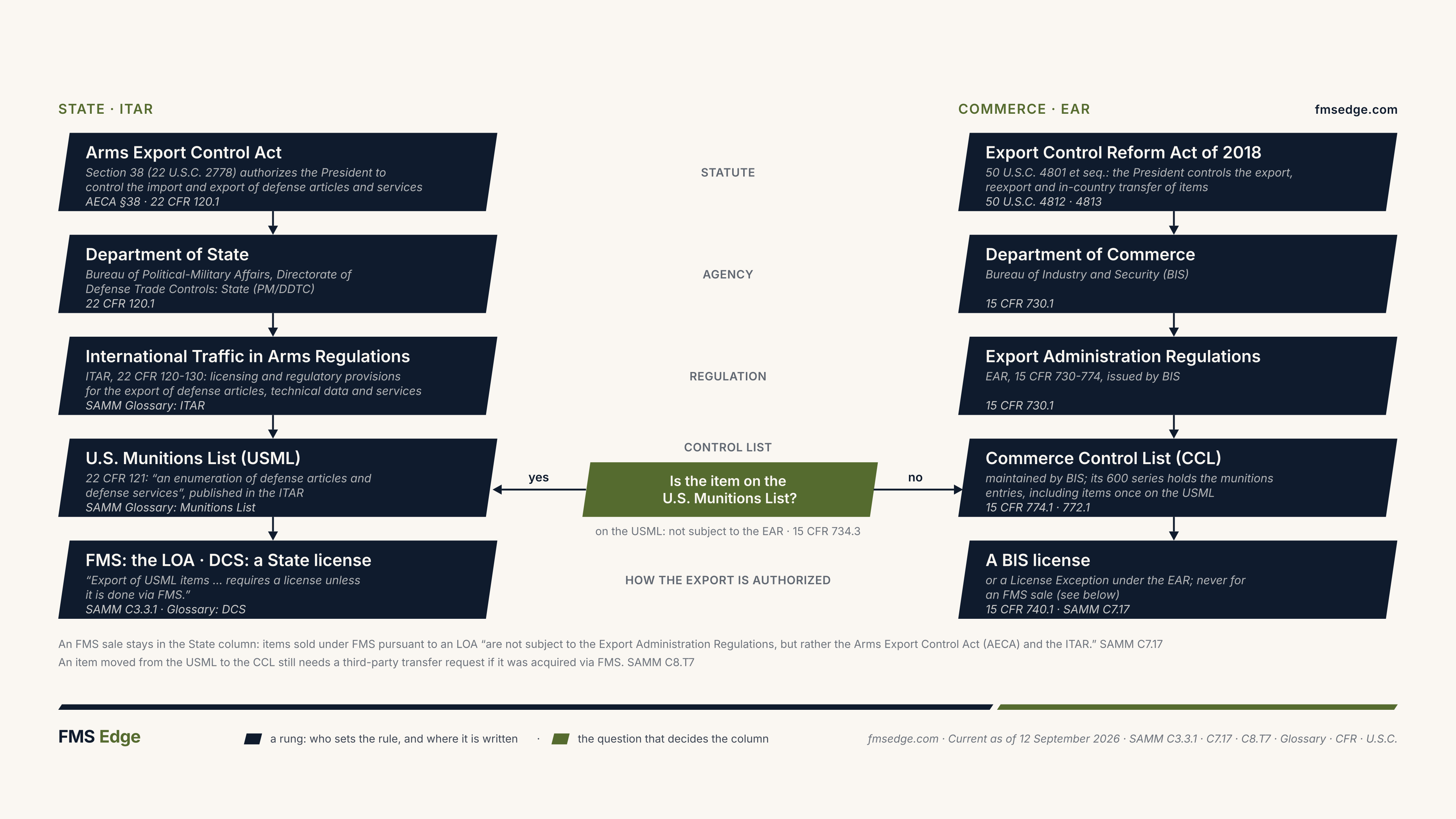
Do you need an export license for a Foreign Military Sale?
A Foreign Military Sale needs no separate export license. Exporting U.S. items, certain services and technical information included, requires a license unless the export is done through . A contractor must still obtain the appropriate export license if its marketing involves disclosing or temporarily exporting defense articles [SAMM ].
In the International Traffic in Arms Regulations, the Department of State sets out its policies and procedures for the permanent export of U.S. items bought through . For the Department of War (DoW), the Defense Administration () researches license applications and validates them [SAMM ].
, whose authorities come from Title 10 or annual National Defense Authorization Acts, are executed on Letters of Offer and Acceptance, also known as cases.
U.S. industry requires separate export authorization [SAMM ]. This authorization can take the form of export licenses/agreements or exceptions/exemptions from the Department of State or the Department of Commerce, as appropriate.
A transfer of materiel to the purchaser inside the United States needs no export license. Before such a shipment is exported, however, Customs and Border Protection () must have current implemented data for the , including all Amendments and Modifications [SAMM ]. The of the provides that information to electronically. The purchaser must still file Electronic Export Information () in the Automated Export System () at the time of export [SAMM ].
Table C7.T1 sets out what purchasers and their freight forwarders are each responsible for. A that exports materiel must meet the requirements in Section C7.5 [SAMM ].
A purchaser that acts as its own must register with the Directorate of Defense Trade Controls () in the Department of State's Bureau of Political-Military Affairs [SAMM ]. It must also file a statement that it will comply with the International Traffic in Arms Regulations [SAMM ].
For materiel that involves classified articles or data, a is required. The requirements are set out in 22 CFR 126.6 and Chapter 7 [SAMM ].
The governs the export of defense articles and defense services to foreign countries and international organizations and includes both commercial and government programs. It authorizes a list of controlled articles, the U.S. (), which is contained in the International Traffic in Arms Regulations () published by the Department of State. The forms the legal basis for the security requirements in most DoW international programs. The states that foreign sales (i.e., access) should be consistent with U.S. foreign policy interests, strengthen the security of the U.S., and contribute to world peace.
Section 3(a), , sets the conditions under which the U.S. Government () sells or leases defense articles and defense services to a country or international organization. The President must find that furnishing them will strengthen the security of the United States and promote world peace, and the recipient must have agreed to three security-related conditions [SAMM ] []. Section 505(a), Foreign Assistance Act (), requires a country that receives defense articles or defense services on a grant basis to agree to similar transfer, use and security conditions []. The three conditions are as follows:
- Transfer: The recipient country or organization agrees not to transfer title or possession of the articles or related to anyone who is not an officer, employee or agent of the country or organization without prior U.S. Government () consent.
- Use: The recipient country or organization agrees not to use the articles or related or permit their use for other than the purpose for which they were furnished without prior consent.
- Protection: The recipient country or organization agrees to maintain security of the articles or related technical information, and provide substantially the same degree of security to it as does the .
These security-related conditions are incorporated into the process via the standard terms and conditions of each . Within any , the standard terms and conditions will be listed at Section 2 “General Purchaser Agreements.” Transfer, use, and protection are specifically addressed in subsections 2.4-2.6 of any . By stating these conditions of sale in the , the international partner agrees to these conditions when they sign to accept the .
The glossary describes the as a Department of State regulation that sets the licensing and regulatory provisions for importing and exporting defense articles, and services. , in the Bureau of Political-Military Affairs, prepares it. It includes the U.S. and is published in the Federal Register as 22 CFR 120-130.
Releasing or otherwise transferring , or technology or subject to the Export Administration Regulations (), to a foreign person in the United States is a deemed export [, ]. is also released through oral or written exchanges with foreign persons in the United States or abroad []. Export of items, including technical information, requires a license unless it is done through or an exemption applies [SAMM , ].
The provides many exemptions from its licensing requirements. Some are self-executing by the contractor that is to use them, and these are normally based on prior authorizations. A DoW Component may request or direct the use of other exemptions, such as the one in 22 CFR 125.4(b)(1). Certain of these exemptions may be exercised only by a Principal Disclosure Authority () or a Designated Disclosure Authority (), in line with the National Industrial Security Program Operating Manual (), 32 CFR Part 117 [SAMM ].
For a contractor to use an exemption for follow-on support, the and the contract must both be specific about the following [SAMM ]:
- the end user
- the end use
- the exporter
- any subcontractors involved
- intermediate consignees
- the specific service or information to be provided
If this information is not fully documented, the program may be delayed and the supporting contractor may have to obtain additional export authorizations [SAMM ].
The Department of State and/or Department of Commerce provide export authorizations with export license/agreements for exports under the and the . Alternatively, U.S. exporters may utilize exceptions/exemptions under the respective regulations [, ].
U.S. industry, organizations, academia, and persons may conduct international transfers under , including directly with foreign parties (i.e., governments, companies, organization, or persons). Certain transfers are controlled; certain controlled transfers require export authorizations [, ].
For example, providing non-export controlled marketing brochures at a trade show in the United States is not controlled and does not require export authorization [, , ].
Technology transfers that are not subject to export control include the following:
- Publicly available information [, ]
- Information provided under the Freedom of Information Act ()
- Information that arises during fundamental research in science and engineering at accredited institutions of higher learning in the United States and is ordinarily published and shared broadly in the scientific community []
References
SAMM
- SAMM C4.T1: Presidential Determination Criteria for Foreign Military Sales Eligibility
- SAMM C3.3.1: International Traffic in Arms Regulations Requirements.
- SAMM C3.3.3.4.1: Export License Requirements for Purchaser-Sponsored Shipments.
- SAMM C3.3.2: International Traffic in Arms Regulations Exemptions.
Public authorities
- AECA §3: Arms Export Control Act of 1976, as amended, §3 (22 U.S.C. §2753)
- FAA §505: Foreign Assistance Act of 1961, as amended, §505 (22 U.S.C. §2314), Furnishing of defense articles or related training or other defense service on grant basis
- 22 CFR 120.50: International Traffic in Arms Regulations, 22 CFR 120.50, Export
- 15 CFR 734.13: Export Administration Regulations, 15 CFR 734.13, Export
- 22 CFR 120.56: International Traffic in Arms Regulations, 22 CFR 120.56, Release
- ITAR, 22 CFR 120-130: International Traffic in Arms Regulations, 22 CFR Chapter I, Subchapter M (Parts 120 to 130)
- EAR, 15 CFR 730-774: Export Administration Regulations, 15 CFR Chapter VII, Subchapter C (Parts 730 to 774)
- 22 CFR 120.33: International Traffic in Arms Regulations, 22 CFR 120.33, Technical data
- 22 CFR 120.34: International Traffic in Arms Regulations, 22 CFR 120.34, Public domain
- 15 CFR 734.7: Export Administration Regulations, 15 CFR 734.7, Published
Related
Munitions List
The list, in Part 121 of the International Traffic in Arms Regulations (ITAR), of the defense articles and defense services, related technical data included, that the Department of State controls for export and temporary import.
The U.S. Munitions List (USML) designates the specific items that are defense articles and defense services under Section 47 of the Arms Export Control Act (AECA), and marks Significant Military Equipment (SME) with an asterisk [SAMM C4.4] [22 U.S.C. 2794].
FMS Edge glossary, as of 10 October 2026
Glossary entry →Open the manual’s entry → (opens in new tab)
Foreign Military Sales (FMS)
The part of U.S. security assistance, authorized by the Arms Export Control Act (AECA), in which eligible foreign governments and international organizations buy defense articles, services and training from the U.S. Government under formal government-to-government agreements.
The articles come either from Department of War stocks or from new procurement under contracts the Department manages [22 U.S.C. 2761, 22 U.S.C. 2762]. A sale is FMS whatever the source of the purchaser's financing.
FMS Edge glossary, as of 10 October 2026
Glossary entry →Open the manual’s entry → (opens in new tab)
Direct Commercial Sale (DCS)
A sale of defense articles or defense services made under a Department of State issued license by U.S. industry directly to a foreign buyer, and which is not administered by DoD through Foreign Military Sales procedures.
SAMM Glossary, as of 12 September 2026
Glossary entry →Open the manual’s entry → (opens in new tab)
Technical Data
Recorded information of a scientific or technical nature, regardless of form or characteristic. Examples of technical data packages include research and engineering drawings and associated lists, specifications, standards, process sheets, manuals, technical reports, catalog item identifications, and related information and computer software documentation.
SAMM Glossary, as of 12 September 2026
Glossary entry →Open the manual’s entry → (opens in new tab)
FMS: Foreign Military Sale
SAMM Acronyms, as of 12 September 2026
Technology Security
The comprehensive framework of policies, practices, and procedures designed to protect U.S. military and dual-use technologies from unauthorized access, transfer, or exploitation by adversaries.
SAMM Glossary, as of 26 October 2026
DTSA: Defense Technology Security Administration
SAMM Acronyms, as of 12 September 2026
Building Partner Capacity (BPC) Programs
Security cooperation and security assistance activities funded with USG appropriations (not including Foreign Military Sales Credit and Military Assistance Program/Merger).
SAMM Glossary, as of 12 September 2026
Glossary entry →Open the manual’s entry → (opens in new tab)
Letter of Offer and Acceptance (LOA)
The legal instrument that lists the defense articles and services, including training, that the U.S. Government transfers to a foreign country or international organization, with their estimated costs and the terms and conditions. The benefitting partner does not sign a Building Partner Capacity (BPC) LOA.
The Letter of Offer and Acceptance (LOA) is the instrument the U.S. Government uses to sell under the Arms Export Control Act (AECA); signed LOAs and their later Amendments and Modifications are also called Foreign Military Sales (FMS) cases [SAMM C5.6.1].
FMS Edge glossary, as of 10 October 2026
Glossary entry →Open the manual’s entry → (opens in new tab)
Security Cooperation Information Portal (SCIP)
A web-based tool, managed by the Defense Security Cooperation Agency (DSCA), that gives international purchasers, their agents such as freight forwarders, and authorized U.S. Government personnel information on Foreign Military Sales (FMS) cases and other security cooperation programs.
It covers case, line, requisition and supply data, supply transactions and end-use monitoring information, drawn from the Defense Security Assistance Management System (DSAMS) and the Military Departments' case execution systems.
FMS Edge glossary, as of 10 October 2026
Glossary entry →Open the manual’s entry → (opens in new tab)
Defense Security Cooperation Agency (DSCA)
The Department of War agency that directs, administers and provides guidance to the Department's components and its representatives at U.S. missions for the execution of the security cooperation programs for which it is responsible [SAMM C1.3.2.2]. The agency also provides financial and technical assistance, arranges the transfer of defense materiel, training and services to international partners, and promotes military-to-military contacts.
FMS Edge glossary, as of 10 October 2026
Glossary entry →Open the manual’s entry → (opens in new tab)
Freight Forwarder
A commercial import/export company registered with the Department of State, Bureau of Political-Military Affairs, Directorate of Defense Trade Controls and under contract to the Foreign Military Sales customer which arranges transportation of materiel from a point specified in the Letter of Offer and Acceptance to the final destination.
SAMM Glossary, as of 12 September 2026
Glossary entry →Open the manual’s entry → (opens in new tab)
DDTC: Directorate of Defense Trade Controls
Transportation Plan
A document that details the transportation and security arrangements for moving classified or sensitive material, and identifies individuals responsible for providing security at various points during transportation.
SAMM Glossary, as of 12 September 2026
Glossary entry →Open the manual’s entry → (opens in new tab)
Arms Export Control Act (AECA)
The basic U.S. law providing the authority and general rules for the conduct of Foreign Military Sales and commercial sales of defense articles, defense services, and training. The Arms Export Control Act (AECA) came into existence with the passage of the Foreign Military Sales Act (FMSA) of 1968. An amendment in the International Security Assistance and AECA of 1976 changed the name of FMSA to the AECA.
SAMM Glossary, as of 12 September 2026
Glossary entry →Open the manual’s entry → (opens in new tab)
ITAR: International Traffic in Arms Regulations
SAMM Acronyms, as of 12 September 2026
Glossary entry →International Traffic in Arms Regulation (ITAR) →
AECA: Arms Export Control Act
SAMM Acronyms, as of 12 September 2026
LOA: Letter of Offer and Acceptance
SAMM Acronyms, as of 12 September 2026
SAMM: Security Assistance Management Manual
SAMM Acronyms, as of 12 September 2026
Glossary entry →Security Assistance Management Manual (SAMM) →
International Traffic in Arms Regulation (ITAR)
The Department of State regulations, administered by its Directorate of Defense Trade Controls, that control the export and temporary import of defense articles, technical data and defense services through vetting, licensing and other regulatory requirements.
The regulations include the U.S. Munitions List [ITAR, 22 CFR 120-130].
FMS Edge glossary, as of 10 October 2026
Glossary entry →Open the manual’s entry → (opens in new tab)
Source Code (SC) (Letter of Offer and Acceptance)
A single digit code on every line on a Letter of Offer and Acceptance that identifies the source for the item. Codes include:
S = Shipment from DoD stocks or performance by DoD personnel
P = From new procurement
R = From rebuild, repair, or modification by the USG
X = Mixed source, such as stock and procurement, or undetermined
E = Excess items, as is
F = Special Defense Acquisition Fund items
Also known as "Source of Supply (SoS) Code."
SAMM Glossary, as of 12 September 2026
Glossary entry →Open the manual’s entry → (opens in new tab)
EAR: Export Administration Regulations
NISPOM: National Industrial Security Program Operating Manual
SAMM Acronyms, as of 12 September 2026
DCS: Direct Commercial Sales
SAMM Acronyms, as of 12 September 2026
SAMM C3.3.1: International Traffic in Arms Regulations Requirements.
“Department of State (State) policies and procedures for the permanent export of items on the U.S. Munitions List (USML), purchased under the Foreign Military Sales (FMS) program, are set forth in the International Traffic in Arms Regulations (ITAR). Export of USML items, including certain services and technical information, requires a license unless it is done via FMS. If marketing efforts …”
Security Assistance Management Manual, as of 5 October 2026
SAMM C3.3.3.4.1: Export License Requirements for Purchaser-Sponsored Shipments.
“An export license is not required when FMS materiel is transferred to the purchaser within the United States; however, Customs and Border Protection (CBP) must have currently implemented data for LOAs, including all Amendments or Modifications, prior to export of these shipments. This information is provided electronically by DSCA Security Cooperation Information Portal (SCIP) to CBP. A license is not …”
Security Assistance Management Manual, as of 5 October 2026
SAMM C4.T1: Presidential Determination Criteria for Foreign Military Sales Eligibility
“Table C4.T1. Presidential Determination Criteria for Foreign Military Sales Eligibility # Eligibility Criteria 1 The President finds that the furnishing of defense articles and defense services to such country or international organization will strengthen the security of the United States and promote world peace; 2 The country or international organization has agreed not to transfer title to, or possession of, …”
Security Assistance Management Manual, as of 26 October 2026
Foreign Assistance Act of 1961, as amended, §505 (22 U.S.C. §2314), Furnishing of defense articles or related training or other defense service on grant basis
FAA §505 · Statute
International Traffic in Arms Regulations, 22 CFR 120.50, Export
22 CFR 120.50 · Regulation
International Traffic in Arms Regulations, 22 CFR 120.56, Release
22 CFR 120.56 · Regulation
SAMM C3.3.2: International Traffic in Arms Regulations Exemptions.
“The ITAR includes many exemptions from the licensing requirements. Some are self-executing by the contractor who is to use them and normally are based on prior authorizations. Other exemptions, such as the exemption in 22 CFR 125.4(b)(1), may be requested or directed by the DoW Component. Only a Principal Disclosure Authority (PDA) or Designated Disclosure Authority (DDA) has the authority …”
Security Assistance Management Manual, as of 5 October 2026
International Traffic in Arms Regulations, 22 CFR Chapter I, Subchapter M (Parts 120 to 130)
ITAR, 22 CFR 120-130 · Regulation
Export Administration Regulations, 15 CFR Chapter VII, Subchapter C (Parts 730 to 774)
EAR, 15 CFR 730-774 · Regulation
International Traffic in Arms Regulations, 22 CFR 120.33, Technical data
22 CFR 120.33 · Regulation
International Traffic in Arms Regulations, 22 CFR 120.34, Public domain
22 CFR 120.34 · Regulation
Export Administration Regulations, 15 CFR 734.7, Published
15 CFR 734.7 · Regulation