
Guide
What is the difference between the Arms Export Control Act and the Foreign Assistance Act?
rests on two authorizing laws. The Foreign Assistance Act of 1961 authorizes grant programs such as International Military Education and Training, emergency drawdowns and grant transfers of . The is the statutory basis for , for Foreign Military Financing and for the control of commercial arms exports.
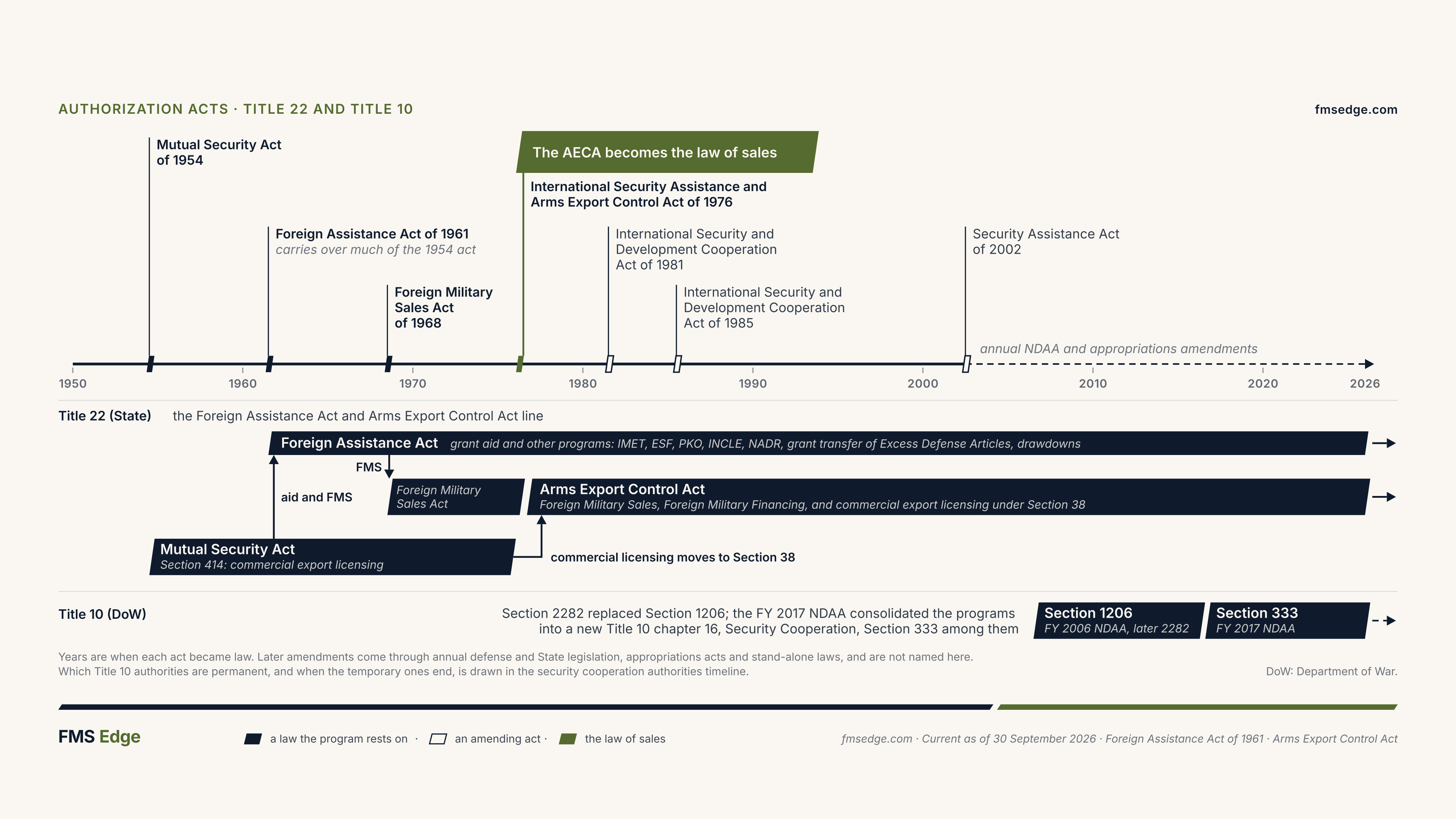
U.S. security assistance rests on the Foreign Assistance Act of 1961, which carries grant aid, and on the Arms Export Control Act, which carries sales and took its name in 1976. From 2006 a separate line of Department of War authorities has grown under Title 10.
What is the difference between the Arms Export Control Act and the Foreign Assistance Act?
The authorizes grant programs, and the authorizes sales and controls arms exports. The covers programs such as military education and training, emergency drawdowns and grant transfers of . The covers , Foreign Military Financing and the licensing of commercial arms exports.
The U.S. program, a major component of (), has its foundation in public law, which provides both authorizations and appropriations.
Congress both authorizes and appropriates funds for programs [SAMM ]. The programs funded this way include the following:
- Foreign Military Financing Programs ()
- Peacekeeping Operations ()
- Nonproliferation, Anti-Terrorism, Demining, and Related Programs ()
, commercial exports or Direct Commercial Sales (), drawdowns, and leasing are also addressed in legislation, though not from a funding standpoint since U.S.-appropriated dollars are not normally required. Instead, these programs are addressed from a reporting, control, and oversight perspective.
Each year the submission includes the Administration's request for appropriations, and the Administration may also ask Congress to amend the authorization and appropriations laws. Congress reviews the requests, authorizes and appropriates funds, and enacts the amendments needed to carry out programs. Appropriations may also be requested to reimburse the Department of War for the value of items furnished under Military Assistance Drawdown. When appropriations are not enacted before the fiscal year begins, essential activities usually continue under a Authority (CRA). A CRA is a stopgap or temporary appropriation by Congress, with special rules for expenditures [SAMM ].
authorizations and appropriations rest primarily on three public laws: the Foreign Assistance Act of 1961, the of 1976, and the annual appropriations acts for Foreign Operations, Export Financing and Related Programs [SAMM ]. The first two are the basic laws of the current U.S. program:
- Foreign Assistance Act (), as amended []
- , as amended []
Both the and follow a succession of earlier acts which served as the basis for many of the current provisions in the and .
The of 1961 contains many provisions formerly in the Mutual Security Act of 1954, as amended. The is the authorizing legislation for , ESF, , , , overseas program management, grant transfer of , emergency drawdowns, and a wide variety of other foreign assistance programs.
Much of the addresses programs outside the purview of :
- Development assistance
- Famine prevention
- International organizations
- Support for East European Democracy (SEED) Act of 1989
- Freedom for Russia and Emerging Eurasian Democracies and Open Markets (FREEDOM) Support Act
The came into being under a different title, the Act of 1968 (FMSA). Before 1968, the basic authority for was the . The FMSA served to incorporate the program under a new and separate act. The International and of 1976 changed the title of the FMSA to the current . The 1976 Act also repealed Section 414 of the Mutual Security Act of 1954, which provided authority for commercial licensing through the International Traffic in Arms Regulations ().
The commercial licensing authority was placed in a new Section 38, , “Control of Arms Exports and Imports,” which governs the licensing and sale of items through direct commercial channels []. The is the statutory basis for the conduct of , funding for , and the control of commercial sales of defense articles and services.
The and the may be amended by annual or biennial or foreign assistance authorization acts. However, Congress has used annual Department of War (DoW) and Department of State () legislation, stand-alone legislation, and various functional laws to amend the or . In the absence of an authorization act, the appropriations committee has included program authorization language in the affected annual appropriations act, in other acts or in stand-alone legislation to authorize additional programs.
The Senate Foreign Relations Committee () and the House Foreign Affairs Committee () are responsible for foreign assistance and program authorization legislation. The Senate Armed Services Committee () and the House Armed Services Committee () are responsible for defense programs authorization legislation, including DoW authorities related to and authorities for the broadly defined programs.
The largest reorganization of () and its programs occurred with the National Defense Authorization Act () for fiscal year () 2017, P.L. 114-328, 23 December 2016 (herein referred to as 2017). 2017 reformed, consolidated, and codified existing programs, along with other major changes to the conduct, oversight, and execution of . Section 1241 of 2017 established a new Chapter 16 in Title 10 called “.”
Section 382(a) of Chapter 16 requires the Secretary of War to assign oversight of strategic policy and guidance for DoW and activities, and their overall resource allocation, to a single official and office. That official and office sit in the Office of the Secretary of War, at the level of Under Secretary of War or below []. Additionally, Chapter 16 includes sections encompassing the main aspects of previous programs that have been repealed, re-codified, and/or codified, and sometimes consolidated into a new program/section.
Many existing programs were consolidated into new sections, such as Section 333, enacted by 2017 in place of several prior train-and-equip authorities [SAMM ]. Section 333 is a permanent authority: it is codified in Title 10 of the U.S. Code and does not require renewed authorization legislation each year [SAMM , ]. Congress also uses the annual to update previous : to extend numerous programs that were temporary in nature, to expand programs, to provide more guidance to DoW on programs, to limit the scope of programs, and to reinforce the importance of previous legislation.
The general subject areas are referred to as “titles.” Most laws codifying can be viewed under Title 22, “Foreign Relations and Intercourse” [SAMM ]. Certain -related laws and laws codifying can be viewed under Title 10, “Armed Forces” [SAMM ]. These titles are often referred to when differentiating between authorities and appropriations for the and its responsibility for foreign affairs and the DoW and its responsibility for national defense.
() 13637 holds detailed delegations. It allocates authority and responsibility for principally to the Secretary of War and the Secretary of . The Secretary of War's authority is delegated in turn to the Deputy Secretary of War, then to the Under Secretary of War for Policy (USW(P)), and finally, in Directive () 5105.65, to the Director of the [SAMM ].
References
SAMM
- SAMM AP8.S333.1.4: Prior Department of War Train & Equip Programs.
- SAMM C11.2.4.1: Permanent Authority
- SAMM C11.T2: Security Assistance and Security Cooperation Programs
- SAMM C1.1.2.2: Security Assistance Programs.
- SAMM C1.2.2: Legislative Authorities for Security Cooperation.
- SAMM C1.2.1
- SAMM C1.2.3: Executive Orders for Security Assistance.
Public authorities
- 22 U.S.C. ch. 32: 22 U.S.C. Chapter 32, Foreign Assistance (the Foreign Assistance Act of 1961, Pub. L. 87-195, 22 U.S.C. 2151 et seq.)
- 22 U.S.C. ch. 39: 22 U.S.C. Chapter 39, Arms Export Control (the Arms Export Control Act, 22 U.S.C. 2751 et seq.)
- AECA §38: Arms Export Control Act of 1976, as amended, §38 (22 U.S.C. §2778)
- 10 U.S.C. 382: 10 U.S.C. §382, Execution and administration of programs and activities
- SecWar memo, 7 Nov 2025: Secretary of War memorandum, 7 November 2025, "Unifying the Department's Arms Transfer and Security Cooperation Enterprise to Improve Efficiency and Enable Burden-Sharing"
- DoW release, 10 Feb 2026: Department of War release, 10 February 2026, "Department of War Finalizes Realignment of the Defense Security Cooperation Agency and the Defense Technology Security Administration"
Related
Security Assistance (SA)
A group of programs authorized by federal statutes by which the United States provides defense articles, military training, and other defense-related services by grant, lease, loan, credit, or cash sales in furtherance of national policies and objectives, and those that are funded and authorized through the Department of State to be administered by Department of Defense/Defense Security Cooperation Agency, which are considered part of security cooperation.
SAMM Glossary, as of 12 September 2026
Glossary entry →Open the manual’s entry → (opens in new tab)
Excess Defense Articles (EDA)
Defense articles owned by the USG which are neither procured in anticipation of military assistance or sales requirements, nor procured pursuant to a military assistance or sales order. EDA are items (except construction equipment) that are in excess of the Approved Force Acquisition Objective and Approved Force Retention Stock of all DoD components at the time such articles are dropped from inventory by the supplying agency for delivery to countries or international organizations.
SAMM Glossary, as of 12 September 2026
Glossary entry →Open the manual’s entry → (opens in new tab)
Arms Export Control Act (AECA)
The basic U.S. law providing the authority and general rules for the conduct of Foreign Military Sales and commercial sales of defense articles, defense services, and training. The Arms Export Control Act (AECA) came into existence with the passage of the Foreign Military Sales Act (FMSA) of 1968. An amendment in the International Security Assistance and AECA of 1976 changed the name of FMSA to the AECA.
SAMM Glossary, as of 12 September 2026
Glossary entry →Open the manual’s entry → (opens in new tab)
Foreign Military Sales (FMS)
The part of U.S. security assistance, authorized by the Arms Export Control Act (AECA), in which eligible foreign governments and international organizations buy defense articles, services and training from the U.S. Government under formal government-to-government agreements.
The articles come either from Department of War stocks or from new procurement under contracts the Department manages [22 U.S.C. 2761, 22 U.S.C. 2762]. A sale is FMS whatever the source of the purchaser's financing.
FMS Edge glossary, as of 10 October 2026
Glossary entry →Open the manual’s entry → (opens in new tab)
Foreign Assistance Act (FAA) of 1961
The basic U.S. law, as amended, that authorizes the government's grant foreign assistance programs and sets the general rules for carrying them out, military assistance such as International Military Education and Training (IMET) among them.
FMS Edge glossary, as of 10 October 2026
Glossary entry →Open the manual’s entry → (opens in new tab)
AECA: Arms Export Control Act
SAMM Acronyms, as of 12 September 2026
Security Cooperation
Activities by which the Department of War encourages and enables international partners to cooperate with the United States toward strategic objectives, spanning every interaction with foreign defense and security establishments and every security assistance program the Department administers.
Under chapter 16 of Title 10, their purposes are to develop allied and friendly security capabilities for self-defense and multinational operations, to give U.S. forces peacetime and contingency access, and to build relationships promoting specific U.S. security interests [10 U.S.C. 301(7)].
FMS Edge glossary, as of 10 October 2026
Glossary entry →Open the manual’s entry → (opens in new tab)
International Military Education And Training (IMET) Program
A grant program of the Department of State, carried out by the Department of War under the Foreign Assistance Act (FAA), that funds education and training for foreign military personnel and selected civilian officials in the United States or overseas.
The International Military Education and Training (IMET) program is a Department of State program, jointly managed by the Defense Security Cooperation Agency (DSCA) and the Department of State, whose courses are given mainly at military schoolhouses in the United States [SAMM C10.6.1].
FMS Edge glossary, as of 10 October 2026
Glossary entry →Open the manual’s entry → (opens in new tab)
FMFP: Foreign Military Financing Program
Economic Support Fund (ESF)
A USG security assistance program through which economic assistance is provided on a grant basis, to selected foreign governments. The funds may be used to finance imports of commodities, capital, or technical assistance in accordance with the terms of a bilateral agreement; counterpart funds thereby generated may be used as budgetary support. These funds enable a recipient to devote more of its own resources to defense and security purposes than it otherwise could do without serious economic or political consequences (Formerly termed "Security Supporting Assistance").
SAMM Glossary, as of 12 September 2026
Glossary entry →Open the manual’s entry → (opens in new tab)
International Narcotics Control And Law Enforcement (INCLE)
Counter drug bureau/programs managed by Department of State, but can have materiel, services, and training support provided and managed by DoD using Security Cooperation assets and procedures.
SAMM Glossary, as of 12 September 2026
Glossary entry →Open the manual’s entry → (opens in new tab)
DCS: Direct Commercial Sales
SAMM Acronyms, as of 12 September 2026
President's Budget
The document sent to Congress by the President in January or February of each year, as required by law (31 U.S.C. 1105), requesting new budget authority for federal programs and estimating federal revenues and outlays for the upcoming fiscal year and 4 subsequent outyears. Although the title of the document is Budget of the USG, it represents proposals for congressional consideration.
SAMM Glossary, as of 12 September 2026
Glossary entry →Open the manual’s entry → (opens in new tab)
Continuing Resolution (CR)
Continuing resolutions (CRs) are joint resolutions that provide continuing appropriations for part of a fiscal year or for a full fiscal year. A CR that covers only a part of a fiscal year is referred to as a "short-term" CR, and a CR that covers a full fiscal year is referred to as a "full-year" CR. A CR is often enacted when the Congress has not yet passed new appropriations bills by October 1 or when the President has vetoed congressionally passed appropriations bills. Because of the nature of a short-term CR, you should operate at a minimal level until after your regular fiscal year appropriations is enacted.
SAMM Glossary, as of 12 September 2026
Glossary entry →Open the manual’s entry → (opens in new tab)
IMET: International Military Education and Training
SAMM Acronyms, as of 12 September 2026
INCLE: International Narcotics Control and Law Enforcement
SAMM Acronyms, as of 12 September 2026
Glossary entry →International Narcotics Control And Law Enforcement (INCLE) →
FMS: Foreign Military Sale
SAMM Acronyms, as of 12 September 2026
ITAR: International Traffic in Arms Regulations
SAMM Acronyms, as of 12 September 2026
Glossary entry →International Traffic in Arms Regulation (ITAR) →
SFRC: Senate Foreign Relations Committee
HFAC: House Foreign Affairs Committee
SASC: Senate Armed Services Committee
HASC: House Armed Services Committee
Fiscal Year (FY)
The USG’s accounting period. It begins on October 1 and ends on September 30 and is designated by the calendar year in which it ends.
SAMM Glossary, as of 12 September 2026
Glossary entry →Open the manual’s entry → (opens in new tab)
Security Cooperation Programs
Any program, activity (including an exercise), or interaction of the Department of Defense with the security establishment of a partner or international organization to achieve a purpose as follows:
To build and develop allied and friendly security capabilities for self-defense and multinational operations.
To provide the armed forces with access to the partner or international organization during peacetime or a contingency operation.
To build relationships that promote specific United States security interests.
SAMM Glossary, as of 12 September 2026
Glossary entry →Open the manual’s entry → (opens in new tab)
Executive Order (EO)
A numbered official document through which the President manages the operations of the Federal Government, normally used to create or change the organization or procedures of executive branch agencies; its authority rests on the Constitution or on powers that acts of Congress grant. The text of each executive order is published in the Federal Register once the President has signed it.
FMS Edge glossary, as of 10 October 2026
Glossary entry →Open the manual’s entry → (opens in new tab)
Defense Security Cooperation Agency (DSCA)
The Department of War agency that directs, administers and provides guidance to the Department's components and its representatives at U.S. missions for the execution of the security cooperation programs for which it is responsible [SAMM C1.3.2.2]. The agency also provides financial and technical assistance, arranges the transfer of defense materiel, training and services to international partners, and promotes military-to-military contacts.
FMS Edge glossary, as of 10 October 2026
Glossary entry →Open the manual’s entry → (opens in new tab)
DSCA: Defense Security Cooperation Agency
SAMM Acronyms, as of 12 September 2026
Glossary entry →Defense Security Cooperation Agency (DSCA) →
Technology Security
The comprehensive framework of policies, practices, and procedures designed to protect U.S. military and dual-use technologies from unauthorized access, transfer, or exploitation by adversaries.
SAMM Glossary, as of 26 October 2026
SAMM C1.2.1
“Legislative Authorities for Security Assistance. Security assistance (SA) authorizations and appropriations are provided primarily under three public laws: The Foreign Assistance Act (FAA) of 1961, as amended (22 U.S.C. Chapter 32) The Arms Export Control Act (AECA) of 1976, as amended (22 U.S.C. Chapter 39) Annual appropriations acts for Foreign Operations, Export Financing and Related Programs”
Security Assistance Management Manual, as of 26 October 2026
22 U.S.C. Chapter 32, Foreign Assistance (the Foreign Assistance Act of 1961, Pub. L. 87-195, 22 U.S.C. 2151 et seq.)
22 U.S.C. ch. 32 · Statute
22 U.S.C. Chapter 39, Arms Export Control (the Arms Export Control Act, 22 U.S.C. 2751 et seq.)
22 U.S.C. ch. 39 · Statute
Arms Export Control Act of 1976, as amended, §38 (22 U.S.C. §2778)
AECA §38 · Statute
10 U.S.C. §382, Execution and administration of programs and activities
10 U.S.C. 382 · Statute
SAMM AP8.S333.1.4: Prior Department of War Train & Equip Programs.
“The Fiscal Year (FY) 2017 National Defense Authorization Act (NDAA) enacted the Section 333 authority. Table S333.T1. lists some of the prior DoW Train and Equip authorities that DoW relied upon to build the capacity of foreign security forces prior to the enactment of Section 333.”
Security Assistance Management Manual, as of 12 October 2026
SAMM C11.2.4.1: Permanent Authority
“Legislative authorities that are codified in either Title 10 or Title 22 of the U.S. Code and do not require renewed authorization legislation each year are permanent authorities. Congress may use annual authorizing legislation or the appropriation authorization to modify the permanent authorities that exist within the U.S. Code.”
Security Assistance Management Manual, as of 11 September 2026
SAMM C11.T2: Security Assistance and Security Cooperation Programs
“Table C11.T2. Security Assistance and Security Cooperation Programs Title Program Acronym Program Authority Status Program Duration Legal Citation SC or SA Afghanistan Security Forces Fund ASFF Expired Temporary See Section ASFF.8. for listing. SC Coalition Readiness Support Program CRSP Active Temporary Section 1233 of the Fiscal Year (FY) 2008 National Defense Authorization Act (NDAA) (P.L. 110-181), as amended SC Counter-Islamic …”
Security Assistance Management Manual, as of 26 October 2026
SAMM C1.1.2.2: Security Assistance Programs.
“SA is a group of programs, authorized under Title 22 authorities, by which the United States provides defense articles, military education and training, and other defense-related services by grant, loan, credit, cash sales, or lease, in furtherance of national policies and objectives. All SA programs are subject to the continuous supervision and general direction of the Secretary of State to …”
Security Assistance Management Manual, as of 26 October 2026
SAMM C1.2.2: Legislative Authorities for Security Cooperation.
“Security cooperation (SC) authorizations and appropriations are provided primarily under annual DoW Appropriations Acts, Supplementals, and a range of other Title 10 provisions. These authorities and programs are discussed in detail in Chapter 11 and Appendix 8.”
Security Assistance Management Manual, as of 26 October 2026
SAMM C1.2.3: Executive Orders for Security Assistance.
“Detailed SA delegations are also found in Executive Order (E.O.) 13637. This EO allocates authority and responsibility for SA principally to the SECWAR and the Secretary of State. The SECWAR authority is further delegated to the Deputy SECWAR, to the Under Secretary of War for Policy (USW(P)), and finally to the Director, DSCA, in DoD Directive (DoDD) 5105.65.”
Security Assistance Management Manual, as of 26 October 2026