
Guide
What is the difference between security assistance and security cooperation?
is a group of programs authorized under Title 22 and supervised by the Secretary of , among them. is the wider term, covering every Department of War interaction with foreign defense and security establishments, including the programs the Department administers. The statutes that authorize and fund a program decide which it is.
Title 22 and Title 10 answer the same four questions differently. Security assistance rests on the Foreign Assistance Act and the Arms Export Control Act under the Secretary of State's supervision; security cooperation programs rest on Title 10 or the annual NDAA and are funded by Department of War appropriations.
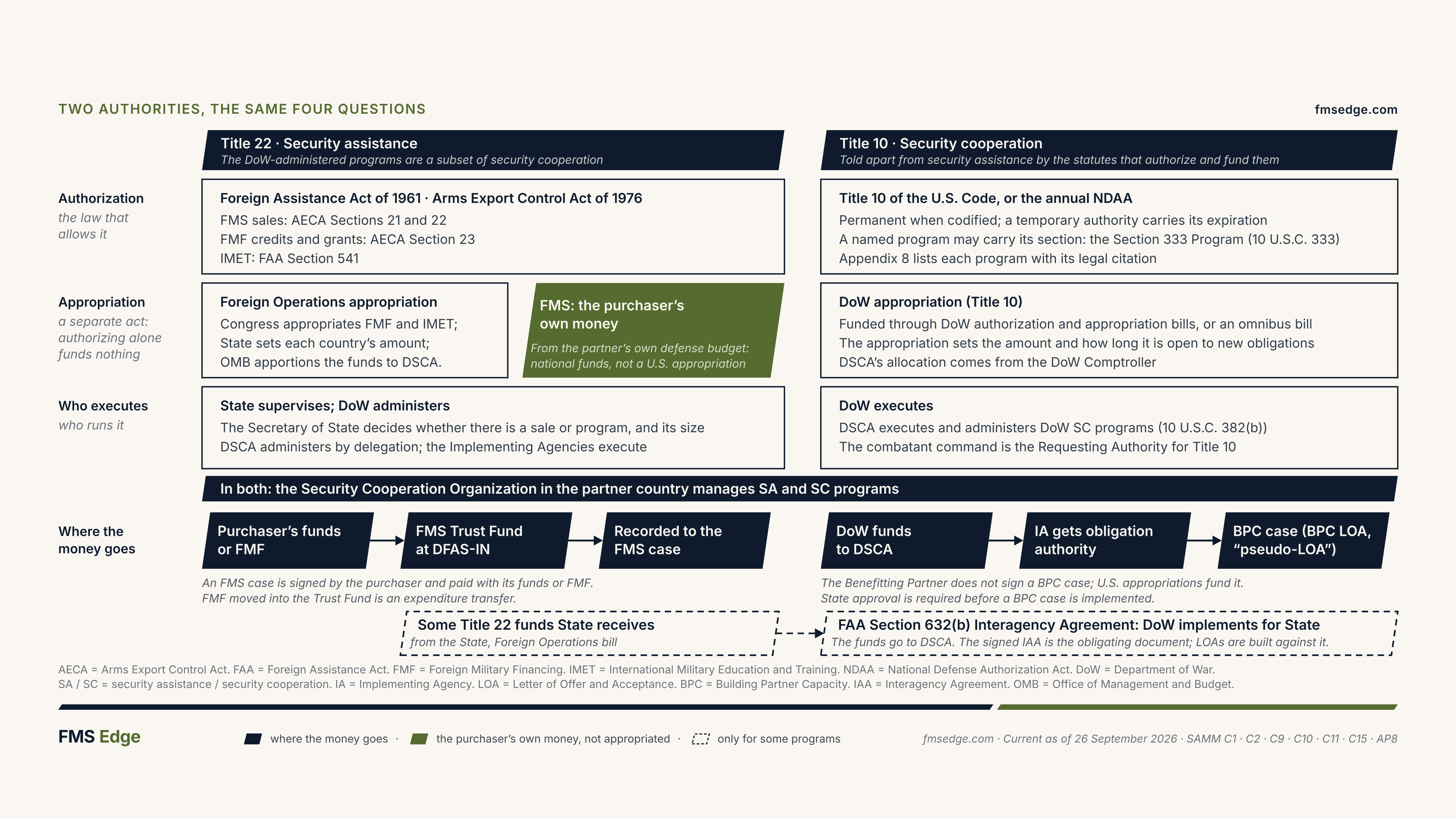
What is the difference between security assistance and security cooperation?
is a group of programs authorized under Title 22, while () covers every Department of War (DoW) interaction with foreign defense and security establishments, including the programs the DoW administers [SAMM , ]. comprises all the activities through which the DoW encourages and enables international partners to work with the United States toward strategic objectives. Its interactions build defense and security relationships and promote specific U.S. security interests, among them all activities and activities. They also build allied and friendly military capabilities for multinational operations and self-defense, and give U.S. forces peacetime and contingency access to host nations [SAMM ].
Under DoW policy, is an important tool of both national security and foreign policy, and an integral element of the DoW mission. activities shall be planned, programmed, budgeted and executed with as much attention and efficiency as the DoW's other integral activities. requirements shall be combined with the DoW's other requirements and carried out through its standard systems, facilities and procedures. The manual's reference for this policy is Directive () 5132.03 [SAMM ].
According to Title 10 U.S. Code, Chapter 16, Section 301, the term “ and activities of the Department of Defense” means any program, activity (including an exercise), or interaction of the DoW with the security establishment of a foreign country to achieve a purpose as follows: (A) To build and develop allied and friendly security capabilities for self-defense and multinational operations. (B) To provide the armed forces with access to the foreign country during peacetime or a contingency operation. (C) To build relationships that promote specific United States security interests []. Other DoW policy statements identify DoW-managed or administered programs as components of [SAMM ].
Over the years, has included programs authorized by the Foreign Assistance Act () or the . Section 502B of the , as amended, defines . The definition covers assistance under the 's parts on military assistance, the , military education and training, peacekeeping operations and antiterrorism assistance. It covers sales of defense articles or services, extensions of credits and guaranties of loans under the . It also covers any license in effect for exports to or for the armed forces, police, intelligence, or other forces of a foreign country. Those licenses are for defense articles or defense services under Section 38 of the , or for items in the 600 series of the Commerce Control List []. Many of these programs are administered by the DoW, through the , but all programs are subject to the continuous supervision and general direction of the Secretary of [SAMM , ].
Under the programs, the United States provides, by grant, loan, credit, cash sale or lease, military education and training, defense articles and other defense-related services, in furtherance of national policies and objectives. All programs are under the continuous supervision and general direction of the Secretary of , so that they best serve U.S. foreign policy interests. Some are administered by the DoW and others by the Department of State. The programs the DoW administers are a subset of [SAMM ].
Under the authority of Title 10, Chapter 16, and the annual National Defense Authorization Act (), the DoW provides materiel assistance and related training to international partners to build their security force capability. These programs are funded under annual appropriations legislation; Building Partner Capacity () authorities receive DoW Operations and Maintenance () appropriations [SAMM , ]. By statute or , these programs are sometimes required to be exercised in coordination with the Secretary of [SAMM ].
Authorizations and appropriations for programs are provided to the Secretary of War, mainly in the annual and in appropriations acts. The programs vary widely in which agency or DoW activity is responsible for them and in how they are planned and funded. Chapter 11 and Appendix 8 describe the individual programs in more detail [SAMM ].
Where security force assistance fits
Security force assistance is the set of DoW activities that contribute to unified action by the U.S. Government to help develop the capacity and capability of foreign security forces and the institutions that support them. The forces may be those of a partner or of an international organization (a regional security organization). The definition is the one in Instruction (DoDI) 3000.11. Security force assistance is a subset of , and the DoW uses it in support of U.S. strategic objectives in a crisis response or a contingency operation [SAMM ].
Moving from tactical to strategic levels, Security Force Assistance () is engagement at the tactical and operational level, Defense Institution Building (), as part of Institutional Capacity Building (), is engagement at the operational (ministerial) level and Security Sector Assistance () is engagement at the strategic, whole-of-government level.
encompasses all activities required to develop a foreign security force (), identifying and generating needed functions from the leadership level of the partner nation (PN) ministry of defense down to the entry-level private. The and the broader terms of the security sector encompass the military, paramilitary, police, border police, coast guard, customs officials, prison guards, and correctional personnel that provide security for an international partner and its relevant population or support a regional security organization’s mission. U.S. DoW civilians, contractors, conventional, and Special Operations Forces can be the providers of . As a subset of DoW , draws from multiple to include (Title 22) for resources.
In summary, as part of activities, , , and all work together at their respective levels with international partners toward strengthening their capabilities while also supporting U.S. national security goals and achieving DoW end states.
References
SAMM
- SAMM C1.2.3: Executive Orders for Security Assistance.
- SAMM C15.1.1: Definition of Building Partner Capacity.
- SAMM C15.1.4.1: Current or Unexpired Funds.
- SAMM C11.2.3: Security Force Assistance.
- SAMM C1.1.1: Definition and Purpose.
- SAMM C1.1.2.1: Security Cooperation Programs.
- SAMM C1.1.2.2: Security Assistance Programs.
Public authorities
- 10 U.S.C. §301: 10 U.S.C. §301, Definitions (chapter 16, Security Cooperation)
- FAA §502B: Foreign Assistance Act of 1961, as amended, §502B (22 U.S.C. §2304)
Related
Security Assistance (SA)
A group of programs authorized by federal statutes by which the United States provides defense articles, military training, and other defense-related services by grant, lease, loan, credit, or cash sales in furtherance of national policies and objectives, and those that are funded and authorized through the Department of State to be administered by Department of Defense/Defense Security Cooperation Agency, which are considered part of security cooperation.
SAMM Glossary, as of 12 September 2026
Glossary entry →Open the manual’s entry → (opens in new tab)
Foreign Military Sales (FMS)
The part of U.S. security assistance, authorized by the Arms Export Control Act (AECA), in which eligible foreign governments and international organizations buy defense articles, services and training from the U.S. Government under formal government-to-government agreements.
The articles come either from Department of War stocks or from new procurement under contracts the Department manages [22 U.S.C. 2761, 22 U.S.C. 2762]. A sale is FMS whatever the source of the purchaser's financing.
FMS Edge glossary, as of 10 October 2026
Glossary entry →Open the manual’s entry → (opens in new tab)
Security Cooperation
Activities by which the Department of War encourages and enables international partners to cooperate with the United States toward strategic objectives, spanning every interaction with foreign defense and security establishments and every security assistance program the Department administers.
Under chapter 16 of Title 10, their purposes are to develop allied and friendly security capabilities for self-defense and multinational operations, to give U.S. forces peacetime and contingency access, and to build relationships promoting specific U.S. security interests [10 U.S.C. 301(7)].
FMS Edge glossary, as of 10 October 2026
Glossary entry →Open the manual’s entry → (opens in new tab)
International Armaments Cooperation (IAC)
Programs and activities through which the United States works with allied and friendly countries to promote rationalization, standardization and interoperability, usually under written bilateral or multilateral agreements that set each party's responsibilities for shared projects or exchanges.
International Armaments Cooperation (IAC) covers U.S. cooperation with other countries and international organizations to research, develop, acquire and sustain military systems, including the Information Exchange Program, the Engineer and Scientist Exchange Program, foreign comparative testing and cooperative logistics [SAMM C2.1.7.2.1].
FMS Edge glossary, as of 10 October 2026
Glossary entry →Open the manual’s entry → (opens in new tab)
Security Cooperation Programs
Any program, activity (including an exercise), or interaction of the Department of Defense with the security establishment of a partner or international organization to achieve a purpose as follows:
To build and develop allied and friendly security capabilities for self-defense and multinational operations.
To provide the armed forces with access to the partner or international organization during peacetime or a contingency operation.
To build relationships that promote specific United States security interests.
SAMM Glossary, as of 12 September 2026
Glossary entry →Open the manual’s entry → (opens in new tab)
Arms Export Control Act (AECA)
The basic U.S. law providing the authority and general rules for the conduct of Foreign Military Sales and commercial sales of defense articles, defense services, and training. The Arms Export Control Act (AECA) came into existence with the passage of the Foreign Military Sales Act (FMSA) of 1968. An amendment in the International Security Assistance and AECA of 1976 changed the name of FMSA to the AECA.
SAMM Glossary, as of 12 September 2026
Glossary entry →Open the manual’s entry → (opens in new tab)
Economic Support Fund (ESF)
A USG security assistance program through which economic assistance is provided on a grant basis, to selected foreign governments. The funds may be used to finance imports of commodities, capital, or technical assistance in accordance with the terms of a bilateral agreement; counterpart funds thereby generated may be used as budgetary support. These funds enable a recipient to devote more of its own resources to defense and security purposes than it otherwise could do without serious economic or political consequences (Formerly termed "Security Supporting Assistance").
SAMM Glossary, as of 12 September 2026
Glossary entry →Open the manual’s entry → (opens in new tab)
AECA: Arms Export Control Act
SAMM Acronyms, as of 12 September 2026
Internal Security
The state of law and order prevailing within a nation.
SAMM Glossary, as of 12 September 2026
Glossary entry →Open the manual’s entry → (opens in new tab)
Defense Security Cooperation Agency (DSCA)
The Department of War agency that directs, administers and provides guidance to the Department's components and its representatives at U.S. missions for the execution of the security cooperation programs for which it is responsible [SAMM C1.3.2.2]. The agency also provides financial and technical assistance, arranges the transfer of defense materiel, training and services to international partners, and promotes military-to-military contacts.
FMS Edge glossary, as of 10 October 2026
Glossary entry →Open the manual’s entry → (opens in new tab)
Executive Order (EO)
A numbered official document through which the President manages the operations of the Federal Government, normally used to create or change the organization or procedures of executive branch agencies; its authority rests on the Constitution or on powers that acts of Congress grant. The text of each executive order is published in the Federal Register once the President has signed it.
FMS Edge glossary, as of 10 October 2026
Glossary entry →Open the manual’s entry → (opens in new tab)
SAMM: Security Assistance Management Manual
SAMM Acronyms, as of 12 September 2026
Glossary entry →Security Assistance Management Manual (SAMM) →
Security Force Assistance (SFA)
Department of War activities that support the development of the capacity and capability of foreign security forces and their supporting institutions.
Security Force Assistance (SFA) is a subset of security cooperation that the Department of War uses to support U.S. strategic objectives in a crisis response or contingency operation, for partners and international organizations [SAMM C11.2.3].
FMS Edge glossary, as of 10 October 2026
DIB: Defense Institution Building
SSA: Security Sector Assistance
FSF: Foreign Security Forces
SAMM C1.1.1: Definition and Purpose.
“Security cooperation (SC) comprises all activities undertaken by the DoW to encourage and enable international partners to work with the United States to achieve strategic objectives. It includes all DoW interactions with foreign defense and security establishments, including all DoW-administered security assistance (SA) programs, that build defense and security relationships; promote specific U.S. security interests, including all international armaments cooperation …”
Security Assistance Management Manual, as of 26 October 2026
SAMM C1.1.2.2: Security Assistance Programs.
“SA is a group of programs, authorized under Title 22 authorities, by which the United States provides defense articles, military education and training, and other defense-related services by grant, loan, credit, cash sales, or lease, in furtherance of national policies and objectives. All SA programs are subject to the continuous supervision and general direction of the Secretary of State to …”
Security Assistance Management Manual, as of 26 October 2026
10 U.S.C. §301, Definitions (chapter 16, Security Cooperation)
10 U.S.C. §301 · Statute
Foreign Assistance Act of 1961, as amended, §502B (22 U.S.C. §2304)
FAA §502B · Statute
SAMM C1.2.3: Executive Orders for Security Assistance.
“Detailed SA delegations are also found in Executive Order (E.O.) 13637. This EO allocates authority and responsibility for SA principally to the SECWAR and the Secretary of State. The SECWAR authority is further delegated to the Deputy SECWAR, to the Under Secretary of War for Policy (USW(P)), and finally to the Director, DSCA, in DoD Directive (DoDD) 5105.65.”
Security Assistance Management Manual, as of 26 October 2026
SAMM C15.1.1: Definition of Building Partner Capacity.
“Building Partner Capacity (BPC) programs are USG security cooperation (SC) projects, programs, activities, and engagements, funded by USG appropriations for the purpose of building partner security force capability. Program authorizations originate in Title 10 of the U.S. Code or in annual National Defense Authorization legislation and are funded under annual appropriations legislation. The SC community designs, coordinates, and centrally manages …”
Security Assistance Management Manual, as of 11 September 2026
SAMM C15.1.4.1: Current or Unexpired Funds.
“The period of availability (POA) of funds is the period of time in which budget authority is available to incur new obligations (see DoW FMR, Volume 3, Chapter 13, Section 3.2.1.1.) During the period of availability (see DoW FMR, Volume 3, Chapter 13, Section 3.2.1.2.1.), IAs and Program Offices have the authority to utilize current funds for new obligations, obligation …”
Security Assistance Management Manual, as of 5 October 2026
SAMM C1.1.2.1: Security Cooperation Programs.
“SC program authorizations and appropriations are provided to the Secretary of War (SECWAR) primarily under the annual National Defense Authorization Act (NDAA) and appropriations acts. By statute or Executive Order (EO), they are sometimes required to be exercised in coordination with the Secretary of State. These programs vary greatly in terms of the agency or DoW activity responsible and the …”
Security Assistance Management Manual, as of 26 October 2026
SAMM C11.2.3: Security Force Assistance.
“In accordance with DoD Instruction (DoDI) 3000.11, Security Force Assistance (SFA) is a set of DoW activities that contribute to unified action by the USG to support the development of the capacity and capability of foreign security forces and their supporting institutions, whether of a partner or an international organization (i.e., regional security organization). As a subset of SC, DoW …”
Security Assistance Management Manual, as of 26 October 2026