
Guide
What is a Building Partner Capacity case?
A Building Partner Capacity case is a that the U.S. Government uses to transfer defense articles and services, including training, to a partner under Title 10 or Title 22 authorities, paid for with U.S. appropriations rather than the partner's own funds. It runs on the machinery, but the benefiting partner does not sign it, because its commitments come through a signed Section 505 agreement.
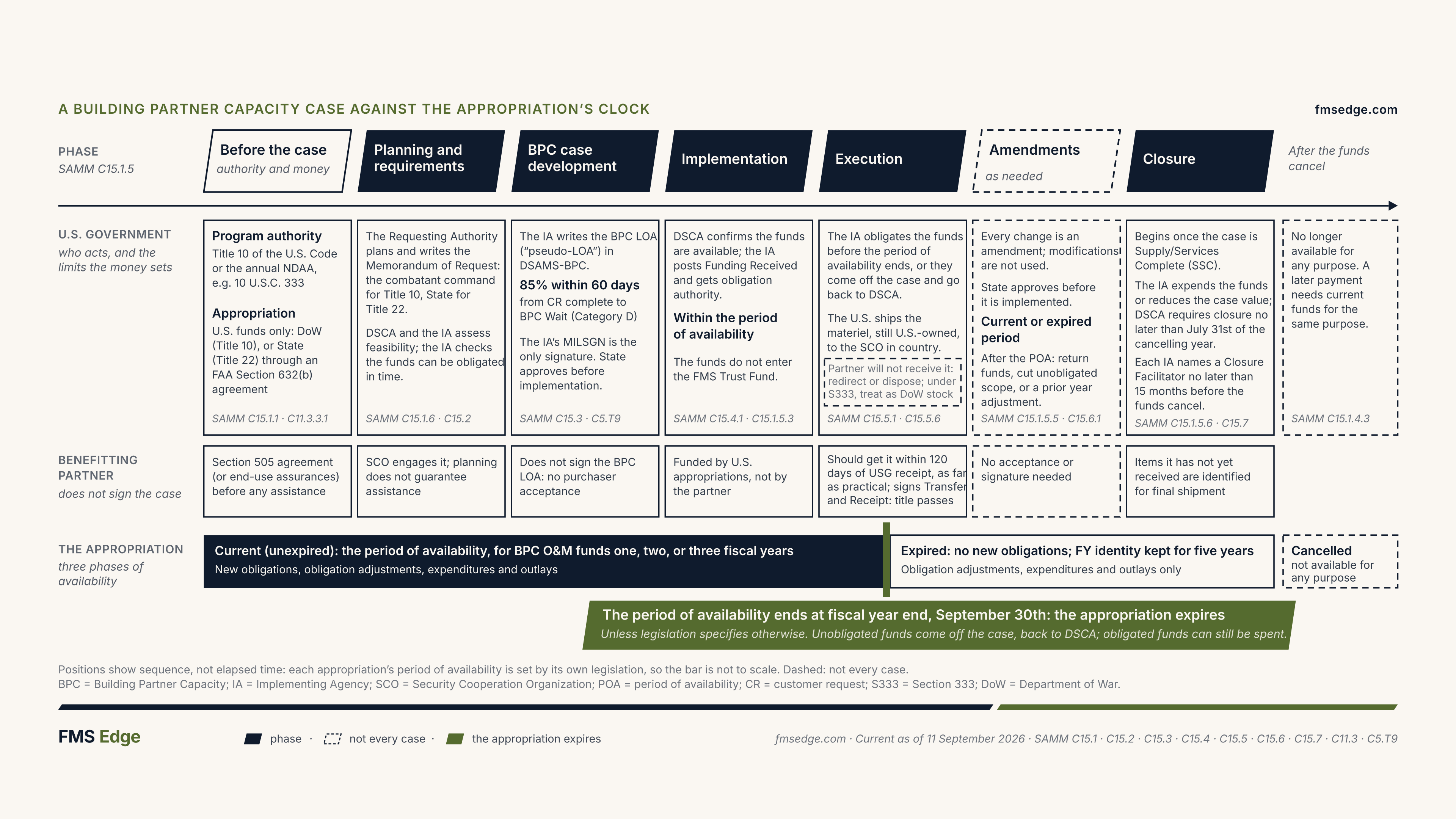
A Building Partner Capacity case runs in six phases, all inside the life of the U.S. appropriation that pays for it. New obligations can be made only while the appropriation is current, one, two, or three fiscal years for the Operations and Maintenance funds BPC authorities receive. DSCA requires closure no later than July 31st of the year the appropriation cancels.
What is a Building Partner Capacity case?
A is a U.S. that serves as the U.S. Government's legal instrument for transferring defense articles and defense services, training included, to a foreign country or an international organization. The case includes any later amendment to that . It rests on authorities in the annual National Defense Authorization Act or in Title 10 or Title 22 of the U.S. Code, and an Appropriation Act funds it. The Benefitting Partner does not sign a , because its commitments on end-use, security and retransfer are given in a signed Section 505 agreement. Implementing Agencies make every change to a case by amendment; modifications may not be used, because for documents funded with U.S. Government appropriations there is no meaningful difference between the two [SAMM ].
programs use U.S. appropriated funds, under Title 10 or Title 22 authorities, to transfer defense articles and services, and are managed through processes.
Typically, these additional authorities allow the Department of War (DoW) and to focus on building capacities of the international partner security forces and enhancing their capabilities to conduct/support:
- Counterterrorism operations
- Counter drug operations
- Counterinsurgency operations
- U.S. military and stability operations
- Multilateral peace operations
These types of activities funded with U.S. Government appropriations are called programs and are administratively managed using the infrastructure. Implementing Agencies () develop cases using established automated systems. The has dedicated Chapter 15 of the as the source for comprehensive policy for case and guidance.
A effort is executed in one of two ways, through a case or through a training grant. One program that uses both (also called cases) and training grants may require several cases and grants to be developed and implemented, with more than one executing them. The community follows the process in Chapter 15 to execute and manage programs that need a case, a training grant or both [SAMM ].
The has overall responsibility for each case and training grant, from development and timely obligation of funds through execution and closure [SAMM ].
After planning, the submits a pre-coordinated request or proposal to the and [SAMM ].
The request, called a , is similar to a traditional , and it will identify the required services, equipment, and the legal authority for the program. and the conduct a feasibility assessment to ensure such areas as requirements, definitions, transportation plans, technology/disclosure, special contracting issues, etc., are addressed and compliant with the program guidelines. The assessment will also verify that the requirements identified are actionable within the program budget constraints and obligation time lines.
Table C5.T9 counts the Category D case development standard, 85% within 60 days, from Receipt (from Customer Request Complete for Title 10 funded cases under the Long Term Solution) to Wait [SAMM ]. Section C15.3.3 starts that timeline for cases when the customer request is complete, which is when the approves it [SAMM ].
Chapter 15 of the also includes specific operating guidelines required when developing and executing the programs:
- Congressional notification may be required [SAMM ].
- Once implemented, the case and its supporting documents, except protected information, may be shared with the Benefitting Partner’s Ministry of Defense (MoD) representatives, as appropriate [SAMM ].
- The U.S. Government () is responsible for transporting the materiel to the Benefitting Partner [SAMM ]. The , another employee or a designee inventories the materiel, but only the or another employee may inventory classified items. The or another employee then transfers custody to the partner [SAMM ].
- Items are delivered when the materiel and title pass to a representative of the Benefitting Partner, and the documents the transfer on a document signed by that representative [SAMM ].
- A case is not signed by the Benefitting Partner, so its terms and notes do not create a legally binding commitment from that partner [SAMM ].
- assigns a unique two-digit alphanumeric or alpha-alpha program code to each ’s appropriation, and the code stays in use until its case designators run out [SAMM ].
- The program code becomes part of the [SAMM ].
- The case names its and the of the funds that finance it.
- One or more Benefitting Partners identified to receive the program materiel or services may be identified in the case, each on its own line [SAMM ].
- When a case has multiple Benefitting Partners, its information is not normally shared among the Benefitting Partners [SAMM ].
- program assistance is subject to the and DoW “Leahy” laws, Section 620M of the Foreign Assistance Act () and 10 U.S.C. 362, as applicable. They bar assistance to a foreign security force unit when the Secretary of or the Secretary of War has credible information that the unit committed a gross violation of human rights, subject to the statutes’ exceptions [, ].
The and the play a significant role in the case. They interface with the recipient international partner to translate the specific program objectives into detailed package requests. program requests should be linked to the international partner and theater planning documents. Since some cases have a short financial life cycle and are authorized only to counter immediate crisis situations, they generally do not contain sustainment support. Therefore, these sustainment support elements should be considered and funded through other such as or International Military Education and Training (). The and should include these sustainment elements in their planning documents.
References
SAMM
- SAMM C15.1.5.5: Building Partner Capacity Case and Training Grant Amendments.
- SAMM C15.2.1: General.
- SAMM C5.T9: Case Development Categories and Standards
- SAMM C15.3.3: Building Partner Capacity Case Development Timelines.
- SAMM C15.5.3.1: Sharing Building Partner Capacity Case Information with Benefitting Partners.
- SAMM C15.5.1: General.
- SAMM C15.5.1.3: Receipt and Transfer.
- SAMM C15.5.6.5: Title Transfer.
- SAMM C15.1.3: Department of War Building Partner Capacity Cases.
- SAMM C15.2.4: Building Partner Capacity Security Cooperation Customer Codes.
- SAMM C15.3.4: Initiating a Building Partner Capacity Case or Training Grant.
- SAMM C15.3.5.4: Benefitting Partners.
- SAMM C15.3.1: General.
- SAMM C15.1.1.1: Building Partner Capacity Program Execution Methods.
- SAMM C15.1.6.7: The Implementing Agency.
- SAMM C15.2.6.4: Feasibility Assessment.
- SAMM C15.2.10.1: Congressional Notification.
Public authorities
- FAA §620M: Foreign Assistance Act of 1961, as amended, §620M (22 U.S.C. §2378d), Limitation on assistance to security forces (the State Leahy law)
- 10 U.S.C. §362: 10 U.S.C. §362, Prohibition on use of funds for assistance to units of foreign security forces that have committed a gross violation of human rights (the DoW Leahy law)
- WarU Acquipedia AINT 012: Warfighting Acquisition University (WarU), Acquipedia AINT 012: International Acquisition - Building Partner Capacity (BPC)
Facts referenced
- Case development standard, share of documents expected to meet the standard: 85% (as of 26 October 2026; SAMM C5.T9)
- Case development standard, Category D (BPC; LOR Receipt or Customer Request Complete to BPC Wait): 60 days (as of 26 October 2026; SAMM C5.T9)
Related
Letter of Offer and Acceptance (LOA)
The legal instrument that lists the defense articles and services, including training, that the U.S. Government transfers to a foreign country or international organization, with their estimated costs and the terms and conditions. The benefitting partner does not sign a Building Partner Capacity (BPC) LOA.
The Letter of Offer and Acceptance (LOA) is the instrument the U.S. Government uses to sell under the Arms Export Control Act (AECA); signed LOAs and their later Amendments and Modifications are also called Foreign Military Sales (FMS) cases [SAMM C5.6.1].
FMS Edge glossary, as of 10 October 2026
Glossary entry →Open the manual’s entry → (opens in new tab)
Foreign Military Sales (FMS)
The part of U.S. security assistance, authorized by the Arms Export Control Act (AECA), in which eligible foreign governments and international organizations buy defense articles, services and training from the U.S. Government under formal government-to-government agreements.
The articles come either from Department of War stocks or from new procurement under contracts the Department manages [22 U.S.C. 2761, 22 U.S.C. 2762]. A sale is FMS whatever the source of the purchaser's financing.
FMS Edge glossary, as of 10 October 2026
Glossary entry →Open the manual’s entry → (opens in new tab)
Building Partner Capacity (BPC) Case
A U.S. Letter of Offer and Acceptance (LOA), and any subsequent Amendment, that is the legal instrument used by the USG to transfer defense articles and defense services (including training) to a foreign country or international organization under authorities provided in either Title 10 or Title 22 of the U.S. Code or in annual National Defense Authorization legislation and funded by an Appropriation Act. Modifications can only be executed on BPC cases for which DoD is not using the Semi-Permanent Security Cooperation Customer Codes. BPC LOAs are not signed by the Benefitting Partner, as the Benefitting Partner's commitment on end-use, security, and re-transfer assurances is provided through a signed Section 505 agreement. See also "BPC Programs" and "LOA."
SAMM Glossary, as of 12 September 2026
Glossary entry →Open the manual’s entry → (opens in new tab)
LOA: Letter of Offer and Acceptance
SAMM Acronyms, as of 12 September 2026
Implementing Agency (IA)
The military department or defense agency responsible for the execution of military assistance programs. With respect to FMS, the military department or defense agency assigned responsibility by the Defense Security Cooperation Agency to prepare an LOA and to implement an FMS case. The implementing agency is responsible for the overall management of the actions that will result in delivery of the materials or services set forth in the LOA that was accepted by a foreign country or international organization.
SAMM Glossary, as of 12 September 2026
Glossary entry →Open the manual’s entry → (opens in new tab)
Security Assistance (SA)
A group of programs authorized by federal statutes by which the United States provides defense articles, military training, and other defense-related services by grant, lease, loan, credit, or cash sales in furtherance of national policies and objectives, and those that are funded and authorized through the Department of State to be administered by Department of Defense/Defense Security Cooperation Agency, which are considered part of security cooperation.
SAMM Glossary, as of 12 September 2026
Glossary entry →Open the manual’s entry → (opens in new tab)
Defense Security Cooperation Agency (DSCA)
The Department of War agency that directs, administers and provides guidance to the Department's components and its representatives at U.S. missions for the execution of the security cooperation programs for which it is responsible [SAMM C1.3.2.2]. The agency also provides financial and technical assistance, arranges the transfer of defense materiel, training and services to international partners, and promotes military-to-military contacts.
FMS Edge glossary, as of 10 October 2026
Glossary entry →Open the manual’s entry → (opens in new tab)
Security Assistance Management Manual (SAMM)
DSCA Manual 5105.38-M required under DoD Directive 5105.65, "Defense Security Cooperation Agency" mandatory for use by all DoD Components. The SAMM provides DoD-wide guidance to the Office of the Secretary of Defense (OSD), the Military Departments (MILDEPs), the Office of the Chairman of the Joint Chiefs of Staff and the Joint Staff, the Combatant Commands, the Defense Agencies, the DoD Field Activities, the Security Cooperation Organizations (SCOs), and all other organizational entities within the DoD engaged in the management or implementation of DoD Security Assistance and Security Cooperation programs over which DSCA has responsibility.
SAMM Glossary, as of 12 September 2026
Glossary entry →Open the manual’s entry → (opens in new tab)
Security Cooperation
Activities by which the Department of War encourages and enables international partners to cooperate with the United States toward strategic objectives, spanning every interaction with foreign defense and security establishments and every security assistance program the Department administers.
Under chapter 16 of Title 10, their purposes are to develop allied and friendly security capabilities for self-defense and multinational operations, to give U.S. forces peacetime and contingency access, and to build relationships promoting specific U.S. security interests [10 U.S.C. 301(7)].
FMS Edge glossary, as of 10 October 2026
Glossary entry →Open the manual’s entry → (opens in new tab)
SAMM: Security Assistance Management Manual
SAMM Acronyms, as of 12 September 2026
Glossary entry →Security Assistance Management Manual (SAMM) →
DSCA: Defense Security Cooperation Agency
SAMM Acronyms, as of 12 September 2026
Glossary entry →Defense Security Cooperation Agency (DSCA) →
Memorandum of Request (MOR)
A document prepared and submitted by the Requesting Authority which identifies requirements and initiates the case development process under a Building Partner Capacity program.
SAMM Glossary, as of 12 September 2026
Glossary entry →Open the manual’s entry → (opens in new tab)
FMS: Foreign Military Sale
SAMM Acronyms, as of 12 September 2026
Letter of Request (LOR)
The term used to identify a request from an eligible FMS participant country for the purchase of U.S. defense articles and services. The request may be in message or letter format.
SAMM Glossary, as of 12 September 2026
Glossary entry →Open the manual’s entry → (opens in new tab)
LOR: Letter of Request
SAMM Acronyms, as of 12 September 2026
Security Cooperation Organization (SCO)
A Department of Defense element that is part of the United States Diplomatic mission located in a foreign country to carry out security assistance and security cooperation management functions under the supervision and coordination authority of the senior defense official/defense attaché.
SAMM Glossary, as of 12 September 2026
Glossary entry →Open the manual’s entry → (opens in new tab)
SCO: Security Cooperation Organization
SAMM Acronyms, as of 12 September 2026
Transfer and Receipt
A document which transfers title and custody of Building Partner Capacity defense articles and services from the USG representative in-country to the Benefitting Country. The document is dated and co-signed by both parties.
SAMM Glossary, as of 12 September 2026
Glossary entry →Open the manual’s entry → (opens in new tab)
Case Identifier
A unique six-digit identifier assigned to an Foreign Military Sales case for the purpose of identification, accounting, and data processing of each Letter of Offer and Acceptance. The case identifier consists of the two-letter country code, a one-letter designator for the Implementing Agency, and a three-letter case designator.
SAMM Glossary, as of 12 September 2026
Glossary entry →Open the manual’s entry → (opens in new tab)
Period of Availability
The period of time established by Congress in which budget authority is available to incur new obligations.
SAMM Glossary, as of 12 September 2026
Glossary entry →Open the manual’s entry → (opens in new tab)
Security Cooperation Information Portal (SCIP)
A web-based tool, managed by the Defense Security Cooperation Agency (DSCA), that gives international purchasers, their agents such as freight forwarders, and authorized U.S. Government personnel information on Foreign Military Sales (FMS) cases and other security cooperation programs.
It covers case, line, requisition and supply data, supply transactions and end-use monitoring information, drawn from the Defense Security Assistance Management System (DSAMS) and the Military Departments' case execution systems.
FMS Edge glossary, as of 10 October 2026
Glossary entry →Open the manual’s entry → (opens in new tab)
Combatant Command (CCMD)
A unified or specified command with a broad continuing mission under a single commander established and so designated by the President, through the Secretary of Defense and with the advice and assistance of the Chairman of the Joint Chiefs of Staff. Also called CCMD.
SAMM Glossary, as of 12 September 2026
Glossary entry →Open the manual’s entry → (opens in new tab)
Security Cooperation Programs
Any program, activity (including an exercise), or interaction of the Department of Defense with the security establishment of a partner or international organization to achieve a purpose as follows:
To build and develop allied and friendly security capabilities for self-defense and multinational operations.
To provide the armed forces with access to the partner or international organization during peacetime or a contingency operation.
To build relationships that promote specific United States security interests.
SAMM Glossary, as of 12 September 2026
Glossary entry →Open the manual’s entry → (opens in new tab)
IMET: International Military Education and Training
SAMM Acronyms, as of 12 September 2026
SAMM C15.1.5.5: Building Partner Capacity Case and Training Grant Amendments.
“IAs make all administrative updates and scope changes to the BPC case or training grant via amendment. BPC documents do not require Benefitting Partner acceptance or signature, therefore these changes will be accomplished via a BPC case or training grant amendment. Modifications may not be used for BPC documents as there is no meaningful difference between a modification and amendment …”
Security Assistance Management Manual, as of 11 September 2026
SAMM C15.1.1.1: Building Partner Capacity Program Execution Methods.
“There are two different methods to execute a BPC effort: a BPC case and a BPC training grant. A single BPC program that uses BPC Letters of Offer and Acceptance (LOAs) (also known as BPC cases) and training grants may require the development and implementation of multiple BPC cases and training grants executed by multiple Implementing Agencies (IAs). The SC …”
Security Assistance Management Manual, as of 11 September 2026
SAMM C15.1.6.7: The Implementing Agency.
“The IA has overall responsibility for BPC case and training grant development, timely funds obligation, execution, and closure. IAs must communicate frequently with stakeholders such as the DSCA CPD, the DSCA RPD, the DSCA CFD, the RA, the Procuring Office, the United States Transportation Command (USTRANSCOM), and the MILGP to facilitate information sharing of program plans, status, and changes. The …”
Security Assistance Management Manual, as of 5 October 2026
SAMM C15.2.1: General.
“The Requesting Authority (RA) is responsible for planning and requirements definition of Building Partner Capacity (BPC) efforts to support specific USG objectives. The Implementing Agency (IA) may conduct a feasibility assessment to determine the most appropriate solution. See Section C15.2.6.4. "Feasibility Assessment" for verification requirements to determine if a memorandum of request (MOR), Training and Equipment List (TEL), etc. is …”
Security Assistance Management Manual, as of 11 September 2026
SAMM C5.T9: Case Development Categories and Standards
“Table C5.T9. Case Development Categories and Standards Category Description Standard Clock Start Clock Stop A Blanket order LOAs (including blanket order training); Cooperative Logistics Supply Support Arrangements (CLSSAs), and associated Amendments and Modifications. Note: Modifications for cases that were originally prepared as Category C documents will be prepared using Category A or B standards. 85% within 30 days Letter of …”
Security Assistance Management Manual, as of 26 October 2026
SAMM C15.3.3: Building Partner Capacity Case Development Timelines.
“BPC cases must be developed in DSAMS-BPC in accordance with Case Development Category D standards as described in Table C5.T9., 85 percent of the time. The Group D 60-day timeline for BPC cases begins when the customer request (CR) is complete (CR complete is when the IA approves the CR in DSAMS-BPC) and ends when the "BPC Wait" milestone is …”
Security Assistance Management Manual, as of 11 September 2026
SAMM C15.2.10.1: Congressional Notification.
“BPC program execution may be subject to a CN requirement before funds are made available for case implementation based upon the requirements in the specific authorizing legislation. See the program-specific guidance in Appendix 8 for additional details on roles, format, and time requirements for notifications to Congress.”
Security Assistance Management Manual, as of 11 September 2026
SAMM C15.5.3.1: Sharing Building Partner Capacity Case Information with Benefitting Partners.
“The MILGP may share the BPC case or training grant information and supporting documents, with the exception of protected information (such as proprietary vendor information), with Benefitting Partner Ministry of Defense (MoD) representatives, as appropriate (BPC cases and training grant information with multiple Benefitting Partners will not normally be shared among the Benefitting Partners). MILGPs should clearly communicate to Benefitting …”
Security Assistance Management Manual, as of 5 October 2026
SAMM C15.5.1: General.
“Once DSCA (Office of Business Operations (OBO)) provides Title 10 funded Building Partner Capacity (BPC) funds via Funding Authorization Document (FAD) to the Implementing Agencies (IAs) to implement the BPC Letter of Offer and Acceptance (LOA) (also known as a BPC case) or training grant, the IA is then responsible for obligating the funds and executing the BPC case or …”
Security Assistance Management Manual, as of 5 October 2026
SAMM C15.5.1.3: Receipt and Transfer.
“The MILGP, another USG employee, or designee receives and initially inventories the materiel (MILGPs or other USG employees must inventory classified items, and designees may inventory unclassified items). MILGPs or other USG employees then transfer custody and responsibility of the materiel and services to the Benefitting Partner, documents the transfer of equipment to the Benefitting Partner, provides copies to DSCA …”
Security Assistance Management Manual, as of 5 October 2026
SAMM C15.5.6.5: Title Transfer.
“Items are considered delivered when the materiel and title is transferred to a representative of the Benefitting Partner. The MILGP will conduct a joint inventory, prepare the Transfer and Receipt document, have the document signed by the Benefitting Partner representative, and provide a copy to the IA along with the signed document and attachments. The MILGP is encouraged to hold …”
Security Assistance Management Manual, as of 5 October 2026
SAMM C15.1.3: Department of War Building Partner Capacity Cases.
“The DoW utilizes BPC cases to provide defense articles, services, and training to partners, and to facilitate the DoW’s ability to meet other statutory requirements such as reporting, AM&E, and audit readiness. Unlike Foreign Military Sales (FMS) cases which are funded with partner national funds or Foreign Military Financing (FMF) funds and signed by the partner, BPC cases are only …”
Security Assistance Management Manual, as of 5 October 2026
SAMM C15.2.4: Building Partner Capacity Security Cooperation Customer Codes.
“BPC program implementation and appropriated funds execution must comply with authorizing legislation. Due to the shortage of Security Cooperation Customer Codes (SCCCs), DSCA determined that codes need to be used for more than one yearly consolidated or supplemental budget appropriation under a specific program authority (10 U.S.C. 333, Ukraine Security Assistance Initiative (USAI), etc.). Therefore, DSCA assigns a unique two-digit …”
Security Assistance Management Manual, as of 5 October 2026
SAMM C15.3.4: Initiating a Building Partner Capacity Case or Training Grant.
“The IA initializes the BPC case or training grant in DSAMS-BPC using a unique case identifier (ID) and provides the case ID to the DSCA Country Portfolio Director (CPD) or Regional Portfolio Director (RPD). The case ID is a 6-position alpha-numeric or alpha-alpha string which includes the BPC Security Cooperation Customer Code (SCCC)/program code, the single-position IA code of the …”
Security Assistance Management Manual, as of 5 October 2026
SAMM C15.3.5.4: Benefitting Partners.
“Multiple Benefitting Partners can be included on the same BPC case but may not be included on the same line. A single Benefitting Partner must be listed on a defense article or service line to enable tracking, monitoring, and evaluation of the provided assistance.”
Security Assistance Management Manual, as of 5 October 2026
Foreign Assistance Act of 1961, as amended, §620M (22 U.S.C. §2378d), Limitation on assistance to security forces (the State Leahy law)
FAA §620M · Statute
10 U.S.C. §362, Prohibition on use of funds for assistance to units of foreign security forces that have committed a gross violation of human rights (the DoW Leahy law)
10 U.S.C. §362 · Statute