
Guide
What is Obligational Authority in Foreign Military Sales?
is the financial authority that lets the incur obligations on a case, such as contracts, requisitions and training, up to the value of the case. It is not money. Once the partner has accepted the and the Defense Finance and Accounting Service has received the and posted financial implementation, the processes OA and the case can be implemented.
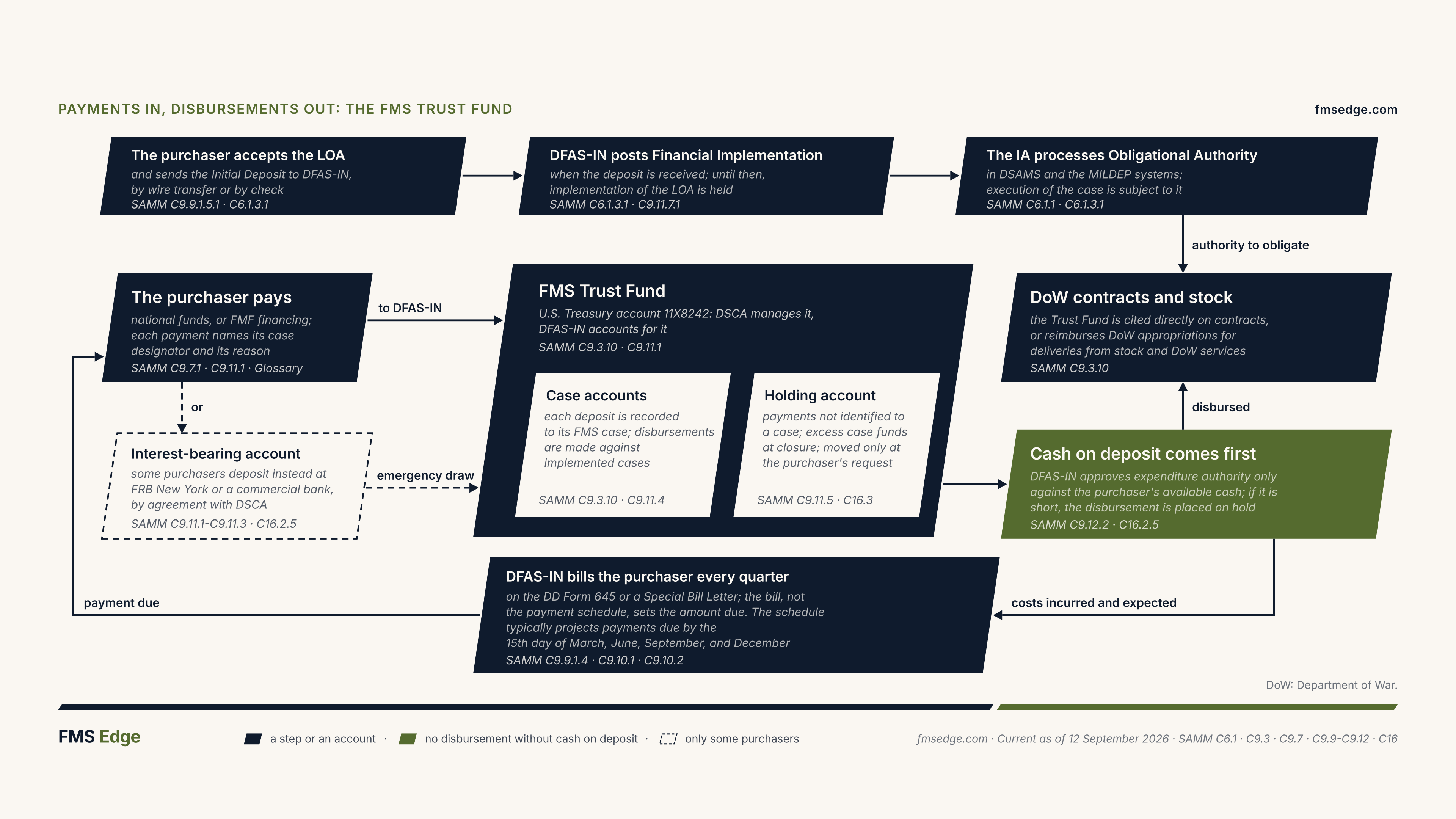
The purchaser's payments go to DFAS-IN for deposit in the FMS Trust Fund, U.S. Treasury account 11X8242, each recorded to its case. The Trust Fund pays contractors and reimburses the Department of War only against cash on deposit, and DFAS-IN bills every quarter for what the cases will need next.
What is Obligational Authority in Foreign Military Sales?
is a financial authority, which allows legally binding financial obligations to be incurred in an amount not to exceed the value of the material and service requirements on a case. Once the international partner has accepted a and provided funds to the Defense Finance and Accounting Service - Indianapolis (), and the has received OA, the case can be implemented. Obligations can then be recorded. The term “obligation” means the amount of orders placed, contracts awarded, services received, and similar transactions in an accounting period that call for payment in that period or a later one.
After the purchaser signs and accepts the or Amendment, the posts the "Acceptance" milestone in the Defense Management System (). If does not receive the , it notifies the Country Finance Director () at the . On the 's approval, tells the , the purchaser's paying office and the that the deposit has not been received [SAMM ].
The then asks the purchaser when it expects to send the deposit, and keeps asking until the deposit arrives. Once it does, the Defense Finance and Accounting Service () will post the Financial Implementation milestone in . With financial implementation in place, the processes the OA in and in the systems [SAMM ].
OA follows case acceptance and receipt of the , because the processes OA once has posted the Financial Implementation milestone [SAMM ]. Case implementation is subject to receipt of the OA the issues [SAMM ]. With OA in place, the can begin to incur obligations against the case. OA is not money, but it provides financial authority allowing the case manager to implement the case.
The acts to implement a case once the purchaser has signed it and given the U.S. Government any required . Before the case is executed, it must be implemented in every applicable data system, such as the systems, the Case Performance Reporting Solution (CPRS), and the [SAMM ]. The should give detailed implementing instructions to the activities involved in executing the case. Those instructions must state that implementation depends on the 's issue of OA [SAMM ].
The OA allows the to prepare and process funding documents on behalf of the international partner.
Once the program data is available and has been established, the may then start to process requisitions [SAMM ].
OA is not granted for Non-Specific Requirements lines, and orders cannot be placed against them. When the purchaser identifies its requirements, the dollar values in a must be moved to lines for specific defense articles or services, with the matching and other adjustments as needed [SAMM ]. An Amendment reallocates the line's funds, unless the purchaser's asks that the funds be usable for price increases on other lines through the Modification process. Such a request must be recorded in the note [SAMM ].
Costs charged to a line of an case must stay within the funds available on that line [SAMM ]. Program management includes analysis and tracking so that funding stays adequate and the program is not disrupted. A Modification should be processed if tracking shows that the line's costs are moving so far from the estimates that later movements are unlikely to bring overall costs back into balance. A Modification should also be processed if OA above the line value will be needed at some point in the program [SAMM ].
A Modification should be provided as well for relatively minor cost adjustments, once all items are on order and prices are reasonably firm. The must provide a price increase Modification before the actual reported to the purchaser exceed the estimates on the case, unless the case is in the closure process [SAMM ].
A Financially Troubled Case (FTC) results when commitments, obligations or expenditures, alone or together, exceed the OA issued. The is responsible for resolving the conditions that cause an FTC as soon as the condition is identified. Section AP7.C2.9.1 of the Reconciliation and Closure Guide gives more guidance on resolving FTCs [SAMM ].
References
SAMM
- SAMM C6.4.3: Requisitions.
- SAMM C6.1.3.1
- SAMM C6.1.1: Routine Case Implementation.
- SAMM C5.6.5.4.16.2: Execution of Non-Specific Requirements Lines.
- SAMM C6.7.3.1.2: Monitoring Funds.
- SAMM C16.2.8: Financially Troubled Case.
Related
Implementing Agency (IA)
The military department or defense agency responsible for the execution of military assistance programs. With respect to FMS, the military department or defense agency assigned responsibility by the Defense Security Cooperation Agency to prepare an LOA and to implement an FMS case. The implementing agency is responsible for the overall management of the actions that will result in delivery of the materials or services set forth in the LOA that was accepted by a foreign country or international organization.
SAMM Glossary, as of 12 September 2026
Glossary entry →Open the manual’s entry → (opens in new tab)
Foreign Military Sales (FMS)
The part of U.S. security assistance, authorized by the Arms Export Control Act (AECA), in which eligible foreign governments and international organizations buy defense articles, services and training from the U.S. Government under formal government-to-government agreements.
The articles come either from Department of War stocks or from new procurement under contracts the Department manages [22 U.S.C. 2761, 22 U.S.C. 2762]. A sale is FMS whatever the source of the purchaser's financing.
FMS Edge glossary, as of 10 October 2026
Glossary entry →Open the manual’s entry → (opens in new tab)
Letter of Offer and Acceptance (LOA)
The legal instrument that lists the defense articles and services, including training, that the U.S. Government transfers to a foreign country or international organization, with their estimated costs and the terms and conditions. The benefitting partner does not sign a Building Partner Capacity (BPC) LOA.
The Letter of Offer and Acceptance (LOA) is the instrument the U.S. Government uses to sell under the Arms Export Control Act (AECA); signed LOAs and their later Amendments and Modifications are also called Foreign Military Sales (FMS) cases [SAMM C5.6.1].
FMS Edge glossary, as of 10 October 2026
Glossary entry →Open the manual’s entry → (opens in new tab)
Initial Deposit
The payment a Foreign Military Sales (FMS) purchaser sends when it accepts a Letter of Offer and Acceptance (LOA), as full or partial payment for the articles, services or training it has agreed to buy.
Each LOA includes an initial deposit that covers the nonrecurring cost payment and the outlays or deliveries expected before the purchaser's first quarterly payment arrives [SAMM C9.9.1.5.1].
FMS Edge glossary, as of 10 October 2026
Glossary entry →Open the manual’s entry → (opens in new tab)
DFAS-IN: Defense Finance and Accounting Service - Indianapolis
SAMM Acronyms, as of 12 September 2026
LOA: Letter of Offer and Acceptance
SAMM Acronyms, as of 12 September 2026
Security Assistance (SA)
A group of programs authorized by federal statutes by which the United States provides defense articles, military training, and other defense-related services by grant, lease, loan, credit, or cash sales in furtherance of national policies and objectives, and those that are funded and authorized through the Department of State to be administered by Department of Defense/Defense Security Cooperation Agency, which are considered part of security cooperation.
SAMM Glossary, as of 12 September 2026
Glossary entry →Open the manual’s entry → (opens in new tab)
DSAMS: Defense Security Assistance Management System
SAMM Acronyms, as of 12 September 2026
Glossary entry →Defense Security Assistance Management Systems (DSAMS) →
Defense Security Cooperation Agency (DSCA)
The Department of War agency that directs, administers and provides guidance to the Department's components and its representatives at U.S. missions for the execution of the security cooperation programs for which it is responsible [SAMM C1.3.2.2]. The agency also provides financial and technical assistance, arranges the transfer of defense materiel, training and services to international partners, and promotes military-to-military contacts.
FMS Edge glossary, as of 10 October 2026
Glossary entry →Open the manual’s entry → (opens in new tab)
Security Cooperation Organization (SCO)
A Department of Defense element that is part of the United States Diplomatic mission located in a foreign country to carry out security assistance and security cooperation management functions under the supervision and coordination authority of the senior defense official/defense attaché.
SAMM Glossary, as of 12 September 2026
Glossary entry →Open the manual’s entry → (opens in new tab)
Military Department (MILDEP)
One of the departments within the DoD created by the National Security Act of 1947, as amended. The Military Departments are: the Department of the Air Force, the Department of the Army, and the Department of the Navy.
SAMM Glossary, as of 12 September 2026
Glossary entry →Open the manual’s entry → (opens in new tab)
Defense Integrated Financial System (DIFS)
A financial system providing DoD-level financial management functions for the security assistance (SA) program. This includes centralized Foreign Military Sales (FMS) trust fund accounting, foreign customer billing, and financial management reporting. DIFS consolidates FMS data from the Army, Navy, Air Force, and other implementing agencies, and provides efficient accountability for oversight of the financial and program management aspects of SA.
SAMM Glossary, as of 12 September 2026
Glossary entry →Open the manual’s entry → (opens in new tab)
International Logistics Control Office (ILCO)
The office in each Military Department that manages the logistics support programs and transactions of Foreign Military Sales (FMS) and other security cooperation programs, and the central point in the continental United States for monitoring purchasers' requisitions.
A purchaser reports a valid supply discrepancy to the International Logistics Control Office (ILCO) of the Military Department concerned [SAMM C2.1.5.4.3].
FMS Edge glossary, as of 10 October 2026
Glossary entry →Open the manual’s entry → (opens in new tab)
Non-Specific Requirements Line
Undefined requirements lines with MASL “R9B 079200N0NSPRQ, Non-Specific Requirements” that can be included on Foreign Military Sales cases when requested by or coordinated with the purchaser as a holding place for funds budgeted but not yet programmed. Non-Specific Requirements lines cannot be used to requisition items or to provide services, are written with Source Code “S” (stock), and only utilize national funds. Non-Specific Requirements lines are written without a defined period of performance.
SAMM Glossary, as of 12 September 2026
Glossary entry →Open the manual’s entry → (opens in new tab)
Payment Schedule
List of dollar amounts and when they are due from the foreign customer. The payment schedule is included in the Letter of Offer and Acceptance (LOA) presented to the customer. After acceptance of the LOA, the payment schedule generally serves as the basis for billing to the customer. Changes in the estimated costs of an Foreign Military Sales case may require changes in the accompanying payment schedule.
SAMM Glossary, as of 12 September 2026
Glossary entry →Open the manual’s entry → (opens in new tab)
Letter of Request (LOR)
The term used to identify a request from an eligible FMS participant country for the purchase of U.S. defense articles and services. The request may be in message or letter format.
SAMM Glossary, as of 12 September 2026
Glossary entry →Open the manual’s entry → (opens in new tab)
FMS: Foreign Military Sale
SAMM Acronyms, as of 12 September 2026
Accrued Costs
The financial value of delivered articles and services and incurred costs reported to DFAS-IN via Delivery Transactions. Incurred costs represent disbursements for which no physical deliveries have yet occurred. Examples are: progress payments to contractors, GFM/GFE provided to contractors, and nonrecurring costs.
SAMM Glossary, as of 12 September 2026
Glossary entry →Open the manual’s entry → (opens in new tab)
SAMM C6.1.3.1
“The FMS purchaser signs and accepts the LOA or Amendment, and the IA posts the “Acceptance” milestone in DSAMS. If the initial deposit is not received by DFAS-IN, they will notify the DSCA CFD. Upon approval from the DSCA CFD, DFAS-IN notifies the U.S. Military Group (MILGP), the FMS purchaser's paying office, and the IA that the initial deposit has …”
Security Assistance Management Manual, as of 26 October 2026
SAMM C6.1.1: Routine Case Implementation.
“Case implementation begins when the purchaser accepts the LOA and satisfies applicable initial deposit requirements and continues through completion of required case implementation actions in DSAMS and other applicable systems. Case implementation ends when the case is financially implemented in DSAMS, as reflected by the applicable implementation milestone, unless otherwise authorized under emergency implementation procedures. For management and tracking purposes, …”
Security Assistance Management Manual, as of 26 October 2026
SAMM C6.4.3: Requisitions.
“The Implementing Agency (IA) or the purchaser may initiate Military Standard Requisitioning and Issue Procedures (MILSTRIP) requisitions under implemented LOAs. Table C6.T2. identifies service points of contact for requisition entry. Table C6.T2. Points of Contact for Requisition Entry MILDEP Address Army U.S. Army Security Assistance Command 54 M Avenue, Suite 1 New Cumberland, PA 17070-5096 For Infrastructure and Engineering LOAs: …”
Security Assistance Management Manual, as of 26 October 2026
SAMM C5.6.5.4.16.2: Execution of Non-Specific Requirements Lines.
“Obligation authority is not granted for Non-Specific Requirements lines. Orders cannot be placed against Non-Specific Requirements lines. When requirements are identified by the FMS purchaser, the applicable dollar values included in the Non-Specific Requirements line must be moved to other specific defense articles or services lines, with commensurate payment schedule and other LOA adjustments, as needed. LOA Amendments are used …”
Security Assistance Management Manual, as of 11 September 2026
SAMM C6.7.3.1.2: Monitoring Funds.
“Costs charged under an FMS case line must not exceed the funds available on that line. Program management responsibility includes analysis and tracking to ensure funding is adequate to avoid program disruption. If tracking shows that costs incurred on the line are deviating from those estimated to the degree that later deviations are unlikely to bring overall costs into balance, …”
Security Assistance Management Manual, as of 11 September 2026
SAMM C16.2.8: Financially Troubled Case.
“Financially Troubled Cases (FTCs) result when commitments, obligations and/or expenditures exceed OA issued. The IA has the responsibility to resolve conditions resulting in an FTC as soon as the condition is identified. Additional guidance in resolving FTCs are contained in the RCG Section AP7.C2.9.1.”
Security Assistance Management Manual, as of 11 September 2026