
Guide
How is a Building Partner Capacity program requested?
A , normally a geographic for Title 10 programs and the Department of State for Title 22 programs, plans the program. It sends its requirements to the and the in a or a similar planning document. and the assess the request, and the builds the case once the request is complete.
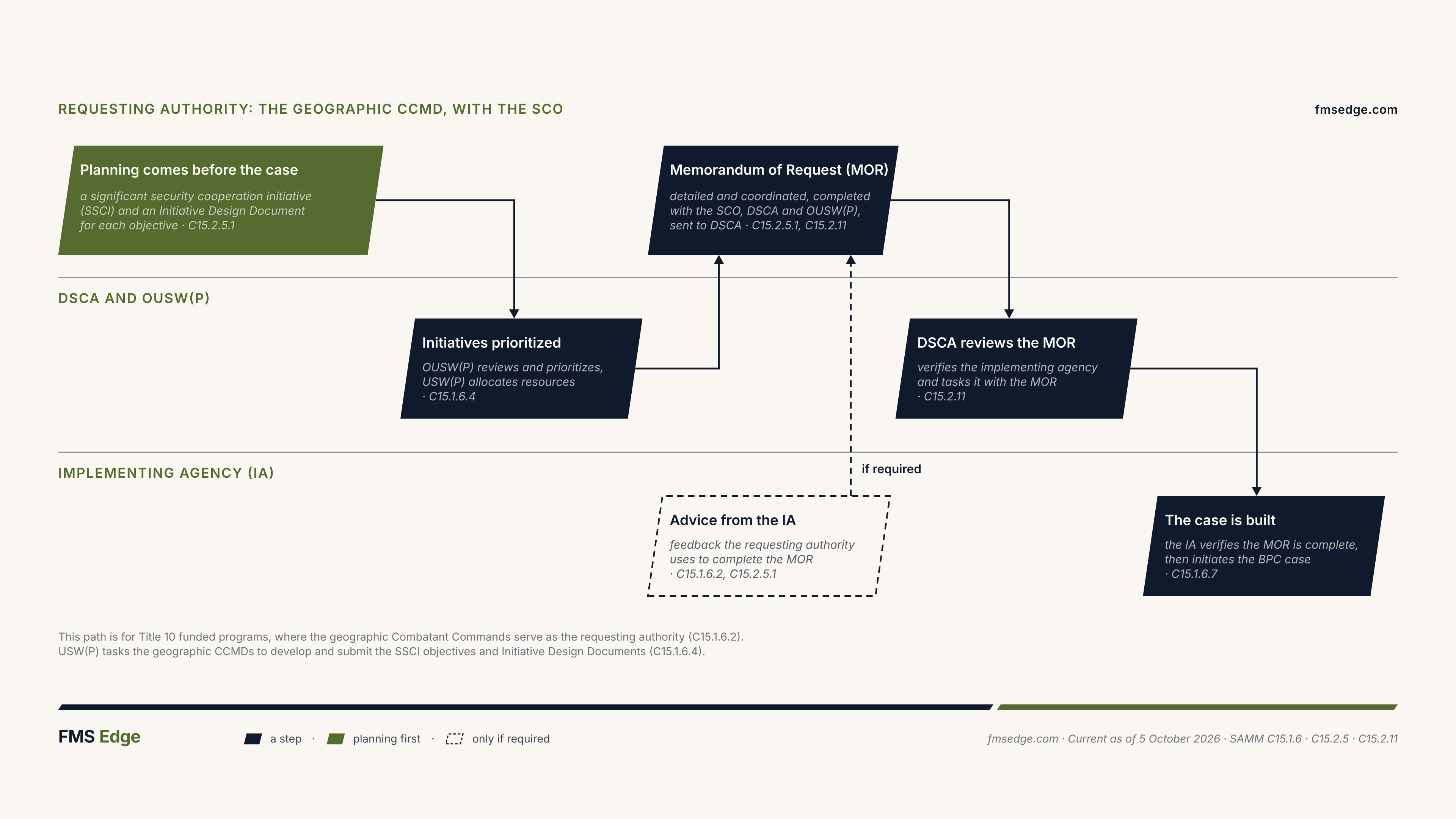
A Title 10 funded Building Partner Capacity case starts with planning, and the request comes later. The Combatant Command plans the initiative, the Office of the Under Secretary of War for Policy (OUSW(P)) prioritizes it, and a Memorandum of Request then goes to the Defense Security Cooperation Agency (DSCA).
Who asks for a Building Partner Capacity program?
A (RA) asks for a Building Partner Capacity () program and is responsible for planning it and defining its requirements [SAMM ]. The RA also monitors the execution of the regional or partner capacity building activities it plans. The geographic combatant commands serve as RAs for Title 10 authorities [SAMM ]. The Department of State is the RA for Title 22 funded programs [SAMM ].
The at the U.S. Embassy supports the RA through each phase, from planning to the transfer of materiel or the provision of services [SAMM ].
Each geographic is responsible for multi-year planning of activities and strategies for the regions and partners within its area of responsibility, documented in the annex and the country-specific appendices of the Campaign Plan [SAMM ].
What does a request contain?
A request contains the RA's detailed requirements, sent to the and the in a pre-planning document such as a or a Training and Equipment List (). The RA completes that document using the 's feedback, and must make sure the has the information it needs to develop the case or training grant. If a requested article cannot be procured in time for expiring funds to be obligated, the RA must approve any substitution or program adjustment proposed because of cost overages [SAMM ].
For a Title 10 funded program, requirements are generated through the Significant Initiative () planning process [SAMM ]. The Office of the Under Secretary of War for Policy, known as OUSW(P), reviews and prioritizes the activities in each through the Policy Executive Council, and recommends to the Under Secretary courses of action for allocating resources [SAMM ]. An is a set of () activities, planned over several years, that serves one specific objective. It is made up of Initiative Design Documents (), and it requires Performance Monitoring Plans (). A sets out the objective statements, monitoring indicators and baseline data for the 's objectives, for its long-term and short-term outcomes, and for its outputs and activities. Each includes an Objective Tree, a logic model linking activities to objectives at three levels: the , the National Defense Strategy () and the Theater Campaign Plan (TCP) [SAMM ].
For each objective, the RA must generate an setting out the programs, projects and activities for a three-to-five-year period. The must be detailed enough that the have the information they need to source appropriate defense articles and services to achieve the objective. This planning phase ends when the RA submits a detailed, coordinated , or similar document that the can execute within the funding and timeline limits. The RA should complete the request package with support from the U.S. Military Group (), the geographic , , OUSW(P) and other stakeholders, and with the 's technical advice if required [SAMM ].
The and objective tree logic framework are linked to the Department of State’s Integrated Country Strategy (ICS) and Country-Specific Section (CSCS) of the Campaign Plan () and are designed to help determine if the request is a priority and executable.
The and objective tree logic framework help to document the initial assessment, international partner baseline, desired outcome, logic framework, theory of change, indicators and milestones, activities and resources required, monitoring plan, risks and guidance to stakeholders.
The theory of change is intended to make implicit assumptions more explicit, describe why certain actions will produce a desired change and clearly states what the intended outcome of the initiative will be and how it will be achieved. The objective tree logic framework maps goals and “SMART” (Specific, Measurable, Achievable, Relevant, Time-bound) objectives to activities necessary to achieve desired changes and visually describes activities and the planned process to achieve goals and objectives.
Once the initiative has been reviewed and prioritized, the develops the .
Before the request is final, and the will conduct a feasibility assessment. It verifies that the requirements are actionable and that the materiel and training can be provided within the restrictions of the authorizing legislation. The RA must confirm any substitute that the proposes and revise the request to match [SAMM ].
The must not share internal U.S. Government () correspondence, information about internal discussions of requirements, or pre-decisional information with Benefitting Partner representatives [SAMM ].
How does a request become a case?
A request becomes a case when the verifies that the is complete and initiates the case or training grant in the Defense Management System () [SAMM ]. This step begins when the RA submits an actionable request to as soon as possible, so that the program stays on its development timeline [SAMM ]. reviews the request, verifies the identified while it was developed, and tasks that with developing the case or training grant [SAMM ].
The Department of State, Bureau of Political-Military Affairs reviews every case and training grant to ensure that it aligns with foreign policy objectives, and approves each one [SAMM ].
The has overall responsibility for developing the case or training grant, obligating its funds on time, executing it and closing it. must communicate often with stakeholders so that program plans, status and changes are shared. Those stakeholders include the RA, the , the Procuring Office, the United States Transportation Command (USTRANSCOM) and the Country Portfolio Director (), Country Finance Director () and Regional Portfolio Director (RPD). The works closely with the RA during planning. It must know the nature and limits of the appropriated funds it uses, so that its activities meet their obligation, expiration and cancellation timelines [SAMM ].
References
SAMM
- SAMM C15.2.1: General.
- SAMM C15.1.6.6: Geographic Combatant Commands.
- SAMM C15.1.6.6.1: United States Military Group.
- SAMM C15.1.6.4: Under Secretary of War for Policy.
- SAMM C15.2.6.4: Feasibility Assessment.
- SAMM C15.2.5.3: Protected Information.
- SAMM C15.2.11: Memorandum of Request.
- SAMM C15.1.6.3: Department of State, Bureau of Political-Military Affairs.
- SAMM C15.1.6.2: Requesting Authority.
- SAMM C15.2.5.1: Title 10 Funded Building Partner Capacity Significant Security Cooperation Initiative Centric Planning.
- SAMM C15.1.6.7: The Implementing Agency.
Facts referenced
- Period over which an Initiative Design Document (IDD) identifies the programs, projects and activities for a Significant Security Cooperation Initiative (SSCI) objective: three-to-five-year (as of 5 October 2026; SAMM C15.2.5.1)
Related
Combatant Command (CCMD)
A unified or specified command with a broad continuing mission under a single commander established and so designated by the President, through the Secretary of Defense and with the advice and assistance of the Chairman of the Joint Chiefs of Staff. Also called CCMD.
SAMM Glossary, as of 12 September 2026
Glossary entry →Open the manual’s entry → (opens in new tab)
Defense Security Cooperation Agency (DSCA)
The Department of War agency that directs, administers and provides guidance to the Department's components and its representatives at U.S. missions for the execution of the security cooperation programs for which it is responsible [SAMM C1.3.2.2]. The agency also provides financial and technical assistance, arranges the transfer of defense materiel, training and services to international partners, and promotes military-to-military contacts.
FMS Edge glossary, as of 10 October 2026
Glossary entry →Open the manual’s entry → (opens in new tab)
Implementing Agency (IA)
The military department or defense agency responsible for the execution of military assistance programs. With respect to FMS, the military department or defense agency assigned responsibility by the Defense Security Cooperation Agency to prepare an LOA and to implement an FMS case. The implementing agency is responsible for the overall management of the actions that will result in delivery of the materials or services set forth in the LOA that was accepted by a foreign country or international organization.
SAMM Glossary, as of 12 September 2026
Glossary entry →Open the manual’s entry → (opens in new tab)
Memorandum of Request (MOR)
A document prepared and submitted by the Requesting Authority which identifies requirements and initiates the case development process under a Building Partner Capacity program.
SAMM Glossary, as of 12 September 2026
Glossary entry →Open the manual’s entry → (opens in new tab)
DSCA: Defense Security Cooperation Agency
SAMM Acronyms, as of 12 September 2026
Glossary entry →Defense Security Cooperation Agency (DSCA) →
Security Cooperation Organization (SCO)
A Department of Defense element that is part of the United States Diplomatic mission located in a foreign country to carry out security assistance and security cooperation management functions under the supervision and coordination authority of the senior defense official/defense attaché.
SAMM Glossary, as of 12 September 2026
Glossary entry →Open the manual’s entry → (opens in new tab)
Security Cooperation
Activities by which the Department of War encourages and enables international partners to cooperate with the United States toward strategic objectives, spanning every interaction with foreign defense and security establishments and every security assistance program the Department administers.
Under chapter 16 of Title 10, their purposes are to develop allied and friendly security capabilities for self-defense and multinational operations, to give U.S. forces peacetime and contingency access, and to build relationships promoting specific U.S. security interests [10 U.S.C. 301(7)].
FMS Edge glossary, as of 10 October 2026
Glossary entry →Open the manual’s entry → (opens in new tab)
National Defense Strategy (NDS)
The Secretary of War's strategic guidance that turns the priorities of the President's National Security Strategy (NSS) into direction for the National Military Strategy (NMS) and for the Department's campaign and contingency planning and force development. It serves inside the Department and in coordination with other U.S. Government agencies, and is normally reviewed when a new or revised NSS is issued.
FMS Edge glossary, as of 10 October 2026
CCP: Combatant Command (CCMD) Campaign Plan
SCO: Security Cooperation Organization
SAMM Acronyms, as of 12 September 2026
Security Assistance (SA)
A group of programs authorized by federal statutes by which the United States provides defense articles, military training, and other defense-related services by grant, lease, loan, credit, or cash sales in furtherance of national policies and objectives, and those that are funded and authorized through the Department of State to be administered by Department of Defense/Defense Security Cooperation Agency, which are considered part of security cooperation.
SAMM Glossary, as of 12 September 2026
Glossary entry →Open the manual’s entry → (opens in new tab)
DSAMS: Defense Security Assistance Management System
SAMM Acronyms, as of 12 September 2026
Glossary entry →Defense Security Assistance Management Systems (DSAMS) →
SAMM C15.2.1: General.
“The Requesting Authority (RA) is responsible for planning and requirements definition of Building Partner Capacity (BPC) efforts to support specific USG objectives. The Implementing Agency (IA) may conduct a feasibility assessment to determine the most appropriate solution. See Section C15.2.6.4. "Feasibility Assessment" for verification requirements to determine if a memorandum of request (MOR), Training and Equipment List (TEL), etc. is …”
Security Assistance Management Manual, as of 11 September 2026
SAMM C15.1.6.2: Requesting Authority.
“The RA is the organization responsible for planning and monitoring program execution of regional or partner capacity building activities. The geographic Combatant Commands (CCMDs) serve as RAs for Title 10 authorities. The RA communicates detailed requirements to DSCA and the IA as part of pre-planning document for a BPC program (e.g. Memorandum of Request (MOR), Training and Equipment List (TEL), …”
Security Assistance Management Manual, as of 11 September 2026
SAMM C15.1.6.6: Geographic Combatant Commands.
“Each geographic CCMD conducts multi-year planning of SC activities and strategies for the regions and partners within its area of responsibility, documented in the security cooperation annex (Annex C) and associated country-specific security cooperation (CSCS) appendices of the Combatant Command Campaign Plan. Each of these documents supports geographic CCMD goals and objectives for regional security and is coordinated with the …”
Security Assistance Management Manual, as of 5 October 2026
SAMM C15.1.6.6.1: United States Military Group.
“The MILGP within each Benefitting Partner supports the RA through each phase of the BPC process from planning to the transfer of materiel or provision of services and interacts closely with Benefitting Partner security forces. The MILGP is entrusted with communicating BPC program objectives and requirements to Benefitting Partner representatives and soliciting information from the Benefitting Partner. The MILGP is …”
Security Assistance Management Manual, as of 5 October 2026
SAMM C15.2.5.1: Title 10 Funded Building Partner Capacity Significant Security Cooperation Initiative Centric Planning.
“The Significant Security Cooperation Initiative (SSCI) planning process serves as the basis of generating requirements for a Title 10 funded BPC program. An SSCI comprises multiple SC activities planned over multiple years in support of a specific SC objective and consists of Initiative Design Documents (IDDs), with Performance Monitoring Plans (PMPs) as a requirement. A PMP outlines objective statements, monitoring …”
Security Assistance Management Manual, as of 5 October 2026
SAMM C15.1.6.4: Under Secretary of War for Policy.
“In accordance with 10 U.S.C. 382(a) the Secretary of War (SECWAR) assigned the Under Secretary of War for Policy (USW(P)) the responsibility to provide oversight of the strategic policy and guidance and overall resource allocation for SC programs and activities funded by O&M, defense-wide appropriated funds allocated to DSCA. USW(P) generates guidance and directs the prioritization of SC resources through …”
Security Assistance Management Manual, as of 5 October 2026
SAMM C15.2.6.4: Feasibility Assessment.
“DSCA and the IA will conduct a feasibility assessment for MORs, TELs, etc. to verify that requirements are actionable, and the desired materiel and training can be provided in accordance with the restrictions of the authorizing legislation. The IA should use the Feasibility Checklist, when a TEL is used, early in the process. The formal feasibility assessment period is 7-14 …”
Security Assistance Management Manual, as of 11 September 2026
SAMM C15.2.5.3: Protected Information.
“MILGPs must not share internal USG correspondence or information about internal USG discussions regarding BPC requirements and pre-decisional information with Benefitting Partner representatives.”
Security Assistance Management Manual, as of 5 October 2026
SAMM C15.1.6.7: The Implementing Agency.
“The IA has overall responsibility for BPC case and training grant development, timely funds obligation, execution, and closure. IAs must communicate frequently with stakeholders such as the DSCA CPD, the DSCA RPD, the DSCA CFD, the RA, the Procuring Office, the United States Transportation Command (USTRANSCOM), and the MILGP to facilitate information sharing of program plans, status, and changes. The …”
Security Assistance Management Manual, as of 5 October 2026
SAMM C15.2.11: Memorandum of Request.
“The RA, in accordance with its internal procedures, finalizes and submits an MOR, TEL, etc. to DSCA. RAs should submit completed MORs, TELs, etc. as expeditiously as possible and in accordance with the authority’s programmatic schedule to allow adequate time for BPC case or training grant development and funds obligation within the established authority’s specified planning timeline (See Section 4 …”
Security Assistance Management Manual, as of 5 October 2026
SAMM C15.1.6.3: Department of State, Bureau of Political-Military Affairs.
“Department of State, Bureau of Political-Military Affairs (State (PM)) negotiates and concludes Section 505 agreements with Benefitting Partners in receipt of U.S. grant assistance. FAA, Section 505 (22 U.S.C. 2314) requires that any partner receiving assistance under the FAA, as amended, sign such an agreement. This requirement applies to the provision of assistance under some Title 10 authorities as a …”
Security Assistance Management Manual, as of 11 September 2026