
Guide
What security cooperation programs does the Department of War run under Title 10?
Besides the programs it administers for the Department of State, the Department of War runs under its own authority in Title 10 of the U.S. Code. They fall into families: train and equip programs such as Section 333, operational support to coalition partners, defense institution building, , , education, combined exercises, military-to-military contacts and personnel exchanges. Most train and equip programs are executed as Building Partner Capacity cases, and each must be coordinated with the Department of State. Some authorities are permanent; others are temporary and end unless Congress renews them.
Most authorities the Department of War uses for security cooperation are permanent law, Section 333 among them. The Maritime Security Initiative expires on December 31, 2027 unless Congress extends it, and the Ukraine Security Assistance Initiative, the Counter-ISIS Train and Equip Fund and the Coalition Readiness Support Program run only as long as each year's defense authorization act renews them. JUMPSTART, an Arms Export Control Act authority the table lists as permanent, is not drawn.
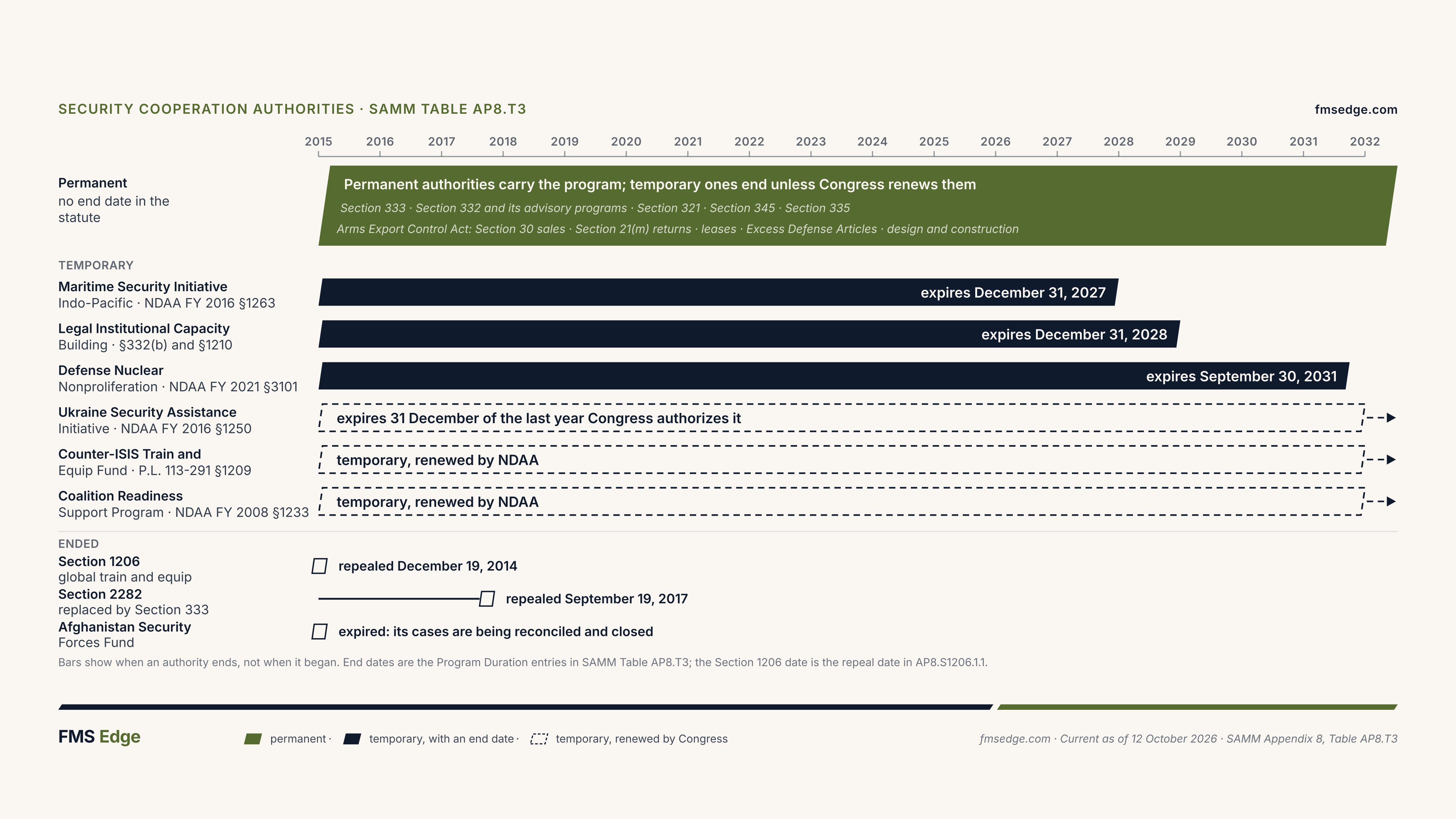
What security cooperation programs does the Department of War run under Title 10?
Title 10 U.S. Code, Chapter 16, Section 301 defines and activities of the Department of War (DoW) as any program or interaction of DoW with the security establishment of a foreign country to build capabilities, provide access or build relationships []. As such, many of the Foreign Assistance Act () and ()-authorized programs administered by the DoW, in accordance with the , fall under the broad definition of [SAMM ].
Train and equip
Under the authority of Title 10, Chapter 16, and the annual National Defense Authorization Act (), the DoW provides materiel assistance and related training to international partners to build their security force capability. These programs are funded under annual appropriations legislation; Building Partner Capacity () authorities receive DoW Operations and Maintenance () appropriations [SAMM , ]. By statute or , these programs are sometimes required to be exercised in coordination with the Secretary of [SAMM ]. Three kinds of transfer under equipping programs that the manages under authorities must be provided pursuant to a case, absent a waiver by the Director, . They are defense articles or subject to export controls, defense articles that require Enhanced End-Use Monitoring (), and defense articles or that the partner must safeguard under a special security arrangement or analogous measure [SAMM ]. is responsible for notifications and other reporting to Congress for certain authorities [SAMM ].
Section 333 of Title 10 authorizes the DoW to build partner security forces' capacity for certain kinds of operational missions. It authorizes the Secretary of War, with the concurrence of the Secretary of , to conduct or support programs that train and equip one or more Benefitting Partners. The aim is to build the capacity of the partners' forces to conduct one or more of the following [SAMM ] []:
- Air domain awareness operations
- Counterterrorism operations
- Counter-illicit drug trafficking operations
- Maritime and border security operations
- Counter-weapons of mass destruction operations
- Military intelligence operations
- Counter-transnational organized crime operations
- Cyberspace security and defensive cyberspace operations
- Operations or activities contributing to an existing international coalition operation that the Secretary of War determines is in the national interest of the United States
Section 1263 of the for Fiscal Year 2016 (P.L. 114-92), as amended, authorizes the Indo-Pacific Maritime Security Initiative (MSI). The authority, as extended, runs to December 31, 2027. Under it, the Secretary of War, with the concurrence of the Secretary of , is authorized to provide assistance and training to the military or security forces of eligible partners whose fundamental responsibilities include maritime security missions. The assistance covers equipment, supplies and small-scale military construction. Its purpose is to increase multilateral maritime and foreign partners' maritime domain awareness in the United States Indo-Pacific Command () area of responsibility [SAMM ].
The DoW interprets the MSI legislation as allowing defense services to be provided. The DoW may also use the initiative for training at the ministry, agency and headquarters levels. MSI serves to strengthen alliances and attract new partnerships in the Indo-Pacific, as the National Defense Strategy outlines. It takes a comprehensive approach to developing the abilities of benefitting partners in maritime security and maritime domain awareness. It also fosters long-term cooperation, through human capital development and bilateral and multilateral exercises, without requiring U.S. involvement, while still advancing their interoperability with U.S. forces in the region [SAMM ].
These investments have improved, and continue to improve, how well benefitting partners can monitor their Exclusive Economic Zones and nearby waters. Partners can better detect and analyze air and maritime activity, share information with other partners in the region, and contribute to and take part in regional maritime exercises or contingency operations [SAMM ].
Funding under the Ukraine Initiative () provides various kinds of support and defense articles to the military of the Government of Ukraine. The initiative aims to strengthen Ukraine's capacity to defend its sovereignty and territorial integrity, to support institutional transformation initiatives, and to advance U.S. political and military objectives [SAMM ].
The Counter-ISIS Train and Equip Fund (CTEF) consolidates operational support programs that were once separate and temporary. Those programs focused on border security in connection with efforts to defeat the Islamic of Iraq and Syria (ISIS). With the funds consolidated, the United States is better able to support Benefitting Partners that are associated with the response of the Government of Iraq to crises and transnational threats, and to support operations that serve U.S. interests [SAMM ].
Consolidating the authorities and creating a dedicated funding source make it possible to strengthen regional security, border security next to conflict areas, and the force protection of U.S. and Benefitting Partner forces. The capability helps allies and partners reduce the flow of hostile fighters, of foreign fighters fleeing back to their homelands and of illicit weapons, as well as narcotics and other forms of smuggling. CTEF funding addresses the urgent and emergent operational support needs of allies and partners who are working against ISIS, Al-Qaeda and the global operations of other violent extremist organizations [SAMM ].
Operational support
Operational support assistance programs enable international partners to participate in coalition operations by developing specific capabilities needed for said operations, such as fuel, bed down, and logistics support. Alternatively, operations support might focus on enhanced interoperability among international partners that assist with sustaining operations when they cannot sustain their own. DoW and congressionally appropriated funds are generally used to execute operational support.
The Coalition Readiness Support Program () is funded by the appropriation for Coalition Support Funds (CSF). It may be used to provide specialized training, to buy supplies and specialized equipment, and to loan equipment, on a non-reimbursable basis because CSF is used, to coalition forces supporting U.S. military named operations [SAMM ].
Defense institution building
Defense Institution Building () is the development and capacity building of international partner defense institutions, normally at the ministerial or chief of defense level, in support of U.S. foreign policy and goals. attempts to promote principles for the establishment of defense institutions that are effective, accountable, transparent, and responsive to national political systems, especially regarding good governance, oversight of security forces, respect for human rights, and the rule of law.
Some areas of focus for are defense institutions, organizations, and processes that can ensure effective oversight, management, and execution of logistics, personnel, budgets, policy, strategy, and doctrine for effective development, employment, and sustainment of defense capabilities.
is authorized under Title 10, Section 332, under which the Secretary of War, with the concurrence of the Secretary of , may provide resident and non-resident bilateral advisory services to the international partner [SAMM ]. Funding from other programs can also be used for related training, education, and professional development.
The Secretary of War, with the concurrence of the Secretary of , may provide bilateral advisory services, resident and non-resident, to ministries of defense or to security agencies that serve a similar defense function or oversee security forces. Those services include training and training support programs, and institutional and ministerial-level advice. They also include other training that supports stabilization or post-conflict activities, or that helps build core institutional capacity, competencies and capabilities to manage defense-related processes [SAMM ].
Programs must assess and address weaknesses; enhance civilian oversight; establish responsible defense governance and internal controls; or enhance overall core management competencies at the ministerial, general or joint staff, or service level [SAMM ]. Section 332 activities must receive the concurrence of the Secretary of and DoW approval through [SAMM ].
International armaments cooperation
consists of U.S. bilateral and multilateral agreements with international partners focused on three cooperative areas:
1. Sharing the costs associated with the cooperative research, development, test, evaluation, and production of mutually required weapons systems or components, defense technologies, systems, or equipment
2. Fostering joint production and follow-on support of defense articles or equipment
3. Procuring foreign technology, equipment, systems or logistics support
Over time, a variety of names have been applied to this area of cooperation to include Armaments Cooperation, , Programs (IACP), and Defense Cooperation in Armaments (DCA).
Humanitarian assistance
consists of a group of designed to improve DoW access, visibility, and influence in an international partner or region and to build the capacity of the international partner government while addressing a humanitarian need. Combatant Commands () may carry out activities funded by Overseas Humanitarian, Disaster and Civic Aid () across respective Unified Command Plan (UCP) theaters, offering DoW another tool to promote regional stability and security [SAMM , ]. personnel should be granted the permissions to submit prioritized partner project nominations for the 's consideration [SAMM ]. The prioritizes the nominations and submits them to for approval [SAMM ].
DoW humanitarian-focused programs and activities include , , , , Excess Property, and the Space Available and Funded Transportation Programs. Chapter 12 implements DoW policy on and and gives program guidance for administering and executing the DoW activities that funds. The should integrate activities into planning as far as possible [SAMM ].
Education
Many provide educational opportunities to partner nation (PN) military and civilian personnel. Training can occur in the U.S., in the PN’s country, and, in some cases, in a third country. Training can include , tactical training, and/or technical skills training when they acquire new equipment from the U.S.
Through a tailored program of education and training activities, the is designed to address the main challenges at the global and regional levels and with specific partners. It is permanently authorized by 10 U.S.C. 345. It gives a flexible way to focus efforts on building partner capacity to meet a specific objective [SAMM ].
Exercises
Combined exercises include U.S. forces and those of one or more countries. The term “joint” refers to two or more services, e.g., Army and Air Force. Exercises can be both joint and combined.
Under Section 321 of Title 10, the primary purpose of the training and exercises will be to train U.S. forces [SAMM ]. There are three types of exercises that may fall under this title:
- Field Training Exercises (): The most realistic exercises, , take place in the field with actual forces, thus allowing capability, employment, and evaluation. These exercises are also the most resource-intensive in money, manpower, materiel, and preparation time.
- Command Post Exercises (): An exercise in which the forces are simulated, involving the commander, the staff, and communications/coordination among the participating headquarters.
- Table Top Exercises (): Tabletop exercises are the least resource-intensive of these three types, ranging from a formal, detailed planning process to a simple discussion. are excellent when senior leaders want to explore a number of possible scenarios or possible futures.
Where the Secretary of War determines that doing so serves U.S. national security interests, the armed forces under the Secretary's jurisdiction may train with a friendly foreign country's military or other security forces [SAMM ].
Contacts
Section 168 of Title 10 formerly authorized contact events and Military-to-Military (M2M) engagements. The National Defense Authorization Act () for Fiscal Year 2017 repealed Section 168, and these events are now authorized under Chapter 16 of Title 10, subchapter II, Military-to-Military Engagements.
Events conducted under this authority should not cross into the training realm. They should be designed to enable defense and military leaders to engage with international partners for discussions, exchanges of tactics, planning, and other purposes that encourage democratic orientation of defense establishments and military forces of other countries, but not training [SAMM ]. The Secretary of War may give Combatant Commanders funds for the following activities only; the funds may not be used for any other defense articles or services, including training [SAMM ]:
- Traveling contact teams
- Exchanges of civilian or military personnel between the DoW and the defense ministries of partner governments
- Military liaison teams
- Seminars and conferences held primarily in a theater of operations
- Distribution of publications primarily in a theater of operations
- Exchanges of military personnel between units of the U.S. armed forces and units of partner armed forces
The Department of War Partnership Program (SPP) is authorized under 10 U.S.C. 341 (Title 10, Chapter 16, subchapter V) [SAMM ] []. The National Guard can support contact events through the SPP.
Exchanges
There are various options for conducting exchanges of military and civilian defense personnel with international partners that may be used to develop familiarity with international partner systems, processes, interoperability, and technical expertise. Exchanges can be between DoW civilian or military personnel and ministries of defense. Under Section 311 of Title 10, the Secretary of War may enter into international defense personnel exchange agreements, and exchanges under them may be reciprocal or non-reciprocal [].
References
SAMM
- SAMM C1.1.2.2: Security Assistance Programs.
- SAMM C15.1.1: Definition of Building Partner Capacity.
- SAMM C15.1.4.1: Current or Unexpired Funds.
- SAMM C1.1.2.1: Security Cooperation Programs.
- SAMM C15.1.3.1
- SAMM C15.1.6.4.1: Defense Security Cooperation Agency.
- SAMM C12.1.1: General.
- SAMM C12.2.1: General.
- SAMM C12.2.3.3.2: Team.
- SAMM C12.4.4: Combatant Command Approval or Submittal to Defense Security Cooperation Agency.
- SAMM AP8.S321.2.1: Purpose of Training and Exercises.
- SAMM C10.22.6.2: Military-to-Military Contacts and Comparable Activities.
- SAMM C10.17.22: The State Partnership Program.
- SAMM AP8.T3: Security Assistance and Security Cooperation Programs
- SAMM AP8.S333.1.1: Program Authority.
- SAMM AP8.S332.1.1
- SAMM AP8.S321.2.1.1: Training With Foreign Forces.
- SAMM AP8.MSI.1.1
- SAMM AP8.USAI.1.1
- SAMM AP8.CTEF.1.1
- SAMM AP8.CRSP.1.1
- SAMM AP8.S345.1.1
- SAMM AP8.S335.1.1
- SAMM AP8.S1206.1.1
- SAMM AP8.S2282.1.1
- SAMM AP8.ASFF.1.1: Afghanistan Security Forces Fund.
- SAMM C2.1.7.3: Humanitarian Assistance Programs.
Public authorities
- 10 U.S.C. §301: 10 U.S.C. §301, Definitions (chapter 16, Security Cooperation)
- 10 U.S.C. §333: 10 U.S.C. §333, Foreign security forces: authority to build capacity
- 10 U.S.C. §341: 10 U.S.C. §341, Department of Defense State Partnership Program
- 10 U.S.C. 311: 10 U.S.C. §311, Exchange of defense personnel between United States and friendly foreign countries: authority
Facts referenced
- Date the temporary authority for the Indo-Pacific Maritime Security Initiative (MSI) expires (SAMM Table AP8.T3, Program Duration): December 31, 2027 (as of 26 October 2026; SAMM AP8.T3)
Related
Security Assistance (SA)
A group of programs authorized by federal statutes by which the United States provides defense articles, military training, and other defense-related services by grant, lease, loan, credit, or cash sales in furtherance of national policies and objectives, and those that are funded and authorized through the Department of State to be administered by Department of Defense/Defense Security Cooperation Agency, which are considered part of security cooperation.
SAMM Glossary, as of 12 September 2026
Glossary entry →Open the manual’s entry → (opens in new tab)
Security Cooperation Programs
Any program, activity (including an exercise), or interaction of the Department of Defense with the security establishment of a partner or international organization to achieve a purpose as follows:
To build and develop allied and friendly security capabilities for self-defense and multinational operations.
To provide the armed forces with access to the partner or international organization during peacetime or a contingency operation.
To build relationships that promote specific United States security interests.
SAMM Glossary, as of 12 September 2026
Glossary entry →Open the manual’s entry → (opens in new tab)
International Armaments Cooperation (IAC)
Programs and activities through which the United States works with allied and friendly countries to promote rationalization, standardization and interoperability, usually under written bilateral or multilateral agreements that set each party's responsibilities for shared projects or exchanges.
International Armaments Cooperation (IAC) covers U.S. cooperation with other countries and international organizations to research, develop, acquire and sustain military systems, including the Information Exchange Program, the Engineer and Scientist Exchange Program, foreign comparative testing and cooperative logistics [SAMM C2.1.7.2.1].
FMS Edge glossary, as of 10 October 2026
Glossary entry →Open the manual’s entry → (opens in new tab)
Humanitarian Assistance (HA)
DoD security cooperation activities with partner nation civilian government authorities, which support partner nation efforts to provide essential human services to civilian populations or to directly relieve or reduce human privation in support of national security priorities. DoD humanitarian assistance activities may be authorized under 10 U.S.C. 166a, 182, 401, 402, 404, 407, 2557, 2561, the Asia Pacific Regional Initiative, the Pacific Deterrence Initiative, the Ukraine Supplemental Appropriations Act, Presidential Drawdown Authority, certain Defense Health Programs, certain Global Health Engagements, and other DoD programs.
SAMM Glossary, as of 12 September 2026
Glossary entry →Open the manual’s entry → (opens in new tab)
Arms Export Control Act (AECA)
The basic U.S. law providing the authority and general rules for the conduct of Foreign Military Sales and commercial sales of defense articles, defense services, and training. The Arms Export Control Act (AECA) came into existence with the passage of the Foreign Military Sales Act (FMSA) of 1968. An amendment in the International Security Assistance and AECA of 1976 changed the name of FMSA to the AECA.
SAMM Glossary, as of 12 September 2026
Glossary entry →Open the manual’s entry → (opens in new tab)
AECA: Arms Export Control Act
SAMM Acronyms, as of 12 September 2026
Security Assistance Management Manual (SAMM)
DSCA Manual 5105.38-M required under DoD Directive 5105.65, "Defense Security Cooperation Agency" mandatory for use by all DoD Components. The SAMM provides DoD-wide guidance to the Office of the Secretary of Defense (OSD), the Military Departments (MILDEPs), the Office of the Chairman of the Joint Chiefs of Staff and the Joint Staff, the Combatant Commands, the Defense Agencies, the DoD Field Activities, the Security Cooperation Organizations (SCOs), and all other organizational entities within the DoD engaged in the management or implementation of DoD Security Assistance and Security Cooperation programs over which DSCA has responsibility.
SAMM Glossary, as of 12 September 2026
Glossary entry →Open the manual’s entry → (opens in new tab)
Security Cooperation
Activities by which the Department of War encourages and enables international partners to cooperate with the United States toward strategic objectives, spanning every interaction with foreign defense and security establishments and every security assistance program the Department administers.
Under chapter 16 of Title 10, their purposes are to develop allied and friendly security capabilities for self-defense and multinational operations, to give U.S. forces peacetime and contingency access, and to build relationships promoting specific U.S. security interests [10 U.S.C. 301(7)].
FMS Edge glossary, as of 10 October 2026
Glossary entry →Open the manual’s entry → (opens in new tab)
Executive Order (EO)
A numbered official document through which the President manages the operations of the Federal Government, normally used to create or change the organization or procedures of executive branch agencies; its authority rests on the Constitution or on powers that acts of Congress grant. The text of each executive order is published in the Federal Register once the President has signed it.
FMS Edge glossary, as of 10 October 2026
Glossary entry →Open the manual’s entry → (opens in new tab)
Defense Security Cooperation Agency (DSCA)
The Department of War agency that directs, administers and provides guidance to the Department's components and its representatives at U.S. missions for the execution of the security cooperation programs for which it is responsible [SAMM C1.3.2.2]. The agency also provides financial and technical assistance, arranges the transfer of defense materiel, training and services to international partners, and promotes military-to-military contacts.
FMS Edge glossary, as of 10 October 2026
Glossary entry →Open the manual’s entry → (opens in new tab)
DSCA: Defense Security Cooperation Agency
SAMM Acronyms, as of 12 September 2026
Glossary entry →Defense Security Cooperation Agency (DSCA) →
Technical Data
Recorded information of a scientific or technical nature, regardless of form or characteristic. Examples of technical data packages include research and engineering drawings and associated lists, specifications, standards, process sheets, manuals, technical reports, catalog item identifications, and related information and computer software documentation.
SAMM Glossary, as of 12 September 2026
Glossary entry →Open the manual’s entry → (opens in new tab)
DIB: Defense Institution Building
Combatant Command (CCMD)
A unified or specified command with a broad continuing mission under a single commander established and so designated by the President, through the Secretary of Defense and with the advice and assistance of the Chairman of the Joint Chiefs of Staff. Also called CCMD.
SAMM Glossary, as of 12 September 2026
Glossary entry →Open the manual’s entry → (opens in new tab)
OHDACA: Overseas Humanitarian, Disaster and Civic Aid
SAMM Acronyms, as of 12 September 2026
Glossary entry →Overseas Humanitarian, Disaster, and Civic Aid (OHDACA) →
Security Cooperation Organization (SCO)
A Department of Defense element that is part of the United States Diplomatic mission located in a foreign country to carry out security assistance and security cooperation management functions under the supervision and coordination authority of the senior defense official/defense attaché.
SAMM Glossary, as of 12 September 2026
Glossary entry →Open the manual’s entry → (opens in new tab)
Foreign Disaster Relief (FDR)
Assistance that can be used immediately to alleviate the suffering of foreign disaster victims that normally includes services and commodities as well as the rescue and evacuation of victims; the provision and transportation of food, water, clothing, medicines, beds, bedding, temporary shelter; the furnishing of medical equipment, medical and technical personnel; and making repairs to essential services.
SAMM Glossary, as of 12 September 2026
Glossary entry →Open the manual’s entry → (opens in new tab)
Humanitarian and Civic Assistance (HCA)
DoD assistance to the local populace pursuant to 10 U.S.C. 401 and provided by U.S. forces in conjunction with military operations and exercises.
SAMM Glossary, as of 12 September 2026
Glossary entry →Open the manual’s entry → (opens in new tab)
Humanitarian Mine Action (HMA)
DoD activities that strive to reduce the social, economic, and environmental impact of land mines, unexploded ordnance, and small arms ammunition.
SAMM Glossary, as of 12 September 2026
Glossary entry →Open the manual’s entry → (opens in new tab)
SAMM: Security Assistance Management Manual
SAMM Acronyms, as of 12 September 2026
Glossary entry →Security Assistance Management Manual (SAMM) →
FDR: Foreign Disaster Relief
SAMM Acronyms, as of 12 September 2026
SCO: Security Cooperation Organization
SAMM Acronyms, as of 12 September 2026
Professional Military Education (PME)
Career training designed to provide or enhance leadership and the recipient force's capabilities to conduct military planning, programming, management, budgeting, and force development to the level of sophistication appropriate to that force.
SAMM Glossary, as of 12 September 2026
Glossary entry →Open the manual’s entry → (opens in new tab)
Regional Defense Fellowship Program (RDFP)
A Department of War security cooperation program that funds education and training in irregular warfare and counterterrorism for partner defense and security officials at the mid and senior levels, earlier known as the Combating Terrorism Fellowship Program (CTFP).
Permanently authorized by 10 U.S.C. 345, it gives a flexible tool for building partner capacity toward a specific combatant command objective [SAMM AP8.S345.1.1] [10 U.S.C. 345].
FMS Edge glossary, as of 11 October 2026
Glossary entry →Open the manual’s entry → (opens in new tab)
FTX: Field Training Exercise
CPX: Command Post Exercise
TTX: Table Top Exercise
10 U.S.C. §301, Definitions (chapter 16, Security Cooperation)
10 U.S.C. §301 · Statute
SAMM C1.1.2.2: Security Assistance Programs.
“SA is a group of programs, authorized under Title 22 authorities, by which the United States provides defense articles, military education and training, and other defense-related services by grant, loan, credit, cash sales, or lease, in furtherance of national policies and objectives. All SA programs are subject to the continuous supervision and general direction of the Secretary of State to …”
Security Assistance Management Manual, as of 26 October 2026
SAMM C15.1.1: Definition of Building Partner Capacity.
“Building Partner Capacity (BPC) programs are USG security cooperation (SC) projects, programs, activities, and engagements, funded by USG appropriations for the purpose of building partner security force capability. Program authorizations originate in Title 10 of the U.S. Code or in annual National Defense Authorization legislation and are funded under annual appropriations legislation. The SC community designs, coordinates, and centrally manages …”
Security Assistance Management Manual, as of 11 September 2026
SAMM C15.1.4.1: Current or Unexpired Funds.
“The period of availability (POA) of funds is the period of time in which budget authority is available to incur new obligations (see DoW FMR, Volume 3, Chapter 13, Section 3.2.1.1.) During the period of availability (see DoW FMR, Volume 3, Chapter 13, Section 3.2.1.2.1.), IAs and Program Offices have the authority to utilize current funds for new obligations, obligation …”
Security Assistance Management Manual, as of 5 October 2026
SAMM C1.1.2.1: Security Cooperation Programs.
“SC program authorizations and appropriations are provided to the Secretary of War (SECWAR) primarily under the annual National Defense Authorization Act (NDAA) and appropriations acts. By statute or Executive Order (EO), they are sometimes required to be exercised in coordination with the Secretary of State. These programs vary greatly in terms of the agency or DoW activity responsible and the …”
Security Assistance Management Manual, as of 26 October 2026
SAMM C15.1.3.1
“DSCA-managed BPC equipping programs must be provided pursuant to a BPC case, absent a waiver by the Director, DSCA, for the following: The transfer of any defense article or technical data that are subject to export controls, The transfer of any defense article that requires Enhanced End-Use Monitoring (EEUM), and The transfer of a defense article or technical data that …”
Security Assistance Management Manual, as of 5 October 2026
SAMM C15.1.6.4.1: Defense Security Cooperation Agency.
“DSCA supports DoW components on the appropriate use, integration, and execution of SC programs to develop comprehensive, full-spectrum, and sustainable approaches building allied or partner defense and security capabilities and capacity, and to achieve other USG defense policy goals. DSCA provides guidance to DoW components, U.S. Military Groups (MILGPs), and IAs on the development, administration, and execution of BPC program …”
Security Assistance Management Manual, as of 5 October 2026
SAMM AP8.S333.1.1: Program Authority.
“10 U.S.C. 333 provides DoW authority to build the capacity of partner security forces to conduct certain types of operational missions. Section 333 authorizes the Secretary of War (SECWAR), with the concurrence of the Secretary of State (SECSTATE), to conduct or support a program or programs to provide training and equipment to one or more Benefitting Partners for the purpose …”
Security Assistance Management Manual, as of 12 October 2026
10 U.S.C. §333, Foreign security forces: authority to build capacity
10 U.S.C. §333 · Statute
SAMM AP8.MSI.1.1
“Section 1263 of the National Defense Authorization Act (NDAA) for Fiscal Year (FY) 2016 (P.L. 114-92), as amended, provides authority for the Indo-Pacific Maritime Security Initiative (MSI) until December 31, 2025, which has since been extended to December 31, 2027 by P.L. 117-81. The Secretary of War (SECWAR), with the concurrence of the Secretary of State (SECSTATE), is authorized to …”
Security Assistance Management Manual, as of 26 October 2026
SAMM AP8.USAI.1.1
“The Ukraine Security Assistance Initiative (USAI) is intended to build Ukraine's capacity to defend its sovereignty and territorial integrity, support institutional transformation initiatives, and advance U.S. political and military objectives. This funding provides various support and defense articles to the Government of Ukraine’s military.”
Security Assistance Management Manual, as of 30 September 2026
SAMM AP8.CTEF.1.1
“The Counter- Islamic State of Iraq and Syria (ISIS) Train and Equip Fund (CTEF) consolidates previously disparate and temporary operational support programs focused on border security in association with efforts to defeat ISIS. The consolidation of these funds enhances the ability of the United States to support Benefitting Partners associated with the Government of Iraq’s response to crises and transnational …”
Security Assistance Management Manual, as of 30 September 2026
SAMM AP8.CRSP.1.1
“The Coalition Readiness Support Program (CRSP) is a program funded by the appropriation for Coalition Support Funds (CSF) and may be used to provide specialized training, procure supplies and specialized equipment, and loan equipment on a non-reimbursable basis (due to the use of CSF) to coalition forces supporting U.S. military named operations.”
Security Assistance Management Manual, as of 30 September 2026
SAMM AP8.S332.1.1
“The Secretary of War (SECWAR), with the concurrence of the Secretary of State (SECSTATE), may provide both resident and non-resident bi-lateral advisory services, including training and training support programs to ministries of defense (or security agencies serving a similar defense function or with security force oversight). Advisory services include providing institutional, ministerial-level advice, and other training in support of stabilization …”
Security Assistance Management Manual, as of 26 October 2026
SAMM C12.1.1: General.
“The DoW conducts Humanitarian Assistance (HA) to relieve or reduce endemic conditions such as human suffering, disease, hunger, privation, and the adverse effects of unexploded explosive ordnance (UXO), particularly in regions where humanitarian needs may pose major challenges to stability, prosperity, and respect for universal human values. The Overseas Humanitarian, Disaster, and Civic Aid (OHDACA) appropriation funds DoW HA activities …”
Security Assistance Management Manual, as of 26 October 2026
SAMM C12.2.1: General.
“DSCA provides overall management of Overseas Humanitarian, Disaster, and Civic Aid (OHDACA)-funded Humanitarian Assistance (HA) and Foreign Disaster Relief (FDR) activities, performs all financial management, budgeting, and reporting requirements for the OHDACA appropriation, allocates OHDACA funds to the Combatant Commands (CCMDs), and reviews and approves OHDACA-funded projects to ensure compliance with legal and policy requirements. Additionally, DSCA manages and executes …”
Security Assistance Management Manual, as of 26 October 2026
SAMM C12.2.3.3.2: Team.
“Team level permissions are granted by the CCMD to organizations or personnel that verify each project nomination is acceptable and absorbable by the partner, synchronized with other SC activities planned in the partner’s territory, and fully coordinated with the U.S. Country Team and Chief of Mission (COM). Team permissions allow a User to submit prioritized partner project nominations, as appropriate, …”
Security Assistance Management Manual, as of 26 October 2026
SAMM C12.4.4: Combatant Command Approval or Submittal to Defense Security Cooperation Agency.
“Following all required project coordination, CCMDs have authority to approve minimal-cost HA projects, whether or not they have been included in the CCMD Assessment and Budget Submittal (ABS) (see Section C12.3.2.2.). CCMDs are also responsible for prioritizing and submitting project nominations to DSCA for approval. When the CCMD approves a minimal-cost project or submits a project to DSCA for approval, …”
Security Assistance Management Manual, as of 26 October 2026
SAMM C2.1.7.3: Humanitarian Assistance Programs.
“DoW humanitarian-focused programs and activities include Humanitarian Assistance (HA), Excess Property (EP), Humanitarian Mine Action (HMA), Humanitarian and Civic Assistance (HCA), Space Available and Funded Transportation Programs, and Foreign Disaster Relief (FDR). Chapter 12 implements DoW HA and FDR policy and provides program guidance for the administration and execution of DoW activities funded with the DoW Overseas Humanitarian, Disaster, and …”
Security Assistance Management Manual, as of 26 October 2026
SAMM AP8.S345.1.1
“The Regional Defense Fellowship Program (RDFP) is designed to address key challenges globally, regionally, and with specific partners through a tailored program of education and training activities. Permanently authorized by 10 U.S.C. 345, the RDFP provides a unique and flexible tool to focus efforts toward building partner capacity to meet a specific Combatant Command (CCMD) objective.”
Security Assistance Management Manual, as of 30 September 2026
SAMM AP8.S321.2.1: Purpose of Training and Exercises.
“The primary purpose of the training and exercises will be to train U.S. forces.”
Security Assistance Management Manual, as of 30 September 2026
SAMM AP8.S321.2.1.1: Training With Foreign Forces.
“If the Secretary of War (SECWAR) determines it is in the interest of U.S. national security, armed forces under SECWAR jurisdiction may train with the military forces or other security forces of a friendly foreign country.”
Security Assistance Management Manual, as of 9 November 2026
SAMM C10.22.6.2: Military-to-Military Contacts and Comparable Activities.
“Under authority of Traditional Commanders’ Activities (TCAs) the Secretary of War (SECWAR) may direct military-to-military contacts and comparable activities designed to encourage a democratic orientation of defense establishments and military forces of other countries. SECWAR may provide funds to the CCDRs, which may be used for the activities of traveling contract teams, military liaison teams, exchanges of civilian or military …”
Security Assistance Management Manual, as of 26 October 2026
SAMM C10.17.22: The State Partnership Program.
“The State Partnership Program (SPP) is authorized under 10 U.S.C. 341. While the SPP may support international training, it is not a stand-alone SC authority and must be paired with another authority able to provide training. All activities must adhere to the applicable regulations of the paired authorities and the respective service.”
Security Assistance Management Manual, as of 11 September 2026
10 U.S.C. §341, Department of Defense State Partnership Program
10 U.S.C. §341 · Statute
10 U.S.C. §311, Exchange of defense personnel between United States and friendly foreign countries: authority
10 U.S.C. 311 · Statute