
Guide
How is international armaments cooperation different from Foreign Military Sales?
is the U.S. Government cooperating with other countries and with international organizations to research, develop, acquire and sustain military systems, mostly in the earlier phases of a system's life cycle. normally comes later, once a system is developed and in production. Armaments cooperation answers to a different under secretary and runs on negotiated international agreements rather than Letters of Offer and Acceptance.
Foreign Military Sales usually sells a system already developed, produced and fielded, but a partner does not have to come last. It can pay to develop a system the United States later buys, as with the F-15SA that led to the Air Force's F-15EX. It can also work with the United States through every phase under an international agreement, as Japan did on the SM-3 Block IIA.
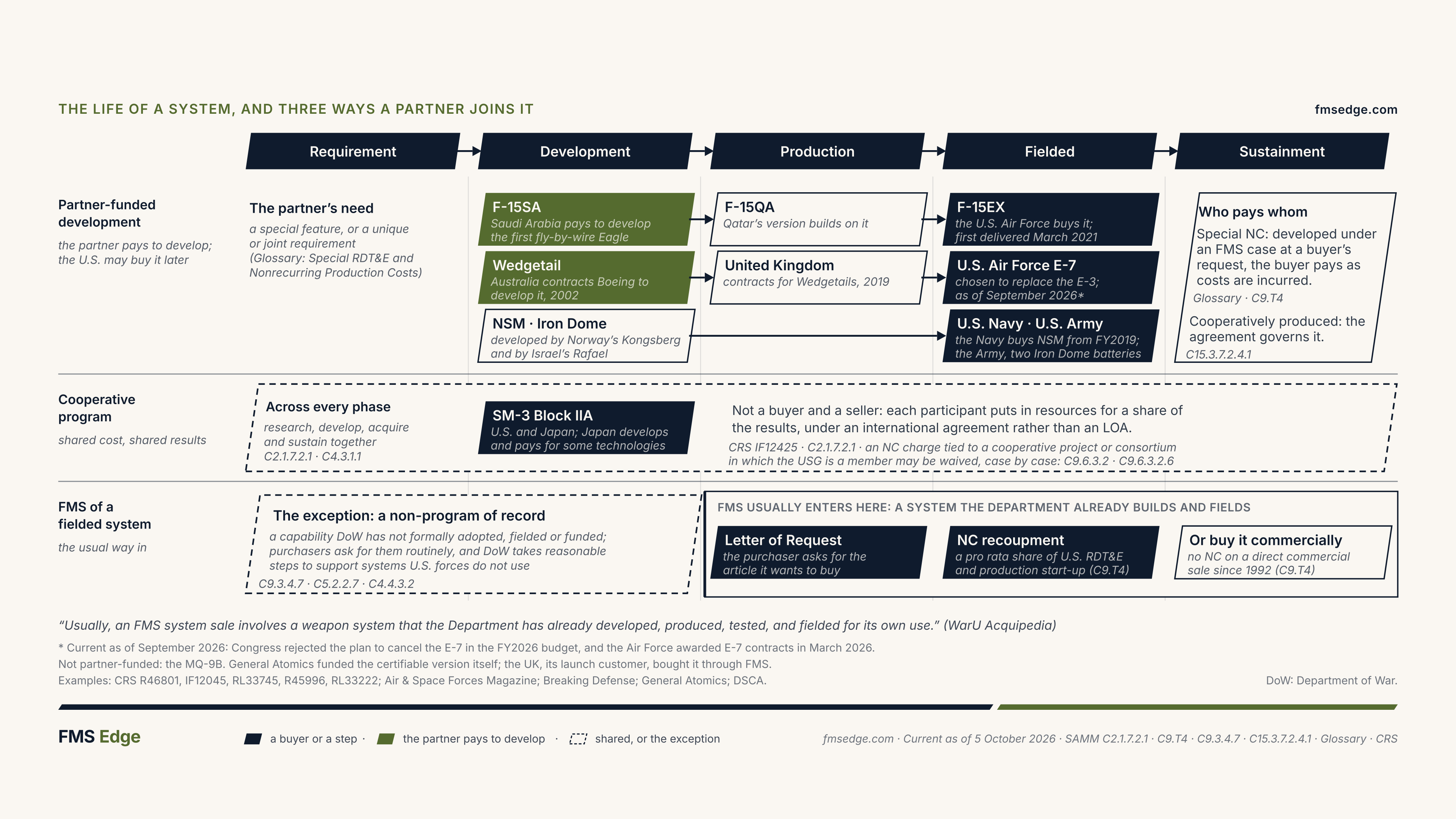
How is international armaments cooperation different from Foreign Military Sales?
When doing activities, the U.S. may work with friends and allies across the entire system acquisition life cycle [SAMM ]. normally occurs later in the life cycle after the system has already been fully developed and placed into production. primarily represents opportunities to cooperatively work with other countries in the earlier developmental phases of a system’s life cycle.
is a broad field in which the U.S. Government cooperates with other countries and with international organizations to research, develop, acquire and sustain military systems. It includes Defense Trade, , Foreign Comparative Testing, the Information Exchange Program (), Cooperative Research, Development and Acquisition, and the Engineer and Scientist Exchange Program () [SAMM ].
is generally conducted with nations that have solid political and economic ties with the U.S., similar military requirements, and a reasonably strong defense, science and technology base. Although some countries may be quite important from a political, economic, or military standpoint, if they have different military requirements or lack a substantial defense , there may be little potential for successful activity.
What armaments cooperation is for
The core objectives of typically include the following:
- Operational: increase military effectiveness through interoperability and partnership with allies and coalition partners
- Economic: reduce weapons acquisition cost by sharing costs, economies of scale and avoiding duplication of development efforts with allies and friends
- Technical: access the best defense technology worldwide and help minimize the capabilities gap with allies and coalition partners
- Political: strengthen alliances and relationships with other friendly countries
- Industrial: bolster domestic and allied defense industrial bases
Although activities are separate, there can be an evolutionary relationship between them. For example, basic discussions originating from one of the meeting forums may lead to an initial basic cooperative program, which may eventually, in turn, lead to a future, more advanced, level of cooperation.
Over the years, Congress has enacted a number of laws encouraging and enabling and International Cooperation (IC) with U.S. allies in the acquisition of defense equipment. Most are codified in Title 10, (U.S.C.), Armed Forces, and Title 22, Foreign Relations and Intercourse. The laws, regulations, and policies that apply to armaments cooperation activities are complex. Given this complexity, assistance in interpreting and applying /IC laws, regulations, and policies should be obtained from one of the Department of War (DoW) /IC organizations.
Who oversees it
The Under Secretary of War for Acquisition and Sustainment is responsible for and also serves as the U.S. National Armaments Director (). By contrast, the Under Secretary of War for Policy oversees and the other traditional programs [SAMM ]. Since a November 2025 realignment, the and the Defense Administration report to the Under Secretary of War for Acquisition and Sustainment, while the Under Secretary of War for Policy keeps responsibility for strategic direction.
The Under Secretary of War for Acquisition and Sustainment (USW(A&S)) established the Office of International Cooperation to oversee activities. The Under Secretary of War for Policy has a supporting role in IC by reviewing international agreements for foreign policy considerations.
Support in the partner country
In addition to the sponsored overseas offices, the DoW assigns dedicated personnel within countries that conduct a significant volume of activity with the U.S. These dedicated armaments cooperation personnel assigned overseas serve as the in-country liaison for the USW(A&S). They assist the host government obtain information on U.S. equipment and programs as well as help DoW acquisition organizations obtain information on host nation equipment, requirements and programs in support of . This function extends to assisting industry in gaining access to the other nation’s defense markets and in developing cooperative programs.
In the partner country, personnel dedicated to usually come under the supervision and oversight of the Chief, or of the Defense Attaché () where there is no . If the has no Armaments Cooperation personnel assigned, the chief is responsible for support functions as far as resources permit [SAMM ].
International agreements instead of Letters of Offer and Acceptance
/IC programs use international agreements as the official government-to-government document rather than Letters of Offer and Acceptance (). Under one or more of the /IC authorities, the U.S. and one or more countries are agreeing to cooperate in research, development, acquisition, or sustainment activity. The international agreement serves as the basis to define the extent and methods for the cooperative activity. Fundamentally, the agreement sets out how the work will be performed, how any costs will be shared and the extent of rights to use the results of the cooperative activities. International agreements may be referred to as Memorandums of Understanding () or Memorandums of Agreement (). Unlike , international agreements constitute a binding commitment subject to international law. Instruction 5530.03, International Agreements, governs the international agreements process.
Under DoDI 5000.85, an International Cooperative Program () is any acquisition program or technology project in which the United States and one or more foreign nations take part, through an international agreement, during any phase of a system's life cycle. Staff pursuing an are encouraged to use the streamlined agreement procedures that the USW(A&S) oversees. A DoW component notifies the Defense Acquisition Executive and obtains approval before it ends or substantially reduces the participation of a major defense acquisition program in an under a signed international agreement.
The Secretary of Defense (now the Secretary of War) may enter into a or other formal agreement to conduct projects on defense equipment and munitions. The other party may be the North Atlantic Treaty Organization (), a organization or member nation, a major non- ally, any other friendly foreign country or the European Union []. The Secretary may not enter into such an agreement unless the Secretary determines that the project will improve conventional defense capabilities, through the application of emerging technology, for or for the United States and the partner together [].
Under Section 27 of the , the President may enter into a cooperative project agreement with or one or more of its member countries []. The President may also enter into one with a friendly country outside , on determining that the agreement would be in the foreign policy or national security interests of the United States [].
A cooperative project under Section 27, , is a jointly managed arrangement set out in a written agreement among the participants. Its purpose is to further the standardization, rationalization and interoperability of the armed forces of members or, for a project outside , to improve the participants' conventional defense capabilities. It provides for one or more of the other participants to share with the United States the costs of research and development, testing, evaluation or joint production of defense articles, including follow-on support. It may instead provide for concurrent production of a jointly developed article, or for U.S. procurement from another participant [].
Unlike , international agreements are developed through a process of negotiation. To assist in developing armaments cooperation international agreements, the DoW created the international agreements generator. The generator permits draft agreements to be quickly developed while ensuring they conform to relevant U.S. law, regulations, and policies as well as the generally accepted international agreement formats and norms used by foreign nations.
For an acquisition-related agreement, the program office, working with its DoW component's international program organization, normally first holds exploratory discussions with the prospective partners to define the project and test its feasibility. The component then drafts a Summary Statement of Intent, a short business case for the project, together with the draft agreement text, and seeks authority to negotiate. For a stand-alone , that authority comes from the Office of the USW(A&S). When negotiations end, the component updates the statement and submits the negotiated text to the same office for final approval before the agreement is signed.
Under the Case Act, 1 U.S.C. 112b, an international agreement may not be signed or otherwise concluded on behalf of the United States without prior consultation with the Secretary of , and the consultation may cover a class of agreements rather than a single one []. A department or agency that enters into an international agreement shall provide its text to the Secretary not later than fifteen days after the agreement is signed or otherwise concluded [].
For sales of defense articles and services, the case document is normally sufficient to establish the rights and obligations of each party to the agreement. However, in exceptional instances, it may be in the U.S. Government’s (’s) interest to negotiate and conclude an international agreement before, concurrent with, or after conclusion of the case.
For coproduction programs pursuant to an , the Director, must provide written approval to enter into negotiations [SAMM ]. Implementing Agencies () that are considering negotiating and concluding an international agreement are strongly encouraged to consult with their supporting counsel well in advance of need, as justification documents, draft text, and approvals, including Department of State involvement, can be arduous and time consuming.
References
Public authorities
- 10 U.S.C. 2350a: 10 U.S.C. §2350a, Cooperative research and development agreements: NATO organizations; allied and friendly foreign countries
- AECA §27: Arms Export Control Act of 1976, as amended, §27 (22 U.S.C. §2767)
- 1 U.S.C. 112b: Case-Zablocki Act, 1 U.S.C. §112b, United States international agreements; transmission to Congress
- SecWar memo, 7 Nov 2025: Secretary of War memorandum, 7 November 2025, "Unifying the Department's Arms Transfer and Security Cooperation Enterprise to Improve Efficiency and Enable Burden-Sharing"
- DoDI 5000.85: DoD Instruction 5000.85, Major Capability Acquisition, 6 August 2020, Change 1, 4 November 2021
- WarU Acquipedia AINT 013: Warfighting Acquisition University (WarU), Acquipedia AINT 013: International Acquisition - International Agreements Process
- WarU Acquipedia AINT 007: Warfighting Acquisition University (WarU), Acquipedia AINT 007: International Acquisition - International Cooperative Programs (ICPs)
Related
International Armaments Cooperation (IAC)
Programs and activities through which the United States works with allied and friendly countries to promote rationalization, standardization and interoperability, usually under written bilateral or multilateral agreements that set each party's responsibilities for shared projects or exchanges.
International Armaments Cooperation (IAC) covers U.S. cooperation with other countries and international organizations to research, develop, acquire and sustain military systems, including the Information Exchange Program, the Engineer and Scientist Exchange Program, foreign comparative testing and cooperative logistics [SAMM C2.1.7.2.1].
FMS Edge glossary, as of 10 October 2026
Glossary entry →Open the manual’s entry → (opens in new tab)
Foreign Military Sales (FMS)
The part of U.S. security assistance, authorized by the Arms Export Control Act (AECA), in which eligible foreign governments and international organizations buy defense articles, services and training from the U.S. Government under formal government-to-government agreements.
The articles come either from Department of War stocks or from new procurement under contracts the Department manages [22 U.S.C. 2761, 22 U.S.C. 2762]. A sale is FMS whatever the source of the purchaser's financing.
FMS Edge glossary, as of 10 October 2026
Glossary entry →Open the manual’s entry → (opens in new tab)
FMS: Foreign Military Sale
SAMM Acronyms, as of 12 September 2026
IAC: International Armaments Cooperation
SAMM Acronyms, as of 12 September 2026
Cooperative Logistics
The logistics support provided a foreign government/agency through its participation in a U.S. DoD logistics system, with reimbursement paid to the USG for the support provided.
SAMM Glossary, as of 12 September 2026
Glossary entry →Open the manual’s entry → (opens in new tab)
Industrial Base
The part of a national economy that manufactures and maintains goods, chiefly through factories, maintenance facilities, processing plants and laboratories, whether privately or government owned. For U.S. defense it is the public facilities, academic institutions and commercial companies that research, develop, produce, deliver and maintain weapon systems and their parts for the U.S. military, together with closely connected capacity in Canada.
FMS Edge glossary, as of 10 October 2026
Glossary entry →Open the manual’s entry → (opens in new tab)
United States Code (USC)
The codification of the general and permanent federal laws, arranged by subject into titles and published by the Office of the Law Revision Counsel of the U.S. House of Representatives.
It states each law as amended, so a reader need not trace the individual amendments through the Statutes at Large.
FMS Edge glossary, as of 10 October 2026
Glossary entry →Open the manual’s entry → (opens in new tab)
Security Assistance (SA)
A group of programs authorized by federal statutes by which the United States provides defense articles, military training, and other defense-related services by grant, lease, loan, credit, or cash sales in furtherance of national policies and objectives, and those that are funded and authorized through the Department of State to be administered by Department of Defense/Defense Security Cooperation Agency, which are considered part of security cooperation.
SAMM Glossary, as of 12 September 2026
Glossary entry →Open the manual’s entry → (opens in new tab)
Defense Security Cooperation Agency (DSCA)
The Department of War agency that directs, administers and provides guidance to the Department's components and its representatives at U.S. missions for the execution of the security cooperation programs for which it is responsible [SAMM C1.3.2.2]. The agency also provides financial and technical assistance, arranges the transfer of defense materiel, training and services to international partners, and promotes military-to-military contacts.
FMS Edge glossary, as of 10 October 2026
Glossary entry →Open the manual’s entry → (opens in new tab)
Technology Security
The comprehensive framework of policies, practices, and procedures designed to protect U.S. military and dual-use technologies from unauthorized access, transfer, or exploitation by adversaries.
SAMM Glossary, as of 26 October 2026
Military Department (MILDEP)
One of the departments within the DoD created by the National Security Act of 1947, as amended. The Military Departments are: the Department of the Air Force, the Department of the Army, and the Department of the Navy.
SAMM Glossary, as of 12 September 2026
Glossary entry →Open the manual’s entry → (opens in new tab)
Security Cooperation Organization (SCO)
A Department of Defense element that is part of the United States Diplomatic mission located in a foreign country to carry out security assistance and security cooperation management functions under the supervision and coordination authority of the senior defense official/defense attaché.
SAMM Glossary, as of 12 September 2026
Glossary entry →Open the manual’s entry → (opens in new tab)
Senior Defense Official (SDO) and Defense Attaché (DATT)
Principal DoD official in a U.S. embassy, as designated by the Secretary of Defense. The SDO or DATT is the Chief of Mission's principal military advisor on defense and national security issues, the senior diplomatically accredited DoD military officer assigned to a diplomatic mission, and the single point of contact for all DoD matters involving the embassy or DoD elements assigned to or working from the embassy. The SDO or DATT is considered the dual-hatted chief of both the Security Cooperation Organization and Defense Attaché Office in the embassy. This position was established by DoDD 5205.75, Department of Defense Operations at U.S. Embassies, December 21, 2007. The same document gives coordinating authority (see glossary definition) to the SDO or DATT for the purpose of ensuring that all DoD elements in a country are working in consonance with each other and under the guidance of the Chief of Mission. The SDO or DATT program replaces the now defunct U.S. Defense Representative model.
SAMM Glossary, as of 12 September 2026
Glossary entry →Open the manual’s entry → (opens in new tab)
SCO: Security Cooperation Organization
SAMM Acronyms, as of 12 September 2026
LOA: Letter of Offer and Acceptance
SAMM Acronyms, as of 12 September 2026
MOU: Memorandum of Understanding
SAMM Acronyms, as of 12 September 2026
MOA: Memorandum of Agreement
SAMM Acronyms, as of 12 September 2026
ICP: Inventory Control Point
SAMM Acronyms, as of 12 September 2026
Memorandum of Understanding (MOU)
An arrangement between sovereign states or their executive agencies, or international organizations, that is not legally binding under international law.
SAMM Glossary, as of 12 September 2026
Glossary entry →Open the manual’s entry → (opens in new tab)
Cooperative Research and Development
A project in which the United States and one or more other countries or organizations jointly carry out research and development on new conventional defense equipment and munitions, or modify existing equipment to meet U.S. military requirements. The partners work under a memorandum of understanding or another formal agreement. Governments use it to make better use of their combined research and development resources, through technical data exchanges and co-development of new systems.
FMS Edge glossary, as of 10 October 2026
Glossary entry →Open the manual’s entry → (opens in new tab)
Arms Export Control Act (AECA)
The basic U.S. law providing the authority and general rules for the conduct of Foreign Military Sales and commercial sales of defense articles, defense services, and training. The Arms Export Control Act (AECA) came into existence with the passage of the Foreign Military Sales Act (FMSA) of 1968. An amendment in the International Security Assistance and AECA of 1976 changed the name of FMSA to the AECA.
SAMM Glossary, as of 12 September 2026
Glossary entry →Open the manual’s entry → (opens in new tab)
AECA: Arms Export Control Act
SAMM Acronyms, as of 12 September 2026
Implementing Agency (IA)
The military department or defense agency responsible for the execution of military assistance programs. With respect to FMS, the military department or defense agency assigned responsibility by the Defense Security Cooperation Agency to prepare an LOA and to implement an FMS case. The implementing agency is responsible for the overall management of the actions that will result in delivery of the materials or services set forth in the LOA that was accepted by a foreign country or international organization.
SAMM Glossary, as of 12 September 2026
Glossary entry →Open the manual’s entry → (opens in new tab)
SAMM C2.1.7.2.1
“The term International Armaments Cooperation (IAC) covers a multi-faceted area in which the USG cooperates with other countries and international organizations to research, develop, acquire and sustain military systems. IAC includes the Information Exchange Program (IEP), the Engineer and Scientist Exchange Program (ESEP), Foreign Comparative Testing, Cooperative Research, Development and Acquisition, Defense Trade, and Cooperative Logistics.”
Security Assistance Management Manual, as of 11 September 2026
SAMM C2.1.7.2.2
“While oversight for the FMS and other traditional SA is the responsibility of the Under Secretary of War for Policy (USW(P)), IAC is the responsibility of the Under Secretary of War for Acquisition and Sustainment (USW(A&S) who also serves as the U.S. National Armaments Director (NAD).”
Security Assistance Management Manual, as of 26 October 2026
SAMM C2.1.7.2.3
“In-country personnel dedicated to IAC usually fall under the supervision and oversight of the MILGP Chief (or DATT in the absence of a MILGP). If there are no Armaments Cooperation personnel assigned to the MILGP, the MILGP chief is responsible for IAC support functions to the degree that resources permit.”
Security Assistance Management Manual, as of 26 October 2026
10 U.S.C. §2350a, Cooperative research and development agreements: NATO organizations; allied and friendly foreign countries
10 U.S.C. 2350a · Statute
Arms Export Control Act of 1976, as amended, §27 (22 U.S.C. §2767)
AECA §27 · Statute
Case-Zablocki Act, 1 U.S.C. §112b, United States international agreements; transmission to Congress
1 U.S.C. 112b · Statute
SAMM C4.4.5
“Coproduction policy is provided in DoD Instruction (DoDI) 2010.06. Per DoDI 5530.03, the Director, DSCA must provide written approval to enter into negotiations for coproduction programs pursuant to an LOA. Requests for DSCA authority must include a description of the project as well as fiscal and legal memoranda. Discussions on coproduction programs may be initiated by the IA or by …”
Security Assistance Management Manual, as of 26 October 2026