
Guide
How does the Department of War acquire its weapon systems?
The Department of War first decides what military capability it needs, then runs an acquisition program, led by a program manager and a program office, to develop, produce and sustain a system that meets the need. typically enters late in the life cycle, once a system has finished operational testing and is in production, and the same program office then acquires for the partner. Export and technology-release questions are examined during development rather than when a arrives.
Foreign Military Sales usually sells a system already developed, produced and fielded, but a partner does not have to come last. It can pay to develop a system the United States later buys, as with the F-15SA that led to the Air Force's F-15EX. It can also work with the United States through every phase under an international agreement, as Japan did on the SM-3 Block IIA.
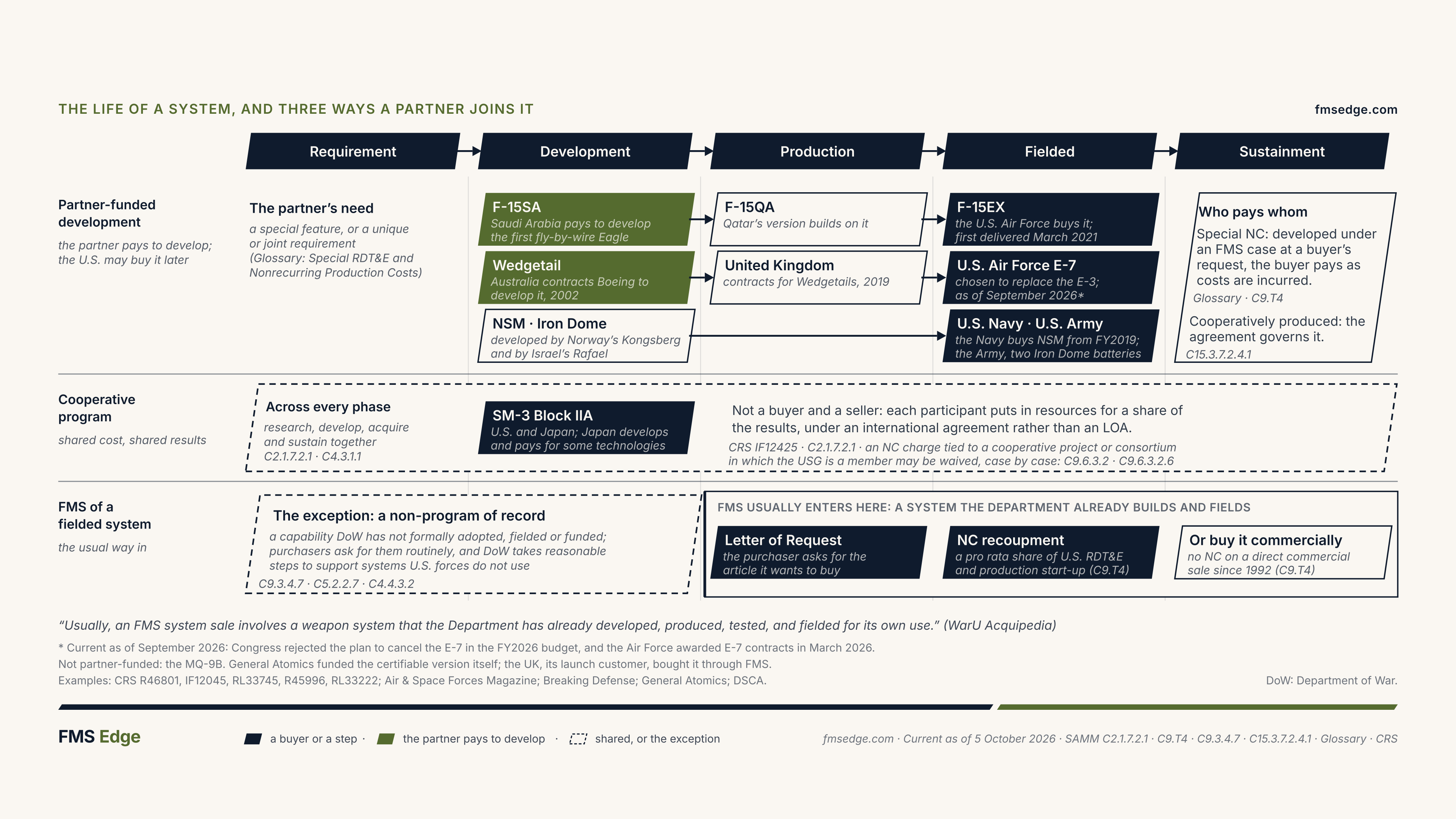
How does the Department of War acquire its weapon systems?
The Department of War acquires its weapon systems through the Defense Acquisition System, which turns a validated capability requirement that needs a materiel solution into an acquisition program led by a program manager and a program office.
The program predominately involves the sale of various defense systems that the Department of War (DoW) has already developed and deployed to its own forces. , by contrast, predominantly focuses on interfacing with international partners during the Research, Development, Test, and Evaluation (), production, operations, and sustainment phases of the U.S. systems acquisition process.
Like , seeks to enhance U.S. national security but does so through different methods. From the international partner’s perspective, both areas involve a defense relationship with the U.S. The international partner might not recognize the different management structure the U.S. applies to programs versus the management structure for programs.
The Under Secretary of War for Policy is responsible for oversight of and the rest of traditional . The Under Secretary of War for Acquisition and Sustainment, who also serves as the U.S. National Armaments Director, is responsible for [SAMM ].
Requirements come first
Validated capability requirements that need a materiel solution are managed to resolution through the Defense Acquisition System. The Defense Acquisition System is the management framework the DoW uses to develop, produce, and sustain weapon systems. The key system acquisition policy documents for the DoW (which are both posted on the Washington Headquarters Services website and accessible there via the applicable Issuances link) are:
- Directive 5000.01, (The Defense Acquisition System)
- Instruction 5000.02, (Operation of the Adaptive Acquisition Framework)
Program offices and oversight
The Defense Acquisition System divides its development program into Acquisition Categories (ACAT). These categories set the level and amount of oversight, the decision authority, and the procedures that apply to a program. An acquisition category is assigned to a program primarily by the expected program cost and/or level of interest. The Defense Acquisition Executive () reviews and decides the most complex and expensive acquisition programs. The is the Under Secretary of War for Acquisition and Sustainment (USW(A&S)). The Component Acquisition Executive (), the senior acquisition individual within each military service, reviews the next tier of programs (ACAT II). For the final tier (ACAT III), an individual designated by the makes the decisions. In the acquisition management structure, Program Executive Officers (PEOs) are individuals that typically have responsibility for overseeing one or more acquisition programs and report to the .
An acquisition program manager (PM) is responsible for leading a multidisciplinary team to manage all aspects of an individual acquisition program and for guiding the program toward meeting all cost, schedule, and system performance goals. An acquisition program management team typically includes functional experts from program management, systems engineering, testing, finance, contracting, logistics, information technology, and manufacturing.
With the support of the system program management office team, the program manager is responsible for leading the program through the remaining phases, decision reviews, and acquisition milestones of the defense acquisition system process. In addition, the program management office remains in place to manage all the technical and life-cycle sustainment aspects of the system after the system is delivered to U.S. forces. The program management office will also be responsible for acquiring any additional quantities for the DoW as well as potentially developing improved or modified configurations.
If the U.S. agrees to sell the system through , the acquisition will be accomplished with support by the same program management office that is managing the system for the DoW. The system program management office may acquire the requirements either as separate individual procurements or by consolidating the requirements with DoW requirements on the same U.S. contract.
Where Foreign Military Sales enters
The DoW should not wait until an is submitted to begin evaluating the various technology-transfer, exportability, and releasability issues. Under DoW system acquisition policy, these issues are examined concurrently with new system development. Under DoDI 5000.02, Program Managers consider acquisition strategies that use international acquisition and supportability planning to improve economies of scale, strengthen the defense , and enhance coalition partner capabilities to prepare for joint operations.
Under DoDI 5000.85, program managers integrate international acquisition and exportability planning into the acquisition strategy, from the program's entry milestone through every phase of the acquisition process. They design the system for export to foreign partners unless the milestone decision authority has approved a waiver for a U.S.-only design. A program whose system has export markets begins an exportability roadmap study no later than Milestone B. Under DoDI 5000.83, the program protection plan includes planning for exportability and potential foreign involvement.
Opportunities for with allied and friendly countries shall be addressed in the acquisition strategy for each planned DoW project, so that they are considered early in the formal development review process []. An International Acquisition and Exportability (IA&E) assessment, conducted early in the life cycle, prepares the program for this: it examines interoperability requirements, program protection, cooperative opportunities and international markets.
A sale of that has not completed operational test and evaluation (OT&E) and is not yet in full production carries additional requirements. The must include a case note on the risk, and the must tell the partner about the risk early, with all pricing correspondence [SAMM , ]. For the Major Capability Acquisition pathway, programs are typically generated during the last two phases (Production & Deployment, and Operations and Support) of the system-acquisition life cycle. Therefore, the key acquisition event from an perspective is OT&E completion, which precedes the Full Rate Production decision.
The reason for this policy concerns future supportability and interoperability issues. Prior to completion of OT&E and a Full Rate Production decision, there is the risk that the U.S. may decide not to produce the system. This would present an undesirable situation if the U.S. has committed under an to deliver a system to an customer but decided not to deliver this same system to U.S. forces. The customer would encounter a nonstandard support environment to sustain the system and might lack interoperability with U.S. forces [SAMM ].
Under DoDI 5000.85, a sale of through or Direct Commercial Sales () before OT&E is successfully completed needs the approval of the USW(A&S), known as a Yockey waiver.
The signed containing the mandatory Appendix 6 case note “OT&E Incomplete” is the official, legally binding record that the partner was notified of the risk and accepted it. To document that the early notification took place, the will enter a comment in the Defense Management System before it submits the case to the [SAMM ].
The end of the acquisition life cycle concerns disposal. An integral part of the system development effort is to plan for eventual demilitarization and disposal.
For the customer, the DoW decision to curtail or end operations of a given system can impact sustainment support. The components of the system may transition from being standard to nonstandard items. The DoW will take reasonable steps to support systems that U.S. forces do not use, including items they never adopted. Such support is provided once mutually satisfactory arrangements have been made with the country concerned and supply sources are available [SAMM ].
References
SAMM
- SAMM C5.3.3.1: Early Risk Communication.
- SAMM C4.4.3.2
- SAMM C2.1.7.2.2
- SAMM C5.3.3: Operational Test and Evaluation Incomplete Sales Policy.
- SAMM C5.3.3.2: Recordkeeping.
- SAMM C4.4.3: Logistics Support.
Public authorities
- Joint requirements memo, 20 Aug 2025: Secretary of Defense and Deputy Secretary of Defense memorandum, 20 August 2025, "Reforming the Joint Requirements Process to Accelerate Fielding of Warfighting Capabilities"
- Acquisition transformation memo, 7 Nov 2025: Secretary of War memorandum, 7 November 2025, "Transforming the Defense Acquisition System into the Warfighting Acquisition System to Accelerate Fielding of Urgently Needed Capabilities to Our Warriors"
- 10 U.S.C. 2350a: 10 U.S.C. §2350a, Cooperative research and development agreements: NATO organizations; allied and friendly foreign countries
- DoDI 5000.85: DoD Instruction 5000.85, Major Capability Acquisition, 6 August 2020, Change 1, 4 November 2021
- DoDI 5000.83: DoD Instruction 5000.83, Technology and Program Protection to Maintain Technological Advantage, 20 July 2020, Change 1, 21 May 2021
- WarU International Acquisition & Exportability (IA&E) Assessment JST: Warfighting Acquisition University (WarU), International Acquisition & Exportability (IA&E) Assessment Job Support Tool (JST), April 2026
Related
Foreign Military Sales (FMS)
The part of U.S. security assistance, authorized by the Arms Export Control Act (AECA), in which eligible foreign governments and international organizations buy defense articles, services and training from the U.S. Government under formal government-to-government agreements.
The articles come either from Department of War stocks or from new procurement under contracts the Department manages [22 U.S.C. 2761, 22 U.S.C. 2762]. A sale is FMS whatever the source of the purchaser's financing.
FMS Edge glossary, as of 10 October 2026
Glossary entry →Open the manual’s entry → (opens in new tab)
Letter of Request (LOR)
The term used to identify a request from an eligible FMS participant country for the purchase of U.S. defense articles and services. The request may be in message or letter format.
SAMM Glossary, as of 12 September 2026
Glossary entry →Open the manual’s entry → (opens in new tab)
International Armaments Cooperation (IAC)
Programs and activities through which the United States works with allied and friendly countries to promote rationalization, standardization and interoperability, usually under written bilateral or multilateral agreements that set each party's responsibilities for shared projects or exchanges.
International Armaments Cooperation (IAC) covers U.S. cooperation with other countries and international organizations to research, develop, acquire and sustain military systems, including the Information Exchange Program, the Engineer and Scientist Exchange Program, foreign comparative testing and cooperative logistics [SAMM C2.1.7.2.1].
FMS Edge glossary, as of 10 October 2026
Glossary entry →Open the manual’s entry → (opens in new tab)
RDT&E: Research, Development, Test, and Evaluation
SAMM Acronyms, as of 12 September 2026
Security Assistance (SA)
A group of programs authorized by federal statutes by which the United States provides defense articles, military training, and other defense-related services by grant, lease, loan, credit, or cash sales in furtherance of national policies and objectives, and those that are funded and authorized through the Department of State to be administered by Department of Defense/Defense Security Cooperation Agency, which are considered part of security cooperation.
SAMM Glossary, as of 12 September 2026
Glossary entry →Open the manual’s entry → (opens in new tab)
IAC: International Armaments Cooperation
SAMM Acronyms, as of 12 September 2026
FMS: Foreign Military Sale
SAMM Acronyms, as of 12 September 2026
DAE: Defense Acquisition Executive
CAE: Component Acquisition Executive
Industrial Base
The part of a national economy that manufactures and maintains goods, chiefly through factories, maintenance facilities, processing plants and laboratories, whether privately or government owned. For U.S. defense it is the public facilities, academic institutions and commercial companies that research, develop, produce, deliver and maintain weapon systems and their parts for the U.S. military, together with closely connected capacity in Canada.
FMS Edge glossary, as of 10 October 2026
Glossary entry →Open the manual’s entry → (opens in new tab)
Cooperative Research and Development
A project in which the United States and one or more other countries or organizations jointly carry out research and development on new conventional defense equipment and munitions, or modify existing equipment to meet U.S. military requirements. The partners work under a memorandum of understanding or another formal agreement. Governments use it to make better use of their combined research and development resources, through technical data exchanges and co-development of new systems.
FMS Edge glossary, as of 10 October 2026
Glossary entry →Open the manual’s entry → (opens in new tab)
Major Defense Equipment (MDE)
Any item of Significant Military Equipment on the U.S. Munitions List having a nonrecurring research and development cost of more than $50 million or a total production cost of more than $200 million. Also defined in section 47 (6), Arms Export Control Act.
SAMM Glossary, as of 12 September 2026
Glossary entry →Open the manual’s entry → (opens in new tab)
Letter of Offer and Acceptance (LOA)
The legal instrument that lists the defense articles and services, including training, that the U.S. Government transfers to a foreign country or international organization, with their estimated costs and the terms and conditions. The benefitting partner does not sign a Building Partner Capacity (BPC) LOA.
The Letter of Offer and Acceptance (LOA) is the instrument the U.S. Government uses to sell under the Arms Export Control Act (AECA); signed LOAs and their later Amendments and Modifications are also called Foreign Military Sales (FMS) cases [SAMM C5.6.1].
FMS Edge glossary, as of 10 October 2026
Glossary entry →Open the manual’s entry → (opens in new tab)
Implementing Agency (IA)
The military department or defense agency responsible for the execution of military assistance programs. With respect to FMS, the military department or defense agency assigned responsibility by the Defense Security Cooperation Agency to prepare an LOA and to implement an FMS case. The implementing agency is responsible for the overall management of the actions that will result in delivery of the materials or services set forth in the LOA that was accepted by a foreign country or international organization.
SAMM Glossary, as of 12 September 2026
Glossary entry →Open the manual’s entry → (opens in new tab)
LOA: Letter of Offer and Acceptance
SAMM Acronyms, as of 12 September 2026
DCS: Direct Commercial Sales
SAMM Acronyms, as of 12 September 2026
Defense Security Cooperation Agency (DSCA)
The Department of War agency that directs, administers and provides guidance to the Department's components and its representatives at U.S. missions for the execution of the security cooperation programs for which it is responsible [SAMM C1.3.2.2]. The agency also provides financial and technical assistance, arranges the transfer of defense materiel, training and services to international partners, and promotes military-to-military contacts.
FMS Edge glossary, as of 10 October 2026
Glossary entry →Open the manual’s entry → (opens in new tab)
SAMM C2.1.7.2.2
“While oversight for the FMS and other traditional SA is the responsibility of the Under Secretary of War for Policy (USW(P)), IAC is the responsibility of the Under Secretary of War for Acquisition and Sustainment (USW(A&S) who also serves as the U.S. National Armaments Director (NAD).”
Security Assistance Management Manual, as of 26 October 2026
10 U.S.C. §2350a, Cooperative research and development agreements: NATO organizations; allied and friendly foreign countries
10 U.S.C. 2350a · Statute
SAMM C5.3.3: Operational Test and Evaluation Incomplete Sales Policy.
“FMS cases with MDE that has not sufficiently completed U.S. Government testing and is not yet in full production (i.e., has not satisfactorily completed Operational Testing and Evaluation (OT&E) in accordance with DoD Instruction (DoDI) 5000.85) have additional requirements. LOAs require a case note (see Appendix 6 Operational Test and Evaluation (OT&E) Incomplete LOA Note). Additionally, the Implementing Agencies (IAs) …”
Security Assistance Management Manual, as of 5 October 2026
SAMM C5.3.3.1: Early Risk Communication.
“For Foreign Military Sales (FMS) cases containing MDE that has not satisfactorily completed OT&E in accordance with DoDI 5000.85, the IAs will communicate to the partner the risk associated with the procurement. This early communication is in addition to the required case note in the LOA. The IA must communicate the risk associated with the procurement with all pricing correspondence …”
Security Assistance Management Manual, as of 5 October 2026
SAMM C5.3.3.2: Recordkeeping.
“The signed LOA containing the mandatory case note (see Appendix 6 Operational Test and Evaluation (OT&E) Incomplete LOA Note) serves as the official, legally binding record of risk notification and partner acceptance. To document that early notification of the risk occurred, the IA will enter a comment in DSAMS prior to submitting the case to DSCA.”
Security Assistance Management Manual, as of 5 October 2026
SAMM C4.4.3.2
“DoW will take reasonable steps to support systems that are not used by U.S. Forces including items that were never adopted by U.S. Forces. Support is provided for these items when mutually satisfactory arrangements are made with the country involved and supply sources are available. Effort is made to support non-standard items, whether acquired commercially or through FMS, when this …”
Security Assistance Management Manual, as of 26 October 2026