
Guide
What is technology security and foreign disclosure (TSFD) review?
and is the set of Department of War reviews that decide whether military technology and classified information may be released to a foreign partner. The Department of War conducts the national security reviews, while the authority to authorize a transfer rests with the Departments of and Commerce. High-level release requests go to a senior steering group, and disclosure authorities decide case by case whether classified information can be disclosed.
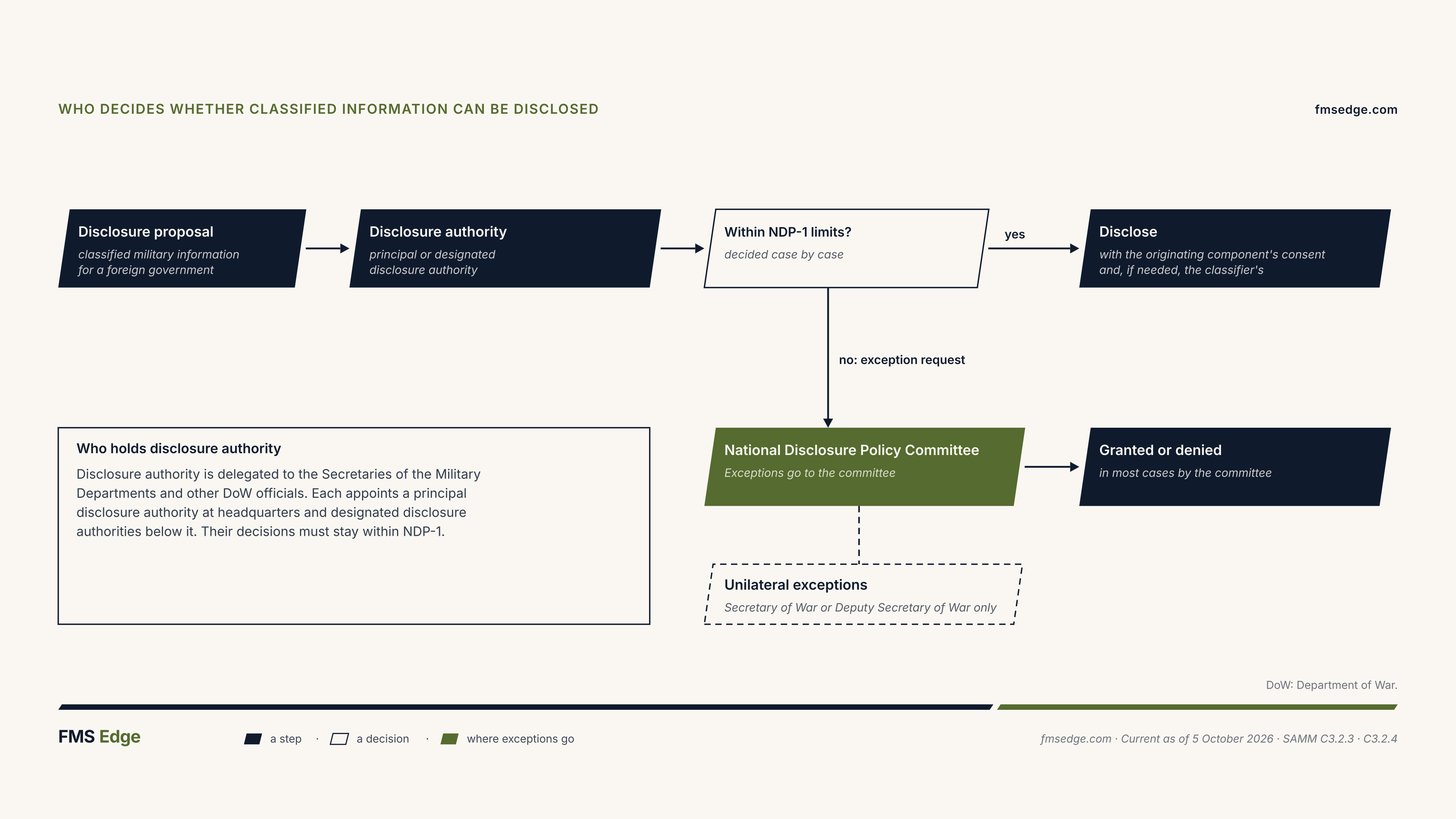
A principal or designated disclosure authority decides each proposal to disclose classified military information to a foreign government against the limits of the National Disclosure Policy (NDP-1). An exception beyond those limits goes to the National Disclosure Policy Committee.
What is technology security and foreign disclosure?
and is the set of Department of War review processes that decide whether U.S. military technology and classified military information may be released to a foreign partner. DoDI 2040.02 requires the department to protect defense-related technology and to transfer it only in pursuit of national security and foreign policy objectives, weighing them before any commitment to disclose or release it [SAMM ]. Classified military information must be protected and shared with a foreign government only when the United States gains a clearly defined benefit, when officials designated for the purpose authorize it, and when every requirement of the disclosure policy is met [SAMM ].
Technology transfer in the simplest form is the transfer of technology from one source to another; it is agnostic of the method or manner in which the transfer takes place. seeks to securely transfer this technology from the source or origin to another authorized recipient. The United States uses various laws, regulations, and policies to protect technology. DODI 2040.02 establishes the Department of War (DoW) policy on international transfers, assigns responsibilities within the Department, and prescribes the procedures for transfers.
The Department of War is responsible for conducting national security reviews in order to provide policy and regulatory guidance on U.S. transfers or exports. These national security reviews include the complete spectrum from broad strategic reviews down to individual transactional reviews. The DoW does not have the authority to authorize transfers; that authority lies solely with the Departments of and Commerce. All transfers under and () programs undergo national security and foreign policy reviews as a matter of law and policy. The , Chapter 3, “Technology Transfer and Disclosure,” is a reference when working technology transfer and disclosure aspects of and programs or activities.
For a case that requires Congressional Notification () under Section 36(b) of the , Table C5.T22 sets out specific releasability review and approval requirements. They must be met before the notification, and the must reflect them before it is offered [SAMM ].
Within the DoW, the processes and procedures that bear on the approval to export military technology have been codified and mapped as the and review processes.
Several separate but related and (TSFD) processes support DoW release decisions. Additionally, each and many DoW agencies have internal review processes for approving the transfer of capabilities and technologies within their purview.
Under DoDI 5000.85, a program that holds classified information or Controlled Unclassified Information () and is pursuing an international cooperative program obtains a delegation of disclosure authority letter before it enters discussions with potential foreign partners. The letter, or other written authorization, comes from the DoW component's office. In preparing for an international acquisition effort, program managers should consult the and authorities, such as a principal or designated disclosure authority, on whether such information can be disclosed to other governments or international organizations.
The Deputy Secretary of War has empowered the Arms Transfer and Senior Steering Group (ATTR SSG) as the primary forum for review and adjudication of High Level Decision (HLD) TSFD release requests. The ATTR SSG has been charged with streamlining and harmonizing DoW TSFD release processes. The ATTR SSG develops, guides, and directs (consistent with U.S. policy and national security objectives) DoW-wide reform, implementation, and subsequent management of the DoW TSFD system, and ensures critical U.S. technologies are protected, and release considerations are balanced with building allied and international partner capability objectives.
Principal Disclosure Authorities () and Designated Disclosure Authorities () evaluate each proposal to disclose classified information about defense articles and services case by case, under the National Disclosure Policy (), regulations and the DoW directive on disclosing classified military information. An affirmative decision requires the consent of the or who represents the DoW Component where the information originated [SAMM ]. Where the originator has not already marked the information as releasable to the intended recipient government or international organization, the decision also requires the written consent of the official with original classification authority for it [SAMM ].
The or must also make sure that the disclosure criteria, conditions and limitations in the DoW directive on disclosing classified military information are satisfied, including that a bilateral General Security Agreement () on the mutual protection of classified information is in place. Without a , the security requirements may be set out in a program agreement, such as a for co-production or cooperative development, or in a program-specific security agreement of the kind Section C3.2.6 describes. Every authorization to disclose classified information goes on record in the National Disclosure Policy System (). In-country release of all information to a purchaser must be approved by the chief of the U.S. diplomatic mission [SAMM ].
References
SAMM
- SAMM C3.1.1
- SAMM C3.2.1: Policy on Disclosure of Classified Military Information to Foreign Government and International Organizations.
- SAMM C3.1.1.1
- SAMM C3.2.4: Disclosure Decisions.
Public authorities
- DoDI 5000.85: DoD Instruction 5000.85, Major Capability Acquisition, 6 August 2020, Change 1, 4 November 2021
Related
Technology Security
The comprehensive framework of policies, practices, and procedures designed to protect U.S. military and dual-use technologies from unauthorized access, transfer, or exploitation by adversaries.
SAMM Glossary, as of 26 October 2026
Foreign Disclosure
The authorized release or transfer of classified or controlled unclassified information (CUI) from the U.S. government to foreign governments, international organizations, or foreign nationals. This process is governed by strict policies and procedures to ensure that the release of information aligns with U.S. national security and foreign policy objectives.
SAMM Glossary, as of 26 October 2026
Glossary entry →Open the manual’s entry → (opens in new tab)
Security Assistance (SA)
A group of programs authorized by federal statutes by which the United States provides defense articles, military training, and other defense-related services by grant, lease, loan, credit, or cash sales in furtherance of national policies and objectives, and those that are funded and authorized through the Department of State to be administered by Department of Defense/Defense Security Cooperation Agency, which are considered part of security cooperation.
SAMM Glossary, as of 12 September 2026
Glossary entry →Open the manual’s entry → (opens in new tab)
Security Cooperation
Activities by which the Department of War encourages and enables international partners to cooperate with the United States toward strategic objectives, spanning every interaction with foreign defense and security establishments and every security assistance program the Department administers.
Under chapter 16 of Title 10, their purposes are to develop allied and friendly security capabilities for self-defense and multinational operations, to give U.S. forces peacetime and contingency access, and to build relationships promoting specific U.S. security interests [10 U.S.C. 301(7)].
FMS Edge glossary, as of 10 October 2026
Glossary entry →Open the manual’s entry → (opens in new tab)
Security Assistance Management Manual (SAMM)
DSCA Manual 5105.38-M required under DoD Directive 5105.65, "Defense Security Cooperation Agency" mandatory for use by all DoD Components. The SAMM provides DoD-wide guidance to the Office of the Secretary of Defense (OSD), the Military Departments (MILDEPs), the Office of the Chairman of the Joint Chiefs of Staff and the Joint Staff, the Combatant Commands, the Defense Agencies, the DoD Field Activities, the Security Cooperation Organizations (SCOs), and all other organizational entities within the DoD engaged in the management or implementation of DoD Security Assistance and Security Cooperation programs over which DSCA has responsibility.
SAMM Glossary, as of 12 September 2026
Glossary entry →Open the manual’s entry → (opens in new tab)
Arms Export Control Act (AECA)
The basic U.S. law providing the authority and general rules for the conduct of Foreign Military Sales and commercial sales of defense articles, defense services, and training. The Arms Export Control Act (AECA) came into existence with the passage of the Foreign Military Sales Act (FMSA) of 1968. An amendment in the International Security Assistance and AECA of 1976 changed the name of FMSA to the AECA.
SAMM Glossary, as of 12 September 2026
Glossary entry →Open the manual’s entry → (opens in new tab)
Letter of Offer and Acceptance (LOA)
The legal instrument that lists the defense articles and services, including training, that the U.S. Government transfers to a foreign country or international organization, with their estimated costs and the terms and conditions. The benefitting partner does not sign a Building Partner Capacity (BPC) LOA.
The Letter of Offer and Acceptance (LOA) is the instrument the U.S. Government uses to sell under the Arms Export Control Act (AECA); signed LOAs and their later Amendments and Modifications are also called Foreign Military Sales (FMS) cases [SAMM C5.6.1].
FMS Edge glossary, as of 10 October 2026
Glossary entry →Open the manual’s entry → (opens in new tab)
Military Department (MILDEP)
One of the departments within the DoD created by the National Security Act of 1947, as amended. The Military Departments are: the Department of the Air Force, the Department of the Army, and the Department of the Navy.
SAMM Glossary, as of 12 September 2026
Glossary entry →Open the manual’s entry → (opens in new tab)
Technology Release
The formal U.S. Government decision processes that seek approval to transfer specific defense items, technical data, or defense services to a foreign partner pursuant to Foreign Military Sales, Direct Commercial Sales, or Cooperative Agreements.
SAMM Glossary, as of 26 October 2026
Glossary entry →Open the manual’s entry → (opens in new tab)
Memorandum of Understanding (MOU)
An arrangement between sovereign states or their executive agencies, or international organizations, that is not legally binding under international law.
SAMM Glossary, as of 12 September 2026
Glossary entry →Open the manual’s entry → (opens in new tab)
SAMM C3.1.1
“DoD Instruction (DoDI) 2040.02 “International Transfers of Technology, Articles, and Services,” requires that the DoW treat dual-use and defense-related technology as valuable national security resources, to be protected and transferred only in pursuit of national security and foreign policy objectives. These objectives include ensuring that: critical U.S. military technological advantages are preserved; transfers that could prove detrimental to U.S. security …”
Security Assistance Management Manual, as of 5 October 2026
SAMM C3.2.1: Policy on Disclosure of Classified Military Information to Foreign Government and International Organizations.
“DoD Directive (DoDD) 5230.11 implements National Disclosure Policy (NDP-1). It is U.S. national and DoW policy that Classified Military Information (CMI) is a national security asset that must be protected and shared with foreign governments only when there is a clearly defined benefit to the United States, when authorized by officials designated under the Directive and then only when all …”
Security Assistance Management Manual, as of 5 October 2026
SAMM C3.1.1.1
“Technology Transfer Requirements prior to Congressional Notification. Table C5.T21. identifies specific releasability review and approval requirements, which must be met prior to Arms Export Control Act (AECA) Section 36(b) Congressional Notification (CN), for those cases that require notification. The Letter of Offer and Acceptance (LOA) must reflect the approval requirements prior to offer.”
Security Assistance Management Manual, as of 5 October 2026
SAMM C3.2.4: Disclosure Decisions.
“PDAs or DDAs evaluate proposals for disclosure of classified information relating to defense articles and services on a case-by-case basis in accordance with NDP-1, DoDD 5230.11, and MILDEP regulations. An affirmative disclosure decision requires consent of the PDA or DDA representing the DoW Component that originated the information and the written consent of the official having original classification authority for …”
Security Assistance Management Manual, as of 5 October 2026