
Guide
What is the National Disclosure Policy in Foreign Military Sales?
The National Disclosure Policy is the framework for approving or denying the release of classified military information to foreign governments. Disclosure authorities decide each proposal case by case under and the Department of War directive on disclosing classified military information, and the National Disclosure Policy Committee grants or denies most exceptions. When a sale would require classified information, disclosure must be approved before the system is offered or even priced.
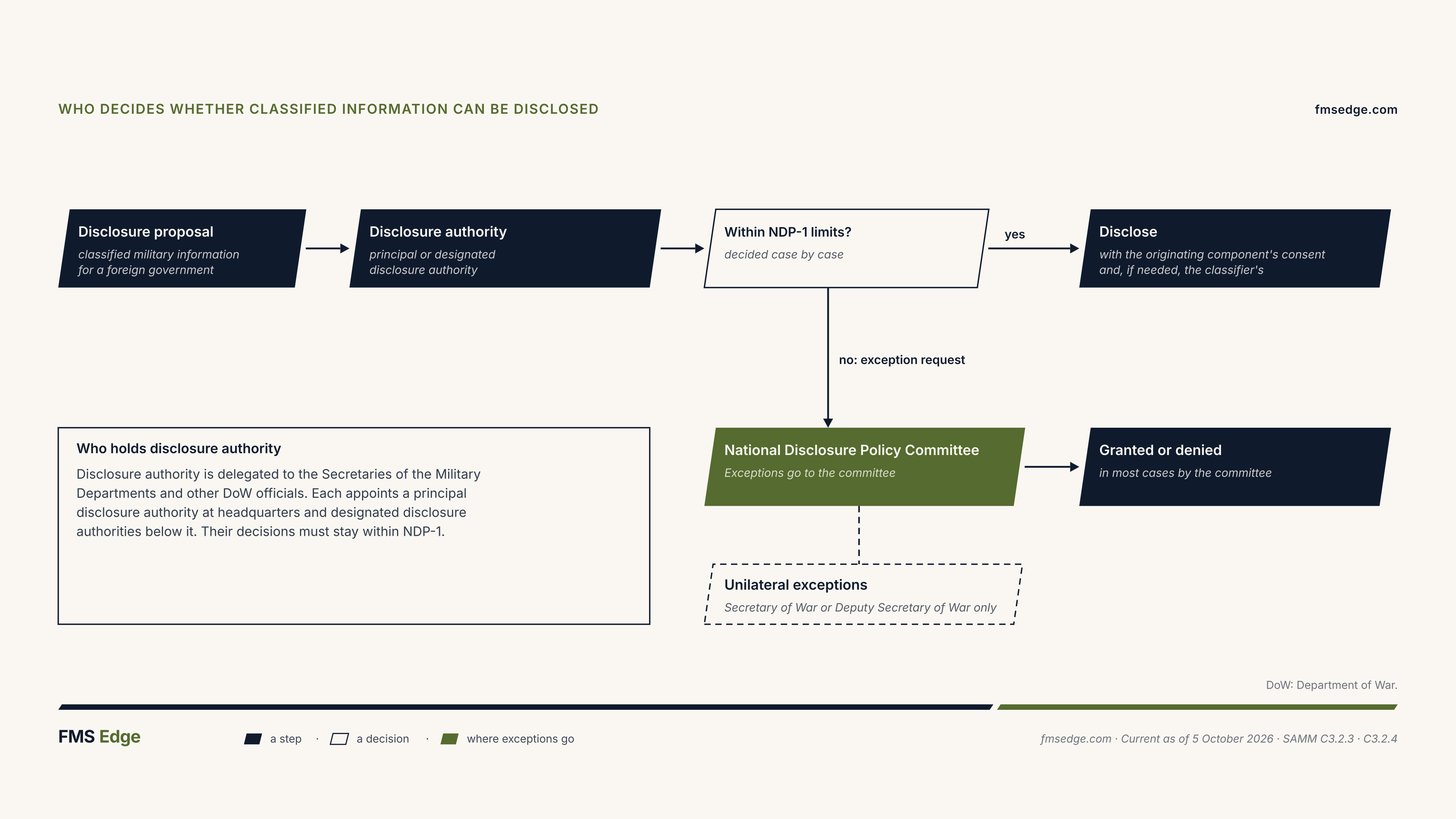
A principal or designated disclosure authority decides each proposal to disclose classified military information to a foreign government against the limits of the National Disclosure Policy (NDP-1). An exception beyond those limits goes to the National Disclosure Policy Committee.
What is the National Disclosure Policy in Foreign Military Sales?
The National Disclosure Policy () was established as a framework for the approval or denial of the transfer of Classified Military Information () to foreign governments and international organizations. Basic authority and policy for transferring are contained in National Security Decision Memorandum () 119, which is implemented by the classified publication, National Policy and Procedures for Disclosure of Classified Military Information to Foreign Governments and International Organizations, short title .
The is the interagency document that implements the core U.S. policy for the disclosure of . It promulgates U.S. policy in the form of specific disclosure criteria and limitations, procedures for handling exceptions to policy, and other guidance governing disclosure decisions of .
The Department of War (DoW) directive on disclosing classified military information implements the National Disclosure Policy within the DoW [SAMM ].
Who decides what can be disclosed?
Disclosure decisions are made by officials holding delegated authority: a Principal Disclosure Authority at component headquarters and Designated Disclosure Authorities below it [SAMM ].
The Secretaries of the Military Departments and the other DoW officials to whom the Secretary of War has delegated disclosure authority, and whose decisions must comply with , are required to appoint two kinds of disclosure official. A Principal Disclosure Authority () at component headquarters level oversees the disclosure process. A Designated Disclosure Authority () at each subordinate command and agency level oversees disclosure decisions at that level when disclosure authority has been delegated. A or must authorize any commitment to disclose or to release controlled defense-related information or technology, unless a Delegation of Disclosure Authority Letter () has delegated that authority [SAMM ]. Only the Secretary of War and the Deputy Secretary of War may grant a unilateral exception to , although in most cases the National Disclosure Policy Committee () grants or denies exceptions to policy [SAMM ].
Under , the interagency National Disclosure Policy Committee () is the central authority for formulating, promulgating, administering, and monitoring national disclosure policy [SAMM ]. General members of the include the following:
- Secretary of
- Secretary of War (appoints Chairman)
- Secretary of the Army
- Secretary of the Navy
- Secretary of the Air Force
- Chairman, Joint Chiefs of Staff
On a day-to-day basis, these officials are represented in decisions by designated senior officials on their staff. general members have a broad interest in all committee activities and vote on all issues that come before the committee. Other members (such as the Director of National Intelligence and the Secretary of Energy) may vote on issues in which they have a direct interest.
What must be true before classified information is released?
Classified Military Information () may be shared with a foreign government only when the United States gains a clearly defined benefit and officials designated under the DoW directive on disclosing classified military information authorize the release. All requirements of the directive must also be met. U.S. national and DoW policy treats as a national security asset that must be protected [SAMM ].
Under the DoW directive on disclosing classified military information, the Secretary of War has delegated disclosure authority both to the Secretaries of the Military Departments () and to other DoW officials. Their decisions must comply with [SAMM ]. That directive contains the policy and guidance for implementing [SAMM ]. , by itself, does not authorize any disclosures. The Annex (classified) identifies the maximum classification level of information that can be released by country and by category of classified military information. The directive states that the will release in accordance with the Annex only if all of the following five conditions or criteria, originally outlined in 119, are met:
1. Disclosure is consistent with U.S. foreign policy and national security objectives.
2. Disclosures, if compromised, will not constitute an unreasonable risk to the U.S. position in military technology or operational capabilities.
3. The foreign recipient of the information will afford it substantially the same degree of security protection given to it by the U.S. The intent of a foreign government to protect U.S. is established, in part, by the negotiation of general security agreements.
4. Disclosure will result in benefits to the U.S. at least equivalent to the value of the information disclosed.
5. The disclosure is limited to information necessary to accomplish the purpose for which disclosure was authorized.
If the classification of the information proposed for disclosure exceeds the country’s eligibility in the Annex, or if the policy criteria cannot be met, then the proposed disclosure must be denied unless an Exception to National Disclosure Policy () is granted [SAMM , ]. Moreover, even if the U.S. disclosure official has determined that eligibility in the Annex exists and that all policy criteria have been met, disclosures of may not be made until the affected originator’s approval has been obtained or appropriate authority to disclose has been received [SAMM , ].
and weigh each proposal to disclose classified information about defense articles and services case by case, under , regulations and the DoW directive on disclosing classified military information. An affirmative decision requires the consent of the or who speaks for the DoW Component where the information originated [SAMM ]. Where the originator has not already marked the information for disclosure to the intended recipient government or international organization, the decision also requires the written consent of the official with original classification authority for that information [SAMM ].
The or must also make sure that the criteria, conditions and limitations in the DoW directive on disclosing classified military information are satisfied, including that a bilateral General Security Agreement () on the mutual protection of classified information is in place [SAMM ]. Without a , the security requirements may be set out in a program agreement, such as a for co-production or cooperative development, or in a program-specific security agreement. For that kind of agreement, the manual points to C3.2.6. Each authorization to disclose classified information is recorded in the National Disclosure Policy System (). The in-country release of all information to a purchaser must be approved by the chief of the U.S. diplomatic mission [SAMM ].
In addition to making determinations on the release of , the also conducts security surveys (also called security visits) of foreign governments or international organizations. teams conduct periodic visits to foreign governments and their national industrial bases to assess capability and intent to protect U.S.-origin . The teams are usually made up of members of the Department of State and DoW. The primary areas reviewed by the teams are personnel security, , industrial security and physical security. The views of the local U.S. embassy are also sought. If the result of a survey is satisfactory, it may result in an international security agreement with the other government. A survey may also result in changes to the classified annex in concerning a country’s classification and eligibility for without engaging the process.
What is an exception to National Disclosure Policy?
When an exception to () is required, because disclosure criteria cannot be met within the existing authorized classification level, such exceptions may be granted only by the , the Secretary of War, or the Deputy Secretary of War [SAMM ]. An member, normally the cognizant for the classified information proposed for transfer, sponsors a request for an . For military weapon systems, this is normally the that has developed and produced the system.
The Secretary of War and the Deputy Secretary of War are the only officials who may grant unilateral exceptions to the [SAMM ]. All disclosure authority rests in the first instance with the head of the department or agency that originates the information, and each disclosure official confirms holding the required authority before disclosing the information in question.
Why is there no pricing before disclosure is approved?
The release of unclassified data must be authorized in advance when it would lead to the eventual disclosure of . Designated disclosure officials of the originating agencies, or the , give that authorization for any such proposal. It must also be stated explicitly, and acknowledged, that no U.S. commitment to furnish classified information or materiel is intended or implied until disclosure is approved [SAMM ].
It is the policy of the U.S. to avoid creating false impressions of its intention to provide classified military material, technology, or information. Much military hardware is unclassified; however, this same unclassified hardware, if sold, may require the release of classified information for its operation or maintenance, or for the foreign recipient training [SAMM ]. Therefore, a disclosure decision rests on the classification level of all the information that would be required for release if the system were transferred. This means that there can be no weapon-specific information, and no release of data until authority is obtained to release the highest level of classified information ultimately required for disclosure.
The same advance authorization applies to any proposal to a foreign government or international organization that grows out of initial planning by the United States, alone or jointly with the proposed recipient, and will lead to the eventual disclosure of [SAMM ]. Some classified information, such as sensitive compartmented information () and information, may require approval from outside DoW and the [SAMM ].
Disclosure planning before a Letter of Request
Under the DoW directive on disclosing classified military information, planning for possible foreign involvement should start at the beginning of the acquisition process, to facilitate decisions on disclosure in support of foreign sales or cooperative programs.
When no formal is available, a Pre- Assessment Request () serves in place of an and as grounds for the to initiate applicable and release processes. However, a cannot be used as an for any purpose other than initiating the and release processes [SAMM ].
In the preparation of the , the should compile the information described in Table C3.T2 and consult with the relevant and for releasability and technical information. When complete, the forwards the to the . Because the is an extraordinary process, a endorsement is required in each case to support initiation of the and (TSFD) release processes. The provides comments on each of the elements addressed in the in the endorsement, and forwards the and endorsement to the Joint Staff, the applicable , and the . This process forms the basis for a collaborative effort to analyze the recipient nation’s military requirements, in order to identify a capability that fulfills those requirements and initiates the DoW’s TSFD processes to meet the partner’s acquisition needs [SAMM ].
It is DoW policy to treat defense-related technology as a valuable national security resource to be protected and transferred only in pursuit of national security and foreign policy objectives [SAMM ].
References
SAMM
- SAMM C3.2.4: Disclosure Decisions.
- SAMM C3.1.2: Pre-Letter of Request Assessment Requests for Classified and Advanced Technology Release Decisions in Support of Security Cooperation Initiatives and Competitions.
- SAMM C3.1.2.2
- SAMM C3.1.1
- SAMM C3.2.1: Policy on Disclosure of Classified Military Information to Foreign Government and International Organizations.
- SAMM C3.2.2: Avoiding False Impressions.
- SAMM C3.2.3: Disclosure Authorities.
Related
NSDM: National Security Decision Memorandum
DDL: Delegation of Disclosure Authority Letter
SAMM Acronyms, as of 12 September 2026
Military Department (MILDEP)
One of the departments within the DoD created by the National Security Act of 1947, as amended. The Military Departments are: the Department of the Air Force, the Department of the Army, and the Department of the Navy.
SAMM Glossary, as of 12 September 2026
Glossary entry →Open the manual’s entry → (opens in new tab)
Memorandum of Understanding (MOU)
An arrangement between sovereign states or their executive agencies, or international organizations, that is not legally binding under international law.
SAMM Glossary, as of 12 September 2026
Glossary entry →Open the manual’s entry → (opens in new tab)
SAMM: Security Assistance Management Manual
SAMM Acronyms, as of 12 September 2026
Glossary entry →Security Assistance Management Manual (SAMM) →
Security Assistance (SA)
A group of programs authorized by federal statutes by which the United States provides defense articles, military training, and other defense-related services by grant, lease, loan, credit, or cash sales in furtherance of national policies and objectives, and those that are funded and authorized through the Department of State to be administered by Department of Defense/Defense Security Cooperation Agency, which are considered part of security cooperation.
SAMM Glossary, as of 12 September 2026
Glossary entry →Open the manual’s entry → (opens in new tab)
Information Security (INFOSEC)
The protection of information systems against unauthorized access to or modification of information, whether in storage, processing, or transit, and against the denial of service to authorized users, including those measures necessary to detect, document and counter such threat. INFOSEC is applied through the application of Cybersecurity and Communications Security (COMSEC).
SAMM Glossary, as of 12 September 2026
Glossary entry →Open the manual’s entry → (opens in new tab)
Price and Availability (P&A)
Preliminary pricing and availability estimates for articles or services that an Implementing Agency (IA) prepares at the request of a foreign government or international organization for an international competition, or of a U.S. Government requesting authority for building partner capacity.
Price and Availability (P&A) responses are estimates of cost and availability, not valid for preparing a Letter of Offer and Acceptance (LOA), and furnishing them does not commit the U.S. Government to offer the articles or services for sale [SAMM C5.5.2, C5.5.1].
FMS Edge glossary, as of 10 October 2026
Glossary entry →Open the manual’s entry → (opens in new tab)
Foreign Military Sales (FMS)
The part of U.S. security assistance, authorized by the Arms Export Control Act (AECA), in which eligible foreign governments and international organizations buy defense articles, services and training from the U.S. Government under formal government-to-government agreements.
The articles come either from Department of War stocks or from new procurement under contracts the Department manages [22 U.S.C. 2761, 22 U.S.C. 2762]. A sale is FMS whatever the source of the purchaser's financing.
FMS Edge glossary, as of 10 October 2026
Glossary entry →Open the manual’s entry → (opens in new tab)
P&A: Price and Availability
SAMM Acronyms, as of 12 September 2026
Communications Security (COMSEC)
The measures and controls taken to deny unauthorized persons’ information derived from telecommunications and other information systems, and technologies necessary to ensure the authenticity of such communications. COMSEC includes cryptographic security, transmission security, emissions security, and physical security of COMSEC material. Secure telecommunication or information system cryptographic components are the primary COMSEC products for transmission security and commonly called COMSEC devices or products. COMSEC devices are designated Controlled Cryptographic Items (CCI).
SAMM Glossary, as of 12 September 2026
Glossary entry →Open the manual’s entry → (opens in new tab)
Weapon System
A combination of one or more weapons with all related equipment, materials, services, personnel, and means of delivery and deployment (if applicable) required for self-sufficiency.
SAMM Glossary, as of 12 September 2026
Glossary entry →Open the manual’s entry → (opens in new tab)
Letter of Request (LOR)
The term used to identify a request from an eligible FMS participant country for the purchase of U.S. defense articles and services. The request may be in message or letter format.
SAMM Glossary, as of 12 September 2026
Glossary entry →Open the manual’s entry → (opens in new tab)
LOR: Letter of Request
SAMM Acronyms, as of 12 September 2026
Country Team Assessment (CTA)
A USG coordinated position of senior U.S. embassy leadership that includes an assessment of a proposed transfer and provides key information necessary for USG evaluation. CTAs can be provided as published cables or dated memos on embassy letterhead and signed by a member of the country team.
SAMM Glossary, as of 12 September 2026
Glossary entry →Open the manual’s entry → (opens in new tab)
Implementing Agency (IA)
The military department or defense agency responsible for the execution of military assistance programs. With respect to FMS, the military department or defense agency assigned responsibility by the Defense Security Cooperation Agency to prepare an LOA and to implement an FMS case. The implementing agency is responsible for the overall management of the actions that will result in delivery of the materials or services set forth in the LOA that was accepted by a foreign country or international organization.
SAMM Glossary, as of 12 September 2026
Glossary entry →Open the manual’s entry → (opens in new tab)
Foreign Disclosure
The authorized release or transfer of classified or controlled unclassified information (CUI) from the U.S. government to foreign governments, international organizations, or foreign nationals. This process is governed by strict policies and procedures to ensure that the release of information aligns with U.S. national security and foreign policy objectives.
SAMM Glossary, as of 26 October 2026
Glossary entry →Open the manual’s entry → (opens in new tab)
Technology Security
The comprehensive framework of policies, practices, and procedures designed to protect U.S. military and dual-use technologies from unauthorized access, transfer, or exploitation by adversaries.
SAMM Glossary, as of 26 October 2026
Security Cooperation Organization (SCO)
A Department of Defense element that is part of the United States Diplomatic mission located in a foreign country to carry out security assistance and security cooperation management functions under the supervision and coordination authority of the senior defense official/defense attaché.
SAMM Glossary, as of 12 September 2026
Glossary entry →Open the manual’s entry → (opens in new tab)
Combatant Command (CCMD)
A unified or specified command with a broad continuing mission under a single commander established and so designated by the President, through the Secretary of Defense and with the advice and assistance of the Chairman of the Joint Chiefs of Staff. Also called CCMD.
SAMM Glossary, as of 12 September 2026
Glossary entry →Open the manual’s entry → (opens in new tab)
SCO: Security Cooperation Organization
SAMM Acronyms, as of 12 September 2026
Defense Security Cooperation Agency (DSCA)
The Department of War agency that directs, administers and provides guidance to the Department's components and its representatives at U.S. missions for the execution of the security cooperation programs for which it is responsible [SAMM C1.3.2.2]. The agency also provides financial and technical assistance, arranges the transfer of defense materiel, training and services to international partners, and promotes military-to-military contacts.
FMS Edge glossary, as of 10 October 2026
Glossary entry →Open the manual’s entry → (opens in new tab)
SAMM C3.2.1: Policy on Disclosure of Classified Military Information to Foreign Government and International Organizations.
“DoD Directive (DoDD) 5230.11 implements National Disclosure Policy (NDP-1). It is U.S. national and DoW policy that Classified Military Information (CMI) is a national security asset that must be protected and shared with foreign governments only when there is a clearly defined benefit to the United States, when authorized by officials designated under the Directive and then only when all …”
Security Assistance Management Manual, as of 5 October 2026
SAMM C3.2.3: Disclosure Authorities.
“Under the terms of NDP-1, the NDPC is the central authority for formulating, promulgating, administering, and monitoring national disclosure policy. The Secretary of War (SECWAR) and the Deputy SECWAR are the only officials who may grant unilateral exceptions to NDP-1. However, in most cases, exceptions to policy are granted or denied by the NDPC. Under DoDD 5230.11., the SECWAR has …”
Security Assistance Management Manual, as of 5 October 2026
SAMM C3.2.4: Disclosure Decisions.
“PDAs or DDAs evaluate proposals for disclosure of classified information relating to defense articles and services on a case-by-case basis in accordance with NDP-1, DoDD 5230.11, and MILDEP regulations. An affirmative disclosure decision requires consent of the PDA or DDA representing the DoW Component that originated the information and the written consent of the official having original classification authority for …”
Security Assistance Management Manual, as of 5 October 2026
SAMM C3.2.2: Avoiding False Impressions.
“U.S. policy is to avoid creating false impressions of USG readiness to make available classified military materiel, technology, or information. Much military hardware is unclassified; however, its operation and maintenance or related training may involve sensitive classified information. Some classified information (e.g., sensitive compartmented information (SCI), communications security (COMSEC) information, etc.) may require approval outside of DoW and the National …”
Security Assistance Management Manual, as of 5 October 2026
SAMM C3.1.2: Pre-Letter of Request Assessment Requests for Classified and Advanced Technology Release Decisions in Support of Security Cooperation Initiatives and Competitions.
“When potential sales of sensitive or classified defense articles or information that will require inter-agency technology security and foreign disclosure (TSFD) release determinations are identified in the Foreign Military Sales (FMS) Sales Forecast within Categories of A or B, or when the U.S. Military Group (MILGP) becomes aware of credible demand signals (i.e., written or verbal statements from senior procurement …”
Security Assistance Management Manual, as of 5 October 2026
SAMM C3.1.2.2
“In the preparation of the PAR, the MILGP consults with the IAs, including their Foreign Disclosure Office for releasability and technical information, and the relevant Combatant Command (CCMD). When complete, the MILGP forwards the PAR to the CCMD. As the PAR is an extraordinary process, a CCMD endorsement is required in each case to support initiation of the TSFD release …”
Security Assistance Management Manual, as of 5 October 2026
SAMM C3.1.1
“DoD Instruction (DoDI) 2040.02 “International Transfers of Technology, Articles, and Services,” requires that the DoW treat dual-use and defense-related technology as valuable national security resources, to be protected and transferred only in pursuit of national security and foreign policy objectives. These objectives include ensuring that: critical U.S. military technological advantages are preserved; transfers that could prove detrimental to U.S. security …”
Security Assistance Management Manual, as of 5 October 2026