
Guide
What is nonrecurring cost recoupment in Foreign Military Sales?
A purchaser of pays a pro rata share of the U.S. nonrecurring investment in developing and producing it, included in the price of the equipment on the . The charge does not apply to cases fully financed with non-repayable Foreign Military Financing or funds, and the Director of the may approve a full or partial waiver, case by case.
An LOA's total case value is its net case value (the line items) plus the charges added below them. The base price, contract administration services and nonrecurring cost on major defense equipment sit above the line; the administrative surcharge and packing, crating and handling sit below.
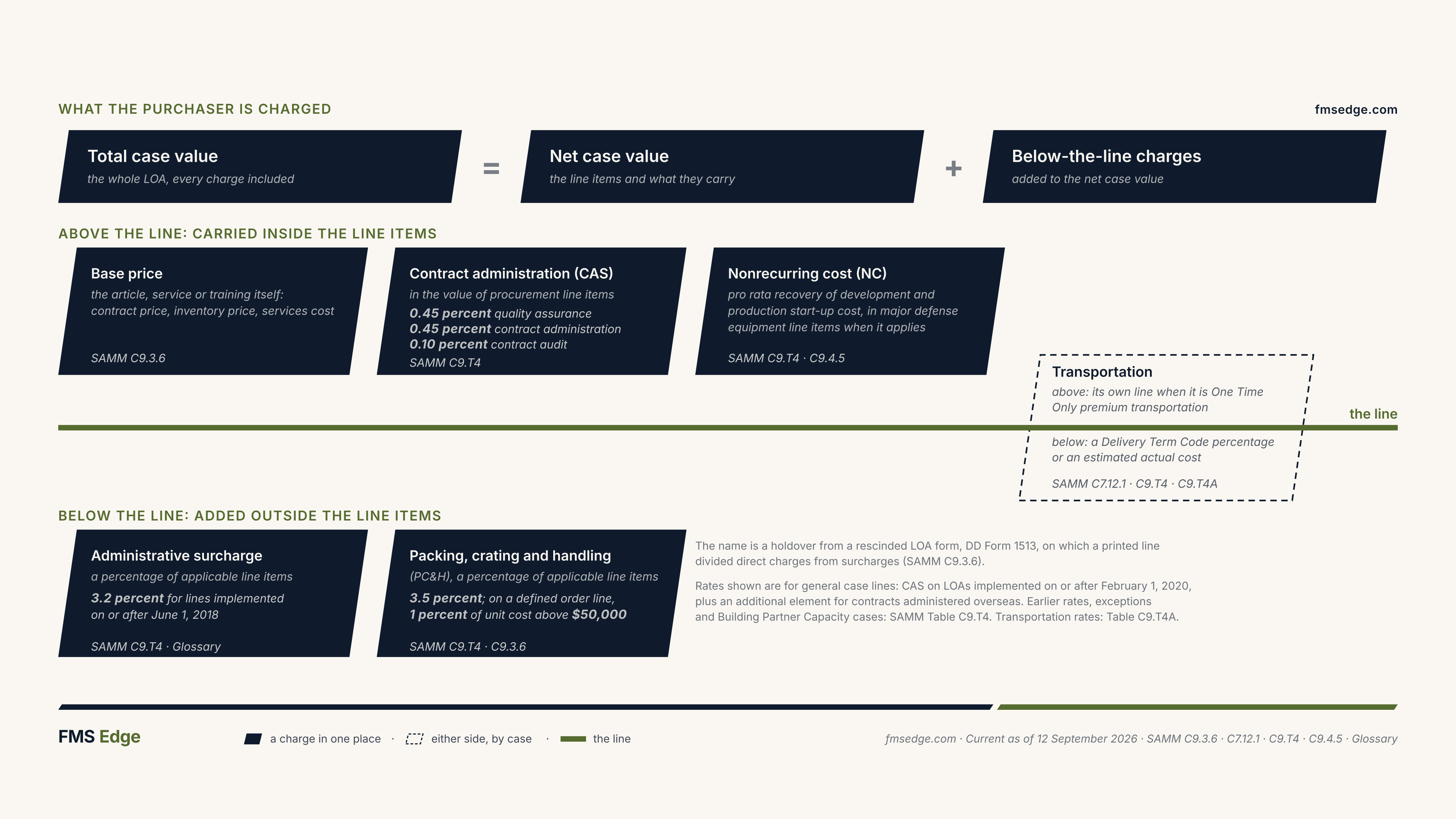
What is nonrecurring cost recoupment?
The Nonrecurring Cost () charge recovers, pro rata, the costs of research, development, test and evaluation () and of production startup. It is included in the value of the applicable lines on the [SAMM ]. are costs funded by an appropriation to develop or improve a product or technology, whether through a contract or in-house. They also include one-time costs that supported earlier production of a specified model, and costs that support a total projected production run. The defines in Section 47(6).
Purchasers other than the U.S. Government () must pay for the value of Department of War (DoW) nonrecurring investment in the development and production of , as Section 21(e)(1)(B), , requires, unless an recoupment charge waiver has been approved by the Director, , who has been delegated the authority to waive Recoupment costs on [, ]. staffs each waiver request with the Under Secretary of War for Acquisition and Sustainment and the Under Secretary of War (Comptroller), and with the Under Secretary of War for Policy when the basis is loss of sale; the Director, then approves, partially approves or disapproves it [SAMM ]. Under the Financial Management Regulation (), the waiver decision also requires coordination with the Under Secretary of War for Research and Engineering, and an unresolved request goes to the Deputy Secretary of War for final determination [].
For , an recoupment charge is applicable to all . The charge does not apply to cases fully financed with non-repayable Foreign Military Financing or funds [SAMM , ]. is any item of listed on the U.S. having a nonrecurring research and development cost of more than $50 million or total production cost of more than $200 million. The DoW-approved listing of with associated charges can be found in the , Appendix 1 (Nonrecurring Cost Recoupment Charges for ).
The Military Departments () and defense agencies are required per the and Directive 2140.02 (Recoupment of [] on Sales of U.S. Items) to review approved recoupment charges on a biennial basis to determine if there has been a change in factors or assumptions used to compute an recoupment charge []. When a recoupment charge is revised, the previous value is retained in the , Appendix 1. Subsequent revisions to the pro rata charge must be applied to new cases and must not be retroactive []. In instances where the initial rate has not yet been approved, DoW Components must provide for an estimated rate based on the most accurate information available to the DoW Component. The case must be modified to specify the subsequently approved rate, and only that approved rate is to be billed [SAMM ] [].
When recoupment is applicable, the unit price on the case must include the specific recoupment charge. recoupment charges may also include special recoupment costs incurred under , paid by an international partner to develop a special feature or unique or joint requirement. charges apply only to government-to-government sales, government-to-international organization sales among them, and may waive them under specific circumstances [SAMM ]. Per the and Foreign Assistance Act (), recoupment cases fully financed by the Merger or non-repayable Foreign Military Financing () are not assessed a recoupment charge [SAMM ] []. The requirement for the to recover on Direct Commercial Sales () was eliminated. The recoupment charge does not apply to Building Partner Capacity () cases [SAMM ].
In standard cases, a partial waiver of the recoupment charge may be granted based on the following criteria [SAMM ]:
- For sales that would significantly advance U.S. interests in North Atlantic Treaty Organization standardization; standardization with the Armed Forces of Japan, Australia, the Republic of Korea, Israel, New Zealand; or foreign procurement in the United States under co-production arrangements (AECA, Section 21(e)(2)) [].
- For the sale of also being procured for U.S. Armed Forces and resulting in a cost savings to the U.S. on the U.S. procured equipment that substantially offsets the revenue lost as a result of the waiver.
- For sales when imposition of the charge would likely result in the loss of the sale.
- For the sale of at a reduced price due to age or condition, the is reduced by the same percentage.
A purchaser submits a request to waive the charge to the , preferably with the [SAMM ]. may be waived or partially waived case by case; blanket waivers are not considered [SAMM ]. In most cases the request must be submitted before the purchaser accepts the , or the Amendment that increases quantities, although some requests for North Atlantic Treaty Organization () interoperability may be approved after acceptance [SAMM ]. The builds the waiver package and forwards it to , which staffs it with the Under Secretary of War for Acquisition and Sustainment and the Under Secretary of War (Comptroller), and with the Under Secretary of War for Policy when the basis is loss of sale; the Director, then approves, partially approves or disapproves it [SAMM , ]. Waiver requests below the $5,000 threshold will be returned to the , and the applicable charge will be added to the for recovery from the purchaser [SAMM ]. Once receives the complete waiver package from the , it shall respond within 30 business days [SAMM ].
Sometimes an charge is still being developed while an to sell the item is being prepared. Where the approval process cannot be completed in time, an estimated amount should be included in the item's unit price on the . The shall include a note telling the purchaser that the charges on the line are estimates only. The note also says that a modification will be made to adjust the price once the approved value is known ( Appendix 6 gives the exact wording). An estimated charge of this kind shall expire no later than 6 months from the date it was created, unless 's Division (/GEX/SCD) approves an extension [SAMM ].
Without historical documentation, the shall calculate the pro rata charge from the last known DoW acquisition cost. The must send the result to (/GEX/SCD), with the reasoning that shows the item would have met the threshold. Figure C9.F3 sets out the process for establishing an charge [SAMM ].
charges will be collected in the , then moved to the account through offsetting collections. AP8.SDAF.2.1.5.4 covers how offsetting collections are processed [SAMM ].
To standardize waiver procedures within the DoW, only waiver requests that total at least a minimum charge will be accepted. Detailed cost analysis has shown that the administrative expense of processing individual waiver requests is significant [SAMM ].
References
SAMM
- SAMM C9.T4: Table of Charges
- SAMM C9.6.3.2.1.1
- SAMM C9.4.5: Nonrecurring Cost Recoupment Charges.
- SAMM C9.6.3.1: Basis for Partial Waiver of the Nonrecurring Cost.
- SAMM C9.6.3.2.1
- SAMM C9.6.3.2: Waiver Process for Nonrecurring Costs Charges.
- SAMM C9.6.3.2.8
- SAMM C9.4.5.2: Estimated Nonrecurring Cost Charges.
- SAMM C9.4.5.3: Determining Nonrecurring Cost Charges When Documentation is Not Available.
- SAMM C9.4.5.5: Initial Deposit.
- SAMM C9.6.3.1.1
- SAMM C9.6.3.1.2
- SAMM C9.6.3.1.3
- SAMM C9.6.3.1.4
- SAMM C9.6.3.2.2
Public authorities
- DoD FMR Vol 15: DoD Financial Management Regulation 7000.14-R, Volume 15 (Security Cooperation Policy)
- AECA §21: Arms Export Control Act of 1976, as amended, §21 (22 U.S.C. §2761)
Facts referenced
- Nonrecurring research and development cost above which Significant Military Equipment is Major Defense Equipment (AECA section 47): $50 million (as of 5 October 2026; SAMM C5.2.2.3)
- Total production cost above which Significant Military Equipment is Major Defense Equipment (AECA section 47): $200 million (as of 5 October 2026; SAMM C5.2.2.3)
- Minimum nonrecurring cost (NC) charge a waiver request must total; requests below it are returned to the IA and the NC charge is added to the LOA: $5,000 (as of 5 October 2026; SAMM C9.6.3.2.2)
- Business days within which DSCA responds to a nonrecurring cost (NC) waiver request once it receives the complete package from the IA: 30 business days (as of 26 October 2026; SAMM C9.6.3.2.8)
- Latest expiry of an estimated nonrecurring cost (NC) charge put on an LOA while the NC charge is still being approved, counted from its date of creation, unless DSCA (IOPS/GEX/SCD) approves an extension: 6 months (as of 5 October 2026; SAMM C9.4.5.2)
Related
Major Defense Equipment (MDE)
Any item of Significant Military Equipment on the U.S. Munitions List having a nonrecurring research and development cost of more than $50 million or a total production cost of more than $200 million. Also defined in section 47 (6), Arms Export Control Act.
SAMM Glossary, as of 12 September 2026
Glossary entry →Open the manual’s entry → (opens in new tab)
Letter of Offer and Acceptance (LOA)
The legal instrument that lists the defense articles and services, including training, that the U.S. Government transfers to a foreign country or international organization, with their estimated costs and the terms and conditions. The benefitting partner does not sign a Building Partner Capacity (BPC) LOA.
The Letter of Offer and Acceptance (LOA) is the instrument the U.S. Government uses to sell under the Arms Export Control Act (AECA); signed LOAs and their later Amendments and Modifications are also called Foreign Military Sales (FMS) cases [SAMM C5.6.1].
FMS Edge glossary, as of 10 October 2026
Glossary entry →Open the manual’s entry → (opens in new tab)
Military Assistance Program (MAP)
That portion of the United States Security Assistance program authorized by the Foreign Assistance Act of 1961, as amended, which once provided defense articles and services to recipients on a nonreimbursable (grant) basis. Funding for MAP was consolidated under the Foreign Military Financing program beginning in Fiscal Year 1990.
SAMM Glossary, as of 12 September 2026
Glossary entry →Open the manual’s entry → (opens in new tab)
Defense Security Cooperation Agency (DSCA)
The Department of War agency that directs, administers and provides guidance to the Department's components and its representatives at U.S. missions for the execution of the security cooperation programs for which it is responsible [SAMM C1.3.2.2]. The agency also provides financial and technical assistance, arranges the transfer of defense materiel, training and services to international partners, and promotes military-to-military contacts.
FMS Edge glossary, as of 10 October 2026
Glossary entry →Open the manual’s entry → (opens in new tab)
Nonrecurring Costs (NC)
Costs funded by a Research, Development, Test, and Evaluation appropriation to develop or improve a product or technology either through contract or in-house effort. NC also includes one-time costs incurred in support of previous production of a specified model and costs incurred in support of a total projected production run. See "Nonrecurring Production Costs" and "Nonrecurring Research, Development, Test, and Evaluation Costs."
SAMM Glossary, as of 12 September 2026
Glossary entry →Open the manual’s entry → (opens in new tab)
RDT&E: Research, Development, Test, and Evaluation
SAMM Acronyms, as of 12 September 2026
Arms Export Control Act (AECA)
The basic U.S. law providing the authority and general rules for the conduct of Foreign Military Sales and commercial sales of defense articles, defense services, and training. The Arms Export Control Act (AECA) came into existence with the passage of the Foreign Military Sales Act (FMSA) of 1968. An amendment in the International Security Assistance and AECA of 1976 changed the name of FMSA to the AECA.
SAMM Glossary, as of 12 September 2026
Glossary entry →Open the manual’s entry → (opens in new tab)
Foreign Military Sales (FMS)
The part of U.S. security assistance, authorized by the Arms Export Control Act (AECA), in which eligible foreign governments and international organizations buy defense articles, services and training from the U.S. Government under formal government-to-government agreements.
The articles come either from Department of War stocks or from new procurement under contracts the Department manages [22 U.S.C. 2761, 22 U.S.C. 2762]. A sale is FMS whatever the source of the purchaser's financing.
FMS Edge glossary, as of 10 October 2026
Glossary entry →Open the manual’s entry → (opens in new tab)
DSCA: Defense Security Cooperation Agency
SAMM Acronyms, as of 12 September 2026
Glossary entry →Defense Security Cooperation Agency (DSCA) →
FMS: Foreign Military Sale
SAMM Acronyms, as of 12 September 2026
MDE: Major Defense Equipment
SAMM Acronyms, as of 12 September 2026
Significant Military Equipment (SME)
Defense articles for which special export controls are warranted because of the capacity of such articles for substantial military utility or capability. These items are identified on the U.S. Munitions List in the International Traffic in Arms Regulations by an asterisk preceding the item category listing.
SAMM Glossary, as of 12 September 2026
Glossary entry →Open the manual’s entry → (opens in new tab)
Munitions List
The list, in Part 121 of the International Traffic in Arms Regulations (ITAR), of the defense articles and defense services, related technical data included, that the Department of State controls for export and temporary import.
The U.S. Munitions List (USML) designates the specific items that are defense articles and defense services under Section 47 of the Arms Export Control Act (AECA), and marks Significant Military Equipment (SME) with an asterisk [SAMM C4.4] [22 U.S.C. 2794].
FMS Edge glossary, as of 10 October 2026
Glossary entry →Open the manual’s entry → (opens in new tab)
SAMM: Security Assistance Management Manual
SAMM Acronyms, as of 12 September 2026
Glossary entry →Security Assistance Management Manual (SAMM) →
Military Department (MILDEP)
One of the departments within the DoD created by the National Security Act of 1947, as amended. The Military Departments are: the Department of the Air Force, the Department of the Army, and the Department of the Navy.
SAMM Glossary, as of 12 September 2026
Glossary entry →Open the manual’s entry → (opens in new tab)
AECA: Arms Export Control Act
SAMM Acronyms, as of 12 September 2026
DCS: Direct Commercial Sales
SAMM Acronyms, as of 12 September 2026
Implementing Agency (IA)
The military department or defense agency responsible for the execution of military assistance programs. With respect to FMS, the military department or defense agency assigned responsibility by the Defense Security Cooperation Agency to prepare an LOA and to implement an FMS case. The implementing agency is responsible for the overall management of the actions that will result in delivery of the materials or services set forth in the LOA that was accepted by a foreign country or international organization.
SAMM Glossary, as of 12 September 2026
Glossary entry →Open the manual’s entry → (opens in new tab)
Letter of Request (LOR)
The term used to identify a request from an eligible FMS participant country for the purchase of U.S. defense articles and services. The request may be in message or letter format.
SAMM Glossary, as of 12 September 2026
Glossary entry →Open the manual’s entry → (opens in new tab)
LOA: Letter of Offer and Acceptance
SAMM Acronyms, as of 12 September 2026
Security Cooperation
Activities by which the Department of War encourages and enables international partners to cooperate with the United States toward strategic objectives, spanning every interaction with foreign defense and security establishments and every security assistance program the Department administers.
Under chapter 16 of Title 10, their purposes are to develop allied and friendly security capabilities for self-defense and multinational operations, to give U.S. forces peacetime and contingency access, and to build relationships promoting specific U.S. security interests [10 U.S.C. 301(7)].
FMS Edge glossary, as of 10 October 2026
Glossary entry →Open the manual’s entry → (opens in new tab)
Initial Deposit
The payment a Foreign Military Sales (FMS) purchaser sends when it accepts a Letter of Offer and Acceptance (LOA), as full or partial payment for the articles, services or training it has agreed to buy.
Each LOA includes an initial deposit that covers the nonrecurring cost payment and the outlays or deliveries expected before the purchaser's first quarterly payment arrives [SAMM C9.9.1.5.1].
FMS Edge glossary, as of 10 October 2026
Glossary entry →Open the manual’s entry → (opens in new tab)
Special Defense Acquisition Fund (SDAF)
Authorized in 1981 under section 51 of the Arms Export Control Act (AECA) (22 U.S.C. 2795), the SDAF is a revolving fund that finances the acquisition of defense articles and services in anticipation of their future sale to foreign governments and international organizations under the AECA.
SAMM Glossary, as of 12 September 2026
Glossary entry →Open the manual’s entry → (opens in new tab)
LOR: Letter of Request
SAMM Acronyms, as of 12 September 2026
SAMM C9.T4: Table of Charges
“Table C9.T4. Table of Charges Charge Description How Priced Applied by - for Billing References Acceleration Rates To recover full cost of providing USG services. Included in the line item value on the Letter of Offer and Acceptance (LOA). Specific to Building Partner Capacity (BPC) cases: Do not charge unfunded civilian retirement. Implementing Agency (IA) DoD Financial Management Regulation (DoD …”
Security Assistance Management Manual, as of 5 October 2026
DoD Financial Management Regulation 7000.14-R, Volume 15 (Security Cooperation Policy)
DoD FMR Vol 15 · Regulation
Arms Export Control Act of 1976, as amended, §21 (22 U.S.C. §2761)
AECA §21 · Statute
SAMM C9.6.3.2.1.1
“The IA shall forward the complete package to DSCA (IOPS, Global Execution Directorate, Security Cooperation Division (IOPS/GEX/SCD)) for evaluation. DSCA (IOPS) staffs the package within DSCA, USW (A&S), and USW (C); additionally, if the basis of the NC waiver is "loss of sale", the package is staffed within the Office of the Under Secretary of War for Policy (OUSW (P)). …”
Security Assistance Management Manual, as of 5 October 2026
SAMM C9.4.5: Nonrecurring Cost Recoupment Charges.
“DoW FMR, Volume 15, Chapter 7, and DoDD 2140.02 provide detailed guidance on establishing NC charges and pricing these costs on LOA documents. These NC charges do not apply to cases that are fully financed with non-repayable Foreign Military Financing (FMF) or non-repayable Military Assistance Program (MAP) funds. See Section C9.6.3. on NC charge waiver requirements and processes. For questions …”
Security Assistance Management Manual, as of 5 October 2026
SAMM C9.4.5.2: Estimated Nonrecurring Cost Charges.
“There may be instances when an NC charge is being developed at the same time that an LOA is being prepared to sell the item in question. If there is not enough time to complete the NC approval process, an estimated amount for NC should be included in the unit price of the item on the LOA. The LOA should …”
Security Assistance Management Manual, as of 5 October 2026
SAMM C9.6.3.1: Basis for Partial Waiver of the Nonrecurring Cost.
“In standard cases, a partial waiver of the NC charge may be granted based on the following criteria:”
Security Assistance Management Manual, as of 5 October 2026
SAMM C9.6.3.2.1
“FMS purchasers submit NC waiver requests to the Implementing Agency (IA) (preferably with the LOR). If the IA concurs, it should prepare a complete NC Waiver package that includes: A signed IA endorsement memorandum of the request FMS purchaser's written NC waiver request (including justification and rationale), concurrence (or non-concurrence) FMS case identifier Description and quantity of items Copy of …”
Security Assistance Management Manual, as of 5 October 2026
SAMM C9.6.3.2: Waiver Process for Nonrecurring Costs Charges.
“Waivers of the NC charge shall be granted on a case-by-case basis; blanket waivers are not considered. In most cases, the FMS purchaser's request must be submitted to the USG prior to acceptance of the LOA (or Amendment for increased quantities); however, waiver requests for ensuring NATO interoperability may be approved after the LOA acceptance in certain cases.”
Security Assistance Management Manual, as of 5 October 2026
SAMM C9.6.3.2.2
“To standardize the waiver procedures within the DoW, only waiver requests totaling a minimum NC charge will be accepted. Detailed cost analysis has indicated that the administrative expenses for processing individual NC waiver requests are significant. Waiver requests below the $5,000.00 threshold will be returned to the IA. In such cases, the applicable NC charge will be added to the …”
Security Assistance Management Manual, as of 5 October 2026
SAMM C9.6.3.2.8
“Once DSCA receives the complete waiver request package from the IA, it shall respond within 30 business days. Should priority processing be necessary, the IA may request expedited handling with appropriate justification, subject to endorsement by the DSCA Director. Upon the Director's determination on the waiver request, DSCA (IOPS/GEX/SCD) will send notifications to the IA and Defense Finance and Accounting …”
Security Assistance Management Manual, as of 26 October 2026
SAMM C9.4.5.3: Determining Nonrecurring Cost Charges When Documentation is Not Available.
“If historical documentation is not available, the IA shall calculate the pro rata NC charge using the last known DoW acquisition cost. The IA must submit the resulting calculation, along with the rationale for concluding that the item would have met the MDE threshold, to DSCA (IOPS/GEX/SCD). Figure C9.F3. Establishing Nonrecurring Cost Process Flow”
Security Assistance Management Manual, as of 5 October 2026
SAMM C9.4.5.5: Initial Deposit.
“NC charges will be collected in the initial deposit and transferred to the SDAF account via offsetting collections. See Section SDAF.2.1.5.4. for processing offsetting collections.”
Security Assistance Management Manual, as of 11 September 2026