
Guide
What is the Foreign Military Sales administrative surcharge?
The administrative surcharge is collected to cover the U.S. Government's costs of administering , as a percentage of the applicable lines of a case. Those costs must always be paid, so a surcharge waived for the purchaser is recouped from another funding source. Implementing Agencies must spend the surcharge funds prudently, with priority on case execution, and may spend only a capped share of them on work before a .
An LOA's total case value is its net case value (the line items) plus the charges added below them. The base price, contract administration services and nonrecurring cost on major defense equipment sit above the line; the administrative surcharge and packing, crating and handling sit below.
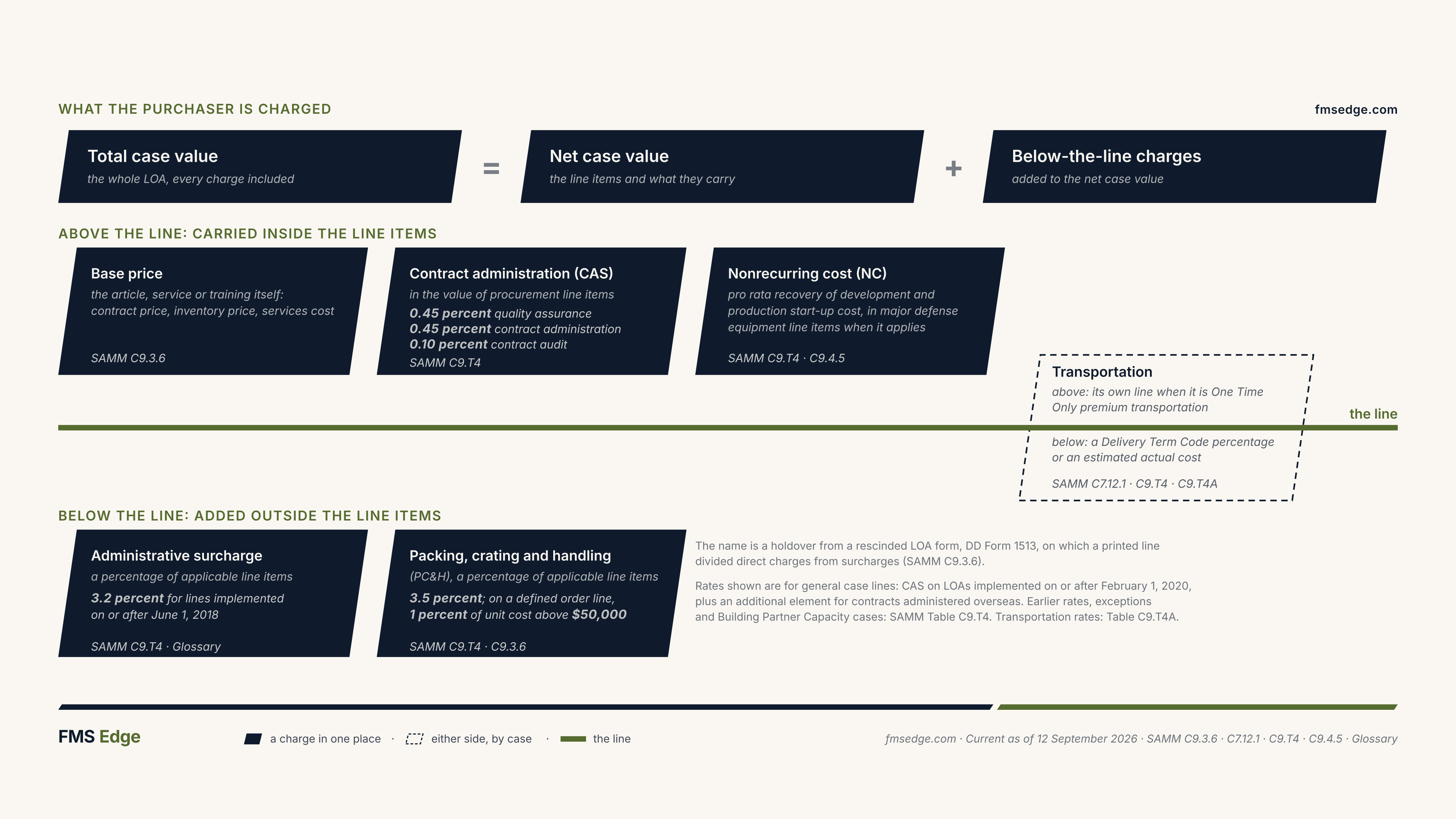
What is the Foreign Military Sales administrative surcharge?
The Administrative Surcharge is collected to cover the U.S. Government () costs of administering and -like programs, as defined by the Case-Related Manpower Functions and Funding Source Manpower Matrix ( C9.T2A and C9.T2B). Title 10-funded Building Partner Capacity cases have not been assessed it since 14 August 2020. It is included as a percentage of applicable line items as a below-the-line charge on the . It does not apply to Program Management Lines (), Small Case Management Lines () or grant lines, and it may be excluded from non-dedicated training lines for countries with reciprocal pricing agreements [SAMM ].
Surcharges are subject to change without prior approval of the purchaser, and the administrative surcharge applicable to each line on the is to be specified in a note in each document. For cost increases within the scope of the , modifications retain the administrative surcharge rates associated with the lines modified. When an amendment adds a new line to an existing case, or changes the scope of the , the rate in effect at that time is applied. For any case that is closed, the will retain funds to pay for estimated administrative costs associated with the case, even if no articles or services have been delivered ($0 delivered value) []. The Administrative Surcharge are shown in block 10 of the ’s Estimated Cost Summary.
The of a case is the value of the costs associated with administering the program. The states the prescribed administrative percentage for the case, and that percentage is applied against the case; expenses the prescribes as direct charges to the case are not included. Administrative costs can be referred to by the "L6A".
The Administrative Surcharge rates, included as a percentage of the applicable line items as a below-the-line charge, are the following [SAMM ]:
- 3.2 percent for both standard and nonstandard articles and services, for case lines implemented on or after June 1, 2018
- 3.5 percent for both standard and nonstandard articles and services, for case lines accepted on or after November 1, 2012 and before June 1, 2018
- 3.8 percent for both standard and nonstandard articles and services, for case lines accepted on or after August 1, 2006 and before November 1, 2012
- 2.5 percent for standard articles and services, for case lines implemented on or after June 1, 1999 and before August 1, 2006
- 3 percent for standard articles and services, for case lines implemented on or after October 1, 1977 and before June 1, 1999
- 2 percent for cases signed before October 1, 1977
- 5 percent for nonstandard articles and services, for case lines implemented before August 1, 2006
- 5 percent for I cases
Title 10-funded Building Partner Capacity () cases are also not assessed the Packing, Crating, and Handling () accessorial charge or the transportation surcharge, effective 14 August 2020 [SAMM ]. Once a case is implemented, its funds are neither transferred into the nor accounted for in the [SAMM ]. Under Policy Memorandum 20-47 of the , a Title 10 case financially implemented before 14 August 2020 is allowed to follow the earlier process.
Under Section 21(e)(1) of the , letters of offer shall include appropriate charges for administrative services, calculated on an average percentage basis to recover the full estimated costs of administration of sales []. Costs of administering must always be paid or collected, and if a waiver of the surcharge is approved for a purchaser, the cost must still be recouped from another funding source [SAMM ].
Implementing Agencies () must make prudent choices when they spend Administrative Surcharge funds, and in budgeting those funds, priority should go to supporting case execution activities [SAMM ].
An may spend no more than eight percent of its total Administrative Surcharge allocation for a fiscal year on activities that come before a . A request for an to go beyond that limit requires the approval of the Director. The request must include an accounting of the funds expended and remaining and the priorities for the rest of the year [SAMM ].
Try the tool: LOA cost estimator
References
SAMM
- SAMM C15.1.5.3: Building Partner Capacity Case and Training Grant Implementation.
- SAMM C9.3.4.1: Priority to Case Execution.
- SAMM C9.3.4.2: Limits on Pre-Letter of Request Expenditures.
- SAMM C9.6.1: Waiver of Foreign Military Sales Administrative Surcharge.
- SAMM C9.T4: Table of Charges
Public authorities
- DoD FMR Vol 15: DoD Financial Management Regulation 7000.14-R, Volume 15 (Security Cooperation Policy)
- AECA §21: Arms Export Control Act of 1976, as amended, §21 (22 U.S.C. §2761)
Facts referenced
- FMS Administrative Surcharge rate, LOA lines implemented on or after 1 June 2018 (current rate): 3.2 percent (as of 5 October 2026; SAMM C9.T4)
- Effective date of the current FMS Administrative Surcharge rate (LOA lines implemented on or after): June 1, 2018 (as of 5 October 2026; SAMM C9.T4)
- FMS Administrative Surcharge rate, LOA lines accepted 1 November 2012 to 31 May 2018 (historical): 3.5 percent (as of 5 October 2026; SAMM C9.T4)
- FMS Administrative Surcharge rate, LOA lines accepted 1 August 2006 to 31 October 2012 (historical): 3.8 percent (as of 5 October 2026; SAMM C9.T4)
- FMS Administrative Surcharge rate, standard articles/services, LOA lines implemented 1 June 1999 to 31 July 2006 (historical): 2.5 percent (as of 5 October 2026; SAMM C9.T4)
- FMS Administrative Surcharge rate, standard articles/services, LOA lines implemented 1 October 1977 to 31 May 1999 (historical): 3 percent (as of 5 October 2026; SAMM C9.T4)
- FMS Administrative Surcharge rate, cases signed before 1 October 1977 (historical): 2 percent (as of 5 October 2026; SAMM C9.T4)
- FMS Administrative Surcharge rate, non-standard articles/services, LOA lines implemented before 1 August 2006 (historical): 5 percent (as of 5 October 2026; SAMM C9.T4)
- FMS Administrative Surcharge rate, Foreign Military Sales Order (FMSO) I cases: 5 percent (as of 5 October 2026; SAMM C9.T4)
- Ceiling on the share of an Implementing Agency's annual FMS Administrative Surcharge allocation spendable on pre-LOR activities: eight percent (as of 11 September 2026; SAMM C9.3.4.2)
Related
Foreign Military Sales (FMS)
The part of U.S. security assistance, authorized by the Arms Export Control Act (AECA), in which eligible foreign governments and international organizations buy defense articles, services and training from the U.S. Government under formal government-to-government agreements.
The articles come either from Department of War stocks or from new procurement under contracts the Department manages [22 U.S.C. 2761, 22 U.S.C. 2762]. A sale is FMS whatever the source of the purchaser's financing.
FMS Edge glossary, as of 10 October 2026
Glossary entry →Open the manual’s entry → (opens in new tab)
Letter of Request (LOR)
The term used to identify a request from an eligible FMS participant country for the purchase of U.S. defense articles and services. The request may be in message or letter format.
SAMM Glossary, as of 12 September 2026
Glossary entry →Open the manual’s entry → (opens in new tab)
FMS: Foreign Military Sale
SAMM Acronyms, as of 12 September 2026
SAMM: Security Assistance Management Manual
SAMM Acronyms, as of 12 September 2026
Glossary entry →Security Assistance Management Manual (SAMM) →
Letter of Offer and Acceptance (LOA)
The legal instrument that lists the defense articles and services, including training, that the U.S. Government transfers to a foreign country or international organization, with their estimated costs and the terms and conditions. The benefitting partner does not sign a Building Partner Capacity (BPC) LOA.
The Letter of Offer and Acceptance (LOA) is the instrument the U.S. Government uses to sell under the Arms Export Control Act (AECA); signed LOAs and their later Amendments and Modifications are also called Foreign Military Sales (FMS) cases [SAMM C5.6.1].
FMS Edge glossary, as of 10 October 2026
Glossary entry →Open the manual’s entry → (opens in new tab)
Excess Defense Articles (EDA)
Defense articles owned by the USG which are neither procured in anticipation of military assistance or sales requirements, nor procured pursuant to a military assistance or sales order. EDA are items (except construction equipment) that are in excess of the Approved Force Acquisition Objective and Approved Force Retention Stock of all DoD components at the time such articles are dropped from inventory by the supplying agency for delivery to countries or international organizations.
SAMM Glossary, as of 12 September 2026
Glossary entry →Open the manual’s entry → (opens in new tab)
LOA: Letter of Offer and Acceptance
SAMM Acronyms, as of 12 September 2026
Below-the-line Costs
Accessorial charges and surcharges that are not included within the value of a Letter of Offer and Acceptance (LOA) line, such as the transportation surcharge and packing, crating and handling (PC&H) [SAMM C9.3.6]. They are added to the line values to reach the LOA's total estimated cost.
FMS Edge glossary, as of 10 October 2026
Glossary entry →Open the manual’s entry → (opens in new tab)
Administrative Cost
The value of costs associated with the administration of the Foreign Military Sales (FMS) program. The prescribed administrative percentage cost for a case appears in the Letter of Offer and Acceptance (LOA). This percentage is applied against the case. Expenses charged directly to the FMS case (as prescribed by the LOA) are not included. May be commonly referred to by the generic code "L6A" for administrative costs.
SAMM Glossary, as of 12 September 2026
Glossary entry →Open the manual’s entry → (opens in new tab)
Generic Code
A three-digit code identified in the Military Articles and Services List and in Appendix 4 of the SAMM, which represents the type of materiel or services to be furnished according to a specific budget activity/project account classification.
SAMM Glossary, as of 12 September 2026
Glossary entry →Open the manual’s entry → (opens in new tab)
Foreign Military Sales Order (FMSO)
A term used to describe Letters of Offer and Acceptance (LOAs) that implement Cooperative Logistics Supply Support Arrangements. Two LOAs are written: a FMSO I and a FMSO II.
SAMM Glossary, as of 12 September 2026
Glossary entry →Open the manual’s entry → (opens in new tab)
Trust Fund
A fund or account that law designates as a trust fund, credited with receipts that law earmarks and that the government holds in trust, in a fiduciary capacity, for specific purposes and programs under an agreement.
A trust fund account is usually a receipt account, an expenditure account or a revolving fund account.
FMS Edge glossary, as of 10 October 2026
Glossary entry →Open the manual’s entry → (opens in new tab)
Defense Integrated Financial System (DIFS)
A financial system providing DoD-level financial management functions for the security assistance (SA) program. This includes centralized Foreign Military Sales (FMS) trust fund accounting, foreign customer billing, and financial management reporting. DIFS consolidates FMS data from the Army, Navy, Air Force, and other implementing agencies, and provides efficient accountability for oversight of the financial and program management aspects of SA.
SAMM Glossary, as of 12 September 2026
Glossary entry →Open the manual’s entry → (opens in new tab)
Defense Security Cooperation Agency (DSCA)
The Department of War agency that directs, administers and provides guidance to the Department's components and its representatives at U.S. missions for the execution of the security cooperation programs for which it is responsible [SAMM C1.3.2.2]. The agency also provides financial and technical assistance, arranges the transfer of defense materiel, training and services to international partners, and promotes military-to-military contacts.
FMS Edge glossary, as of 10 October 2026
Glossary entry →Open the manual’s entry → (opens in new tab)
Arms Export Control Act (AECA)
The basic U.S. law providing the authority and general rules for the conduct of Foreign Military Sales and commercial sales of defense articles, defense services, and training. The Arms Export Control Act (AECA) came into existence with the passage of the Foreign Military Sales Act (FMSA) of 1968. An amendment in the International Security Assistance and AECA of 1976 changed the name of FMSA to the AECA.
SAMM Glossary, as of 12 September 2026
Glossary entry →Open the manual’s entry → (opens in new tab)
Implementing Agency (IA)
The military department or defense agency responsible for the execution of military assistance programs. With respect to FMS, the military department or defense agency assigned responsibility by the Defense Security Cooperation Agency to prepare an LOA and to implement an FMS case. The implementing agency is responsible for the overall management of the actions that will result in delivery of the materials or services set forth in the LOA that was accepted by a foreign country or international organization.
SAMM Glossary, as of 12 September 2026
Glossary entry →Open the manual’s entry → (opens in new tab)
Exception to Policy (ETP) (SAMM)
Exception to SAMM policy. Does not include exceptions outside of SAMM purview.
SAMM Glossary, as of 12 September 2026
Glossary entry →Open the manual’s entry → (opens in new tab)
DSCA: Defense Security Cooperation Agency
SAMM Acronyms, as of 12 September 2026
Glossary entry →Defense Security Cooperation Agency (DSCA) →
SAMM C9.T4: Table of Charges
“Table C9.T4. Table of Charges Charge Description How Priced Applied by - for Billing References Acceleration Rates To recover full cost of providing USG services. Included in the line item value on the Letter of Offer and Acceptance (LOA). Specific to Building Partner Capacity (BPC) cases: Do not charge unfunded civilian retirement. Implementing Agency (IA) DoD Financial Management Regulation (DoD …”
Security Assistance Management Manual, as of 5 October 2026
DoD Financial Management Regulation 7000.14-R, Volume 15 (Security Cooperation Policy)
DoD FMR Vol 15 · Regulation
SAMM C15.1.5.3: Building Partner Capacity Case and Training Grant Implementation.
“The Defense Finance and Accounting Service, Security Cooperation Accounting Directorate (DFAS-SCA) does not have oversight of BPC case or training grant funds. Upon implementation, funds are not transferred into the FMS trust fund or accounted for in the Defense Integrated Financial System (DIFS) (see Section C15.4. for more details).”
Security Assistance Management Manual, as of 11 September 2026
Arms Export Control Act of 1976, as amended, §21 (22 U.S.C. §2761)
AECA §21 · Statute
SAMM C9.6.1: Waiver of Foreign Military Sales Administrative Surcharge.
“Costs associated with administering the Foreign Military Sales (FMS) program must always be paid and/or collected (Arms Export Control Act (AECA), Section 21(e)(1) (22 U.S.C. 2761(e)(1))). If a waiver of the FMS Administrative Surcharge for the purchaser is approved in one of the circumstances described below, it must still be recouped from another funding source.”
Security Assistance Management Manual, as of 11 September 2026
SAMM C9.3.4.1: Priority to Case Execution.
“IAs must make prudent choices when expending FMS Administrative Surcharge funds. In budgeting FMS Administrative Surcharge funds, priority should be placed upon providing support to IA case execution activities.”
Security Assistance Management Manual, as of 11 September 2026
SAMM C9.3.4.2: Limits on Pre-Letter of Request Expenditures.
“No more than eight percent of the total FMS Administrative Surcharge funds allocated to an IA in a fiscal year may be expended on pre-LOR activities. Requests for an exception to policy to exceed the eight percent limit on IA expenditure of FMS Administrative Surcharge funds on pre-LOR activities require DSCA Director approval. Requests for an exception to policy must …”
Security Assistance Management Manual, as of 11 September 2026