
Guide
What is a significant security cooperation initiative?
A significant initiative is a set of activities planned over several years in support of one objective. Planners break the end state into intermediate objectives and group the activities, events, operations and investments that advance each one into lines of activity. They measure progress with measures of performance and measures of effectiveness, and for a Title 10 funded Building Partner Capacity program the initiative's planning process is the basis for generating requirements.
A significant security cooperation initiative groups activities into lines of activity, each leading to an intermediate military objective on the way to its end state. Measures of performance ask whether things were done right; measures of effectiveness ask whether the right things were done.
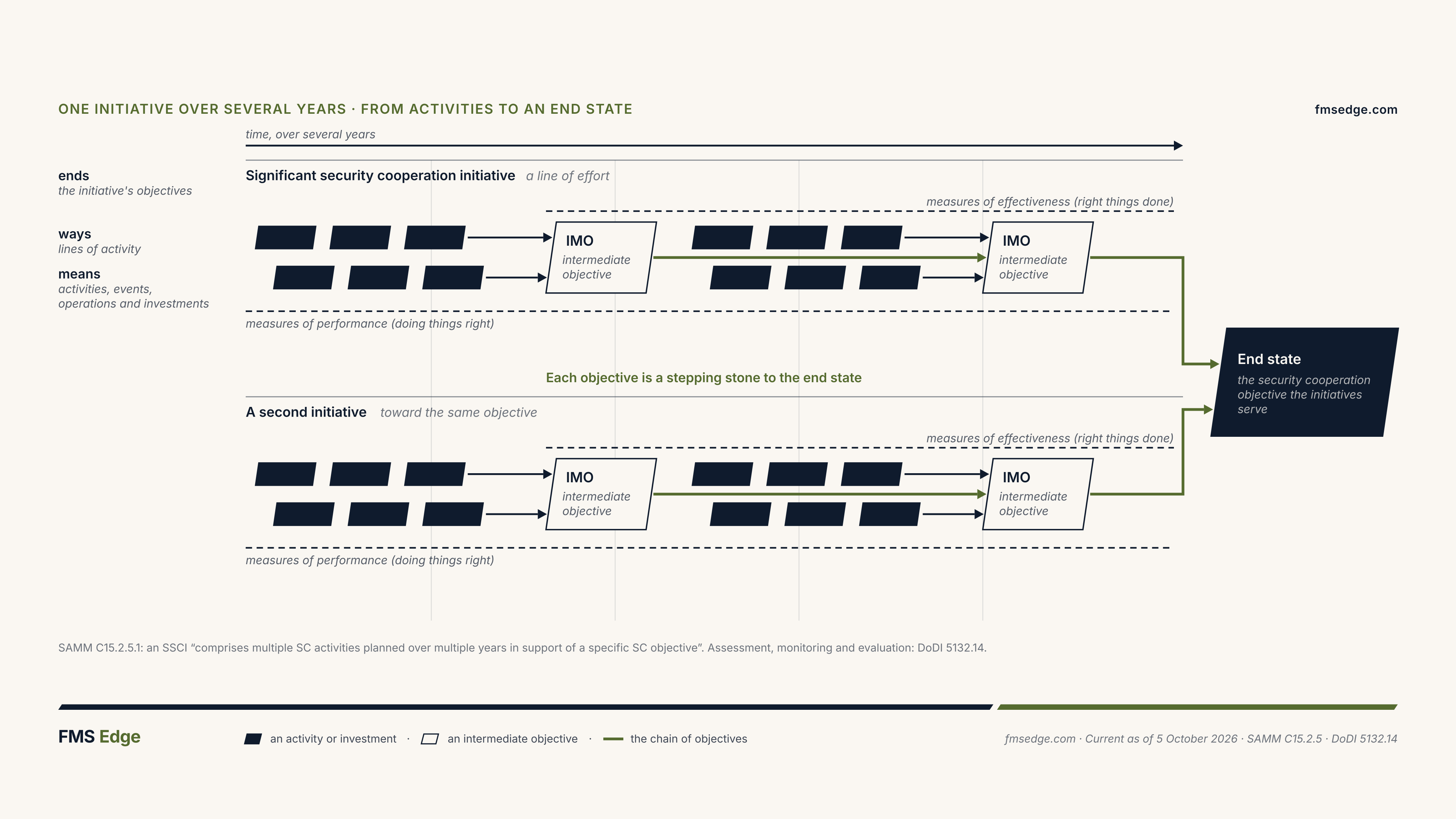
What is a significant security cooperation initiative?
A Significant Initiative () is a set of () activities, planned over several years, that supports one specific objective [SAMM ]. For a Title 10 funded Building Partner Capacity () program, the planning process is the basis for generating requirements. An is made up of Initiative Design Documents (), and Performance Monitoring Plans () are a required part of it. A sets out the objective statements, monitoring indicators and baseline data for the 's objectives, its long-term and short-term outcomes, its outputs and its activities. It also includes an Objective Tree, which is a logic model linking each activity to the objectives it serves at three levels: the , the National Defense Strategy () and the Theater Campaign Plan (TCP) [SAMM ].
Each objective requires the (RA) to produce an [SAMM ]. The names the programs, projects and activities planned over a three-to-five-year period, in enough detail that the Implementing Agencies () have the information they need to source suitable defense articles and services for that objective. This phase of a requirement ends when the RA submits a detailed, coordinated , Training and Equipment List () or similar request that the can carry out within its funding and timeline limits. The RA should complete the request package with support from the Military Group (), the geographic , the , the Office of the Under Secretary of War for Policy and other stakeholders, and with technical advice from the where it is needed [SAMM ].
Planners translate theater strategic end states into () Objectives, also known as outcomes, as stepping stones, and then break those objectives down into activities and events.
What seasoned practitioners and senior leaders are used to calling ‘Activities, Events, Operations and Investments’ are increasingly referred to as inputs and outputs by interagency teammates, thus the terminology that is being used is changing and planners should understand both. The term Intermediate Military Objective () was introduced in the inaugural Guidance for Employment of the Force () to mean the collection of near-, mid-, and long-term objectives that cumulatively contribute to the achievement of an end state or Objective. Thus what some personnel might refer to as an , might be called a sub-outcome or outcome within the interagency community. What the Department of War (DoW) has previously called a Line of Effort () might now be called a Significant Initiative (). In fact, previous Guidance has directed that Geographic Combatant Commands should scope similar to a line of effort. Finally, what someone might have previously called a Objective could now be called a Objective or even Strategic Effect.
Planning Guidance goals and objectives are the most specific description of the national strategic objectives presented to the or, in operational art parlance, the “ends.” Based on the Planning Guidance, the develop . Each is meant to move the demonstrably toward strategic end states. A strategic end state can take one or several over the three- to five-year time frame of the Campaign Plan (). The planners should also develop ways to properly evaluate Measures of Performance (MOP), Measures of Effectiveness (MOE), or both as ways to determine the achievement of the Objective.
In general, MOPs are quantitative and can also apply qualitative attributes to task accomplishment. Simply put, MOPs measure what the partner nation (PN) is doing but encourage the planners to ask whether the PN is doing the right things to achieve the desired effect.
MOEs assess the impact of the actions of the PN on the effectiveness of achieving the Objectives. MOEs do not measure task performance, rather they assess changes in behavior, capability, or operational environment. MOEs measure what is accomplished and help verify whether objectives, goals, and end states are being met. MOEs, either qualitative or quantitative, are typically more subjective than MOPs. For instance, a MOE can be based on quantitative measures to reflect a trend and show progress toward an Objective.
are written to be specific and achievable so that the can measure progress. In preparing , the acronym “SMART” (Specific, Measurable, Achievable, Relevant and Results-oriented, Time-bound) should be observed:
- Specific: objective is discrete; describes what is expected, by whom, and for/with whom
- Measurable: success is clearly and objectively defined; a regular, observable, objective, and sustainable method of measurement is in place
- Achievable: requisite authorities, programs, and resources are in place; partner-nation agreement secured; political and fiscal risks duly considered
- Relevant and results-oriented: contributes to strategic goals; focused on significant partnership outcomes; prioritized and hierarchically organized
- Time-bound: establishes a deadline or reasonable time frame for completion
Lines of effort and lines of activity are concepts referenced in other documents under different terminology that align and synchronize the in a logical sequence, driving toward a desired end state.
A theory of change is a statement of expectations regarding how planned activities will lead to stated objectives. It articulates assumptions and plans about how and why a set of activities and actions are expected to evolve in the future, including causal linkages through which early and intermediate outcomes will lead to long-term results. A theory of change intended to make implicit assumptions more explicit, describes why certain actions will produce a desired change in a given context, and clearly states what the intended outcome of the initiative will be and how it will be achieved. Monitoring the capability or capacity development then lets personnel validate the theory of change and make informed decisions about how likely the PN is to achieve the expected results. If the PN is not progressing as expected, the theory of change can help personnel make informed decisions on corrective actions.
The logic model maps goals and “SMART” objectives to the activities necessary to achieve desired changes. The logic model visually describes activities and the planned process of contributing to initiative goals and achieving objectives.
Based upon goals and objectives, as outlined in planning guidance, Significant Initiatives () are identified and generally led by the . The are coordinated with the Office of the Under Secretary of War for Policy and the Joint Staff and involve applying multiple tools and programs [SAMM , ]. can be overseen and managed by various DoW components and the Department of State () over multiple years to realize a country, or region, or functional objective such as maritime security or counterterrorism. An could even involve several interagency actors or other PNs.
An or links related Objectives in order to focus efforts toward the Planning Guidance End State(s). This approach allows planners to bundle various activities, events, operations, and investments, thereby logically linking more specific planning details to strategic end states. Thus, within a or , Objectives are the steps needed in order to reach the desired end state. / are useful to group near-term and long-term Objectives that are completed simultaneously or sequentially.
Lines of Activity more clearly define the activities, events, operations, and/or investments (inputs) supporting a particular . Lines of activity become the “ways” to advance the strategy. Thus, lines of activity allow the planner to dive down in increasing detail to answer the question, “What activities, events, operations, and/or investments are needed to achieve the ?” The individual activities are, therefore, the “means” to achieve the line of activity.
End states are achieved by moving along the /, from to . are achieved by following lines of activity and are defined by a sequence of specific activities, events, operations, and investments. Just as this process of increasing detail provides the planner a logical way to think through the problem, the plan will provide the program manager justification as to resourcing specific events, i.e., how a particular three-day event fits into the overall plan to achieve strategic end states. Hence, the (and, by extension, the pertinent CSCS) justifies for the “means” of the “ways” to achieve the “ends.”
At this stage, planners need to review their previous gap analysis and reassess the theater strategic end states and . Planners need to assess what constitutes success in achieving the desired end state and re-determine the current “baseline.” Next, planners need to assess the , confirm the are properly sequenced, and ensure the cumulative effect of the achieves, or at least makes progress toward, the desired end state.
Monitoring is the second pillar of the Assessment, Monitoring, and Evaluation (AM&E) framework. Monitoring involves collecting data and information to help determine whether implementation is on track and to identify any timely corrections or adjustments needed to improve efficiency or effectiveness. Monitoring provides evidence of change over time and allows managers to track progress toward objective achievement at regular intervals, as described below. managers can begin to build monitoring plans during the early phases of planning to collect information relevant for management decision-making during implementation, including building on existing data sources as practicable and identifying gaps in needed data. This includes the identification of relevant indicators following assessments and analyses to set the stage for data collection and progress reporting.
Monitoring data, coupled with information from programmatic evaluations and other sources, should answer questions about what is working and contribute to leadership decisions on more strategic questions of progress toward objective achievement. Ideally, data gathered according to monitoring plans will inform analysis of progress in achieving , National Military Strategy, and National Defense Strategy () objectives.
Evaluation supports stakeholders in executing performance management by going beyond tracking progress. As a core part of the overall AM&E program, evaluations help determine which initiatives are working (why and how), and identify the underlying factors that affect whether initiatives achieved U.S. Government intended outputs and outcomes.
Office of Management and Budget () Memorandum M-18-04 defines evaluation as “the systematic collection and analysis of information about the characteristics and outcomes of the program, including projects conducted under such program, as a basis for making judgments and evaluations regarding the program; improving program effectiveness; and informing decisions about current and future programming.” Evaluation is a standard U.S. Government requirement for programs and constituent projects.
Evaluations allow managers and decision-makers to understand why an initiative is or is not making progress towards intended U.S. Government outputs or outcomes, help identify needed changes, and maximize use of scarce resources.
Evaluations should allow DoW and stakeholders to:
- Foster a culture of learning and continuous improvement of contributions to strategic objective achievement;
- Improve policy, planning, and implementation of programs, initiatives, and activities;
- Support senior leader decision-making by providing rigorous evidence to inform decisions about policy oversight and resource allocation, planning and reporting, program management, and proposals to adjust legislated authorities;
- Inform Congress and provide transparency and accountability to taxpayers; and
- Facilitate collaboration among stakeholders throughout the enterprise.
References
SAMM
- SAMM C15.1.6.4: Under Secretary of War for Policy.
- SAMM C15.2.5.1: Title 10 Funded Building Partner Capacity Significant Security Cooperation Initiative Centric Planning.
Public authorities
- DoDI 5132.14: DoD Instruction 5132.14, Assessment, Monitoring, and Evaluation Policy for the Security Cooperation Enterprise, 13 January 2017
Facts referenced
- Period over which an Initiative Design Document (IDD) identifies the programs, projects and activities for a Significant Security Cooperation Initiative (SSCI) objective: three-to-five-year (as of 5 October 2026; SAMM C15.2.5.1)
Related
Security Cooperation
Activities by which the Department of War encourages and enables international partners to cooperate with the United States toward strategic objectives, spanning every interaction with foreign defense and security establishments and every security assistance program the Department administers.
Under chapter 16 of Title 10, their purposes are to develop allied and friendly security capabilities for self-defense and multinational operations, to give U.S. forces peacetime and contingency access, and to build relationships promoting specific U.S. security interests [10 U.S.C. 301(7)].
FMS Edge glossary, as of 10 October 2026
Glossary entry →Open the manual’s entry → (opens in new tab)
National Defense Strategy (NDS)
The Secretary of War's strategic guidance that turns the priorities of the President's National Security Strategy (NSS) into direction for the National Military Strategy (NMS) and for the Department's campaign and contingency planning and force development. It serves inside the Department and in coordination with other U.S. Government agencies, and is normally reviewed when a new or revised NSS is issued.
FMS Edge glossary, as of 10 October 2026
Implementing Agency (IA)
The military department or defense agency responsible for the execution of military assistance programs. With respect to FMS, the military department or defense agency assigned responsibility by the Defense Security Cooperation Agency to prepare an LOA and to implement an FMS case. The implementing agency is responsible for the overall management of the actions that will result in delivery of the materials or services set forth in the LOA that was accepted by a foreign country or international organization.
SAMM Glossary, as of 12 September 2026
Glossary entry →Open the manual’s entry → (opens in new tab)
Memorandum of Request (MOR)
A document prepared and submitted by the Requesting Authority which identifies requirements and initiates the case development process under a Building Partner Capacity program.
SAMM Glossary, as of 12 September 2026
Glossary entry →Open the manual’s entry → (opens in new tab)
Combatant Command (CCMD)
A unified or specified command with a broad continuing mission under a single commander established and so designated by the President, through the Secretary of Defense and with the advice and assistance of the Chairman of the Joint Chiefs of Staff. Also called CCMD.
SAMM Glossary, as of 12 September 2026
Glossary entry →Open the manual’s entry → (opens in new tab)
Defense Security Cooperation Agency (DSCA)
The Department of War agency that directs, administers and provides guidance to the Department's components and its representatives at U.S. missions for the execution of the security cooperation programs for which it is responsible [SAMM C1.3.2.2]. The agency also provides financial and technical assistance, arranges the transfer of defense materiel, training and services to international partners, and promotes military-to-military contacts.
FMS Edge glossary, as of 10 October 2026
Glossary entry →Open the manual’s entry → (opens in new tab)
IMO: Intermediate Military Objective
LOE: Line of Effort
CCP: Combatant Command (CCMD) Campaign Plan
SAMM C15.2.5.1: Title 10 Funded Building Partner Capacity Significant Security Cooperation Initiative Centric Planning.
“The Significant Security Cooperation Initiative (SSCI) planning process serves as the basis of generating requirements for a Title 10 funded BPC program. An SSCI comprises multiple SC activities planned over multiple years in support of a specific SC objective and consists of Initiative Design Documents (IDDs), with Performance Monitoring Plans (PMPs) as a requirement. A PMP outlines objective statements, monitoring …”
Security Assistance Management Manual, as of 5 October 2026
SAMM C15.1.6.4: Under Secretary of War for Policy.
“In accordance with 10 U.S.C. 382(a) the Secretary of War (SECWAR) assigned the Under Secretary of War for Policy (USW(P)) the responsibility to provide oversight of the strategic policy and guidance and overall resource allocation for SC programs and activities funded by O&M, defense-wide appropriated funds allocated to DSCA. USW(P) generates guidance and directs the prioritization of SC resources through …”
Security Assistance Management Manual, as of 5 October 2026