
Guide
How does a combatant command plan security cooperation?
A geographic turns national-level guidance into a theater strategy, and the theater strategy into a campaign plan. planners weigh the whole region, prioritize activities across its partner nations, identify the resources available and the shortfalls, and group objectives into significant initiatives.
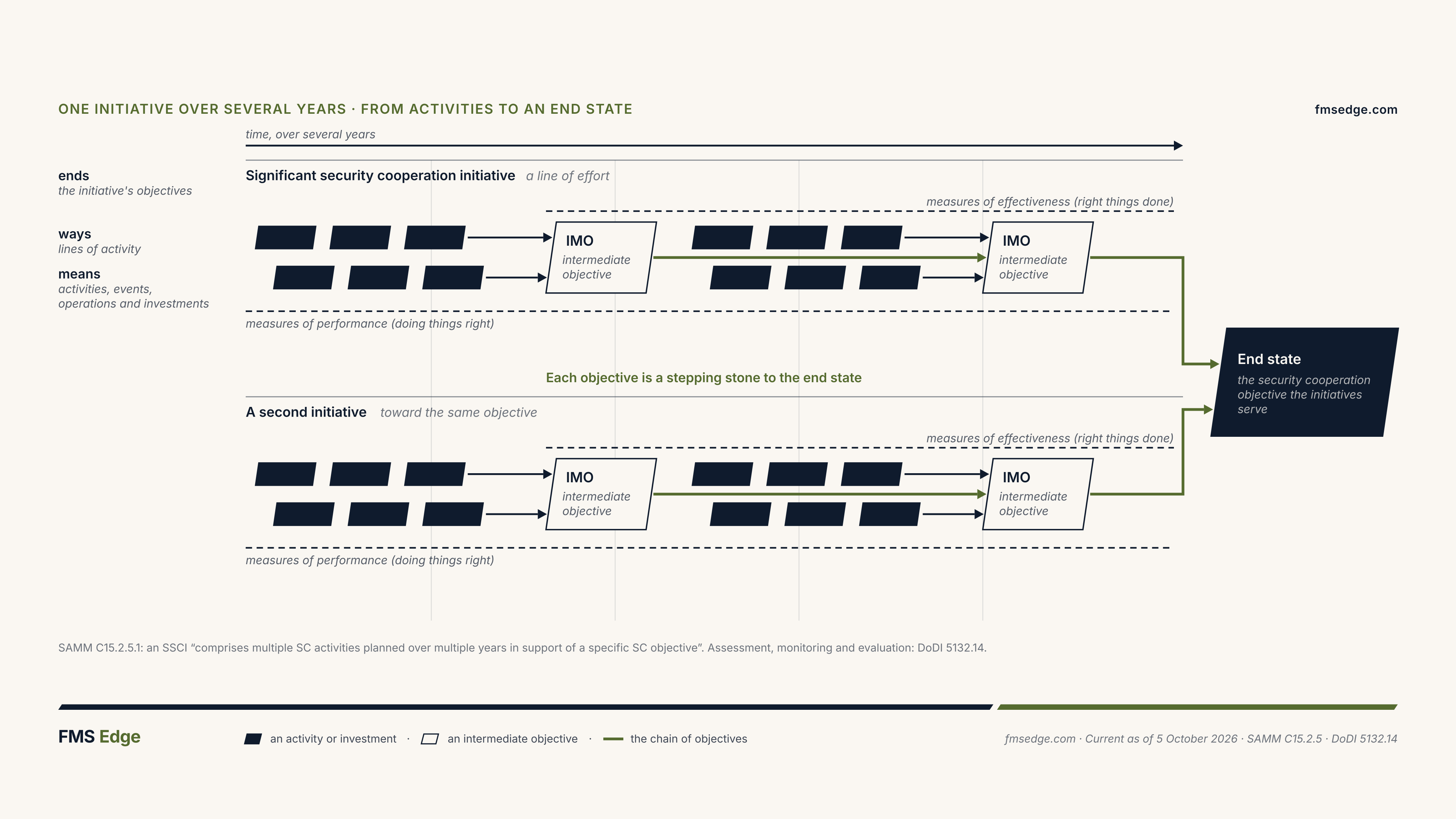
A significant security cooperation initiative groups activities into lines of activity, each leading to an intermediate military objective on the way to its end state. Measures of performance ask whether things were done right; measures of effectiveness ask whether the right things were done.
How does a combatant command plan security cooperation?
The geographic has overall responsibility for prioritizing, coordinating, monitoring and evaluating the success of () activities in its theater [SAMM ]. planning rests on an understanding of the operational and security environment in the theater and of the role the U.S. Government () expects each partner nation (PN) to play. The planners justify the prioritization of activities across the collective group of PNs in the Area of Responsibility (), and the level of assistance can differ from one PN to another.
Based upon the analysis of higher-level guidance, the develops a theater strategy. The theater strategy is a broad statement of how the intends to achieve planned goals and objectives and, thus, serves as a link between the national guidance documents and the Campaign Plan (). Detailed planning for the starts only after the has developed the broad operational approach.
Combatant Commanders () develop campaign plans for conducting programs and activities. For with geographic responsibility, the coordinate on seam issues; for with a global focus, they coordinate on their individual functional responsibilities. also complete campaign plan and campaign support plan assessments as appropriate, and give appropriate assistance when the Under Secretary of War for Policy or the Director of the asks for it. They supervise the Organizations () in matters related to executing the Guidance for Employment of the Force (). That supervision includes giving the necessary technical assistance and administrative support. The related issuance is Directive 5132.03 [SAMM ].
Before detailed planning begins, planners should understand the resources available to the to support the implementation of the . The campaign planning construct should provide a framework that allows commanders to identify and articulate resource requirements to execute the activities needed to implement the theater strategy. A thorough understanding of the types and quantities of resources available should inform, but not constrain, planning. Planners should develop a that seeks to achieve the theater strategic end states and identify any discrepancies between current or projected resource availability and what is needed to implement the . should then communicate the need for additional resources and the risks associated with resource shortfalls through the appropriate venues.
Based upon goals and objectives, as outlined in planning guidance, Significant Initiatives () are identified and generally led by the . The are coordinated with the Office of the Under Secretary of War for Policy and the Joint Staff and involve applying multiple tools and programs [SAMM , ]. can be overseen and managed by various Department of War (DoW) components and the Department of State () over multiple years to realize a country, or region, or functional objective such as maritime security or counterterrorism. An could even involve several interagency actors or other PNs.
For a Title 10 funded Building Partner Capacity () program, requirements are generated from the planning process. Each brings together multiple activities, planned across several years, in support of one specific objective. It consists of Initiative Design Documents (), with Performance Monitoring Plans () required. A lays out objective statements, monitoring indicators and baseline data for the 's objectives, its long-term and short-term outcomes, its outputs and its activities. Its Objective Tree is a logic model connecting activities with specific objectives at the level of the , of the National Defense Strategy () and of the Theater Campaign Plan (TCP) [SAMM ].
For each objective, the (RA) is required to generate an . The sets out, over a three-to-five-year period, the programs, projects and activities in enough detail that the Implementing Agencies () have what they need to source the right defense articles and services to achieve the objective. This phase of a requirement concludes when the RA submits a detailed, coordinated request, such as a or a Training and Equipment List (), that the can execute within its funding and timeline limits. The RA should complete the request package with support from , the geographic , the Military Group (), other stakeholders and the Office of the Under Secretary of War for Policy, and with the 's technical advice if required [SAMM ].
help shape country plans through regular contact with the country desk officers of the J5, and through the regional and country-focused working groups that the J5 sponsors throughout the year. The needs a firm understanding of the 's TCP to advocate the priorities and strategies of DoW and the to the PN and the U.S. embassy . It also needs that understanding to plan and budget resources for the TCP's country-specific objectives. Ideally, planning events are scheduled so that are well prepared to give input to the 's ('s) Mission Strategic Resources Plan () [SAMM ].
References
SAMM
- SAMM AP8.S333.3.2: Combatant Commands.
- SAMM C15.1.6.4: Under Secretary of War for Policy.
- SAMM C1.3.2.10: Combatant Commanders.
- SAMM C15.2.5.1: Title 10 Funded Building Partner Capacity Significant Security Cooperation Initiative Centric Planning.
- SAMM C2.1.3.2.2
Public authorities
Facts referenced
- Period over which an Initiative Design Document (IDD) identifies the programs, projects and activities for a Significant Security Cooperation Initiative (SSCI) objective: three-to-five-year (as of 5 October 2026; SAMM C15.2.5.1)
Related
Combatant Command (CCMD)
A unified or specified command with a broad continuing mission under a single commander established and so designated by the President, through the Secretary of Defense and with the advice and assistance of the Chairman of the Joint Chiefs of Staff. Also called CCMD.
SAMM Glossary, as of 12 September 2026
Glossary entry →Open the manual’s entry → (opens in new tab)
Security Cooperation
Activities by which the Department of War encourages and enables international partners to cooperate with the United States toward strategic objectives, spanning every interaction with foreign defense and security establishments and every security assistance program the Department administers.
Under chapter 16 of Title 10, their purposes are to develop allied and friendly security capabilities for self-defense and multinational operations, to give U.S. forces peacetime and contingency access, and to build relationships promoting specific U.S. security interests [10 U.S.C. 301(7)].
FMS Edge glossary, as of 10 October 2026
Glossary entry →Open the manual’s entry → (opens in new tab)
CCP: Combatant Command (CCMD) Campaign Plan
Defense Security Cooperation Agency (DSCA)
The Department of War agency that directs, administers and provides guidance to the Department's components and its representatives at U.S. missions for the execution of the security cooperation programs for which it is responsible [SAMM C1.3.2.2]. The agency also provides financial and technical assistance, arranges the transfer of defense materiel, training and services to international partners, and promotes military-to-military contacts.
FMS Edge glossary, as of 10 October 2026
Glossary entry →Open the manual’s entry → (opens in new tab)
SCO: Security Cooperation Organization
SAMM Acronyms, as of 12 September 2026
National Defense Strategy (NDS)
The Secretary of War's strategic guidance that turns the priorities of the President's National Security Strategy (NSS) into direction for the National Military Strategy (NMS) and for the Department's campaign and contingency planning and force development. It serves inside the Department and in coordination with other U.S. Government agencies, and is normally reviewed when a new or revised NSS is issued.
FMS Edge glossary, as of 10 October 2026
Implementing Agency (IA)
The military department or defense agency responsible for the execution of military assistance programs. With respect to FMS, the military department or defense agency assigned responsibility by the Defense Security Cooperation Agency to prepare an LOA and to implement an FMS case. The implementing agency is responsible for the overall management of the actions that will result in delivery of the materials or services set forth in the LOA that was accepted by a foreign country or international organization.
SAMM Glossary, as of 12 September 2026
Glossary entry →Open the manual’s entry → (opens in new tab)
Memorandum of Request (MOR)
A document prepared and submitted by the Requesting Authority which identifies requirements and initiates the case development process under a Building Partner Capacity program.
SAMM Glossary, as of 12 September 2026
Glossary entry →Open the manual’s entry → (opens in new tab)
DSCA: Defense Security Cooperation Agency
SAMM Acronyms, as of 12 September 2026
Glossary entry →Defense Security Cooperation Agency (DSCA) →
Country Team
The senior coordinating and supervising body of a U.S. diplomatic mission, headed by the chief of mission (normally the ambassador) and made up of the senior representative of each U.S. department or agency at the post. Its members meet regularly to coordinate U.S. Government political, economic and military activities and policies in the host country.
FMS Edge glossary, as of 10 October 2026
Glossary entry →Open the manual’s entry → (opens in new tab)
Chief of Mission (COM)
The principal officer in charge of a diplomatic facility of the United States, including any individual temporarily assigned to be in charge of such a facility.
SAMM Glossary, as of 12 September 2026
Glossary entry →Open the manual’s entry → (opens in new tab)
MSRP: Mission Strategic Resource Plan
SAMM Acronyms, as of 12 September 2026
SAMM AP8.S333.3.2: Combatant Commands.
“Combatant Commands (CCMDs) are responsible for multi-year planning of Building Partner Capacity (BPC) activities and strategies for the regions and partners within its theater of operations, documented in the Theater Security Cooperation Plan (TSCP). Each TSCP supports geographic CCMD goals and objectives for regional security and is coordinated with the U.S. Missions’ plans for security assistance. CCMDs serve as the …”
Security Assistance Management Manual, as of 12 October 2026
SAMM C1.3.2.10: Combatant Commanders.
“The CCDRs develop campaign plans to conduct SC programs and activities; coordinate on seam issues for CCMDs with geographic responsibility; coordinate on their individual functional responsibilities for CCMDs with a global focus; complete campaign plan and campaign support plan assessments, as appropriate; provide appropriate assistance as requested by the USW(P) or the Director, DSCA; and supervise the MILGPs in matters …”
Security Assistance Management Manual, as of 26 October 2026
SAMM C15.1.6.4: Under Secretary of War for Policy.
“In accordance with 10 U.S.C. 382(a) the Secretary of War (SECWAR) assigned the Under Secretary of War for Policy (USW(P)) the responsibility to provide oversight of the strategic policy and guidance and overall resource allocation for SC programs and activities funded by O&M, defense-wide appropriated funds allocated to DSCA. USW(P) generates guidance and directs the prioritization of SC resources through …”
Security Assistance Management Manual, as of 5 October 2026
SAMM C15.2.5.1: Title 10 Funded Building Partner Capacity Significant Security Cooperation Initiative Centric Planning.
“The Significant Security Cooperation Initiative (SSCI) planning process serves as the basis of generating requirements for a Title 10 funded BPC program. An SSCI comprises multiple SC activities planned over multiple years in support of a specific SC objective and consists of Initiative Design Documents (IDDs), with Performance Monitoring Plans (PMPs) as a requirement. A PMP outlines objective statements, monitoring …”
Security Assistance Management Manual, as of 5 October 2026
SAMM C2.1.3.2.2
“MILGPs shape development of country plans via regular contact with CCMD J5 country desk officers, and through the CCMD J5-sponsored regional and country-focused working groups scheduled throughout the year. A firm understanding of the CCMD TCP is essential to the MILGP in advocating DoW and CCMD priorities and strategies to the U.S. embassy country team and partner nation, and in …”
Security Assistance Management Manual, as of 26 October 2026