
Guide
How does U.S. strategy flow down to a security cooperation plan?
planning starts with the President's National Security Strategy, which informs both the Department of War's strategies and the Department's plans, down to the embassy's Integrated Country Strategy. On the War side, guidance flows through the National Defense Strategy, the National Military Strategy and the Joint Strategic Campaign Plan to each 's campaign plan and the country plan for one partner. Department of War planning must be consistent with U.S. military strategic plans and objectives and with the policy guidance of both the Secretary of War and the Secretary of .
Security cooperation planning descends two ladders from the President's National Security Strategy, one through the Department of War to the combatant command campaign plan's section for one partner, and one through the Department of State to the embassy's Integrated Country Strategy. The ladders meet at the embassy, where the Senior Defense Official and the country team work with both.
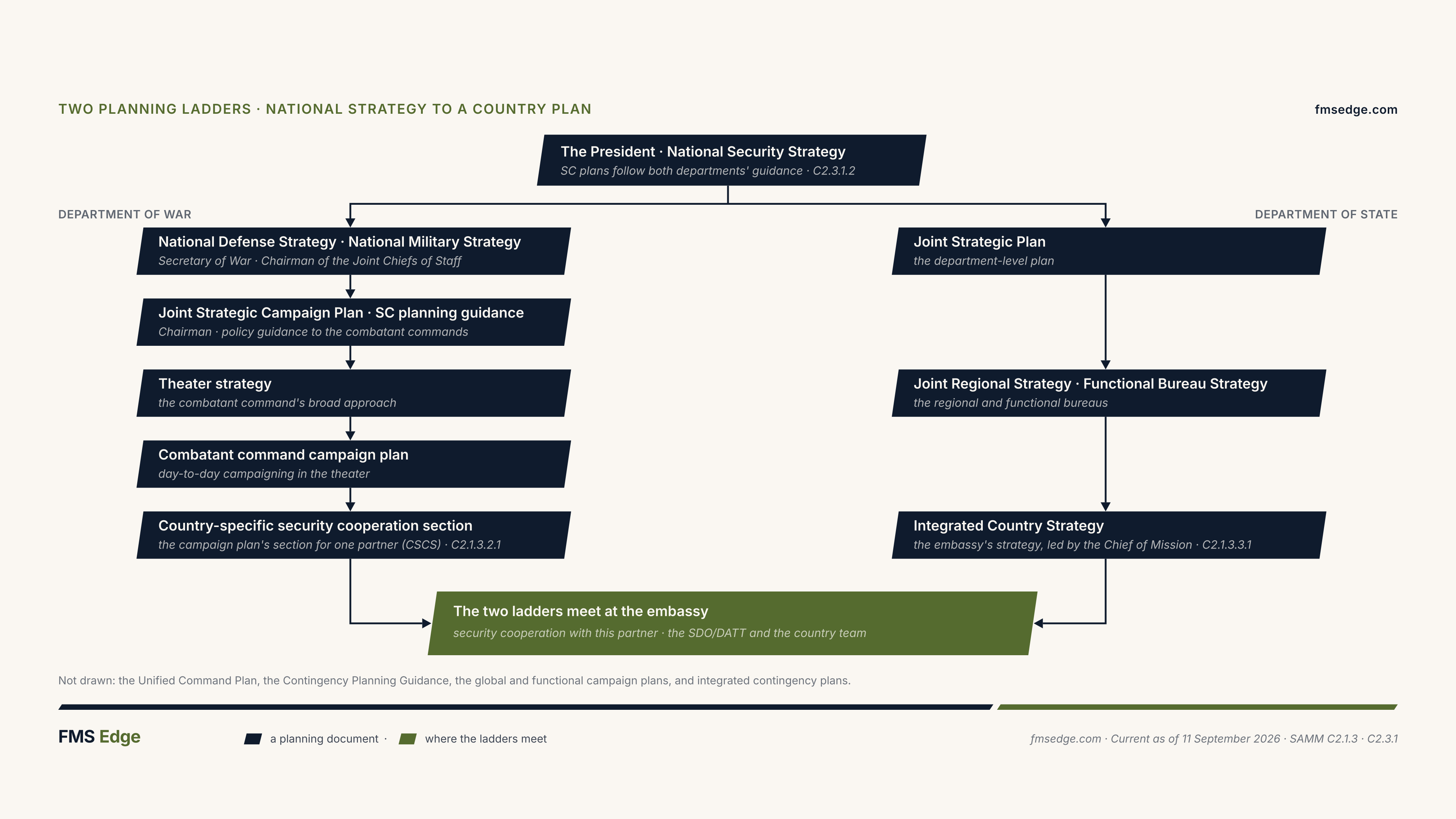
How does U.S. strategy flow down to a security cooperation plan?
() planning begins at the national level with the National Security Strategy (). The President periodically produces the to inform Congress, the public, and foreign constituencies about the Administration’s vision of how to deal with potential national security concerns. The then drives a series of strategies and actions throughout the executive branch, prompting the development of various department-level strategic planning documents.
Three presidential guidance documents provide direction to the Department of War (DoW): the , Unified Command Plan (UCP), and the Contingency Planning Guidance (CPG). The Secretary of War (SecWar) provides strategic direction to the DoW and the Joint Force primarily through the National Defense Strategy (), the Defense Planning Guidance, and force employment guidance. The Office of the Under Secretary of War for Policy also provides planning guidance to the Combatant Commands (). This strategic guidance provides the foundation for National Military Strategy () development.
DoW planning activities must be consistent with the U.S. military's strategic plans and objectives, with the SecWar's policy guidance and with the policy guidance of the Secretary of . The manual points to Directive 5132.03, " Policy and Responsibilities Relating to " [SAMM ].
Section 1206 of the National Defense Authorization Act for Fiscal Year 2022 requires the SecWar, in coordination with the Secretary of , to develop and implement a strategy for each covered . The covered commands are European Command, Indo-Pacific Command, Africa Command, Southern Command, Northern Command and Central Command. The strategy for each command must include the following elements []:
- Support and advance U.S. national security interests in strategic competition with near-peer rivals.
- Prioritize and build key capabilities of allied and partner security forces to enhance bilateral and multilateral interoperability and responsiveness.
- Prioritize and build the capabilities of partner nation (PN) security forces to secure their own territory, including through operations against violent extremist groups.
- Promote and build institutional capabilities for observance of, and respect for, the law of armed conflict, human rights and fundamental freedoms, the rule of law, and civilian control of the military.
- Support programs and activities of law enforcement and civilian agencies, as appropriate, to counter the threat of and reduce risks from illicit drug trafficking and other forms of transnational organized crime.
- objectives for the covered , including primary lines of effort and prioritization of PNs within the covered .
- Descriptions of the DoW authorities for the line of effort, institutional capacity-building programs within the covered , DoW educational programs and institutions, and international institutions relevant to the .
- A discussion of how the development, planning, and implementation of programs or activities under the DoW authorities are coordinated and deconflicted with and other assistance authorities of the Department of State and other civilian agencies.
The is the Chairman of the Joint Chiefs of Staff’s () central strategy and planning document. It translates policy guidance into Joint Force action and assists the SecWar in establishing the strategic direction of the armed forces by providing guidance regarding plans, force employment, posture, and future force development. It provides the strategic framework for the prioritization of planning, resource allocation, and risk distribution.
Part of the ’s Title 10 responsibilities is to review contingency plans and prepare joint logistics and mobility plans. The Joint Strategic Planning System (JSPS) is the primary method by which the fulfills his Title 10 responsibilities, maintains a global perspective, and provides military advice to the SecWar and the President. The JSPS document aligned with this function is the Joint Strategic Campaign Plan ().
The is a five-year global strategic plan (reviewed every two years) that operationalizes the . It is the ’s primary document to guide and direct the preparation and integration of Joint Force campaign and contingency plans. The establishes a common set of processes, products, priorities, roles, and responsibilities to integrate the Joint Force’s global operations, activities, and investments from day-to-day campaigning to contingencies. The directs the development of three types of campaign plans: Global Campaign Plans (GCP), Functional Campaign Plans (FCP), and Campaign Plans ().
As the global integrator, the determines which challenges need GCPs. A GCP addresses the most pressing transregional and multi-functional strategic challenges across all domains. GCPs look across geographic and functional seams. Each GCP has an assigned coordinating authority, the Combatant Commander (), with the preponderance of responsibility for a GCP.
FCPs are assigned to functional and address functional threats or challenges that are not geographically constrained and need coordination across multiple .
are the primary plans through which the execute day-to-day campaigning. address theater objectives and objectives directed by GCPs and FCPs.
The also directs contingency planning, consistent with the Contingency Planning Guidance (CPG), which expands on the CPG with specific objectives, tasks, and linkages between campaign and contingency plans. The directs the development of Integrated Contingency Plans and Global Integration Frameworks (GIF), formerly known as Globally Integrated Base Plans.
The also informs Department of State () planning for the development of the Joint Strategic Plan (JSP), Joint Regional Strategies (JRS), and Functional Bureau Strategies (FBS). The JSP, developed jointly with the United States Agency for International Development (), sets forth the vision and direction for both organizations. has since ceased to implement foreign assistance, and the administers the foreign assistance programs that continue. The JRS articulates priorities to guide missions as they prioritize engagement and resources, and respond to unanticipated events.
These Department and bureau-level strategies, together with national-level guidance and the strategies of interagency partners, inform the Integrated Country Strategy (ICS), produced by the under the direction of the [SAMM ]. Under the direction of the President, the shall have full responsibility for the direction, coordination, and supervision of all Government executive branch employees in the country. The exceptions are Voice of America correspondents on official assignment and employees under the command of a U.S. area military commander []. Thus, the ICS is also the critical whole-of-government document for the , as it details the direction for with the PN and serves as the U.S. Government () whole-of-government strategy for engagement with that country. As U.S. foreign policy is the domain of the , the well-informed planner will have reviewed the relevant JRS and FBS as part of the analysis.
Once activities are authorized and funded through coordination with Office of the Secretary of War and Department of State (), planning for each PN takes the form of mission planning. Planning involves multiple agencies within the and the partner nation.
focus on the country-specific part of the plan, commonly called the Country Plan. It sets out the 's objectives for with that country over the near and mid term, the end states the wants, and the methods for reaching them. and other DoW agencies refer to country plans when they formulate input to Foreign Military Financing and International Military Education and Training budget requests, and when they decide which activities and projects to support with Title 10 funds [SAMM ].
References
SAMM
- SAMM C2.1.3.3: Integrated Country Strategy/Mission Resource Request.
- SAMM C2.3.1.2
- SAMM C2.1.3.2.1
Public authorities
- 22 U.S.C. §3927: Foreign Service Act of 1980, §207 (22 U.S.C. §3927), Chief of mission
- FY2022 NDAA §1206: National Defense Authorization Act for Fiscal Year 2022, Pub. L. 117-81, §1206, Security cooperation strategy for certain combatant commands (10 U.S.C. 301 note)
- CJCSI 3100.01: CJCSI 3100.01, Joint Strategic Planning System (current issue 3100.01F)
Related
Security Cooperation
Activities by which the Department of War encourages and enables international partners to cooperate with the United States toward strategic objectives, spanning every interaction with foreign defense and security establishments and every security assistance program the Department administers.
Under chapter 16 of Title 10, their purposes are to develop allied and friendly security capabilities for self-defense and multinational operations, to give U.S. forces peacetime and contingency access, and to build relationships promoting specific U.S. security interests [10 U.S.C. 301(7)].
FMS Edge glossary, as of 10 October 2026
Glossary entry →Open the manual’s entry → (opens in new tab)
Combatant Command (CCMD)
A unified or specified command with a broad continuing mission under a single commander established and so designated by the President, through the Secretary of Defense and with the advice and assistance of the Chairman of the Joint Chiefs of Staff. Also called CCMD.
SAMM Glossary, as of 12 September 2026
Glossary entry →Open the manual’s entry → (opens in new tab)
National Security Strategy
The President's strategy document on national security, which gives Congress and the executive branch broad policy guidance on the nation's security values and interests. It is the starting point for national defense and security planning and the foundation of the subordinate plans of the Department of War, the Department of State and other cabinet departments.
FMS Edge glossary, as of 10 October 2026
National Defense Strategy (NDS)
The Secretary of War's strategic guidance that turns the priorities of the President's National Security Strategy (NSS) into direction for the National Military Strategy (NMS) and for the Department's campaign and contingency planning and force development. It serves inside the Department and in coordination with other U.S. Government agencies, and is normally reviewed when a new or revised NSS is issued.
FMS Edge glossary, as of 10 October 2026
National Military Strategy (NMS)
The strategic guidance, issued by the Chairman, Joint Chiefs of Staff (CJCS), that directs the armed forces on distributing and applying military power to carry out the National Defense Strategy (NDS). It is designed to produce mutually supporting service and combatant command plans and to assess whether U.S. forces have the capabilities to carry out the NDS and other strategic guidance.
FMS Edge glossary, as of 10 October 2026
Security Assistance (SA)
A group of programs authorized by federal statutes by which the United States provides defense articles, military training, and other defense-related services by grant, lease, loan, credit, or cash sales in furtherance of national policies and objectives, and those that are funded and authorized through the Department of State to be administered by Department of Defense/Defense Security Cooperation Agency, which are considered part of security cooperation.
SAMM Glossary, as of 12 September 2026
Glossary entry →Open the manual’s entry → (opens in new tab)
Joint Strategic Campaign Plan (JSCP)
The global strategic plan, issued by the Chairman, Joint Chiefs of Staff (CJCS), that puts the National Military Strategy into effect and directs the preparation and integration of the joint force's campaign, contingency and support plans. It gives the joint force common processes, products, priorities, roles and responsibilities for integrating its global operations, activities and investments, from day-to-day campaigning to contingencies.
FMS Edge glossary, as of 10 October 2026
CCP: Combatant Command (CCMD) Campaign Plan
USAID: U.S. Agency for International Development
SAMM Acronyms, as of 12 September 2026
Country Team
The senior coordinating and supervising body of a U.S. diplomatic mission, headed by the chief of mission (normally the ambassador) and made up of the senior representative of each U.S. department or agency at the post. Its members meet regularly to coordinate U.S. Government political, economic and military activities and policies in the host country.
FMS Edge glossary, as of 10 October 2026
Glossary entry →Open the manual’s entry → (opens in new tab)
Chief of Mission (COM)
The principal officer in charge of a diplomatic facility of the United States, including any individual temporarily assigned to be in charge of such a facility.
SAMM Glossary, as of 12 September 2026
Glossary entry →Open the manual’s entry → (opens in new tab)
Security Cooperation Organization (SCO)
A Department of Defense element that is part of the United States Diplomatic mission located in a foreign country to carry out security assistance and security cooperation management functions under the supervision and coordination authority of the senior defense official/defense attaché.
SAMM Glossary, as of 12 September 2026
Glossary entry →Open the manual’s entry → (opens in new tab)
SCO: Security Cooperation Organization
SAMM Acronyms, as of 12 September 2026
SAMM C2.3.1.2
“DoW SC planning activities must be consistent with U.S. military strategic plans and objectives, policy guidance issued by the Secretary of War (SECWAR), and policy guidance issued by the Secretary of State (SECSTATE). See Department of Defense Directive (DoDD) 5132.03 "DoD Policy and Responsibilities Relating to Security Cooperation".”
Security Assistance Management Manual, as of 26 October 2026
National Defense Authorization Act for Fiscal Year 2022, Pub. L. 117-81, §1206, Security cooperation strategy for certain combatant commands (10 U.S.C. 301 note)
FY2022 NDAA §1206 · Statute
SAMM C2.1.3.3: Integrated Country Strategy/Mission Resource Request.
“The Integrated Country Strategy (ICS) is the four-year strategy that articulates the U.S. priorities in a given country and is led by the COM. The ICS develops a common set of mission goals and objectives through a coordinated and collaborative planning effort among State and other USG agencies with programming in-country. Higher-level planning documents and strategies, such as the National …”
Security Assistance Management Manual, as of 11 September 2026
Foreign Service Act of 1980, §207 (22 U.S.C. §3927), Chief of mission
22 U.S.C. §3927 · Statute
SAMM C2.1.3.2.1
“MILGPs focus upon the country-specific component of the SC plan, commonly called the Country Plan, which specifies the CCDR’s near and mid-term objectives and desired end-states for SC with a given country and describes the methods to be used in obtaining them. CCMDs and other DoW agencies refer to country plans when formulating input into Foreign Military Financing (FMF) and …”
Security Assistance Management Manual, as of 26 October 2026