
Guide
When does title transfer in a Foreign Military Sale?
Title to materiel passes to the purchaser at the initial point of shipment unless the says otherwise. For an item procured from a vendor and shipped directly to the purchaser, that is the manufacturer's loading facility; for an item sold from stock, it is normally the U.S. depot. Title is not the same as delivery; the point of delivery, set by the , is where responsibility for moving the shipment passes to the purchaser.
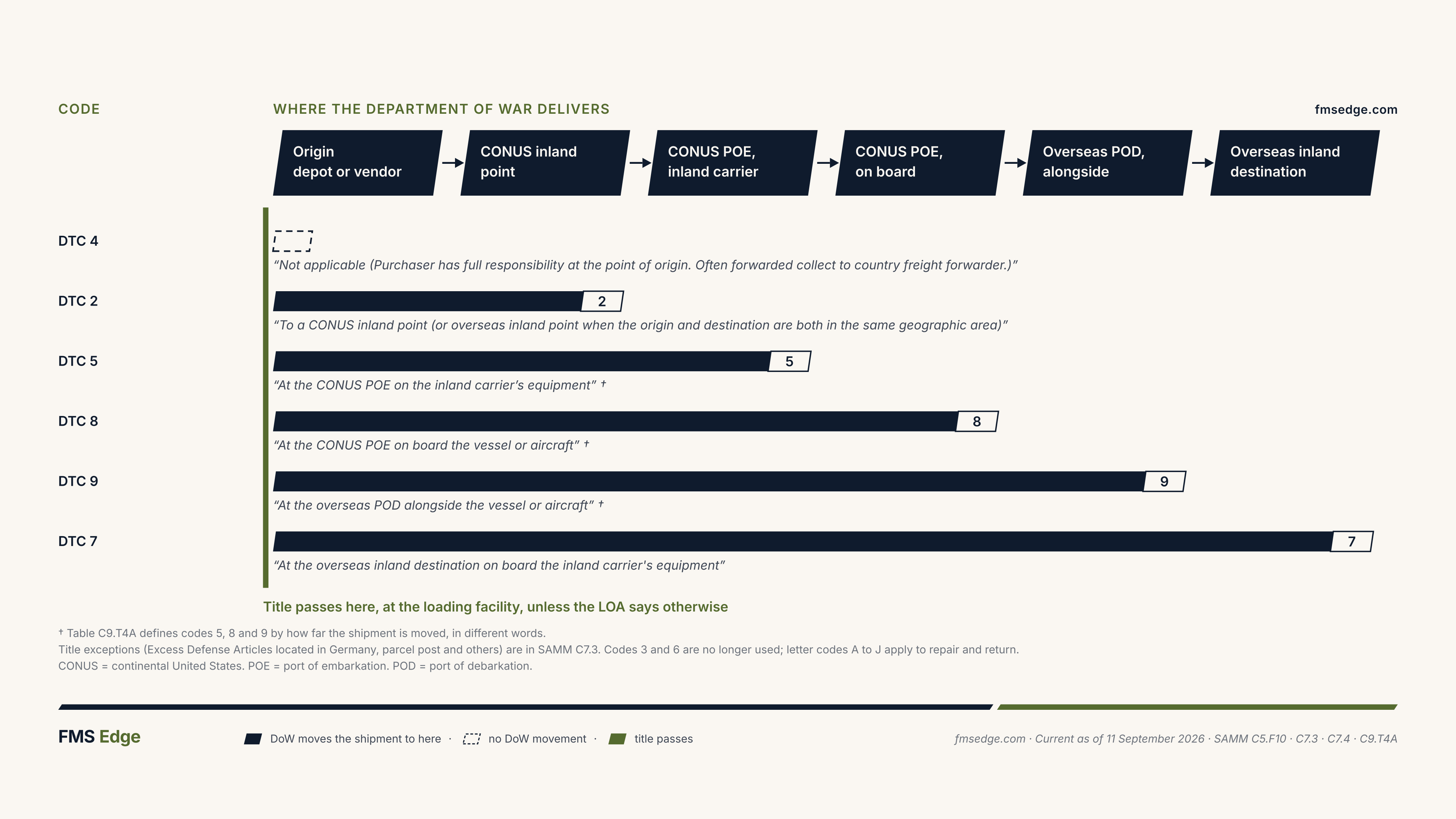
Each numeric Delivery Term Code sets where the Department of War delivers a shipment, from no movement at all (code 4) to the overseas inland destination (code 7). Title passes much earlier, at the loading facility, unless the LOA says otherwise.
When does title transfer in a Foreign Military Sale?
Unless the says otherwise, the title of equipment and materiel will pass at the initial point of shipment (point of origin). Title of Department of War (DoW) articles sold from stock will normally transfer at the U.S. depot. Items procured from contractors will generally pass title at the contractor’s loading facility [SAMM ]. Title to passes at the point of origin. The exception is items located in Germany; unless Germany is the recipient, their title passes at the nearest outside Germany. For defense articles sent by parcel post, title passes to the purchaser on the date of shipment [SAMM , ]. Under , U.S. Government () materiel is delivered when the materiel and its title pass to a representative of the Benefitting Partner, after a joint inventory, on a document [SAMM ]. That document records the title transfer and must be signed before the physical transfer, unless the directs a transfer in writing first because of urgency of need [SAMM ].
The decides when items are released for shipment. The release of a line item or subsystem may be deferred on purpose, so that its title passes at the same time as title to the . Title may pass before the purchaser takes possession. In that case U.S. Government security responsibility lasts until the consignment is under the control of the recipient’s [SAMM ]. A third point, the point of delivery, is where responsibility for the physical movement passes; the on each line sets it [SAMM ].
The may keep title to materiel where operational circumstances require it, and the must then name the point of title transfer if it is not the point of origin. Title retention is not standard practice; it can give an option for materiel that has to transit nations with restrictive Customs requirements. The should direct requests for this limited exception to the ’s Strategy, Plans, and Policy Directorate for approval before case development, and Appendix 6 carries the note for it [SAMM ]. products bought through are titled to North Atlantic Treaty Organization () member nations, Australia and New Zealand [SAMM ]. Any other purchaser, including an international organization other than , must have entered into a Communications Interoperability and Security (), or another agreement, with the through the before it physically receives products. The keeps title to the equipment it transfers, in accordance with the bilateral agreements and the release authorization of the Committee on National Security Systems [SAMM ].
Unless the specifies otherwise, title to materiel bought directly from a vendor and shipped straight to the purchaser passes at the manufacturer's loading facility. transactions are sales between governments. Any contract for materiel that DoW administers should use Free-On-Board () origin terms, consistent with Defense Supplement () PGI 225.7301(c). Section 47.303-1 explains origin. Section C15.5.6.5 gives the guidance on title transfer for defense articles procured under authority. For materiel that requires a , DD Form 1348-5, storage and insurance costs will start as soon as the has been sent to the address listed for it in the . Section C7.11 covers [SAMM ].
When aircraft are ferried, the may accept title to the aircraft from the contractor, and title will then remain with the until the aircraft reaches the point of delivery. The carries a prescribed indemnification and assumption of risk clause, and Appendix 6 gives the applicable note. The purchaser must say whether the aircraft is to be delivered by commercial ferry service (which the purchaser arranges), by DoW ferry or by surface transportation [SAMM ].
The point of delivery is where responsibility for the physical movement of a shipment passes from the DoW to the purchaser. The point of delivery is identified on the by the [SAMM ]. Under the numbered codes, the DoW delivers to a inland point, or to an overseas inland point when origin and destination are in the same geographic area ( 2). It delivers to the either on the inland carrier’s equipment ( 5) or on board the vessel or aircraft ( 8). Overseas, it delivers to the alongside the vessel or aircraft ( 9) or to the inland destination ( 7). Under 4 the purchaser has full responsibility from the point of origin [SAMM ].
The DoW is not responsible for any loss or damage in transit, or once title has passed [SAMM ]. When using the , the generally maintains control and custody of the materiel until delivery to the purchaser, and the DoW performs a reimbursable transportation service for the customer [SAMM , , ].
Under , the Military Group () will keep title to the equipment, and custody of it, until the Benefitting Partner is ready to receive it. defense articles and defense services travel to the Benefitting Partner as -owned materiel and are delivered to the , another employee or a designee in the Benefitting Partner's territory. The defense articles will stay -owned materiel until they have cleared the Benefitting Partner's Customs and been physically transferred to it. Before the hands a or service over to the Benefitting Partner as part of a DoW activity, the International Traffic in Arms Regulations (), 22 C.F.R. 126.4(a)(4), require that the obtain appropriate end-use and retransfer assurances from the partner (see Section C15.1.6.3). A contractor executing a case is required to comply with the when it deals with the and the Benefitting Partner [SAMM ].
References
SAMM
- SAMM C7.3: Title Transfer
- SAMM C7.3.4: Postal Service Deliveries.
- SAMM C15.5.6.5: Title Transfer.
- SAMM C15.5.6.5.2: Transfer Document Preparation.
- SAMM C7.3.5: Retention of Title.
- SAMM C7.3.5.1.1: North Atlantic Treaty Organization.
- SAMM C7.3.5.1.3: International Organizations Other Than North Atlantic Treaty Organization, and Non-North Atlantic Treaty Organization Member Nations Except Australia and New Zealand.
- SAMM C5.F10: Letter of Offer and Acceptance Information
- SAMM C7.4.1: Delivery Term Code.
- SAMM C7.10.1
- SAMM C7.6.3.3: Annotation of Transportation Documents When Department of War Retains Custody.
- SAMM C7.6.2.7: Shipments by the U.S. Government to a Freight Forwarder or Embassy (DTC 5).
- SAMM C9.T4: Table of Charges
- SAMM C7.3.1: Procurement Items.
- SAMM C7.3.3: Excess Defense Articles.
- SAMM C7.3.6: Ferrying of Aircraft.
- SAMM C15.5.6.4: Retention of Title Before Transfer and Receipt of Materiel.
Related
Foreign Military Sales (FMS)
The part of U.S. security assistance, authorized by the Arms Export Control Act (AECA), in which eligible foreign governments and international organizations buy defense articles, services and training from the U.S. Government under formal government-to-government agreements.
The articles come either from Department of War stocks or from new procurement under contracts the Department manages [22 U.S.C. 2761, 22 U.S.C. 2762]. A sale is FMS whatever the source of the purchaser's financing.
FMS Edge glossary, as of 10 October 2026
Glossary entry →Open the manual’s entry → (opens in new tab)
Letter of Offer and Acceptance (LOA)
The legal instrument that lists the defense articles and services, including training, that the U.S. Government transfers to a foreign country or international organization, with their estimated costs and the terms and conditions. The benefitting partner does not sign a Building Partner Capacity (BPC) LOA.
The Letter of Offer and Acceptance (LOA) is the instrument the U.S. Government uses to sell under the Arms Export Control Act (AECA); signed LOAs and their later Amendments and Modifications are also called Foreign Military Sales (FMS) cases [SAMM C5.6.1].
FMS Edge glossary, as of 10 October 2026
Glossary entry →Open the manual’s entry → (opens in new tab)
Delivery Term Code (DTC)
A single-character logistics code that shows how far, from the source of supply to the final destination, the Department of War is responsible for transporting a shipment; it does not set the mode of transportation or how the movement is financed [SAMM C7.4.1].
FMS Edge glossary, as of 10 October 2026
Glossary entry →Open the manual’s entry → (opens in new tab)
Excess Defense Articles (EDA)
Defense articles owned by the USG which are neither procured in anticipation of military assistance or sales requirements, nor procured pursuant to a military assistance or sales order. EDA are items (except construction equipment) that are in excess of the Approved Force Acquisition Objective and Approved Force Retention Stock of all DoD components at the time such articles are dropped from inventory by the supplying agency for delivery to countries or international organizations.
SAMM Glossary, as of 12 September 2026
Glossary entry →Open the manual’s entry → (opens in new tab)
Port of Debarkation (POD)
A military or commercial air or ocean port at which materiel is offloaded. Also referred to as the Port of Discharge.
SAMM Glossary, as of 12 September 2026
Glossary entry →Open the manual’s entry → (opens in new tab)
Building Partner Capacity (BPC) Programs
Security cooperation and security assistance activities funded with USG appropriations (not including Foreign Military Sales Credit and Military Assistance Program/Merger).
SAMM Glossary, as of 12 September 2026
Glossary entry →Open the manual’s entry → (opens in new tab)
Transfer and Receipt
A document which transfers title and custody of Building Partner Capacity defense articles and services from the USG representative in-country to the Benefitting Country. The document is dated and co-signed by both parties.
SAMM Glossary, as of 12 September 2026
Glossary entry →Open the manual’s entry → (opens in new tab)
Defense Security Cooperation Agency (DSCA)
The Department of War agency that directs, administers and provides guidance to the Department's components and its representatives at U.S. missions for the execution of the security cooperation programs for which it is responsible [SAMM C1.3.2.2]. The agency also provides financial and technical assistance, arranges the transfer of defense materiel, training and services to international partners, and promotes military-to-military contacts.
FMS Edge glossary, as of 10 October 2026
Glossary entry →Open the manual’s entry → (opens in new tab)
Implementing Agency (IA)
The military department or defense agency responsible for the execution of military assistance programs. With respect to FMS, the military department or defense agency assigned responsibility by the Defense Security Cooperation Agency to prepare an LOA and to implement an FMS case. The implementing agency is responsible for the overall management of the actions that will result in delivery of the materials or services set forth in the LOA that was accepted by a foreign country or international organization.
SAMM Glossary, as of 12 September 2026
Glossary entry →Open the manual’s entry → (opens in new tab)
End Item
A finished combination of end products, component parts or materials, assembled or completed and ready for its intended use, issue or deployment, such as an aircraft, a truck, a mobile generator or a rifle.
FMS Edge glossary, as of 10 October 2026
Glossary entry →Open the manual’s entry → (opens in new tab)
Designated Government Representative (DGR)
A person or persons duly authorized by a foreign government to act on behalf of that government to negotiate, commit, sign contractual agreements, and/or accept delivery of materiel.
SAMM Glossary, as of 12 September 2026
Glossary entry →Open the manual’s entry → (opens in new tab)
LOA: Letter of Offer and Acceptance
SAMM Acronyms, as of 12 September 2026
Communications Security (COMSEC)
The measures and controls taken to deny unauthorized persons’ information derived from telecommunications and other information systems, and technologies necessary to ensure the authenticity of such communications. COMSEC includes cryptographic security, transmission security, emissions security, and physical security of COMSEC material. Secure telecommunication or information system cryptographic components are the primary COMSEC products for transmission security and commonly called COMSEC devices or products. COMSEC devices are designated Controlled Cryptographic Items (CCI).
SAMM Glossary, as of 12 September 2026
Glossary entry →Open the manual’s entry → (opens in new tab)
Memorandum of Agreement (MOA)
In the manual's usage, a written agreement between sovereign states, or between a state and an international organization, signed by authorized representatives and legally binding under international law.
FMS Edge glossary, as of 10 October 2026
Glossary entry →Open the manual’s entry → (opens in new tab)
CISMOA: Communications Interoperability and Security Memorandum of Agreement
SAMM Acronyms, as of 12 September 2026
Information Security (INFOSEC)
The protection of information systems against unauthorized access to or modification of information, whether in storage, processing, or transit, and against the denial of service to authorized users, including those measures necessary to detect, document and counter such threat. INFOSEC is applied through the application of Cybersecurity and Communications Security (COMSEC).
SAMM Glossary, as of 12 September 2026
Glossary entry →Open the manual’s entry → (opens in new tab)
Combatant Command (CCMD)
A unified or specified command with a broad continuing mission under a single commander established and so designated by the President, through the Secretary of Defense and with the advice and assistance of the Chairman of the Joint Chiefs of Staff. Also called CCMD.
SAMM Glossary, as of 12 September 2026
Glossary entry →Open the manual’s entry → (opens in new tab)
COMSEC: Communications Security
SAMM Acronyms, as of 12 September 2026
FMS: Foreign Military Sale
SAMM Acronyms, as of 12 September 2026
Federal Acquisition Regulation (FAR)
The FAR is the primary regulation for use by federal executive agencies for the acquisition of supplies and services with appropriated funds. The document, published in 1984, consolidated the major procurement regulations of various departments and agencies. The intent of the FAR is to standardize the content, decrease the volume of documents, and to achieve consistency throughout government. The principal agencies involved in putting together the FAR were DoD, the General Services Administration, and the National Aeronautics and Space Administration, the three largest buyers. The FAR is broader than just contracting and applies to all goods and services. It directs the defense program manager in many ways, including contract award procedures, acquisition planning, warranties, and establishing guidelines for competition. Besides the FAR, each agency has its supplement to describe its own particular way of doing business. The DoD supplement is called Defense FAR Supplement.
SAMM Glossary, as of 12 September 2026
Glossary entry →Open the manual’s entry → (opens in new tab)
DFARS: Defense Federal Acquisition Regulation Supplement
SAMM Acronyms, as of 12 September 2026
Notice of Availability (NOA)
Notice, on DD Form 1348-5, from a shipping activity to a Foreign Military Sales (FMS) purchaser or its freight forwarder that materiel is ready for shipment, in time for the recipient to prepare for receipt and respond with delivery instructions.
The Notice of Availability (NOA) goes to the appropriate address in the Military Assistance Program Address Directory (MAPAD) and coordinates the release of materiel requiring special receipt, export processing or special storage procedures [SAMM C7.11.1].
FMS Edge glossary, as of 10 October 2026
Glossary entry →Open the manual’s entry → (opens in new tab)
NOA: Notice of Availability
SAMM Acronyms, as of 12 September 2026
Military Assistance Program Address Directory (MAPAD)
The directory of clear-text addresses of country representatives, freight forwarders and in-country customers used to release Foreign Military Sales (FMS) and grant aid shipments processed under Military Standard Requisitioning and Issue Procedures (MILSTRIP), and to send their shipping documents.
The Military Assistance Program Address Directory (MAPAD) is available to Department of War activities, the General Services Administration (GSA), commercial firms, foreign governments and international organizations taking part in FMS or grant aid programs [SAMM C7.7.1].
FMS Edge glossary, as of 10 October 2026
Glossary entry →Open the manual’s entry → (opens in new tab)
Continental United States (CONUS)
U.S. territory, including the adjacent territorial waters, located within the North American continent between Canada and Mexico. Does not include Hawaii or Alaska.
SAMM Glossary, as of 12 September 2026
Glossary entry →Open the manual’s entry → (opens in new tab)
DTC: Delivery Term Code
SAMM Acronyms, as of 12 September 2026
CONUS: Continental United States
SAMM Acronyms, as of 12 September 2026
Port of Embarkation (POE)
A military or commercial air or ocean port at which a carrier begins the journey to deliver materiel to the consignee. This is also referred to as the Port of Exit.
SAMM Glossary, as of 12 September 2026
Glossary entry →Open the manual’s entry → (opens in new tab)
Letter of Request (LOR)
The term used to identify a request from an eligible FMS participant country for the purchase of U.S. defense articles and services. The request may be in message or letter format.
SAMM Glossary, as of 12 September 2026
Glossary entry →Open the manual’s entry → (opens in new tab)
Defense Transportation System (DTS)
The part of the worldwide transportation infrastructure that supports Department of War transportation needs in peace and war, made up of military (organic) and commercial resources that are organic to the Department, under contract to it or controlled by it [SAMM C7.6.1].
It takes in organic and commercial aircraft and ships, commercial small-package services under Department contract, and U.S. military air and ocean terminals in and outside the United States.
FMS Edge glossary, as of 10 October 2026
Glossary entry →Open the manual’s entry → (opens in new tab)
Defense Article (Foreign Assistance Act; Arms Export Control Act, not including commercial sales subject to the International Traffic in Arms Regulation)
Any weapon, weapon system, munition, aircraft, vessel or other implement of war, together with the property, equipment, tooling, components and parts used to furnish military assistance or sales or to make, maintain or use such items; the International Traffic in Arms Regulations (ITAR) define the term separately for commercial exports.
Section 47 of the Arms Export Control Act (AECA) defines the term, and the U.S. Munitions List designates the specific items that fall within it [SAMM C4.4] [22 U.S.C. 2794].
FMS Edge glossary, as of 10 October 2026
Glossary entry →Open the manual’s entry → (opens in new tab)
Security Cooperation
Activities by which the Department of War encourages and enables international partners to cooperate with the United States toward strategic objectives, spanning every interaction with foreign defense and security establishments and every security assistance program the Department administers.
Under chapter 16 of Title 10, their purposes are to develop allied and friendly security capabilities for self-defense and multinational operations, to give U.S. forces peacetime and contingency access, and to build relationships promoting specific U.S. security interests [10 U.S.C. 301(7)].
FMS Edge glossary, as of 10 October 2026
Glossary entry →Open the manual’s entry → (opens in new tab)
ITAR: International Traffic in Arms Regulations
SAMM Acronyms, as of 12 September 2026
Glossary entry →International Traffic in Arms Regulation (ITAR) →
SAMM C7.3: Title Transfer
“Title to Foreign Military Sales (FMS) materiel is delivered and passed from the USG to the purchaser at the initial point of shipment unless otherwise specified in the Letter of Offer and Acceptance (LOA). With respect to items procured from a commercial manufacturer, items are typically released for delivery to the purchaser at the manufacturer's loading facility. With respect to …”
Security Assistance Management Manual, as of 26 October 2026
SAMM C7.3.3: Excess Defense Articles.
“Title to Excess Defense Articles (EDA) items transfers at the point of origin except for items located in Germany. For EDA items located in Germany, unless Germany is the recipient, title transfers at the nearest Port of Debarkation (POD) outside of Germany.”
Security Assistance Management Manual, as of 11 September 2026
SAMM C7.3.4: Postal Service Deliveries.
“Title to defense articles transported via parcel post passes to the purchaser on the date of shipment. Title passage is at the postal facility at a DoW depot or at the nearest post office if depot personnel take the materiel to the post office in depot-furnished transportation.”
Security Assistance Management Manual, as of 26 October 2026
SAMM C15.5.6.5: Title Transfer.
“Items are considered delivered when the materiel and title is transferred to a representative of the Benefitting Partner. The MILGP will conduct a joint inventory, prepare the Transfer and Receipt document, have the document signed by the Benefitting Partner representative, and provide a copy to the IA along with the signed document and attachments. The MILGP is encouraged to hold …”
Security Assistance Management Manual, as of 5 October 2026
SAMM C15.5.6.5.2: Transfer Document Preparation.
“After joint inventory, the MILGP, another USG employee, or designee will prepare the Transfer and Receipt document. A Transfer and Receipt document, or a comparable form established for this purpose, is used to record the title transfer, must be signed before physical transfer occurs (unless DSCA (IOPS) provides written direction to transfer defense articles due to urgency of need), and …”
Security Assistance Management Manual, as of 5 October 2026
SAMM C7.4.1: Delivery Term Code.
“The Delivery Term Code (DTC) is a logistical code that indicates how far, from the source of supply to the final destination, that the DoW is responsible to transport a shipment. The DTC does not determine the mode of transportation or how it is financed. A purchaser may specify a preferred DTC in the Letter of Request (LOR). See Table …”
Security Assistance Management Manual, as of 26 October 2026
SAMM C7.3.5: Retention of Title.
“The USG may retain title for shipments of FMS materiel if required by operational circumstances. Designation of a point of title transfer other than the point of origin must be specified in the LOA. Title retention by the USG is not a standard practice, but may provide an option to allow materiel to transit through nations with restrictive Customs requirements. …”
Security Assistance Management Manual, as of 11 September 2026
SAMM C7.3.5.1.1: North Atlantic Treaty Organization.
“North Atlantic Treaty Organization (NATO) member nations, Australia and New Zealand. Communications Security (COMSEC) products procured through FMS transfers are titled to those nations.”
Security Assistance Management Manual, as of 11 September 2026
SAMM C7.3.5.1.3: International Organizations Other Than North Atlantic Treaty Organization, and Non-North Atlantic Treaty Organization Member Nations Except Australia and New Zealand.
“Prior to physically receiving any U.S. Information Security (INFOSEC) / COMSEC products or services, the FMS purchaser or recipient must have entered into a bilateral Communications Interoperability and Security Memorandum of Agreement (CISMOA) or other INFOSEC agreement with the USG via the Combatant Command (CCMD). It's recommended that this agreement be initiated before or parallel to LOA development to avoid …”
Security Assistance Management Manual, as of 11 September 2026
SAMM C7.3.1: Procurement Items.
“Unless otherwise specified in the LOA, when FMS material is procured directly from a vendor and shipped directly to the purchaser, title passes at the manufacturer’s loading facility. FMS transactions are government-to-government sales and the terms of any DoW-administered contract for FMS materiel should be Free-On-Board (FOB) origin, consistent with Defense Federal Acquisition Regulation Supplement (DFARS) Procedures, Guidance, and Information …”
Security Assistance Management Manual, as of 26 October 2026
SAMM C7.3.6: Ferrying of Aircraft.
“When ferrying aircraft, the USG may accept title to the aircraft from the contractor. In this case, title will remain with the USG until arrival at the point of delivery. The LOA contains a prescribed indemnification and assumption of risk clause, See Appendix 6, for the applicable LOA note. The FMS purchaser must advise whether the aircraft will be delivered …”
Security Assistance Management Manual, as of 26 October 2026
SAMM C5.F10: Letter of Offer and Acceptance Information
“… Term of Sale Dependable Undertaking with 120 days Payment after Delivery, Source Code P (Procurement), AECA, Section 22(b) (22 U.S.C. 2762(b)). 8 Term of Sale Payment 120 days after Delivery, Source Code S, R, E, or F, Stock Sales with 120 days Payment after Delivery; AECA, Section 21(d) (22 U.S.C. 2761(d)). BN-Q-SEH Page 16 A Term of Sale EDA Grant, …”
Security Assistance Management Manual, as of 11 September 2026
SAMM C7.10.1
“Title of Foreign Military Sales (FMS) shipments transfers to the purchaser at the point of origin unless otherwise specified in the Letter of Offer and Acceptance (LOA). The DoW is not responsible for any loss or damage that occurs in transit or after passage of title. If a purchaser does not want to self-insure a shipment, the purchaser should obtain …”
Security Assistance Management Manual, as of 26 October 2026
SAMM C7.6.3.3: Annotation of Transportation Documents When Department of War Retains Custody.
“When DoW retains custody and transportation responsibility of FMS shipments its arrival at the Port of Debarkation (POD) in the destination country, the BLs for these DTS shipments are annotated with statements to comply with U.S. Customs requirements. See Section C7.6.3.3.1. and Section C7.6.3.3.2. The signature of the issuing officer on the BL serves as certification of these statements. Neither …”
Security Assistance Management Manual, as of 26 October 2026
SAMM C7.6.2.7: Shipments by the U.S. Government to a Freight Forwarder or Embassy (DTC 5).
“USG Shipments to U.S.-located Foreign Military Sales (FMS) freight forwarders or country representatives located at embassies in the United States are DTS shipments until the consignee unloads the materiel from the carrier.”
Security Assistance Management Manual, as of 11 September 2026
SAMM C9.T4: Table of Charges
“Table C9.T4. Table of Charges Charge Description How Priced Applied by - for Billing References Acceleration Rates To recover full cost of providing USG services. Included in the line item value on the Letter of Offer and Acceptance (LOA). Specific to Building Partner Capacity (BPC) cases: Do not charge unfunded civilian retirement. Implementing Agency (IA) DoD Financial Management Regulation (DoD …”
Security Assistance Management Manual, as of 5 October 2026
SAMM C15.5.6.4: Retention of Title Before Transfer and Receipt of Materiel.
“The MILGP will retain title and custody of the equipment until the Benefitting Partner is ready to receive the equipment. BPC defense articles and defense services are transported to the Benefitting Partner as USG-owned materiel and delivered to the MILGP, another USG employee, or designee in the Benefitting Partner’s territory. The defense articles will remain USG-owned materiel until they pass …”
Security Assistance Management Manual, as of 5 October 2026