
Guide
Freight forwarder or Defense Transportation System: how does a Foreign Military Sales purchaser ship its materiel?
The purchaser is responsible for moving its own materiel. It may pay to use the or hire its own , a private firm under contract to it that coordinates, receives, consolidates and stages the materiel in the United States and arranges its onward movement. Arms and ammunition in the security risk categories must move through the or a Department of War-controlled port.
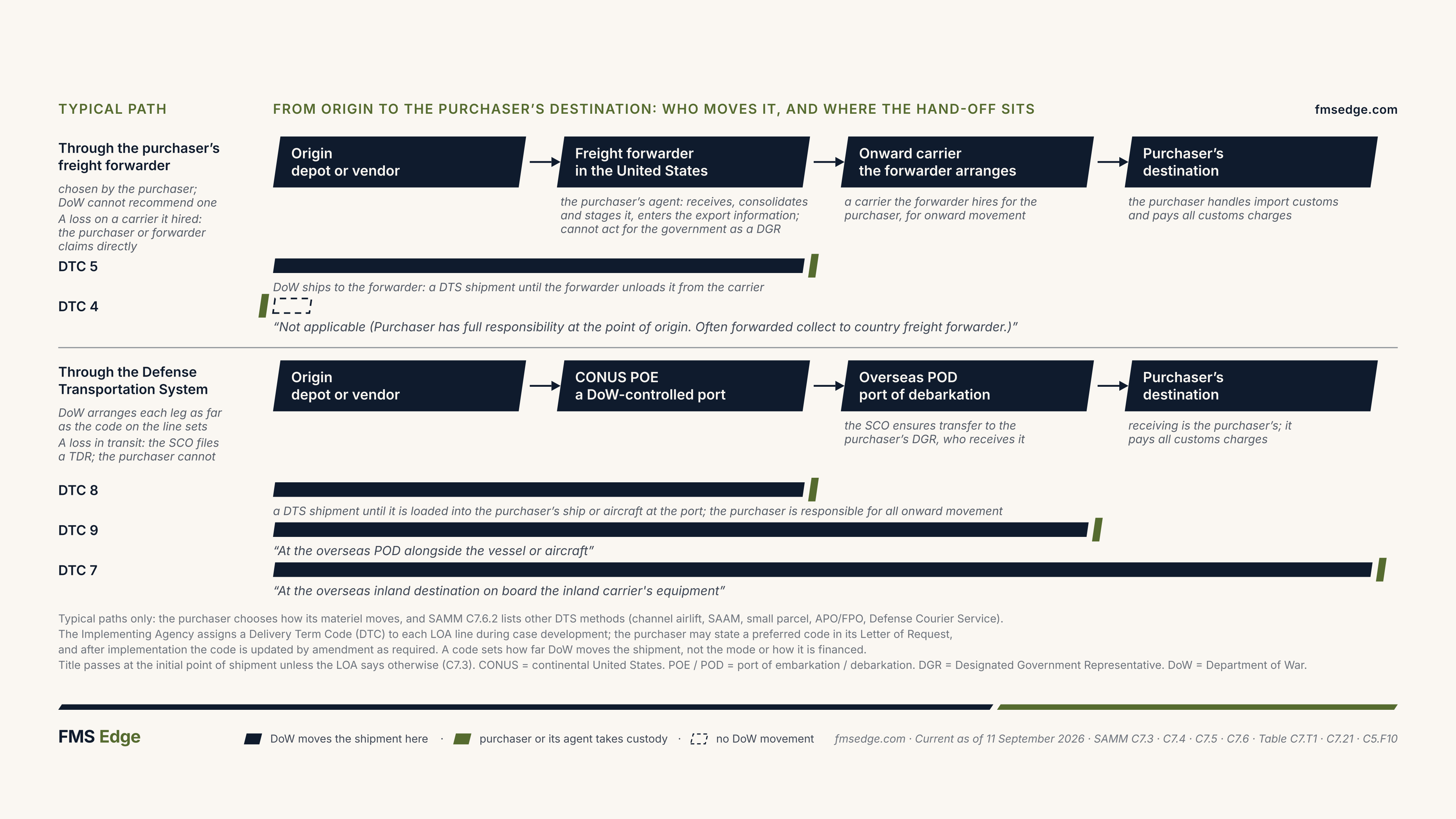
Two typical paths; the purchaser chooses how its materiel moves. Through its own freight forwarder, the Department of War ships to the forwarder (Delivery Term Code 5) or moves nothing (code 4). Through the Defense Transportation System it carries the shipment to the port, the overseas port or the destination (codes 8, 9 and 7).
Should a Foreign Military Sales purchaser use a freight forwarder or the Defense Transportation System?
A purchaser may use the at reimbursable rates or hire its own , within limits that depend on the materiel [SAMM ]. Arms, ammunition and explosives and sensitive items may not be shipped to the purchaser’s or to the purchaser’s facility in the United States, and they require Transportation Plans [SAMM ]. Security Risk Category I items must move by the at least to the overseas unless the purchaser obtains a waiver. Categories II to IV must move through a that the Department of War controls, and that requirement cannot be waived [SAMM , ].
are an exception: they may move through freight forwarders or the if in-transit visibility is kept and the items are reasonably protected against theft and loss at all times [SAMM ]. Canada, which has no freight forwarders, may have all categories moved directly to locations in Canada [SAMM ]. A may take custody of classified materiel for delivery as freight only if it has a valid facility clearance and approved storage at the appropriate level [SAMM ]. The guides on arms, ammunition and explosives and on classified materiel set out these rules in full.
It is Department of War (DoW) policy that the purchaser is responsible for the transportation and delivery of its purchased materiel, and the DoW encourages purchasers to be self-sufficient. The purchaser may use the on a reimbursable basis, or employ an agent, an , to manage transportation and delivery from the point of origin to the purchaser’s desired destination [SAMM ].
Advance planning for transportation by the U.S. Government and the purchaser is critical to case development and execution. A purchaser that uses the pays DoW reimbursable rates. The point of origin is typically in the . The manual's transportation procedures generally apply to all materiel, and requirements specific to are set out in C15.5 and C15-Legacy.5.6 [SAMM ].
The Defense Transportation System
The DoW encourages customers to make informed decisions regarding transportation arrangements [SAMM ]. Not all categories of materiel are eligible to be transported through commercial channels [SAMM ]. The DoW also arranges transportation for the customer using the , on a reimbursable basis [SAMM ].
The prime movers within the are the Service Components of the U.S. Transportation Command (USTRANSCOM): the Air Mobility Command (), the U.S. Army Transportation Command () and the Military Sealift Command () [SAMM ]. manages DoW air terminals and the onward movement of cargo and passengers booked on military airlift. provides worldwide ocean transportation for the DoW. arranges surface movement within the , and vessels it charters are part of the .
When materiel is shipped through the , the customer is charged for the cost of transportation [SAMM ].
For DoW-furnished or contracted transportation, the DoW submits the claims against carriers when a shipment is lost or damaged: for ocean carriers, for air carriers, and DoW shipping activities for inland carriers in the . initiates its claims in response to Transportation Discrepancy Report () packages submitted by the in the purchaser’s country, and the forwards any proceeds to the purchaser’s accounts [SAMM ]. A is financed from funds for the non-receipt or shortage of a stock item shipped by only where U.S. action or inaction prevented the DoW from obtaining satisfaction from the carrier [SAMM ].
Security Risk Category II through IV arms and ammunition must move through a DoW-controlled in the United States. Security Risk Category I items must move by to at least the overseas [SAMM , ]. A shipment to a DoW-controlled remains a shipment until the materiel is loaded into the purchaser’s ship or aircraft, and the purchaser is responsible for all onward movement [SAMM ]. Cargo that needs special consideration because of its weight or size, the urgency or sensitivity of the movement, or other special factors may move on a [SAMM ].
The is the part of the worldwide transportation infrastructure that supports DoW transportation needs in peace and war, as Directive 4500.09 defines it. It has two major elements, military (organic) resources and commercial resources, which include the assets, services and systems that are organic to, contracted for or controlled by DoW. The infrastructure that DoW maintains includes airlift, sealift, ports, railway and highway, traffic management, customs, information management systems and in-transit visibility systems. That infrastructure is central to DoW's ability to project power worldwide. Shipments that move in the must comply with the Defense Transportation Regulation (), 4500.9-R. Using the may give purchasers transportation alternatives to freight forwarders [SAMM ].
Freight forwarders
The purchaser is responsible for transporting its own materiel, furnished under its , beyond the point of delivery its sets [SAMM , ]. The purchaser may choose to hire a commercial to arrange for the receipt, processing, export, and import of materiel. DoW personnel must remain impartial and cannot recommend a to a purchaser or direct a how to conduct operations [SAMM , ].
The is a private firm under contract to the customer to coordinate, receive, consolidate, and stage materiel within the U.S. and arrange for its onward movement. The contract should describe the specific functions to be performed by the [SAMM ].
A 's responsibilities may vary with the terms of its contract with the purchaser. In every case, though, it acts as the purchaser's agent and cannot act for the U.S. Government as a [SAMM ].
The commercial entities on the sample Transportation Plan for a classified and sensitive shipment, naming the freight forwarder, which acts as the purchaser's agent, and each carrier with its security clearance. Bandaria is the manual's fictional training country; the figure is a training example, not a real case.
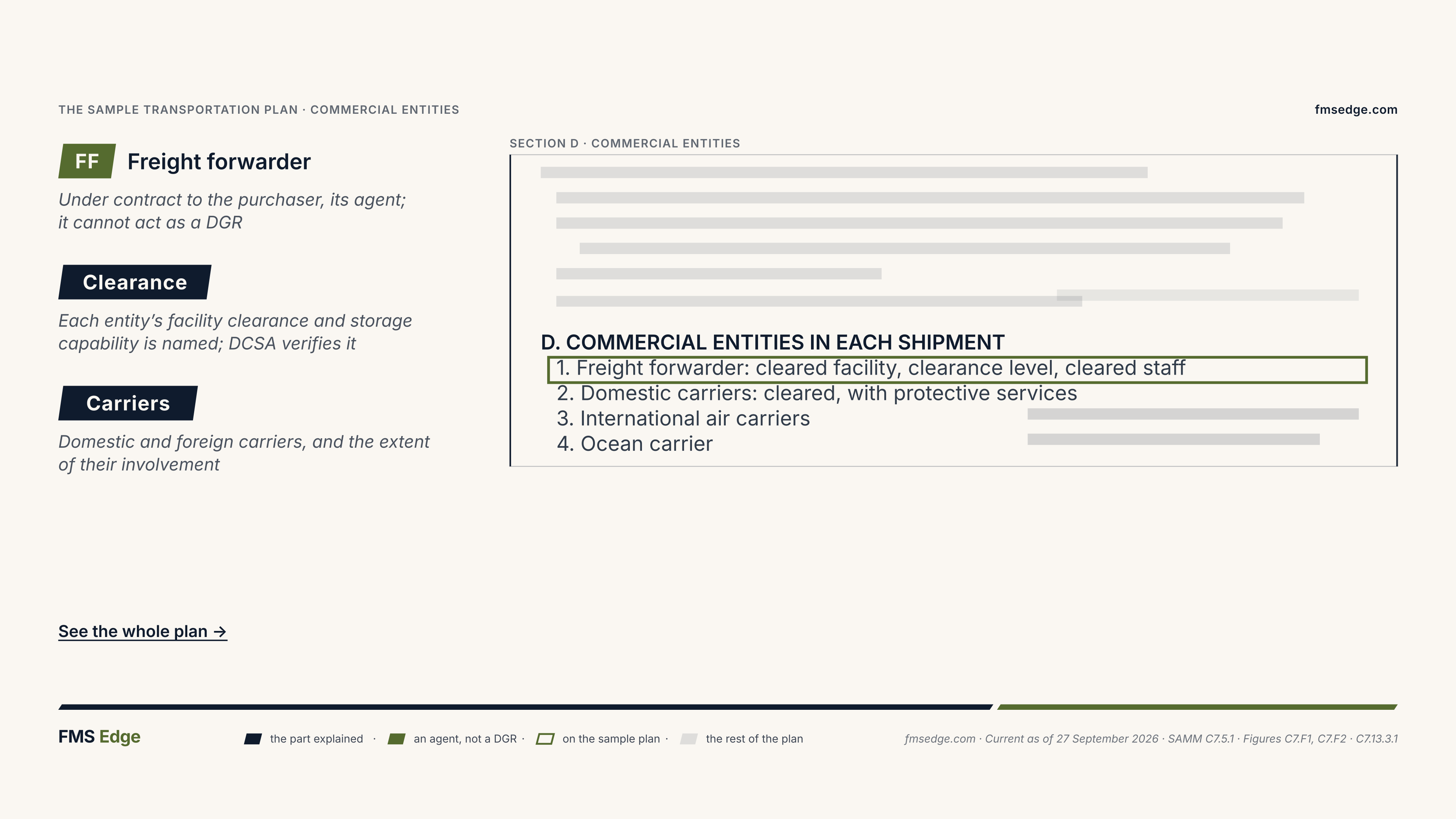
The purchaser must select its itself [SAMM ]. A must hold a valid exporter registration with the Department of State's Directorate of Defense Trade Controls (PM/), in the Bureau of Political-Military Affairs, consistent with the International Traffic in Arms Regulations () [SAMM ]. The purchaser's U.S.-based embassy must also identify the forwarder in writing to as its authorized [SAMM ].
Try the tool: Delivery Term Code picker
References
SAMM
- SAMM C7.15: Transportation of Arms, Ammunition and Explosives and Sensitive Materiel.
- SAMM C7.15.1: Security Risk Category I.
- SAMM C7.15.2: Security Risk Category II through IV.
- SAMM C7.15.4: Controlled Cryptographic Item.
- SAMM C7.15.5: Arms, Ammunition, & Explosives and Sensitive to Canada.
- SAMM C7.5.3.3
- SAMM C7.21.2: Claims That Can Be Submitted by the United States Government.
- SAMM C6.T4: Methods of Financing Approved Supply Discrepancy Reports
- SAMM C7.12.1: Defense Transportation System Costs.
- SAMM C7.6.2.8: Delivery on Board a Purchaser-Controlled Ship or Aircraft at a Department of War Port of Embarkation (DTC 8).
- SAMM C7.6.2.1.2: Special Assignment Airlift Mission Flights.
- SAMM C7.4.1: Delivery Term Code.
- SAMM C7.1.1
- SAMM C7.6.1: Definition.
- SAMM C7.6.2.1: Military (Organic).
- SAMM C7.5.1: Definition.
- SAMM C7.5.2: Selection of a Foreign Military Sales Freight Forwarder.
- SAMM C7.5.3.1
- SAMM C7.5.3.2
Related
Foreign Military Sales (FMS)
The part of U.S. security assistance, authorized by the Arms Export Control Act (AECA), in which eligible foreign governments and international organizations buy defense articles, services and training from the U.S. Government under formal government-to-government agreements.
The articles come either from Department of War stocks or from new procurement under contracts the Department manages [22 U.S.C. 2761, 22 U.S.C. 2762]. A sale is FMS whatever the source of the purchaser's financing.
FMS Edge glossary, as of 10 October 2026
Glossary entry →Open the manual’s entry → (opens in new tab)
Defense Transportation System (DTS)
The part of the worldwide transportation infrastructure that supports Department of War transportation needs in peace and war, made up of military (organic) and commercial resources that are organic to the Department, under contract to it or controlled by it [SAMM C7.6.1].
It takes in organic and commercial aircraft and ships, commercial small-package services under Department contract, and U.S. military air and ocean terminals in and outside the United States.
FMS Edge glossary, as of 10 October 2026
Glossary entry →Open the manual’s entry → (opens in new tab)
Freight Forwarder
A commercial import/export company registered with the Department of State, Bureau of Political-Military Affairs, Directorate of Defense Trade Controls and under contract to the Foreign Military Sales customer which arranges transportation of materiel from a point specified in the Letter of Offer and Acceptance to the final destination.
SAMM Glossary, as of 12 September 2026
Glossary entry →Open the manual’s entry → (opens in new tab)
Port of Debarkation (POD)
A military or commercial air or ocean port at which materiel is offloaded. Also referred to as the Port of Discharge.
SAMM Glossary, as of 12 September 2026
Glossary entry →Open the manual’s entry → (opens in new tab)
Port of Embarkation (POE)
A military or commercial air or ocean port at which a carrier begins the journey to deliver materiel to the consignee. This is also referred to as the Port of Exit.
SAMM Glossary, as of 12 September 2026
Glossary entry →Open the manual’s entry → (opens in new tab)
Controlled Cryptographic Items (CCI)
CCIs are devices that embody cryptographic logic or other cryptographic design, but do not perform the entire Communications Security (COMSEC) function. CCIs are dependent upon host equipment or assemblies to complete and operate COMSEC functions. Un-keyed CCI is unclassified. An item may be designated CCI because its entire component is controlled (e.g. Inline Network Encryptor (INE)), or because the item contains an embedded cryptographic National Security Agency (NSA) Type-1 certified module to encrypt/de-encrypt information (e.g. secure radio).
SAMM Glossary, as of 12 September 2026
Glossary entry →Open the manual’s entry → (opens in new tab)
FMS: Foreign Military Sale
SAMM Acronyms, as of 12 September 2026
DTS: Defense Transportation System
SAMM Acronyms, as of 12 September 2026
Continental United States (CONUS)
U.S. territory, including the adjacent territorial waters, located within the North American continent between Canada and Mexico. Does not include Hawaii or Alaska.
SAMM Glossary, as of 12 September 2026
Glossary entry →Open the manual’s entry → (opens in new tab)
Security Cooperation
Activities by which the Department of War encourages and enables international partners to cooperate with the United States toward strategic objectives, spanning every interaction with foreign defense and security establishments and every security assistance program the Department administers.
Under chapter 16 of Title 10, their purposes are to develop allied and friendly security capabilities for self-defense and multinational operations, to give U.S. forces peacetime and contingency access, and to build relationships promoting specific U.S. security interests [10 U.S.C. 301(7)].
FMS Edge glossary, as of 10 October 2026
Glossary entry →Open the manual’s entry → (opens in new tab)
Building Partner Capacity (BPC) Programs
Security cooperation and security assistance activities funded with USG appropriations (not including Foreign Military Sales Credit and Military Assistance Program/Merger).
SAMM Glossary, as of 12 September 2026
Glossary entry →Open the manual’s entry → (opens in new tab)
SAMM: Security Assistance Management Manual
SAMM Acronyms, as of 12 September 2026
Glossary entry →Security Assistance Management Manual (SAMM) →
U.S. Army Transportation Command
The U.S. Army command, formerly the Military Surface Deployment and Distribution Command (SDDC), that is the Army service component command of U.S. Transportation Command (USTRANSCOM) and a major subordinate command of Army Materiel Command.
Its assets form part of the Defense Transportation System (DTS), and it processes claims against ocean carriers for transportation the Department of War furnishes or contracts [SAMM C7.6.2.1, C7.21.2].
FMS Edge glossary, as of 10 October 2026
Security Cooperation Organization (SCO)
A Department of Defense element that is part of the United States Diplomatic mission located in a foreign country to carry out security assistance and security cooperation management functions under the supervision and coordination authority of the senior defense official/defense attaché.
SAMM Glossary, as of 12 September 2026
Glossary entry →Open the manual’s entry → (opens in new tab)
Implementing Agency (IA)
The military department or defense agency responsible for the execution of military assistance programs. With respect to FMS, the military department or defense agency assigned responsibility by the Defense Security Cooperation Agency to prepare an LOA and to implement an FMS case. The implementing agency is responsible for the overall management of the actions that will result in delivery of the materials or services set forth in the LOA that was accepted by a foreign country or international organization.
SAMM Glossary, as of 12 September 2026
Glossary entry →Open the manual’s entry → (opens in new tab)
Supply Discrepancy Report (SDR)
A process for international customers to file a complaint with the DoD for product loss, quality deficiencies, damage, and various other problems associated with the delivery of material under the Foreign Military Sales program.
SAMM Glossary, as of 12 September 2026
Glossary entry →Open the manual’s entry → (opens in new tab)
Letter of Offer and Acceptance (LOA)
The legal instrument that lists the defense articles and services, including training, that the U.S. Government transfers to a foreign country or international organization, with their estimated costs and the terms and conditions. The benefitting partner does not sign a Building Partner Capacity (BPC) LOA.
The Letter of Offer and Acceptance (LOA) is the instrument the U.S. Government uses to sell under the Arms Export Control Act (AECA); signed LOAs and their later Amendments and Modifications are also called Foreign Military Sales (FMS) cases [SAMM C5.6.1].
FMS Edge glossary, as of 10 October 2026
Glossary entry →Open the manual’s entry → (opens in new tab)
Delivery Term Code (DTC)
A single-character logistics code that shows how far, from the source of supply to the final destination, the Department of War is responsible for transporting a shipment; it does not set the mode of transportation or how the movement is financed [SAMM C7.4.1].
FMS Edge glossary, as of 10 October 2026
Glossary entry →Open the manual’s entry → (opens in new tab)
LOA: Letter of Offer and Acceptance
SAMM Acronyms, as of 12 September 2026
Foreign Military Sales (FMS) Trust Fund
A single account that is authorized to be credited with receipts that may be obligated and expended in accordance with the Arms Export Control Act (AECA). Foreign Military Sales (FMS) Trust Fund receipts must be apportioned prior to obligation and expenditure; however, an official, designated under 31 U.S.C. 1513 (as per 31 U.S.C. 1516), may exempt trust funds from apportionment. The FMS Trust Fund is managed as a single cash entity, regardless of the source of the deposits. All FMS Trust Fund deposits are accounted for at purchaser and FMS case level by source of financing. Examples of funds include Foreign Military Financing (FMF) (FMS Credit and FMS Credit (nonrepayable)) and the Military Assistance Program (MAP) Merger. Examples of other types of funds are a purchaser's national funds, which include third-party funds, and other DoD appropriated funds.
SAMM Glossary, as of 12 September 2026
Glossary entry →Open the manual’s entry → (opens in new tab)
Cost Clearing Account
An account used when standard rates are employed. The actual expenses are debited to the cost clearing account and the amounts billed to customers are credited to the account. At the end of the fiscal year, the account is closed with analysis performed to determine if rates require adjustment.
SAMM Glossary, as of 12 September 2026
Glossary entry →Open the manual’s entry → (opens in new tab)
Special Assignment Airlift Mission (SAAM)
A dedicated U.S. military aircraft, chartered to deliver sensitive, classified or explosive defense articles to a specific customer location when no commercial delivery capability exists.
SAMM Glossary, as of 12 September 2026
Glossary entry →Open the manual’s entry → (opens in new tab)
SAAM: Special Assignment Airlift Mission
SAMM Acronyms, as of 12 September 2026
Service Contract
A contract that calls directly for a contractor's time and effort rather than for a physical end product.
SAMM Glossary, as of 12 September 2026
Glossary entry →Open the manual’s entry → (opens in new tab)
POE: Port of Embarkation
SAMM Acronyms, as of 12 September 2026
Security Assistance (SA)
A group of programs authorized by federal statutes by which the United States provides defense articles, military training, and other defense-related services by grant, lease, loan, credit, or cash sales in furtherance of national policies and objectives, and those that are funded and authorized through the Department of State to be administered by Department of Defense/Defense Security Cooperation Agency, which are considered part of security cooperation.
SAMM Glossary, as of 12 September 2026
Glossary entry →Open the manual’s entry → (opens in new tab)
Designated Government Representative (DGR)
A person or persons duly authorized by a foreign government to act on behalf of that government to negotiate, commit, sign contractual agreements, and/or accept delivery of materiel.
SAMM Glossary, as of 12 September 2026
Glossary entry →Open the manual’s entry → (opens in new tab)
DDTC: Directorate of Defense Trade Controls
ITAR: International Traffic in Arms Regulations
SAMM Acronyms, as of 12 September 2026
Glossary entry →International Traffic in Arms Regulation (ITAR) →
State (PM/DDTC): Department of State, Bureau of Political-Military Affairs, Directorate of Defense Trade Controls
SAMM Acronyms, as of 12 September 2026
SAMM C7.1.1
“The United States Government and the purchaser's advanced planning for transportation of materiel is critical for case development and execution. It is DoW policy that the purchaser is responsible for transportation and delivery of its purchased materiel. DoW encourages purchasers to be self-sufficient by making informed decisions regarding transportation arrangements. Purchasers can use DoW distribution capabilities on a reimbursable basis …”
Security Assistance Management Manual, as of 26 October 2026
SAMM C7.15: Transportation of Arms, Ammunition and Explosives and Sensitive Materiel.
“Arms, Ammunition, & Explosives (AA&E) and Sensitive materiel include items such as small arms, various types of ammunition, explosives, and special items, such as night vision devices and Controlled Cryptographic Items (CCI), that pose special concern if they fall into the wrong hands. AA&E materiel is broken down into four Security Risk Categories (SRC). Sensitive materiel, to include CCI, may …”
Security Assistance Management Manual, as of 26 October 2026
SAMM C7.15.1: Security Risk Category I.
“This category is primarily Man Portable Air Defense Systems (MANPADS), rockets, and ammunition in a ready-to-fire configuration, including components. These items must be moved by DTS to at least the overseas Port of Debarkation (POD). If a purchaser wants to pick up the articles at a DoW-controlled port for overseas movement under its own control, the purchaser must request a …”
Security Assistance Management Manual, as of 26 October 2026
SAMM C7.15.2: Security Risk Category II through IV.
“Collectively, these categories include everything from light automatic weapons and ammunition to non-automatic weapons and ammunition. These items must move through a DoW-controlled Port of Embarkation (POE) and maintain security procedures consistent with Delivery Term Code (DTC) 7, 8, or 9. This requirement cannot be waived. Please consult DSCA (SPP/EPA) for clarification of any requirements.”
Security Assistance Management Manual, as of 26 October 2026
SAMM C7.15.4: Controlled Cryptographic Item.
“CCI recipients are permitted to move CCI (to include external peripheral/support equipment) through FMS freight forwarders or the DTS, provided that in-transit visibility and reasonable protection against theft and loss is maintained at all times. See Figure C7.F4. The FMS purchaser may impose more stringent controls on shipment of CCI when transporting outside the United States.”
Security Assistance Management Manual, as of 11 September 2026
SAMM C7.15.5: Arms, Ammunition, & Explosives and Sensitive to Canada.
“Canada may have shipments of all categories of AA&E and Sensitive items moved directly to locations in Canada. Canada has no freight forwarders and arranges shipments directly with North American carriers.”
Security Assistance Management Manual, as of 11 September 2026
SAMM C7.5.3.3
“If the FMS freight forwarder is expected to handle classified materials, it must maintain appropriate security clearances and facility authorizations with the Defense Counterintelligence and Security Agency (DCSA). Only FMS freight forwarders that have a valid facility clearance and approved storage capabilities at the appropriate level are eligible to take custody of classified material for delivery as freight. FMS freight …”
Security Assistance Management Manual, as of 11 September 2026
SAMM C7.6.2.1: Military (Organic).
“DoW-owned or operated assets, such as trucks, rail cars, ships, aircraft, or other modes of transportation. These assets are under the control of the Service Components of United States Transportation Command (USTRANSCOM): Air Mobility Command (AMC), United States Army Transportation Command (ARTRANS), or Military Sealift Command (MSC).”
Security Assistance Management Manual, as of 26 October 2026
SAMM C7.21.2: Claims That Can Be Submitted by the United States Government.
“For DoW-furnished or contracted transportation, DoW is responsible for submitting claims against carriers. United States Army Transportation Command (ARTRANS) processes claims against ocean carriers, Air Mobility Command (AMC) processes claims against air carriers, and DoW shipping activities submit claims against inland CONUS carriers. The ARTRANS initiates its claims in response to TDR packages submitted by MILGPs in the purchaser’s country. …”
Security Assistance Management Manual, as of 26 October 2026
SAMM C6.T4: Methods of Financing Approved Supply Discrepancy Reports
“Table C6.T4. Methods of Financing Approved Supply Discrepancy Reports Nature of Discrepancy Source of Supply (SoS) Foreign Military Sales (FMS) Funds 1 (Admin, Packing Crating & Handling, Transportation) United States Government Funds/Appropriations (Defense Working Capital Fund, Procurement Appropriation, Operation & Maintenance, Research, Development, Test & Evaluation) Damage, Defect, or Other Deficiency Procurement2 Generally not applicable except where U.S. action or …”
Security Assistance Management Manual, as of 26 October 2026
SAMM C7.6.2.8: Delivery on Board a Purchaser-Controlled Ship or Aircraft at a Department of War Port of Embarkation (DTC 8).
“Shipments to a DoW-controlled Port of Embarkation (POE) in the United States are DTS shipments until the materiel is loaded into a purchaser's ship or aircraft. The purchaser is responsible for all onward movement and documentation.”
Security Assistance Management Manual, as of 26 October 2026
SAMM C7.6.2.1.2: Special Assignment Airlift Mission Flights.
“A Special Assignment Airlift Mission (SAAM) is an assigned airlift requirement for special pickup or delivery by AMC. Costs are billed by the hour from the time the aircraft leaves its home station until it returns to its home station. It is billed as a line item on the Letter of Offer and Acceptance (LOA). If a SAAM is not …”
Security Assistance Management Manual, as of 26 October 2026
SAMM C7.6.1: Definition.
“The Defense Transportation System (DTS) is the portion of the worldwide transportation infrastructure that supports DoW transportation needs in peace and war DoD Directive 4500.09 DTS consists of two major elements: military (organic) and commercial resources. These resources include assets, services, and systems organic to, contracted for, or controlled by DoW. The DTS infrastructure, including ports, airlift, sealift, railway, highway, …”
Security Assistance Management Manual, as of 2 November 2026
SAMM C7.4.1: Delivery Term Code.
“The Delivery Term Code (DTC) is a logistical code that indicates how far, from the source of supply to the final destination, that the DoW is responsible to transport a shipment. The DTC does not determine the mode of transportation or how it is financed. A purchaser may specify a preferred DTC in the Letter of Request (LOR). See Table …”
Security Assistance Management Manual, as of 26 October 2026
SAMM C7.5.1: Definition.
“A Foreign Military Sales (FMS) freight forwarder is a private company under contract to the FMS purchaser to coordinate, receive, consolidate, stage materiel, and arrange for onward movement to a final destination. The contract should describe the specific functions to be performed by the freight forwarder. A FMS freight forwarder’s responsibilities may vary under the terms of the contract with …”
Security Assistance Management Manual, as of 11 September 2026
SAMM C7.5.2: Selection of a Foreign Military Sales Freight Forwarder.
“Selection of a FMS freight forwarder must be made by the FMS purchaser. DoW personnel must remain impartial and cannot recommend a FMS freight forwarder to a purchaser or direct a FMS freight forwarder how to conduct operations.”
Security Assistance Management Manual, as of 26 October 2026
SAMM C7.5.3.1
“FMS freight forwarders must maintain a valid registration as an exporter with the Department of State, Bureau of Political-Military Affairs, Directorate of Defense Trade Controls (PM/DDTC) consistent with the International Traffic in Arms Regulations (ITAR) (22 C.F.R. 120).”
Security Assistance Management Manual, as of 26 October 2026
SAMM C7.5.3.2
“An FMS freight forwarder must be identified to State (PM/DDTC) in writing by the purchaser’s U.S.-based embassy as its authorized FMS freight forwarder.”
Security Assistance Management Manual, as of 11 September 2026