
Guide
What is a Transportation Plan in a Foreign Military Sale?
A sets out how classified, sensitive, and arms, ammunition and explosives materiel on a case is moved and safeguarded where an international transfer occurs, up to receipt by the purchaser's . The that prepares the develops it with the purchaser; the applicable security authority approves it, and the purchaser accepts it in writing, before the materiel moves. Once approved, it becomes an integral part of the .
What is a Transportation Plan in a Foreign Military Sale?
A is required for every that contains classified, sensitive, or arms, ammunition and explosives defense articles and involves an international transfer. The that prepares the develops the plan in coordination with the purchaser [SAMM , ]. Figure C7.F1 lists twelve provisions that the will include as a minimum. Among them are the individual responsible for safeguarding the classified materiel, the methods of transport, the locations of transfer and delivery, the location of storage or processing facilities, and the security clearances of all personnel and facilities involved in the transfer [SAMM ].
Before any classified materiel moves, the must be finalized, approved by the applicable security authority and accepted in writing by the purchaser [SAMM ]. For a plan that includes classified materiel, the ensures that its component Designated Disclosure Authority () reviews and approves or disapproves it [SAMM ]. Once approved, the becomes an integral part of the . It must also be made available to U.S. Customs and Border Protection and other security officials when classified materiel is exported [SAMM ].
The sections of a Transportation Plan, redrawn from the structure of the Bandaria sample plan for a classified and sensitive shipment. Bandaria is the manual's fictional training country; the figure is a training example, not a real case. On the site, each numbered part links to the page that explains it.
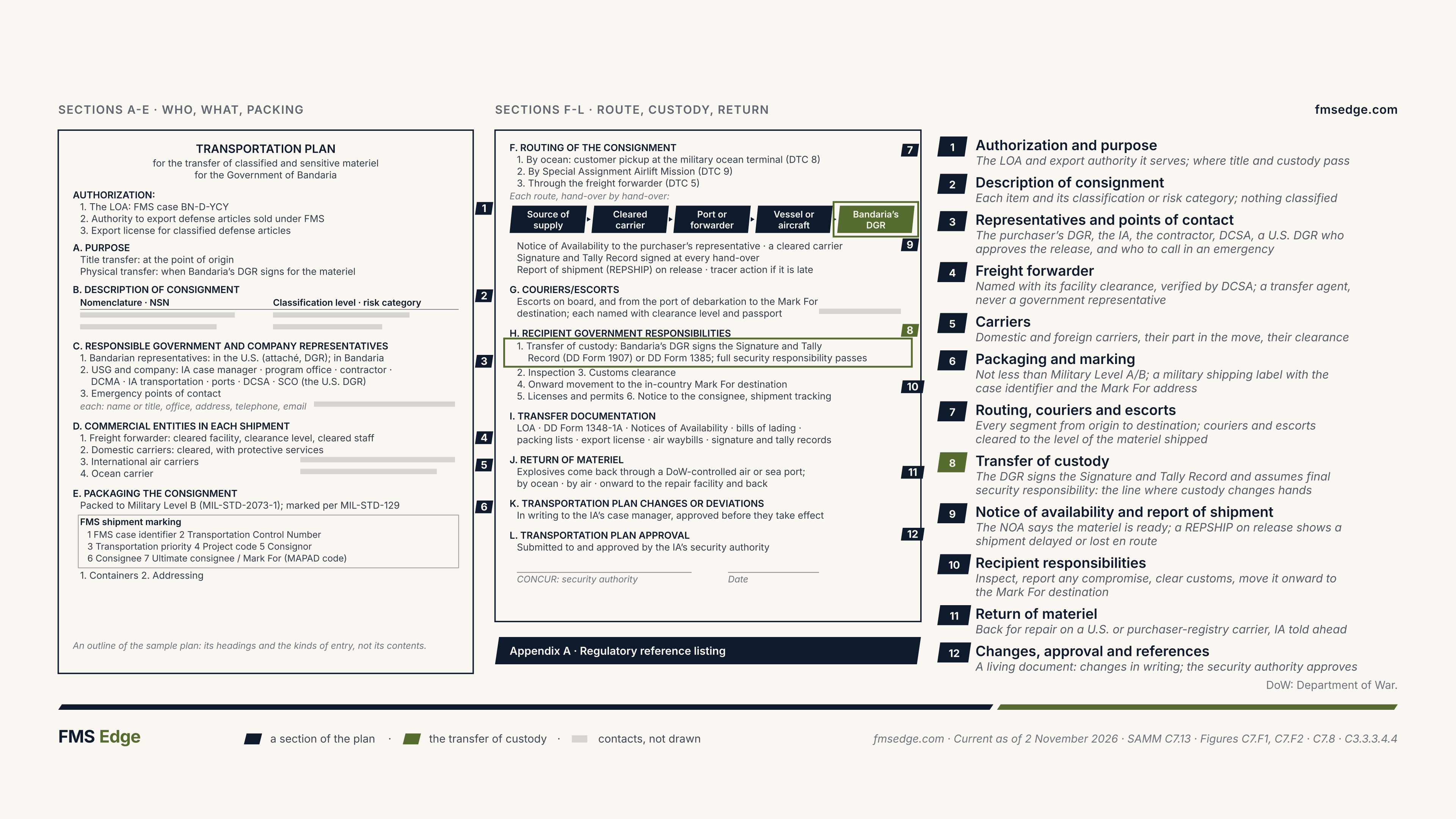
A is required for every that contains classified defense articles (CONFIDENTIAL and SECRET), sensitive articles, including , or Arms, Ammunition and Explosives () in Security Risk Categories () I to IV, where an international transfer occurs. The plan covers all movement, up to and including receipt at the final destination by the or another designated representative acting for the . TOP SECRET materiel must always be transferred by government courier. The format for classified materiel and is at Figure C7.F2 and rests on standards agreed by the Multinational Industrial Security Working Group () and the North Atlantic Treaty Organization (). The format for rests on an instruction issued by the Committee on National Security Systems [SAMM ].
The that prepares the develops the in coordination with the purchaser. The plan is to be submitted to the applicable security authority for approval, and accepted in writing by the purchaser, before the materiel moves. Where (R&R) items are involved, the plan must address every aspect of their return, including the functions the sending and receiving entities perform and the notification requirements. Transportation Plans are living documents and must be continually updated [SAMM ].
For a purchaser-sponsored shipment of classified materiel, the must state that a is required and describe the specific responsibilities for preparing it. The plan must describe the transfer arrangements specifically and give the nationality of the freight forwarders and carriers to be used. All of these shall be consistent with 32 CFR 117, Manual (DoDM) 5200.01 Volume 1, DTM-04-009 and DTM-04-010. A plan is required for any carrier, whether commercial or the , and the must approve it before the materiel is delivered. Chapter 7 gives a detailed description and a standard format [SAMM ].
At the start of negotiations, or in the phase before a is submitted, the will consult Department of War (DoW) transportation authorities on whether a secure shipment is feasible from the point of origin in the to the ultimate foreign destination. The 's security staff will also be consulted, to help make sure that the security aspects of the transportation meet the prescribed standards. DoW security regulations require a that covers classified materiel from the point of origin to the final destination. The that prepares the for such materiel will therefore make sure the plan addresses every security procedure to be followed while the materiel is in that system [SAMM ].
articles require unique protection and security measures. DoW applies stringent controls while the articles are in U.S. custody. Once they are released to the purchaser, DoW requires the partner to apply similar controls. During case development, should assess secure transportation and distribution options that support the customer's preferences. DoW requires a detailed before the materiel is delivered. Once approved, the plan becomes an integral part of the , and U.S. Customs and security officials can review it [SAMM ].
Recipient countries generally do not take control of sensitive in the , except as cargo loaded and prepared for departure. Even so, U.S. Government security standards must apply throughout the article's life cycle, for example in transportation, delivery, testing, operational use, storage and destruction. A may also be required to make sure that the right physical security measures are in place at the destination before delivery. The manual points to DoDM 5100.76 and to Section C7.15 for more on [SAMM ].
Classified materiel may be released only to a person whom the purchasing government has designated in writing as its , or as its transfer agent for onward movement to the point where the government's takes custody. A cleared can be such a transfer agent. The must be consulted to verify which freight forwarders are approved to handle classified shipments. The identities of the transfer agent, the carrier and the go in the , or for individual shipments in the , DD Form 1348-5, as Chapter 7 describes. An for classified materiel tells the purchaser's representative listed in the that the materiel is ready for shipment. Its purpose is to delay the release of materiel that needs special receipt and export processing. Under 32 CFR 117, every entity that holds a classified shipment in its custody shall be required to sign for it [SAMM ].
For classified materiel, the Case Manager and the supporting security office should coordinate with the Defense Counterintelligence and Security Agency () and with other government security and Customs authorities, so that the right security arrangements are made for transfers through port and carrier security [SAMM ]. For unclassified shipments that are sensitive or , the conducts the review of the , and does not require copies [SAMM ].
A for must include the information required for the initial delivery and for returns for repair, and it is updated when demilitarization functions are confirmed. Each of these steps requires the item to pass from the authorized shipping Custodian/Manager to the receiving one. The shipping Custodian/Manager documents the transfer of products on Standard Form (SF) 153, the Material Report. When the item arrives, the receiving Custodian/Manager notifies the shipping one by signing the SF-153 and returning it. Approval of the plan will depend on a Communications Interoperability and Security (), or another agreement, that has been implemented (Section C7.3.5.1.3) [SAMM ].
The forms an integral part of every official copy of the , and it should be kept in the 's case files. The manual discusses Transportation Plans for shipments at length in Section C7.13, and Figure C7.F1 lists the information a plan must hold, with a sample [SAMM ].
Transportation planning before the Letter of Request
International purchasers and Organizations () should address transportation capabilities and limitations in their letters of request or memorandums of request for and Building Partner Capacity () , respectively. Commodities that need such planning include sensitive , classified items, , cryptographic or other sensitive (nonexplosive) items, and oversized major items such as vehicles, aircraft, tanks, helicopters, boats, or heavy construction equipment.
Some of these items can move through a commercial , but I items must move by the at least to the overseas unless a waiver is granted [SAMM , ]. Before the , the should work with the partner, the relevant and the geographic to define the partner's requirements, which may include delivery and transportation considerations [SAMM ]. customers and should address the following concerns in pre- discussions in order to plan for delivery of these commodities:
1. Does the customer have the capability to pick up the materiel in the and transport it to their country using their own carrier?
2. If the materiel will move by surface carrier overseas, does the customer have the capability to accept the materiel at the and arrange for movement to the final destination? What if the is in a third country? The customer will be responsible for clearing customs and arranging for transportation through any other country the materiel must transit [SAMM , ].
3. Are there any unique documents, permits, or handling requirements for the shipment to clear customs?
4. What military or commercial air or water ports are available for delivering materiel? What is the carrier capacity of each port? Does the port have secured storage space?
5. Does the customer have the ability to move the materiel securely from the to the final destination?
If the customer is unable to arrange for onward movement from the to the final destination, the purchaser can use the at reimbursable rates for that leg as well [SAMM ]. Where a dedicated or other dedicated premium transportation must be used, the includes a separate transportation service line for it, and the costs of One Time Only premium transportation must be above the line [SAMM ].
For sensitive or classified materiel, the should conduct a pre-case transportation assessment after it receives the and before the is issued, and coordination with the United States Transportation Command (USTRANSCOM) J3 may be necessary [SAMM ].
Try the tool: Delivery Term Code picker
References
SAMM
- SAMM C7.F1: Transportation Plan Requirements
- SAMM C7.13.3: Transportation Plan Review.
- SAMM C7.13.4: Transportation Plan Usage.
- SAMM C3.3.3.4.4.1: Transportation Plan for Purchaser-Sponsored Shipments.
- SAMM C7.14.1.1
- SAMM C3.3.3.4.4.2: Foreign Government Representative.
- SAMM C7.13.3.1.1
- SAMM C7.13.3.2: Arms, Ammunition, & Explosives Requirements.
- SAMM C7.13.3.3.1
- SAMM C7.1.1
- SAMM C7.15.1: Security Risk Category I.
- SAMM C5.1.3: Assisting Partners to Determine Requirements for Letter of Request.
- SAMM C7.6.4.1: Preparing for Purchaser Receipt.
- SAMM C7.12.1: Defense Transportation System Costs.
- SAMM C7.4.2
- SAMM C7.13.1: General.
- SAMM C7.13.2: Transportation Plan Preparation.
- SAMM C8.3.3: Arms, Ammunition, & Explosives.
- SAMM C2.1.5.4.2: Shipment of Classified Materiel.
Related
Transportation Plan
A document that details the transportation and security arrangements for moving classified or sensitive material, and identifies individuals responsible for providing security at various points during transportation.
SAMM Glossary, as of 12 September 2026
Glossary entry →Open the manual’s entry → (opens in new tab)
Foreign Military Sales (FMS)
The part of U.S. security assistance, authorized by the Arms Export Control Act (AECA), in which eligible foreign governments and international organizations buy defense articles, services and training from the U.S. Government under formal government-to-government agreements.
The articles come either from Department of War stocks or from new procurement under contracts the Department manages [22 U.S.C. 2761, 22 U.S.C. 2762]. A sale is FMS whatever the source of the purchaser's financing.
FMS Edge glossary, as of 10 October 2026
Glossary entry →Open the manual’s entry → (opens in new tab)
Designated Government Representative (DGR)
A person or persons duly authorized by a foreign government to act on behalf of that government to negotiate, commit, sign contractual agreements, and/or accept delivery of materiel.
SAMM Glossary, as of 12 September 2026
Glossary entry →Open the manual’s entry → (opens in new tab)
Implementing Agency (IA)
The military department or defense agency responsible for the execution of military assistance programs. With respect to FMS, the military department or defense agency assigned responsibility by the Defense Security Cooperation Agency to prepare an LOA and to implement an FMS case. The implementing agency is responsible for the overall management of the actions that will result in delivery of the materials or services set forth in the LOA that was accepted by a foreign country or international organization.
SAMM Glossary, as of 12 September 2026
Glossary entry →Open the manual’s entry → (opens in new tab)
Letter of Offer and Acceptance (LOA)
The legal instrument that lists the defense articles and services, including training, that the U.S. Government transfers to a foreign country or international organization, with their estimated costs and the terms and conditions. The benefitting partner does not sign a Building Partner Capacity (BPC) LOA.
The Letter of Offer and Acceptance (LOA) is the instrument the U.S. Government uses to sell under the Arms Export Control Act (AECA); signed LOAs and their later Amendments and Modifications are also called Foreign Military Sales (FMS) cases [SAMM C5.6.1].
FMS Edge glossary, as of 10 October 2026
Glossary entry →Open the manual’s entry → (opens in new tab)
LOA: Letter of Offer and Acceptance
SAMM Acronyms, as of 12 September 2026
FMS: Foreign Military Sale
SAMM Acronyms, as of 12 September 2026
Controlled Cryptographic Items (CCI)
CCIs are devices that embody cryptographic logic or other cryptographic design, but do not perform the entire Communications Security (COMSEC) function. CCIs are dependent upon host equipment or assemblies to complete and operate COMSEC functions. Un-keyed CCI is unclassified. An item may be designated CCI because its entire component is controlled (e.g. Inline Network Encryptor (INE)), or because the item contains an embedded cryptographic National Security Agency (NSA) Type-1 certified module to encrypt/de-encrypt information (e.g. secure radio).
SAMM Glossary, as of 12 September 2026
Glossary entry →Open the manual’s entry → (opens in new tab)
DGR: Designated Government Representative
SAMM Acronyms, as of 12 September 2026
Glossary entry →Designated Government Representative (DGR) →
CCI: Controlled Cryptographic Item
SAMM Acronyms, as of 12 September 2026
Repair and Return
A service where eligible foreign countries return unserviceable repairable items for entry into the U.S. Military Department repair cycle. Upon completion of repairs, the same item is returned to the country and the actual cost of the repair is billed to the country.
SAMM Glossary, as of 12 September 2026
Glossary entry →Open the manual’s entry → (opens in new tab)
Defense Transportation System (DTS)
The part of the worldwide transportation infrastructure that supports Department of War transportation needs in peace and war, made up of military (organic) and commercial resources that are organic to the Department, under contract to it or controlled by it [SAMM C7.6.1].
It takes in organic and commercial aircraft and ships, commercial small-package services under Department contract, and U.S. military air and ocean terminals in and outside the United States.
FMS Edge glossary, as of 10 October 2026
Glossary entry →Open the manual’s entry → (opens in new tab)
SAMM: Security Assistance Management Manual
SAMM Acronyms, as of 12 September 2026
Glossary entry →Security Assistance Management Manual (SAMM) →
Letter of Request (LOR)
The term used to identify a request from an eligible FMS participant country for the purchase of U.S. defense articles and services. The request may be in message or letter format.
SAMM Glossary, as of 12 September 2026
Glossary entry →Open the manual’s entry → (opens in new tab)
Continental United States (CONUS)
U.S. territory, including the adjacent territorial waters, located within the North American continent between Canada and Mexico. Does not include Hawaii or Alaska.
SAMM Glossary, as of 12 September 2026
Glossary entry →Open the manual’s entry → (opens in new tab)
Site Survey
A team of U.S. personnel who assess the Foreign Military Sales customer's logistics capabilities and shortfalls to determine the optimum type and quantity of logistics support to be included in the Total Package Approach.
SAMM Glossary, as of 12 September 2026
Glossary entry →Open the manual’s entry → (opens in new tab)
Freight Forwarder
A commercial import/export company registered with the Department of State, Bureau of Political-Military Affairs, Directorate of Defense Trade Controls and under contract to the Foreign Military Sales customer which arranges transportation of materiel from a point specified in the Letter of Offer and Acceptance to the final destination.
SAMM Glossary, as of 12 September 2026
Glossary entry →Open the manual’s entry → (opens in new tab)
Military Assistance Program Address Directory (MAPAD)
The directory of clear-text addresses of country representatives, freight forwarders and in-country customers used to release Foreign Military Sales (FMS) and grant aid shipments processed under Military Standard Requisitioning and Issue Procedures (MILSTRIP), and to send their shipping documents.
The Military Assistance Program Address Directory (MAPAD) is available to Department of War activities, the General Services Administration (GSA), commercial firms, foreign governments and international organizations taking part in FMS or grant aid programs [SAMM C7.7.1].
FMS Edge glossary, as of 10 October 2026
Glossary entry →Open the manual’s entry → (opens in new tab)
Notice of Availability (NOA)
Notice, on DD Form 1348-5, from a shipping activity to a Foreign Military Sales (FMS) purchaser or its freight forwarder that materiel is ready for shipment, in time for the recipient to prepare for receipt and respond with delivery instructions.
The Notice of Availability (NOA) goes to the appropriate address in the Military Assistance Program Address Directory (MAPAD) and coordinates the release of materiel requiring special receipt, export processing or special storage procedures [SAMM C7.11.1].
FMS Edge glossary, as of 10 October 2026
Glossary entry →Open the manual’s entry → (opens in new tab)
NOA: Notice of Availability
SAMM Acronyms, as of 12 September 2026
MAPAD: Military Assistance Program Address Directory
SAMM Acronyms, as of 12 September 2026
Glossary entry →Military Assistance Program Address Directory (MAPAD) →
Communications Security (COMSEC)
The measures and controls taken to deny unauthorized persons’ information derived from telecommunications and other information systems, and technologies necessary to ensure the authenticity of such communications. COMSEC includes cryptographic security, transmission security, emissions security, and physical security of COMSEC material. Secure telecommunication or information system cryptographic components are the primary COMSEC products for transmission security and commonly called COMSEC devices or products. COMSEC devices are designated Controlled Cryptographic Items (CCI).
SAMM Glossary, as of 12 September 2026
Glossary entry →Open the manual’s entry → (opens in new tab)
COMSEC: Communications Security
SAMM Acronyms, as of 12 September 2026
Memorandum of Agreement (MOA)
In the manual's usage, a written agreement between sovereign states, or between a state and an international organization, signed by authorized representatives and legally binding under international law.
FMS Edge glossary, as of 10 October 2026
Glossary entry →Open the manual’s entry → (opens in new tab)
CISMOA: Communications Interoperability and Security Memorandum of Agreement
SAMM Acronyms, as of 12 September 2026
Security Cooperation Organization (SCO)
A Department of Defense element that is part of the United States Diplomatic mission located in a foreign country to carry out security assistance and security cooperation management functions under the supervision and coordination authority of the senior defense official/defense attaché.
SAMM Glossary, as of 12 September 2026
Glossary entry →Open the manual’s entry → (opens in new tab)
Security Assistance (SA)
A group of programs authorized by federal statutes by which the United States provides defense articles, military training, and other defense-related services by grant, lease, loan, credit, or cash sales in furtherance of national policies and objectives, and those that are funded and authorized through the Department of State to be administered by Department of Defense/Defense Security Cooperation Agency, which are considered part of security cooperation.
SAMM Glossary, as of 12 September 2026
Glossary entry →Open the manual’s entry → (opens in new tab)
Security Cooperation
Activities by which the Department of War encourages and enables international partners to cooperate with the United States toward strategic objectives, spanning every interaction with foreign defense and security establishments and every security assistance program the Department administers.
Under chapter 16 of Title 10, their purposes are to develop allied and friendly security capabilities for self-defense and multinational operations, to give U.S. forces peacetime and contingency access, and to build relationships promoting specific U.S. security interests [10 U.S.C. 301(7)].
FMS Edge glossary, as of 10 October 2026
Glossary entry →Open the manual’s entry → (opens in new tab)
SCO: Security Cooperation Organization
SAMM Acronyms, as of 12 September 2026
Port of Debarkation (POD)
A military or commercial air or ocean port at which materiel is offloaded. Also referred to as the Port of Discharge.
SAMM Glossary, as of 12 September 2026
Glossary entry →Open the manual’s entry → (opens in new tab)
LOR: Letter of Request
SAMM Acronyms, as of 12 September 2026
Combatant Command (CCMD)
A unified or specified command with a broad continuing mission under a single commander established and so designated by the President, through the Secretary of Defense and with the advice and assistance of the Chairman of the Joint Chiefs of Staff. Also called CCMD.
SAMM Glossary, as of 12 September 2026
Glossary entry →Open the manual’s entry → (opens in new tab)
Special Assignment Airlift Mission (SAAM)
A dedicated U.S. military aircraft, chartered to deliver sensitive, classified or explosive defense articles to a specific customer location when no commercial delivery capability exists.
SAMM Glossary, as of 12 September 2026
Glossary entry →Open the manual’s entry → (opens in new tab)
SAMM C7.13.1: General.
“A Transportation Plan is required for each Letter of Offer and Acceptance (LOA) containing defense articles that are Classified (CONFIDENTIAL and SECRET), Sensitive (including Controlled Cryptographic Items (CCI), or Arms, Ammunition, & Explosives (AA&E) (Security Risk Categories (SRC) I - IV) and in which an international transfer occurs. The plan covers all movement including receipt at final destination by the …”
Security Assistance Management Manual, as of 11 September 2026
SAMM C7.13.2: Transportation Plan Preparation.
“The Transportation Plan is developed by the Implementing Agency (IA) that prepares the LOA in coordination with the Foreign Military Sales (FMS) purchaser. It is to be submitted to, and approved by, the applicable security authority and accepted by the FMS purchaser, in writing, prior to the movement of the materiel. If Repair and Return (R&R) items are involved, the …”
Security Assistance Management Manual, as of 11 September 2026
SAMM C7.F1: Transportation Plan Requirements
“… As a minimum, the Transportation Plan will include the following provisions: A description of the materiel together with a brief narrative as to where and under what circumstances transfer of custody occurs; Identification, by name or title, of the Designated Government Representative (DGR) of the foreign recipient government or international organization who will receive and assume responsibility for the materiel …”
Security Assistance Management Manual, as of 5 November 2026
SAMM C7.13.3: Transportation Plan Review.
“Regardless of custody transfers location, the IA ensures its component Designated Disclosure Authority (DDA) reviews and approves/disapproves the Transportation Plan if it includes classified materiel. An information copy of the Transportation Plan should be provided to DSCA (Office of International Operations (IOPS)).”
Security Assistance Management Manual, as of 11 September 2026
SAMM C7.13.4: Transportation Plan Usage.
“Once approved, a Transportation Plan becomes an integral part of the LOA and is available for review by U.S. Customs and security officials when exported. A Transportation Plan must be updated regularly. FMS purchasers are responsible for ensuring that their FMS freight forwarders have copies when involved with exports. When possible, the details of the Transportation Plan should be included …”
Security Assistance Management Manual, as of 5 November 2026
SAMM C3.3.3.4.4.1: Transportation Plan for Purchaser-Sponsored Shipments.
“The LOA must contain the requirement for, and describe the specific responsibilities for preparing, the Transportation Plan. The Transportation Plan must provide a specific description of the transfer arrangements and nationality of freight forwarders and carriers to be used, all of which shall be consistent with DoD Manual (DoDM) 5200.01 Vol. 1, Directive-Type Memorandum (DTM)-04-009, DTM-04-010, and 32 CFR 117. …”
Security Assistance Management Manual, as of 5 October 2026
SAMM C7.14.1.1
“At the outset of negotiations or during the pre-Letter of Request (LOR) phase, the Implementing Agency (IA) will consult with DoW Transportation authorities to determine whether secure shipment from the Continental United States (CONUS) point of origin to the ultimate foreign destination is feasible. The IA security staff also will be consulted to assist in assuring that the security aspects …”
Security Assistance Management Manual, as of 26 October 2026
SAMM C8.3.3: Arms, Ammunition, & Explosives.
“Arms, Ammunition and Explosives (AA&E) defense articles require unique protection and security measures. The DoW applies stringent AA&E controls while these defense articles are in U.S. custody and requires the partner to apply similar controls to the defense articles upon release to the purchaser. During Case Development, Implementing Agencies (IAs) should assess secure transportation and distribution options that support customer …”
Security Assistance Management Manual, as of 11 September 2026
SAMM C3.3.3.4.4.2: Foreign Government Representative.
“Classified materiel may be released only to a person who has been designated by the purchasing government in writing as its Designated Government Representative (DGR) or as its transfer agent (e.g., a cleared freight forwarder) that is used for onward movement to the point where custody of the shipment is assumed by the government’s DGR. The Military Assistance Program Address …”
Security Assistance Management Manual, as of 5 October 2026
SAMM C7.13.3.1.1
“For classified materiel the FMS Case Manager and supporting security office should coordinate with DCSA and other government security and Customs authorities to ensure that the proper security arrangements are made to facilitate transfers through port and carrier security.”
Security Assistance Management Manual, as of 11 September 2026
SAMM C7.13.3.2: Arms, Ammunition, & Explosives Requirements.
“Reviews of Transportation Plans for unclassified shipments that are Sensitive or AA&E are conducted by the IA. DCSA does not require copies.”
Security Assistance Management Manual, as of 11 September 2026
SAMM C7.13.3.3.1
“Transportation Plans for CCI must include required information for the initial delivery, returns for repair, and are updated when demilitarization functions are confirmed, all which requires the transfer of the item from the authorized shipping COMSEC Custodian/Manager to the recipient's COMSEC Custodian/Manager. The Standard Form (SF)-153 “COMSEC Material Report” is used by the shipping COMSEC Custodian/Manager to document the transfer …”
Security Assistance Management Manual, as of 26 October 2026
SAMM C2.1.5.4.2: Shipment of Classified Materiel.
“Before classified FMS materiel can be shipped, the procedures for safeguarding it must be spelled out in a detailed transportation plan by the IA preparing the LOA, in cooperation with the FMS customer. The Transportation Plan is an integral part of all official copies of the LOA and should be maintained in MILGP case files. Transportation Plans for SA shipments …”
Security Assistance Management Manual, as of 26 October 2026
SAMM C7.1.1
“The United States Government and the purchaser's advanced planning for transportation of materiel is critical for case development and execution. It is DoW policy that the purchaser is responsible for transportation and delivery of its purchased materiel. DoW encourages purchasers to be self-sufficient by making informed decisions regarding transportation arrangements. Purchasers can use DoW distribution capabilities on a reimbursable basis …”
Security Assistance Management Manual, as of 26 October 2026
SAMM C7.15.1: Security Risk Category I.
“This category is primarily Man Portable Air Defense Systems (MANPADS), rockets, and ammunition in a ready-to-fire configuration, including components. These items must be moved by DTS to at least the overseas Port of Debarkation (POD). If a purchaser wants to pick up the articles at a DoW-controlled port for overseas movement under its own control, the purchaser must request a …”
Security Assistance Management Manual, as of 26 October 2026
SAMM C5.1.3: Assisting Partners to Determine Requirements for Letter of Request.
“Partners may request USG support in determining what capability options are available to meet their requirements. For some partners, scoping pre-LOR requirements may be critical to support the partner submitting an actionable LOR. The MILGP should, in collaboration with the partner, relevant IA, and geographic CCMD, collaborate to define the partner’s requirements comprehensively. This may include identifying the quantity, desired …”
Security Assistance Management Manual, as of 5 October 2026
SAMM C7.6.4.1: Preparing for Purchaser Receipt.
“MILGPs ensure successful transfer of DTS-routed shipments to the purchaser's Designated Government Representative (DGR). Receiving procedures are the responsibility of the purchaser and MILGPs should ensure that the purchaser is prepared to receive its materiel. Receiving procedures include: checking the materiel against manifests and shipping documents; signing receipts for ocean or air carriers; clearing the shipments through the purchaser's Customs …”
Security Assistance Management Manual, as of 26 October 2026
SAMM C7.12.1: Defense Transportation System Costs.
“When preparing a Letter of Offer and Acceptance (LOA), standard transportation percentages are normally applied based on the Delivery Term Code (DTC). The Transportation Cost Look-up Table (See Appendix 2) is used to compute estimated actual transportation costs for the items listed. When estimated actual costs are used, a note is included in the LOA that identifies the amount, by …”
Security Assistance Management Manual, as of 26 October 2026
SAMM C7.4.2
“During case development, the Implementing Agency’s (IA) role in determining and assigning the proper DTC to each line on the Letter of Offer and Acceptance (LOA) is critical to successful materiel shipment. In cases when sensitive or classified materials are being transported, IAs should conduct a pre-case transportation assessment to determine transportation and distribution requirements following receipt of a LOR …”
Security Assistance Management Manual, as of 11 September 2026