
Guide
Who claims when a Foreign Military Sales shipment is lost or damaged?
It depends on who arranged the transportation; title itself passes to the purchaser at the point of origin, and the U.S. Government bears no loss in transit. Where the purchaser or its hired or paid the carrier, they claim against it directly; where the Department of War furnished or contracted the transportation, it files the claim and proceeds go to the purchaser's account at the Defense Finance and Accounting Service - Indianapolis. Either way the carrier's liability is limited, so insurance is the purchaser's protection for the rest.
Who claims for a lost or damaged shipment depends on who arranged the carrier for that leg. The purchaser or its freight forwarder claims on the legs they arranged and the Department of War on Defense Transportation System legs. Beyond the carrier's limited liability, the purchaser's protection is its own insurance.
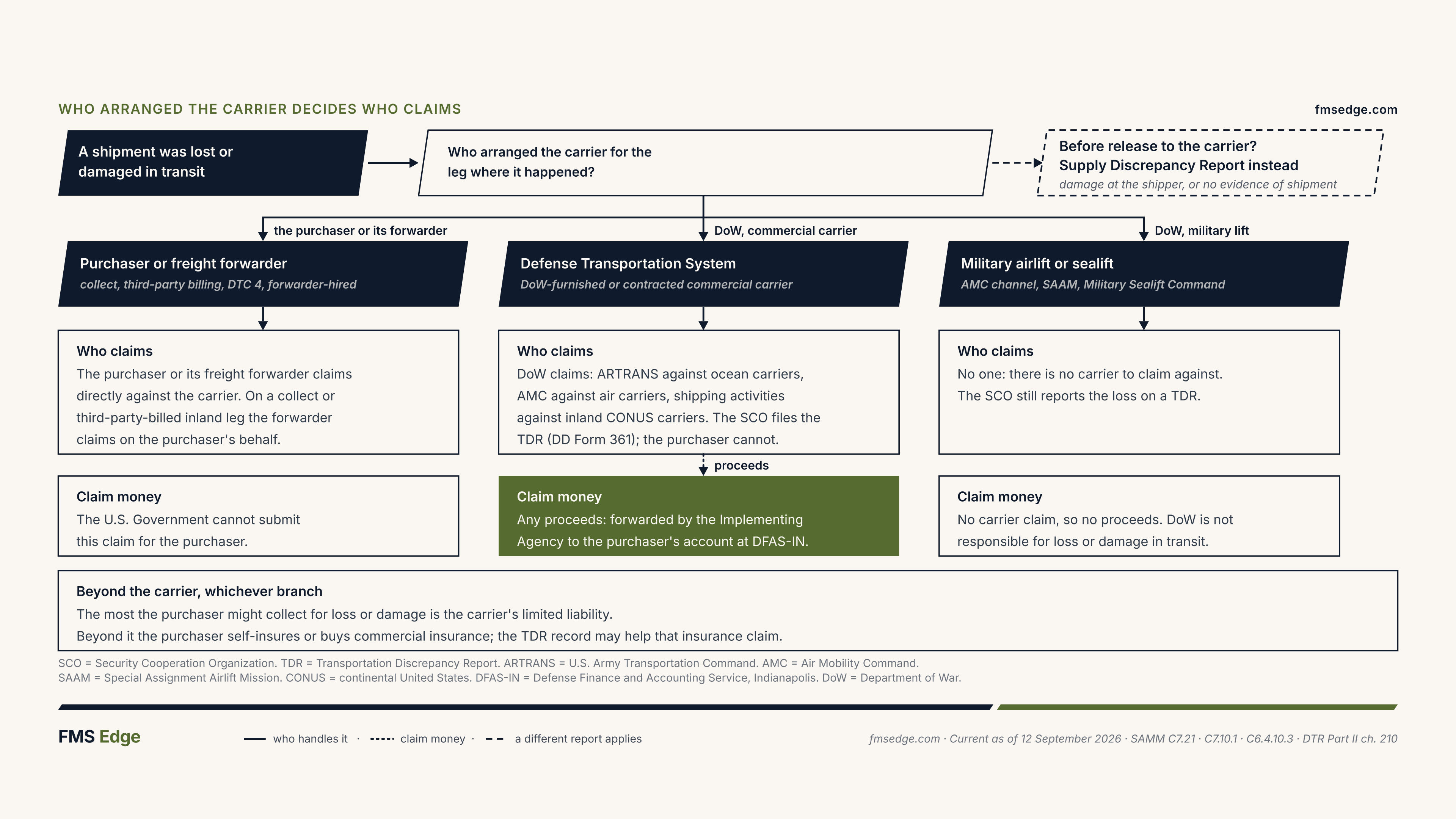
Who claims when a Foreign Military Sales shipment is lost or damaged?
When a shipment is lost or damaged, the purchaser or its claims against the carrier on a leg it arranged, and the Department of War claims against the carrier on transportation it furnished or contracted [SAMM , ].
Title to shipments passes to the purchaser at the point of origin unless the says otherwise. The Department of War (DoW) is not responsible for any loss or damage in transit or after title passes. A purchaser that does not want to self-insure a shipment should obtain commercial insurance, which is highly encouraged for items of large dollar value. The purchaser's should arrange it as part of its contract with the purchaser. In exceptional situations an may obtain the insurance instead, and its cost will be billed as a separate line item on the [SAMM ].
Claims against carriers on third-party billing shipments, and against carriers that freight forwarders contract, must be filed by the purchaser or its directly with the carrier [SAMM ]. On a prepaid shipment that the DoW arranged, the , as a non-DoW entity, cannot submit a claim or a tracing request to the carrier itself. It photographs any damage, notes the damage on the delivery documents with the carrier representative’s signature, and will report the discrepancy to the DoW shipping activity on a Memorandum of Notification, which the shipping activity uses to open the tracer or the damage claim with the carrier [].
If the 's records still show non-receipt and the shipment moved under a Commercial Bill of Lading () or under third-party billing procedures, the purchaser has the open a formal tracer action with the inland carrier. The carrier should then show proof of delivery. Failing that, the must claim against the carrier for the purchaser. If the shipment went to the inland carrier under some method of prepaid transportation, the should send the shipping activity a formal request. The shipping activity can then get proof of delivery from the carrier or claim against it for the lost or damaged goods. If materiel has been misdirected, the may be contacted for help in redirecting it to its correct destination [SAMM ].
When using the , the U.S. Government () generally maintains control and custody of the materiel until delivery to the purchaser, and the DoW performs a reimbursable transportation service for the customer [SAMM , , ]. For DoW-furnished or contracted transportation, the DoW is responsible for submitting claims against carriers; shipping activities submit claims against inland carriers in response to requests from purchaser representatives or freight forwarders. The forwards any proceeds to the purchaser’s account at the Defense Finance and Accounting Service - Indianapolis () [SAMM ].
DoW shipping activities assist with tracer actions by providing constructive proof of delivery or pertinent information obtained from shipping documents or from carriers [SAMM ]. When applicable, the assists the purchaser in processing any claim that may arise for lost or damaged shipments in the same manner it processes claims for -owned materiel. In addition, the DoW components can provide technical assistance and guidance to purchaser representatives/freight forwarders, if requested.
shipments to freight forwarders located in the United States, or to country representatives at embassies in the United States, remain shipments until the consignee takes the materiel off the carrier. This is 5 [SAMM ].
Supply discrepancies arise from duplicate shipments, incorrect items, improper packing or marking, shortages or overages, and condition or quality discrepancies, damage included, before the originating shipper releases the materiel to the carrier. They also arise from documentation or billing errors, deficient performance of services, and cases where the shipper cannot produce evidence of shipment, meaning a signed carrier receipt and shipping document. The Standard Terms and Conditions of the , Figure C5.F9, set out the purchaser's assumptions of risk [SAMM ].
Try the tool: Discrepancy report or claim?
References
SAMM
- SAMM C7.6.3.3: Annotation of Transportation Documents When Department of War Retains Custody.
- SAMM C9.T4: Table of Charges
- SAMM C7.21.3: Tracers.
- SAMM C7.10.1
- SAMM C7.21: Transportation Discrepancies.
- SAMM C7.21.1: Claims That Cannot be Submitted by the United States Government.
- SAMM C7.21.2: Claims That Can Be Submitted by the United States Government.
- SAMM C7.21.3.3
- SAMM C7.6.2.7: Shipments by the U.S. Government to a Freight Forwarder or Embassy (DTC 5).
- SAMM C6.4.10.3: Causes of Discrepancies.
Public authorities
- DoD Regulation 4500.9-R, Defense Transportation Regulations
- DTR 4500.9-R: Defense Transportation Regulation, DTR 4500.9-R
Related
Freight Forwarder
A commercial import/export company registered with the Department of State, Bureau of Political-Military Affairs, Directorate of Defense Trade Controls and under contract to the Foreign Military Sales customer which arranges transportation of materiel from a point specified in the Letter of Offer and Acceptance to the final destination.
SAMM Glossary, as of 12 September 2026
Glossary entry →Open the manual’s entry → (opens in new tab)
Foreign Military Sales (FMS)
The part of U.S. security assistance, authorized by the Arms Export Control Act (AECA), in which eligible foreign governments and international organizations buy defense articles, services and training from the U.S. Government under formal government-to-government agreements.
The articles come either from Department of War stocks or from new procurement under contracts the Department manages [22 U.S.C. 2761, 22 U.S.C. 2762]. A sale is FMS whatever the source of the purchaser's financing.
FMS Edge glossary, as of 10 October 2026
Glossary entry →Open the manual’s entry → (opens in new tab)
Letter of Offer and Acceptance (LOA)
The legal instrument that lists the defense articles and services, including training, that the U.S. Government transfers to a foreign country or international organization, with their estimated costs and the terms and conditions. The benefitting partner does not sign a Building Partner Capacity (BPC) LOA.
The Letter of Offer and Acceptance (LOA) is the instrument the U.S. Government uses to sell under the Arms Export Control Act (AECA); signed LOAs and their later Amendments and Modifications are also called Foreign Military Sales (FMS) cases [SAMM C5.6.1].
FMS Edge glossary, as of 10 October 2026
Glossary entry →Open the manual’s entry → (opens in new tab)
Implementing Agency (IA)
The military department or defense agency responsible for the execution of military assistance programs. With respect to FMS, the military department or defense agency assigned responsibility by the Defense Security Cooperation Agency to prepare an LOA and to implement an FMS case. The implementing agency is responsible for the overall management of the actions that will result in delivery of the materials or services set forth in the LOA that was accepted by a foreign country or international organization.
SAMM Glossary, as of 12 September 2026
Glossary entry →Open the manual’s entry → (opens in new tab)
SAMM: Security Assistance Management Manual
SAMM Acronyms, as of 12 September 2026
Glossary entry →Security Assistance Management Manual (SAMM) →
Defense Transportation System (DTS)
The part of the worldwide transportation infrastructure that supports Department of War transportation needs in peace and war, made up of military (organic) and commercial resources that are organic to the Department, under contract to it or controlled by it [SAMM C7.6.1].
It takes in organic and commercial aircraft and ships, commercial small-package services under Department contract, and U.S. military air and ocean terminals in and outside the United States.
FMS Edge glossary, as of 10 October 2026
Glossary entry →Open the manual’s entry → (opens in new tab)
DFAS-IN: Defense Finance and Accounting Service - Indianapolis
SAMM Acronyms, as of 12 September 2026
FMS: Foreign Military Sale
SAMM Acronyms, as of 12 September 2026
Continental United States (CONUS)
U.S. territory, including the adjacent territorial waters, located within the North American continent between Canada and Mexico. Does not include Hawaii or Alaska.
SAMM Glossary, as of 12 September 2026
Glossary entry →Open the manual’s entry → (opens in new tab)
CONUS: Continental United States
SAMM Acronyms, as of 12 September 2026
DTS: Defense Transportation System
SAMM Acronyms, as of 12 September 2026
Delivery Term Code (DTC)
A single-character logistics code that shows how far, from the source of supply to the final destination, the Department of War is responsible for transporting a shipment; it does not set the mode of transportation or how the movement is financed [SAMM C7.4.1].
FMS Edge glossary, as of 10 October 2026
Glossary entry →Open the manual’s entry → (opens in new tab)
SAMM C7.21.1: Claims That Cannot be Submitted by the United States Government.
“Claims against carriers or third-party billing shipments and FMS freight forwarder-contracted carriers must be filed by purchasers or their FMS freight forwarders directly with the carriers.”
Security Assistance Management Manual, as of 11 September 2026
SAMM C7.21.2: Claims That Can Be Submitted by the United States Government.
“For DoW-furnished or contracted transportation, DoW is responsible for submitting claims against carriers. United States Army Transportation Command (ARTRANS) processes claims against ocean carriers, Air Mobility Command (AMC) processes claims against air carriers, and DoW shipping activities submit claims against inland CONUS carriers. The ARTRANS initiates its claims in response to TDR packages submitted by MILGPs in the purchaser’s country. …”
Security Assistance Management Manual, as of 26 October 2026
SAMM C7.10.1
“Title of Foreign Military Sales (FMS) shipments transfers to the purchaser at the point of origin unless otherwise specified in the Letter of Offer and Acceptance (LOA). The DoW is not responsible for any loss or damage that occurs in transit or after passage of title. If a purchaser does not want to self-insure a shipment, the purchaser should obtain …”
Security Assistance Management Manual, as of 26 October 2026
SAMM C7.21.3.3
“If the FMS freight forwarder's records still show non-receipt, the purchaser directs the FMS freight forwarder to start a formal tracer action with the inland carrier if the shipment was released under a Commercial Bill of Lading (CBL) or third-party billing procedures. The carrier should provide proof of delivery, or the FMS freight forwarder must make a claim against the …”
Security Assistance Management Manual, as of 11 September 2026
SAMM C7.6.3.3: Annotation of Transportation Documents When Department of War Retains Custody.
“When DoW retains custody and transportation responsibility of FMS shipments its arrival at the Port of Debarkation (POD) in the destination country, the BLs for these DTS shipments are annotated with statements to comply with U.S. Customs requirements. See Section C7.6.3.3.1. and Section C7.6.3.3.2. The signature of the issuing officer on the BL serves as certification of these statements. Neither …”
Security Assistance Management Manual, as of 26 October 2026
SAMM C7.6.2.7: Shipments by the U.S. Government to a Freight Forwarder or Embassy (DTC 5).
“USG Shipments to U.S.-located Foreign Military Sales (FMS) freight forwarders or country representatives located at embassies in the United States are DTS shipments until the consignee unloads the materiel from the carrier.”
Security Assistance Management Manual, as of 11 September 2026
SAMM C9.T4: Table of Charges
“Table C9.T4. Table of Charges Charge Description How Priced Applied by - for Billing References Acceleration Rates To recover full cost of providing USG services. Included in the line item value on the Letter of Offer and Acceptance (LOA). Specific to Building Partner Capacity (BPC) cases: Do not charge unfunded civilian retirement. Implementing Agency (IA) DoD Financial Management Regulation (DoD …”
Security Assistance Management Manual, as of 5 October 2026
SAMM C7.21.3: Tracers.
“When an IA has furnished shipment status showing item pickup by an inland carrier, but materiel has not been received, the purchaser is responsible for initiating a tracer action. Whether the materiel moved prepaid, collect, small parcel or a freight shipment, DoW shipping activities assist with the tracer action by providing constructive proof of delivery or pertinent information obtained from …”
Security Assistance Management Manual, as of 26 October 2026
SAMM C6.4.10.3: Causes of Discrepancies.
“Supply discrepancies result from shortages or overages, improper packing or marking, duplicate shipments, incorrect items, and condition or quality discrepancies, including damage, prior to release to the carrier by the originating shipper. Supply discrepancies also result from documentation and/or billing errors, deficiencies in the performance of services, and instances where no evidence of shipment (signed carrier receipt and shipping document) …”
Security Assistance Management Manual, as of 26 October 2026