
Guide
What is a Supply Discrepancy Report in Foreign Military Sales?
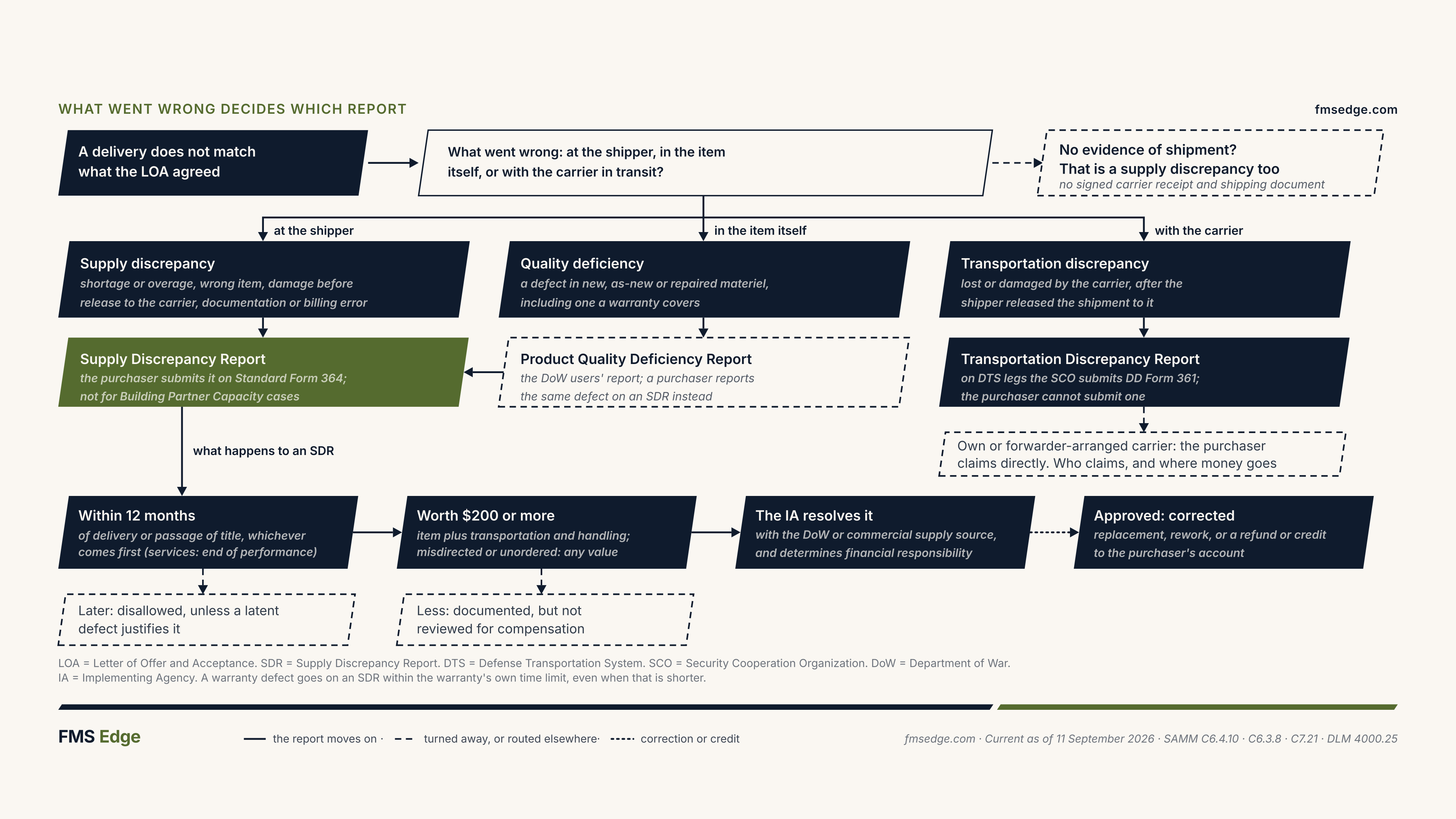
A is how a purchaser files a complaint with the Department of War about a delivery that falls short of what the agreed. It covers shortages or overages, wrong items, damage before the shipper released the shipment to the carrier, documentation or billing errors and services not performed as agreed. The , with the supply source, resolves it and determines financial responsibility.
Which report a delivery problem needs depends on what went wrong. A shortage, a wrong item, damage before release to the carrier, a quality defect or a billing error goes on a Supply Discrepancy Report within 12 months of delivery or passage of title. Loss or damage caused by the carrier goes on a Transportation Discrepancy Report, which a U.S. representative files.
What is a Supply Discrepancy Report?
A is the process an international customer uses to complain to the Department of War about a delivery. It covers product loss, quality deficiencies, damage and other delivery problems.
The Department of War (DoW) has set up a system to quickly validate the problem and respond to the international partner, while documenting trends to preclude recurrence of the discrepancy.
A discrepancy is a difference or variance from a standard. If something does not meet the standard in either quantity or quality, a discrepancy exists. The intention of the U.S. Government () is to resolve the discrepancy and ensure that every effort is made to provide the correct or service in the quantity and quality agreed to in the [SAMM ].
A deviation from a standard can be caused in any number of ways: shipment damage, wrong items, shortages, and many others.
Where the determines that the is responsible, the corrects the discrepancy by a replacement, a refund or credit to the purchaser’s account, or rework of defective items [SAMM , ]. Furthermore, per the standard terms and conditions, Section 5.1, the disclaims any liability for damage or loss to the items incurred after the passage of title, irrespective of whether transportation is by common carrier or by the U.S. [SAMM ]. An exception to this is a discrepancy in billing, which normally occurs after the title has passed to the international partner.
There are three categories of discrepancies. Each has unique reporting requirements for .
- Supply discrepancies, which capture a wide range of issues
- Product quality deficiencies, caused by the manufacturer
- Transportation discrepancies caused by damage or loss during shipment
Supply discrepancies come from shortages or overages, incorrect items, duplicate shipments, improper packing or marking, and condition or quality discrepancies. Those include damage that occurs before the originating shipper releases the shipment to the carrier. They also come from errors in documentation or billing, deficiencies in the performance of services, and cases where the shipper cannot produce evidence of shipment (a signed carrier receipt and a shipping document). For the assumptions of risk the purchaser takes on, the manual points to the Standard Terms and Conditions in Figure C5.F9 [SAMM ].
For shipments processed through freight forwarders, purchasers should direct tracer requests to their freight forwarders before addressing any inquiries to the DoW [SAMM ].
If constructive proof of delivery is provided for an item the purchaser has not received, the purchaser must follow up with its to determine if the item has been received [SAMM ]. When shipments are made through a , an for non-receipt includes documentation from the indicating that no materiel has been received on the applicable requisition and . The denies a non-receipt that does not include this documentation.
An for a shortage can result from a partial shipment of the quantity requested. The supply status received before the shipment, or the shipping document, shows whether the items received are a partial shipment. If an international partner receives a partial shipment, it checks whether the remaining items were received earlier or are still due in to the country.
An is processed only when its estimated value, including transportation and handling costs, is $200 or greater, except for misdirected or unordered shipments. A purchaser may submit an below that value so the problem is documented, but only those over the minimum are reviewed for possible compensation [SAMM ]. A shipment unit is defined as one of multiple shipments with the same document number but with a unique suffix code. Each shipment unit will have its own .
Another problem is caused by the use of multi-pack shipments. This is a packaging method whereby many different items are, for economic reasons, packed and shipped in a single container. The documentation on the outside of the crate or box can identify only the document used to track the container, while the numerous small items consolidated inside can be accounted for individually by the international partner.
Product quality deficiencies are defects or nonconforming conditions, which limit or prohibit the item from fulfilling its intended purpose. These include deficiencies in materiel, manufacturing, and workmanship, e.g., failure to put a gasket in a carburetor. A latent defect is defined as a deficiency in an article that affects the operability and is not normally detected by examination or routine test, but which was present at the time of manufacture.
An for an incorrect item can result when the shipping activity did not have the specific item in stock and shipped an authorized substitute, which carries a different stock number from the item ordered. Previously received status documentation shows whether a substitute was shipped. If the international partner does not desire a substitute, the appropriate advice code should be placed on the original requisition. There are times, however, when human error is involved and an incorrect item is shipped. If an item has not been identified as a suitable substitute for, or interchangeable with, the original item ordered, then an is appropriate.
A shelf life item is an item of supply possessing deteriorative or unstable characteristics to the degree that a storage time period is assigned to ensure that it performs satisfactorily in service. All shelf life items are categorized as one of the following two types:
- TYPE I items are determined through an evaluation of technical test data and/or actual experience to have a non-extendable shelf-life. These items include fresh foods, vaccines, and drugs.
- TYPE II items have an assigned shelf life that may be extended after completion of visual inspection/certified laboratory test, and/or restorative action. These products include petroleum, oil and lubricants, canned or packaged foods, and certain rubber-based products.
Under DoDM 4140.27, Volume 1, DoW Components issue or ship materiel on a first in, first out () basis and issue the oldest within the condition code specified, unless otherwise authorized. The volume provides the following exceptions for requisitions.
Under Volume 1, requisitions are issued in accordance with last in, first out () issue procedures. issue of non-extendable Type I shelf-life items is accomplished by issuing materiel with the latest date of expiration. Extendable Type II items are issued by the latest date of manufacture, date of cure, date of assembly, or date of pack (subsistence and Federal Supply Class 80 only) regardless of the number of extensions.
Under DoDM 4140.27, Volume 1, items with a shelf-life code () of 24 months or greater issued to satisfy either or Outside the () requirements are in supply condition code (SCC) A. They have a minimum of 12 months of shelf life remaining. Requisitioners have the option to waive that minimum by submitting exception requisitions. Items with an of less than 24 months are not subject to the minimum. They are issued from SCC A assets unless the customer specifies that other than SCC A materiel is acceptable or the designates a release from a specified material condition.
Shelf-life extensions for items/materiel in the custody of the international partner can be found by contacting the or international program offices having responsibility over the case. The office can access the DoW shelf-life extension system for applicable data and extension test results. Shelf-life extension policy for is contained in DoDM 4140.27, Volume 2, Shelf-Life Management Program.
may be submitted for materiel received in damaged condition if the damage is the result of improper preservation, packing, marking, loading, handling, or storage provided prior to title transfer. Damage that occurs after release to the carrier is a transportation discrepancy, not a supply discrepancy [SAMM , ].
A billing discrepancy involves materiel, which is received as ordered and with proper accompanying documentation, but the charge is incorrectly reflected on the quarterly billing statement provided by the Defense Finance and Accounting Service. These include duplicate or erroneous billings [SAMM , ]. The international partner can identify these problems by using the delivery listing provided as part of the quarterly billing statement.
When a discrepancy occurs in-transit, Organizations () must submit a DD Form 361: Transportation Discrepancy Report () for ()-routed and grant aid deliveries. The purchaser cannot submit a . procedures are found in the Defense Transportation Regulation (), 4500.9-R Part II, Chapter 210 [SAMM ] []. A documents lost shipments and establishes an official record for future claims against a carrier for loss or damage. Limited liability prevents the purchaser from receiving full value from a carrier, but if the purchaser obtains commercial insurance for its purchases, the official record may help the purchaser when submitting insurance claims. Whether shipments move via under collect or third-party billing terms to freight forwarders or are shipped prepaid to freight forwarders, the most that the purchaser might collect for loss or damage is the limited liability applicable to the commercial ocean, air, or inland carrier [SAMM ].
policy allows for reimbursement of transportation for discrepant materiel approved under an . The policy covers transportation reimbursement for the following:
- items furnished by Defense Working Capital Funds () activities
- items furnished by non- activities
- Packing, crating, and handling relating to materiel
- Local disposal relating to materiel
- Transporting repaired items to the international partner
Under Policy Memo 03-15, Transportation Reimbursement Policy, the agency approving the reimbursement confirms that the policy's reimbursement prerequisites are met.
Try the tool: Discrepancy report or claim?
References
SAMM
- SAMM C6.4.10: Supply Discrepancies.
- SAMM C6.T4: Methods of Financing Approved Supply Discrepancy Reports
- SAMM C5.F9: Letter of Offer and Acceptance Standard Terms and Conditions
- SAMM C7.21.3.1
- SAMM C7.21.3.2
- SAMM C6.4.10.2
- SAMM C7.21: Transportation Discrepancies.
- SAMM C6.4.10.4: Supply Discrepancy Report Responses.
- SAMM C6.4.10.3: Causes of Discrepancies.
Public authorities
- DTR 4500.9-R: Defense Transportation Regulation, DTR 4500.9-R
- DoDM 4140.27, Volume 2: DoD Manual 4140.27, Volume 2, DoD Shelf-Life Management Program: Materiel Quality Control Storage Standards
- DoDM 4140.27, Volume 1: DoD Manual 4140.27, Volume 1, DoD Shelf-Life Management Program: Program Administration
Facts referenced
- Minimum value (item plus transportation and handling) at which a Supply Discrepancy Report is reviewed for possible compensation (LOA Standard Terms and Conditions, Section 5.4): $200 (as of 11 September 2026; SAMM C5.F9)
- Shelf-life code at or above which items issued for FMS or OCONUS requirements are in supply condition code A with a minimum shelf life remaining (DoDM 4140.27, Volume 1, 9.5a): 24 months (as of 11 October 2026)
- Minimum shelf life remaining on items with the threshold shelf-life code issued for FMS or OCONUS requirements, waivable by exception requisition (DoDM 4140.27, Volume 1, 9.5a): 12 months (as of 11 October 2026)
Related
Supply Discrepancy Report (SDR)
A process for international customers to file a complaint with the DoD for product loss, quality deficiencies, damage, and various other problems associated with the delivery of material under the Foreign Military Sales program.
SAMM Glossary, as of 12 September 2026
Glossary entry →Open the manual’s entry → (opens in new tab)
Foreign Military Sales (FMS)
The part of U.S. security assistance, authorized by the Arms Export Control Act (AECA), in which eligible foreign governments and international organizations buy defense articles, services and training from the U.S. Government under formal government-to-government agreements.
The articles come either from Department of War stocks or from new procurement under contracts the Department manages [22 U.S.C. 2761, 22 U.S.C. 2762]. A sale is FMS whatever the source of the purchaser's financing.
FMS Edge glossary, as of 10 October 2026
Glossary entry →Open the manual’s entry → (opens in new tab)
Letter of Offer and Acceptance (LOA)
The legal instrument that lists the defense articles and services, including training, that the U.S. Government transfers to a foreign country or international organization, with their estimated costs and the terms and conditions. The benefitting partner does not sign a Building Partner Capacity (BPC) LOA.
The Letter of Offer and Acceptance (LOA) is the instrument the U.S. Government uses to sell under the Arms Export Control Act (AECA); signed LOAs and their later Amendments and Modifications are also called Foreign Military Sales (FMS) cases [SAMM C5.6.1].
FMS Edge glossary, as of 10 October 2026
Glossary entry →Open the manual’s entry → (opens in new tab)
Implementing Agency (IA)
The military department or defense agency responsible for the execution of military assistance programs. With respect to FMS, the military department or defense agency assigned responsibility by the Defense Security Cooperation Agency to prepare an LOA and to implement an FMS case. The implementing agency is responsible for the overall management of the actions that will result in delivery of the materials or services set forth in the LOA that was accepted by a foreign country or international organization.
SAMM Glossary, as of 12 September 2026
Glossary entry →Open the manual’s entry → (opens in new tab)
Defense Article (Foreign Assistance Act; Arms Export Control Act, not including commercial sales subject to the International Traffic in Arms Regulation)
Any weapon, weapon system, munition, aircraft, vessel or other implement of war, together with the property, equipment, tooling, components and parts used to furnish military assistance or sales or to make, maintain or use such items; the International Traffic in Arms Regulations (ITAR) define the term separately for commercial exports.
Section 47 of the Arms Export Control Act (AECA) defines the term, and the U.S. Munitions List designates the specific items that fall within it [SAMM C4.4] [22 U.S.C. 2794].
FMS Edge glossary, as of 10 October 2026
Glossary entry →Open the manual’s entry → (opens in new tab)
LOA: Letter of Offer and Acceptance
SAMM Acronyms, as of 12 September 2026
Defense Transportation System (DTS)
The part of the worldwide transportation infrastructure that supports Department of War transportation needs in peace and war, made up of military (organic) and commercial resources that are organic to the Department, under contract to it or controlled by it [SAMM C7.6.1].
It takes in organic and commercial aircraft and ships, commercial small-package services under Department contract, and U.S. military air and ocean terminals in and outside the United States.
FMS Edge glossary, as of 10 October 2026
Glossary entry →Open the manual’s entry → (opens in new tab)
FMS: Foreign Military Sale
SAMM Acronyms, as of 12 September 2026
Freight Forwarder
A commercial import/export company registered with the Department of State, Bureau of Political-Military Affairs, Directorate of Defense Trade Controls and under contract to the Foreign Military Sales customer which arranges transportation of materiel from a point specified in the Letter of Offer and Acceptance to the final destination.
SAMM Glossary, as of 12 September 2026
Glossary entry →Open the manual’s entry → (opens in new tab)
SDR: Supply Discrepancy Report
SAMM Acronyms, as of 12 September 2026
Transportation Control Number (TCN)
A 17-character data element assigned to control and manage every shipment unit throughout the transportation pipeline and for payment processing. The TCN for each shipment unit is unique and not to be duplicated within the Defense Transportation System during the life cycle of the TCN. See Defense Travel Regulation Part II, Appendix L for additional information on proper TCN construction.
SAMM Glossary, as of 12 September 2026
Glossary entry →Open the manual’s entry → (opens in new tab)
International Logistics Control Office (ILCO)
The office in each Military Department that manages the logistics support programs and transactions of Foreign Military Sales (FMS) and other security cooperation programs, and the central point in the continental United States for monitoring purchasers' requisitions.
A purchaser reports a valid supply discrepancy to the International Logistics Control Office (ILCO) of the Military Department concerned [SAMM C2.1.5.4.3].
FMS Edge glossary, as of 10 October 2026
Glossary entry →Open the manual’s entry → (opens in new tab)
FIFO: First In, First Out
LIFO: Last In, First Out
SLC: Shelf-Life Code
Continental United States (CONUS)
U.S. territory, including the adjacent territorial waters, located within the North American continent between Canada and Mexico. Does not include Hawaii or Alaska.
SAMM Glossary, as of 12 September 2026
Glossary entry →Open the manual’s entry → (opens in new tab)
Inventory Control Point (ICP)
The organization within a Department of War supply system that manages a group of items for one Military Service or for the whole Department, computing requirements, starting procurement or disposal actions, managing distribution and directing rebuild.
The inventory control point that processes a standard requisition generally issues the assets down to the item's reorder point level [SAMM C6.4.3.1].
FMS Edge glossary, as of 10 October 2026
Glossary entry →Open the manual’s entry → (opens in new tab)
Security Assistance (SA)
A group of programs authorized by federal statutes by which the United States provides defense articles, military training, and other defense-related services by grant, lease, loan, credit, or cash sales in furtherance of national policies and objectives, and those that are funded and authorized through the Department of State to be administered by Department of Defense/Defense Security Cooperation Agency, which are considered part of security cooperation.
SAMM Glossary, as of 12 September 2026
Glossary entry →Open the manual’s entry → (opens in new tab)
Security Cooperation
Activities by which the Department of War encourages and enables international partners to cooperate with the United States toward strategic objectives, spanning every interaction with foreign defense and security establishments and every security assistance program the Department administers.
Under chapter 16 of Title 10, their purposes are to develop allied and friendly security capabilities for self-defense and multinational operations, to give U.S. forces peacetime and contingency access, and to build relationships promoting specific U.S. security interests [10 U.S.C. 301(7)].
FMS Edge glossary, as of 10 October 2026
Glossary entry →Open the manual’s entry → (opens in new tab)
SCO: Security Cooperation Organization
SAMM Acronyms, as of 12 September 2026
DTS: Defense Transportation System
SAMM Acronyms, as of 12 September 2026
DSCA: Defense Security Cooperation Agency
SAMM Acronyms, as of 12 September 2026
Glossary entry →Defense Security Cooperation Agency (DSCA) →
Defense Security Cooperation Agency (DSCA)
The Department of War agency that directs, administers and provides guidance to the Department's components and its representatives at U.S. missions for the execution of the security cooperation programs for which it is responsible [SAMM C1.3.2.2]. The agency also provides financial and technical assistance, arranges the transfer of defense materiel, training and services to international partners, and promotes military-to-military contacts.
FMS Edge glossary, as of 10 October 2026
Glossary entry →Open the manual’s entry → (opens in new tab)
SAMM C6.4.10: Supply Discrepancies.
“The USG makes every effort to provide the correct defense article or service in the quantity and quality shown in the LOA. In the event of a discrepancy, the purchaser submits an SDR using Standard Form (SF) 364. Instructions for SF 364 completion, DoW processing timeframes, and responsibilities are located in the Defense Logistics Management (DLM) 4000.25, Defense Logistics Management …”
Security Assistance Management Manual, as of 26 October 2026
SAMM C6.4.10.4: Supply Discrepancy Report Responses.
“The IA, in conjunction with the DoW or commercial supply source, resolves SDRs and determines financial responsibility. The IA designates a single point of contact for SDR corrective action. Only this point of contact and DSCA are authorized to accept and convey USG liability or originate a commitment for corrective action. Commitments to the purchaser for U.S. financing of discrepancies …”
Security Assistance Management Manual, as of 26 October 2026
SAMM C6.T4: Methods of Financing Approved Supply Discrepancy Reports
“Table C6.T4. Methods of Financing Approved Supply Discrepancy Reports Nature of Discrepancy Source of Supply (SoS) Foreign Military Sales (FMS) Funds 1 (Admin, Packing Crating & Handling, Transportation) United States Government Funds/Appropriations (Defense Working Capital Fund, Procurement Appropriation, Operation & Maintenance, Research, Development, Test & Evaluation) Damage, Defect, or Other Deficiency Procurement2 Generally not applicable except where U.S. action or …”
Security Assistance Management Manual, as of 26 October 2026
SAMM C5.F9: Letter of Offer and Acceptance Standard Terms and Conditions
“… 5.1. The USG agrees to deliver and pass title to the Purchaser at the initial point of shipment unless otherwise specified in this LOA. With respect to items procured for sale to the Purchaser, this will normally be at the manufacturer's loading facility; with respect to items furnished from USG stocks, this will normally be at the U.S. depot. Articles …”
Security Assistance Management Manual, as of 11 September 2026
SAMM C6.4.10.3: Causes of Discrepancies.
“Supply discrepancies result from shortages or overages, improper packing or marking, duplicate shipments, incorrect items, and condition or quality discrepancies, including damage, prior to release to the carrier by the originating shipper. Supply discrepancies also result from documentation and/or billing errors, deficiencies in the performance of services, and instances where no evidence of shipment (signed carrier receipt and shipping document) …”
Security Assistance Management Manual, as of 26 October 2026
SAMM C7.21.3.1
“For all shipments processed through FMS freight forwarders, purchasers should direct tracer requests to their FMS freight forwarders before addressing any inquiries to DoW.”
Security Assistance Management Manual, as of 26 October 2026
SAMM C7.21.3.2
“If a FMS freight forwarder claims non-receipt, it may contact the shipping activity directly for assistance, especially if the shipment is less than 30 days old. Alternately, upon request from purchaser country representatives, the IA may obtain shipping documents and data from the shipping activity. If constructive proof of delivery is provided, the purchaser must follow-up with the FMS freight …”
Security Assistance Management Manual, as of 11 September 2026
SAMM C6.4.10.2
“Time limits for reporting discrepancies relating to contractor warranties are prescribed in the individual warranty clauses and/or contracts. SDRs must be submitted by the purchaser within the contractor warranty timeframe, even when the warranty timeframe is less than one year after delivery or passage of title to the defense articles or less than one year after the scheduled period of …”
Security Assistance Management Manual, as of 26 October 2026
SAMM C7.21: Transportation Discrepancies.
“When a discrepancy occurs in-transit, U.S. Military Groups (MILGPs) must submit a Defense Department (DD) Form 361 “Transportation Discrepancy Report (TDR)” for Defense Transportation System (DTS)-routed Foreign Military Sales (FMS) and grant aid deliveries. The purchaser cannot submit a TDR. TDR procedures are found in Defense Transportation Regulation (DTR) 4500.9-R., Part 2, Chapter 210 “Transportation Discrepancy Reports (TDR).” A TDR …”
Security Assistance Management Manual, as of 26 October 2026