
Guide
Who bears the risk of loss in a Foreign Military Sale?
The purchaser bears it. Under Section 3 of the standard terms, because the U.S. Government buys and furnishes the items on a non-profit basis, the purchaser indemnifies it against loss or liability and relieves its contractors of liability for loss or damage to property, the same risk the U.S. Government carries when it buys for itself.
Each numeric Delivery Term Code sets where the Department of War delivers a shipment, from no movement at all (code 4) to the overseas inland destination (code 7). Title passes much earlier, at the loading facility, unless the LOA says otherwise.
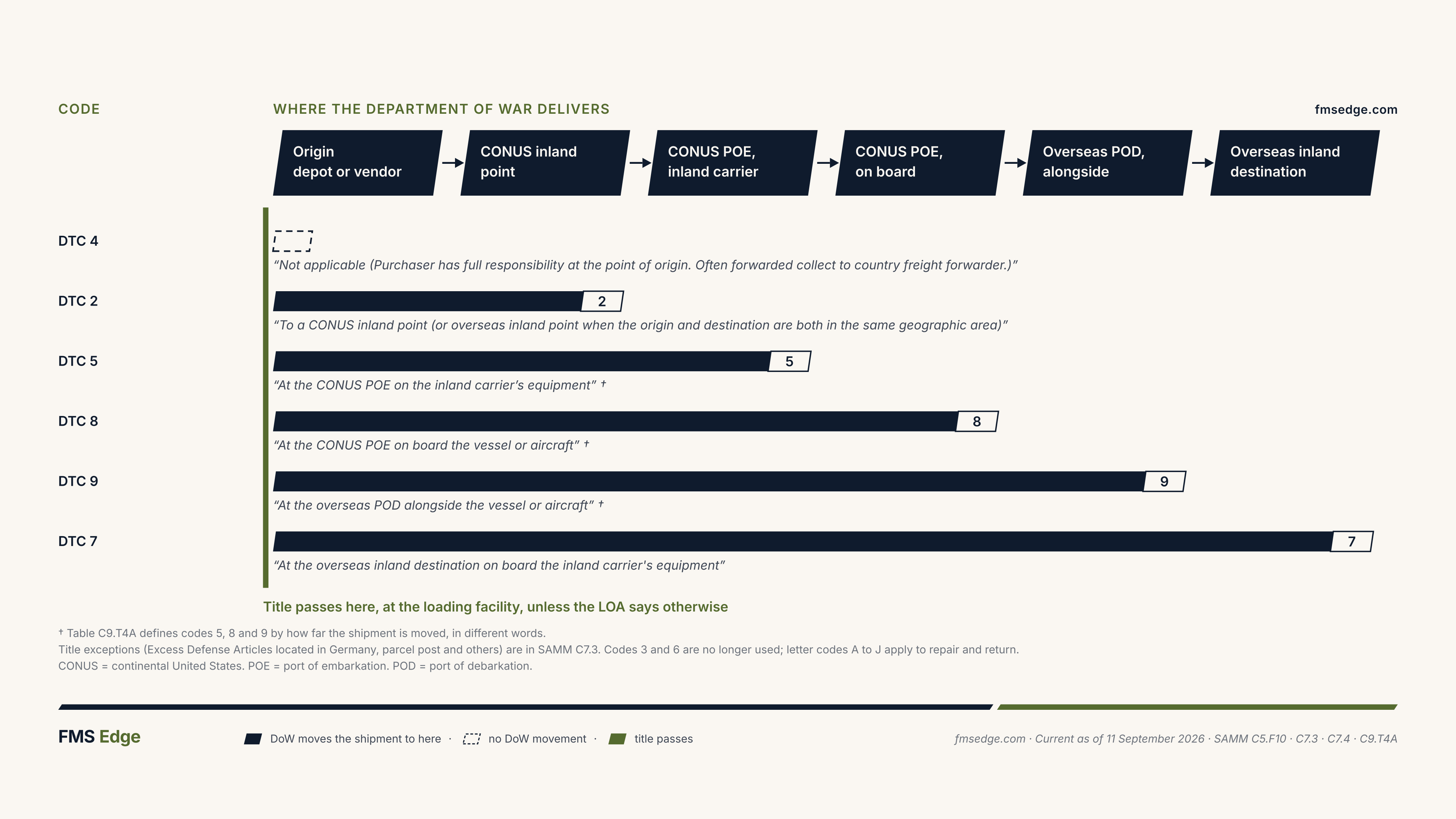
Who bears the risk of loss in a Foreign Military Sale?
In a Foreign Military Sale the purchaser bears the risk of loss. Under Section 3 of the Standard Terms and Conditions it indemnifies the U.S. Government and relieves U.S. contractors of liability, and under Section 5.1 the U.S. Government disclaims any liability for loss or damage after title passes, whether the items move by common carrier or by the [SAMM ]. The Department of War is not responsible for loss or damage in transit. A purchaser that does not want to self-insure a shipment should obtain commercial insurance, which is highly encouraged for items of large dollar value [SAMM ]. Title passes to the purchaser at the initial point of shipment unless the says otherwise, and U.S. Government security responsibility continues until the recipient’s assumes control of the consignment [SAMM ]. How far the Department of War delivers is a third point, set line by line by the [SAMM ]. Who files a claim against a carrier depends on who arranged that leg of the transportation, as the guide on lost or damaged shipments explains.
3.1 Indemnifying the U.S. Government
3.1 The Purchaser recognizes that the will procure and furnish the items described in this on a non-profit basis for the benefit of the Purchaser. The Purchaser therefore undertakes to indemnify and hold the , its agents, officers, and employees harmless from any and all loss or liability (whether in tort or in contract) which might arise in connection with this because of [SAMM ]:
3.1.1 Injury to or death of personnel of the Purchaser or third parties,
3.1.2 Damage to or destruction of (a) property of DoW furnished to the Purchaser or suppliers specifically to implement this , (b) property of the Purchaser (including the items ordered by the Purchaser pursuant to this , before or after passage of title to the Purchaser), or (3) property of third parties, or
3.1.3 Infringement or other violations of intellectual property or rights.
3.2 Relieving U.S. contractors of liability
3.2 Subject to express, special contractual warranties obtained for the Purchaser, the Purchaser agrees to relieve the contractors and subcontractors of the from liability for, and will assume the risk of, loss or damage to [SAMM ]:
3.2.1 The Purchaser’s property (including items procured pursuant to this , before or after passage of title to Purchaser), and
3.2.2 Property of DoW furnished to suppliers to implement this , to the same extent that the would assume for its property if it were procuring for itself the items being procured.
What Section 3 means for the purchaser
Section 3 begins by reminding the international partner that the U.S. Government () procures and furnishes the items on a non-profit basis. In recognition of this fact, this condition states that the international partner indemnifies the . This means that the international partner agrees to accept the risks of financial liabilities that may arise in the execution of the case [SAMM ].
When procuring for the international partner, the Department of War (DoW) will, in general, employ the same contract clauses, , and quality and audit inspection procedures as it would in procuring for itself [SAMM ].
Under the case, the international partner assumes the risk of loss or damage to DoW property furnished to suppliers to the same extent that the would assume if it were procuring the items for itself [SAMM ].
Under Section 3, there are two indemnification provisions: (1) international partner indemnifies and holds harmless the , its agents, officers and employees and (2) international partner relieves the ’s contractors and subcontractors of liability. The first indemnification sections are much broader in coverage than the second. The first indemnification provision (3.1) covers injury or death of international partner’s personnel, damage or destruction of DoW property, international partner or third-party property, and infringement of intellectual property. Section 3.2, coverage for contractors and subcontractors, extends to damage or loss of international partner’s property and DoW property furnished to implement the case [SAMM ].
Supply discrepancies arise from duplicate shipments, incorrect items, shortages or overages, improper packing or marking, and condition or quality discrepancies, including damage, before the originating shipper releases the materiel to the carrier. They also arise from documentation or billing errors, from deficiencies in how services are performed, and from cases in which the shipper cannot produce evidence of shipment (a signed carrier receipt and shipping document). The Standard Terms and Conditions in Figure C5.F9 set out the purchaser's assumptions of risk [SAMM ].
A liability illustration
Suppose, under a , an international partner wanted to purchase an excess aircraft and have that aircraft’s avionics upgraded prior to delivery. Following case acceptance, the U.S. awarded a contract for the upgrade, removed the aircraft from storage, and transported it to a contractor for upgrade work. After the contractor completed the work, the contractor’s test pilot flew the aircraft on a functional check flight. During the check flight, a catastrophic problem developed, which caused the aircraft to crash and be destroyed, also causing significant property damage on the ground at the crash site.
In this hypothetical scenario, financial liability for the costs depends on the cause. The would investigate the crash to determine the cause. In the investigation, the contractor’s contractual responsibility would be examined to determine if contractor non-performance or negligence contributed to the accident. If the contractor would have held some financial responsibility in the case the work was being done for the benefit of the , then the contractor would also be held to the same degree of financial responsibility if the work was being performed for an international partner.
If, at the conclusion of the investigation, it was found that the contractor had fulfilled all its contractual requirements and the accident cause was in an area where the normally accepts the liability risk, this condition states that the international partner will assume this financial liability rather than the or the contractor [SAMM ].
References
SAMM
- SAMM C5.F9: Letter of Offer and Acceptance Standard Terms and Conditions
- SAMM C7.10.1
- SAMM C7.3: Title Transfer
- SAMM C5.F10: Letter of Offer and Acceptance Information
- SAMM C5.6.5.4.1: Standard Terms and Conditions and Letter of Offer and Acceptance Information.
- SAMM C6.4.10.3: Causes of Discrepancies.
Related
Letter of Offer and Acceptance (LOA)
The legal instrument that lists the defense articles and services, including training, that the U.S. Government transfers to a foreign country or international organization, with their estimated costs and the terms and conditions. The benefitting partner does not sign a Building Partner Capacity (BPC) LOA.
The Letter of Offer and Acceptance (LOA) is the instrument the U.S. Government uses to sell under the Arms Export Control Act (AECA); signed LOAs and their later Amendments and Modifications are also called Foreign Military Sales (FMS) cases [SAMM C5.6.1].
FMS Edge glossary, as of 10 October 2026
Glossary entry →Open the manual’s entry → (opens in new tab)
Defense Transportation System (DTS)
The part of the worldwide transportation infrastructure that supports Department of War transportation needs in peace and war, made up of military (organic) and commercial resources that are organic to the Department, under contract to it or controlled by it [SAMM C7.6.1].
It takes in organic and commercial aircraft and ships, commercial small-package services under Department contract, and U.S. military air and ocean terminals in and outside the United States.
FMS Edge glossary, as of 10 October 2026
Glossary entry →Open the manual’s entry → (opens in new tab)
Designated Government Representative (DGR)
A person or persons duly authorized by a foreign government to act on behalf of that government to negotiate, commit, sign contractual agreements, and/or accept delivery of materiel.
SAMM Glossary, as of 12 September 2026
Glossary entry →Open the manual’s entry → (opens in new tab)
Delivery Term Code (DTC)
A single-character logistics code that shows how far, from the source of supply to the final destination, the Department of War is responsible for transporting a shipment; it does not set the mode of transportation or how the movement is financed [SAMM C7.4.1].
FMS Edge glossary, as of 10 October 2026
Glossary entry →Open the manual’s entry → (opens in new tab)
DSCA: Defense Security Cooperation Agency
SAMM Acronyms, as of 12 September 2026
Glossary entry →Defense Security Cooperation Agency (DSCA) →
LOA: Letter of Offer and Acceptance
SAMM Acronyms, as of 12 September 2026
Technical Data
Recorded information of a scientific or technical nature, regardless of form or characteristic. Examples of technical data packages include research and engineering drawings and associated lists, specifications, standards, process sheets, manuals, technical reports, catalog item identifications, and related information and computer software documentation.
SAMM Glossary, as of 12 September 2026
Glossary entry →Open the manual’s entry → (opens in new tab)
Contract Administration
All the activities associated with the performance of a contract, from pre-award to closeout.
SAMM Glossary, as of 12 September 2026
Glossary entry →Open the manual’s entry → (opens in new tab)
Foreign Military Sales (FMS) Case
A Letter of Offer and Acceptance (LOA) that the purchaser has accepted, together with every Amendment and Modification later made to it: the agreement under which the U.S. Government transfers defense articles and services in the Foreign Military Sales (FMS) program.
FMS Edge glossary, as of 10 October 2026
Glossary entry →Open the manual’s entry → (opens in new tab)
SAMM C5.F9: Letter of Offer and Acceptance Standard Terms and Conditions
“1. Conditions - United States Government (USG) Obligations 1.1. Unless otherwise specified, items will be those which are standard to the U.S. Department of War (DoW), without regard to make or model. 1.2. The USG will furnish the items from its stocks and resources, or will procure them under terms and conditions consistent with DoW regulations and procedures. When procuring …”
Security Assistance Management Manual, as of 11 September 2026
SAMM C7.10.1
“Title of Foreign Military Sales (FMS) shipments transfers to the purchaser at the point of origin unless otherwise specified in the Letter of Offer and Acceptance (LOA). The DoW is not responsible for any loss or damage that occurs in transit or after passage of title. If a purchaser does not want to self-insure a shipment, the purchaser should obtain …”
Security Assistance Management Manual, as of 26 October 2026
SAMM C7.3: Title Transfer
“Title to Foreign Military Sales (FMS) materiel is delivered and passed from the USG to the purchaser at the initial point of shipment unless otherwise specified in the Letter of Offer and Acceptance (LOA). With respect to items procured from a commercial manufacturer, items are typically released for delivery to the purchaser at the manufacturer's loading facility. With respect to …”
Security Assistance Management Manual, as of 26 October 2026
SAMM C5.F10: Letter of Offer and Acceptance Information
“… Term of Sale Dependable Undertaking with 120 days Payment after Delivery, Source Code P (Procurement), AECA, Section 22(b) (22 U.S.C. 2762(b)). 8 Term of Sale Payment 120 days after Delivery, Source Code S, R, E, or F, Stock Sales with 120 days Payment after Delivery; AECA, Section 21(d) (22 U.S.C. 2761(d)). BN-Q-SEH Page 16 A Term of Sale EDA Grant, …”
Security Assistance Management Manual, as of 11 September 2026
SAMM C5.F9: Letter of Offer and Acceptance Standard Terms and Conditions
“… 3.1. The Purchaser recognizes that the USG will procure and furnish the items described in this LOA on a non-profit basis for the benefit of the Purchaser. The Purchaser therefore undertakes to indemnify and hold the USG, its agents, officers, and employees harmless from any and all loss or liability (whether in tort or in contract) which might arise in …”
Security Assistance Management Manual, as of 11 September 2026
SAMM C5.F9: Letter of Offer and Acceptance Standard Terms and Conditions
“… 3.2. Subject to express, special contractual warranties obtained for the Purchaser, the Purchaser agrees to relieve the contractors and subcontractors of the USG from liability for, and will assume the risk of, loss or damage to: 3.2.1. The Purchaser's property (including items procured pursuant to this LOA, before or after passage of title to Purchaser), and 3.2.2. Property of DoW …”
Security Assistance Management Manual, as of 11 September 2026
SAMM C5.F9: Letter of Offer and Acceptance Standard Terms and Conditions
“… 1.2. The USG will furnish the items from its stocks and resources, or will procure them under terms and conditions consistent with DoW regulations and procedures. When procuring for the Purchaser, DoW will, in general, employ the same contract clauses, the same contract administration, and the same quality and audit inspection procedures as would be used in procuring for itself; …”
Security Assistance Management Manual, as of 11 September 2026
SAMM C5.F9: Letter of Offer and Acceptance Standard Terms and Conditions
“… 3.2.2. Property of DoW furnished to suppliers to implement this LOA, to the same extent that the USG would assume for its property if it were procuring for itself the items being procured.”
Security Assistance Management Manual, as of 11 September 2026
SAMM C6.4.10.3: Causes of Discrepancies.
“Supply discrepancies result from shortages or overages, improper packing or marking, duplicate shipments, incorrect items, and condition or quality discrepancies, including damage, prior to release to the carrier by the originating shipper. Supply discrepancies also result from documentation and/or billing errors, deficiencies in the performance of services, and instances where no evidence of shipment (signed carrier receipt and shipping document) …”
Security Assistance Management Manual, as of 26 October 2026