
Guide
What does a Foreign Military Sales purchaser agree to?
Section 2 of the standard terms sets out what the purchaser agrees to. It may cancel at its own cost, uses what it buys only for the listed purposes and transfers nothing to a third party without prior written U.S. Government consent. It protects classified items as the United States would, permits end-use monitoring and deals with any offset directly with the U.S. contractor.
What does a Foreign Military Sales purchaser agree to?
Under Section 2 of the standard terms, the purchaser may cancel the case or delete items before delivery, at its own cost, and uses what it buys only for the purposes the terms list, unless both governments agree otherwise in writing [SAMM ]. It transfers nothing furnished under the case to anyone other than an officer, employee or agent of its own government or of the U.S. Government without prior written U.S. Government consent, gives what it receives substantially the same security protection the U.S. Government gives it, classified items included, permits end-use monitoring on request, and treats any offset as a matter between itself and the U.S. [SAMM ].
2.1 The purchaser's right to cancel
2.1 The Purchaser may cancel this or delete items at any time prior to delivery of defense articles or performance of defense services. The Purchaser is responsible for all costs resulting from cancellation under this section [SAMM ].
In Section 1.5, the U.S. Government () retains the right to cancel or suspend part or all of the case under unusual and compelling circumstances when the U.S. national interest requires it. Similarly, this section gives the international partner the right to cancel. Acceptance of the case does not bind the international partner to proceed. The international partner is a voluntary participant and can cancel the entire or delete specific items prior to delivery [SAMM , ].
2.2 End-use purposes
2.2 The purchaser notes its obligations under International Humanitarian Law and Human Rights Law. The Purchaser agrees, except as may otherwise be mutually agreed in writing by the Purchaser and the , to use the defense articles sold hereunder only [SAMM ]:
2.2.1 for ;
2.2.2 for legitimate self-defense;
2.2.3 for preventing or hindering the proliferation of weapons of mass destruction and of the means of delivering such weapons;
2.2.4 to permit the Purchaser to participate in regional or collective arrangements or measures consistent with the Charter of the United Nations, or otherwise to permit the Purchaser to participate in collective measures requested by the United Nations for the purpose of maintaining or restoring international peace and security; or
2.2.5 for the purpose of enabling foreign military forces in less developed countries to construct public works and to engage in other activities helpful to social and economic development.
2.2.6 for purposes specified in any Mutual Defense Assistance Agreement between the and the Purchaser; or,
2.2.7 for purposes specified in any other bilateral or regional defense agreement to which the and the Purchaser are both parties.
The first sentence of this section reads: “The purchaser notes its obligations under International Humanitarian Law and Human Rights Law” [SAMM ]. This sentence highlights the role of humanitarian and human rights law associated with the case.
This condition also stipulates that the international partner will only use the materiel or services purchased under the case for certain purposes, referred to as end use [SAMM ]. The list of acceptable end uses is drawn from the [SAMM ].
2.3 Verifying reports
2.3 The Purchaser agrees that the retains the right to verify reports that defense articles and services have been used for purposes not authorized or for uses not consented to by the [SAMM ].
Section 2.3 establishes the right of the to verify any reports that defense articles or services are being used for purposes other than as specified in Section 2.2. The incorporation of this language into the terms and conditions of the establishes for the the right to investigate any reports of violation to the use provisions of the case [SAMM ]. These conditions are also contained in the agreements that Section 505 of the Foreign Assistance Act () requires of grant recipients [SAMM ] [].
2.4 Third-party transfers
2.4 The Purchaser will not transfer title to, or possession of, the defense articles, components and associated support materiel, related training or other defense services (including plans, specifications, or information), or technology furnished under this to anyone who is not an officer, employee, or agent of the Purchaser (excluding transportation agencies) or of the , and shall not use or permit their use for purposes other than those authorized, unless the written consent of the has first been obtained. The Purchaser will ensure, by all means available to it, respect for proprietary rights in any items and any plans, specifications, or information furnished, whether patented or not. The Purchaser also agrees that the defense articles offered will not be transferred to Cyprus or otherwise used to further the severance or division of Cyprus, and recognizes that the U.S. Congress is required to be notified of any substantial evidence that the defense articles sold in this have been used in a manner that is inconsistent with this provision [SAMM ].
Every purchaser agrees in the LOA not to transfer title to or possession of what it bought, or use it for other purposes, without the U.S. Government's prior written consent. State's Office of Regional Security and Arms Transfers decides each request case by case.
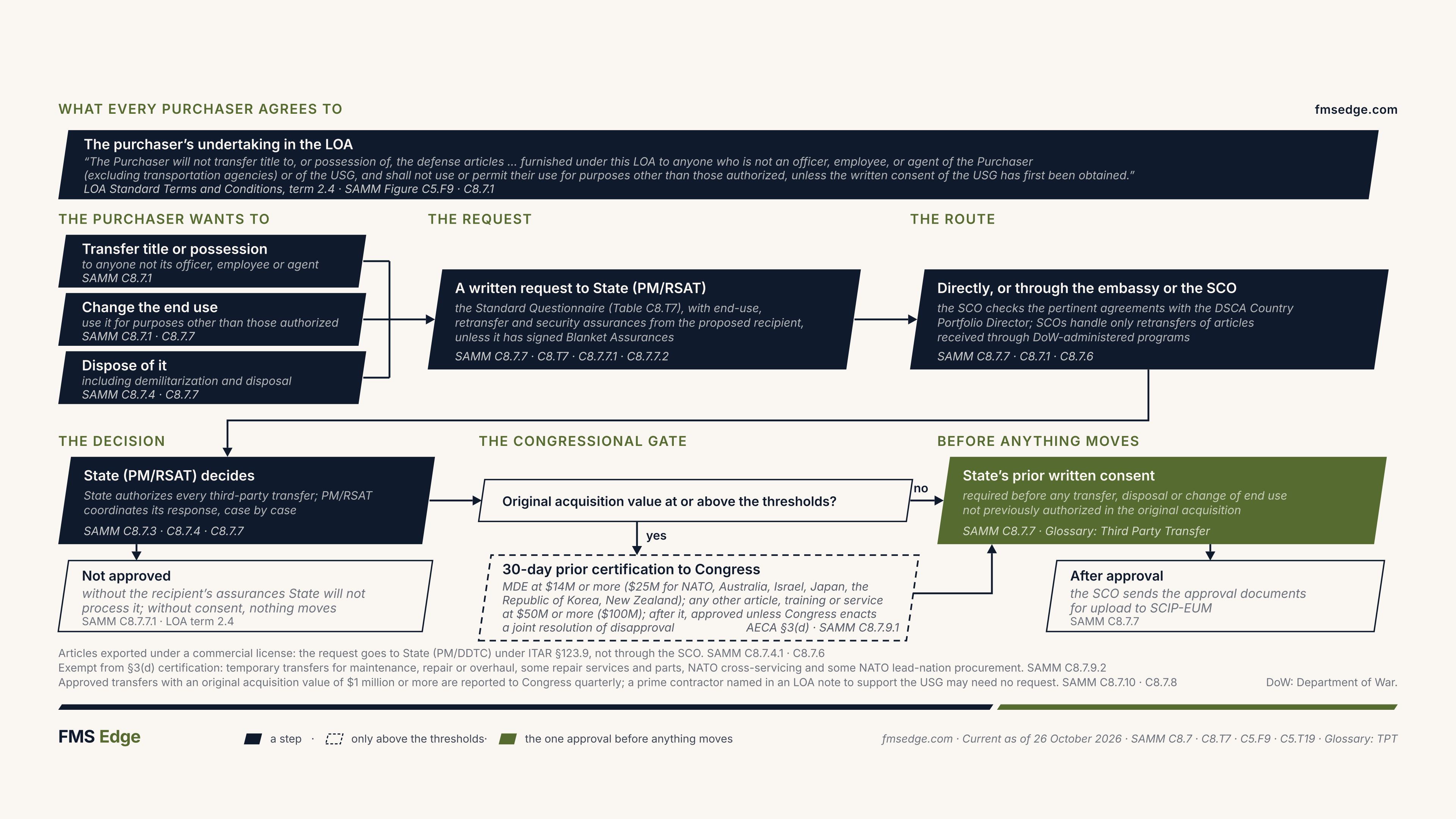
Section 2.4 restates the obligations imposed on the international partner under the . Although the international partner actually becomes owner of the materiel, the requires, as a condition of the sale, that the international partner agrees to not resell or transfer possession of the purchased items without first obtaining written consent. This condition does not mean that the international partner can never sell the materiel or turn over possession for maintenance to a third country [SAMM , ] []. For a weapon, weapons system, munitions, aircraft, military boat, military vessel or other implement of war, the President shall not give consent to a transfer to another country unless the United States itself would transfer that article to that country [].
This condition also requires the international partner to respect the proprietary rights of U.S. contractors. This condition protects the intellectual property of U.S. contractors from misuse. This section also specifically identifies conditions related to Cyprus [SAMM ]. Congress addressed unauthorized transfers of defense articles to Cyprus in Section 620C(e) of the , and the standard terms and conditions used with all cases include the same requirement [].
Under Section 505, FAA, Section 3, , and the Standard Terms and Conditions, a foreign government may not transfer possession of, or title to, any or service without prior written consent from the . The bar does not apply to a transfer to an officer, employee or agent of that government or of the . For third-party transfer purposes, the manual defines an agent as a only. Without that prior written consent, the government also may not use the articles or services, or permit their use, for purposes other than those for which they were furnished. Organizations () should know the agreements with the recipient country that apply to the defense articles involved, including any special diplomatic notes or agreements. They should contact their Country Portfolio Director () at the to make sure they have all of them [SAMM ].
2.5 Missile Technology Control Regime
2.5 The Purchaser agrees not to divert articles and services received under this for purposes or uses other than those for which it was furnished, including, but not limited to, any use that could contribute to the acquisition, design, development or production of a “missile,” as defined in section 74 of the (22 U.S.C. 2797c). The items will be used only for the purposes stated and such use will not be modified nor the items modified or replicated without the prior consent of the ; neither the items nor replicas nor derivatives thereof will be retransferred without the consent of the . The has the right to take action under section 73(a) of the (22 U.S.C. 2797b(a)) in the case of any export or transfer of any Missile Technology Control Regime () equipment or technology that contributes to the acquisition, design, development or production of missiles in a country that is not an adherent [SAMM ].
Section 2.5 alerts the () partner not to divert articles and services provided under the case for purposes other than for which they were furnished. This specifically excludes any use that would support the acquisition, design, development or production of a missile as defined in the . This section also alerts the international partner that the may act to control export or transfer under the Missile Technology Control Regime [SAMM ].
2.6 Security requirements
2.6 The Purchaser will maintain the security of such article or service and will provide substantially the same degree of security protection afforded to such article or service by the United States Government. To the extent that items, including plans, designs, specifications, , or information, furnished in connection with this may be classified by the for security purposes, the Purchaser certifies that it will maintain a similar classification and employ measures necessary to preserve such security, equivalent to those employed by the and commensurate with security agreements between the and the Purchaser. If such security agreements do not exist, the Purchaser certifies that classified items will be provided only to those individuals having an adequate security clearance and a specific need to know in order to carry out the program and that it will promptly and fully inform the of any compromise, or possible compromise, of U.S. classified material or information furnished pursuant to this . The Purchaser further certifies that if a U.S. classified item is to be furnished to its contractor pursuant to this : (a) the item will be exchanged through official Government channels, (b) the specified contractor will have been granted a facility security clearance by the Purchaser at a level at least equal to the classification level of the U.S. information involved, (c) all contractor personnel requiring access to such items will have been cleared to the appropriate level by the Purchaser, and (d) the Purchaser is also responsible for administering security measures while the item is in the contractor’s possession. If a commercial transportation agent is to be used for shipment, the Purchaser certifies that such agent has been cleared at the appropriate level for handling classified items. These measures will be maintained throughout the period during which the may maintain such classification. The will use its best efforts to notify the Purchaser if the classification is changed [SAMM ].
This condition requires the international partner to maintain security measures equivalent to those used by the [SAMM ] []. This does not mean the international partner must use the same security procedures. It means that the end result of the international partner’s security process will achieve a level of security that is equivalent to the security level provided by the . Additionally, the international partner is responsible for security not only when the item is in government possession, but also when it is provided to the international partner’s domestic contractors or when it is in the transportation pipeline [SAMM ].
2.7 End-use monitoring
2.7 Pursuant to section 505 of the Foreign Assistance Act of 1961, as amended () (22 U.S.C. 2314), and section 40A of the (22 U.S.C. 2785), the will be permitted, upon request, to conduct verification with respect to the use, transfer, and security of all defense articles and defense services transferred under this . The Purchaser agrees to permit scheduled inspections or physical inventories upon request, except when other means of verification shall have been mutually agreed. Upon request, inventory and accountability records maintained by the Purchaser will be made available to U.S. personnel conducting verification [SAMM ].
Every purchaser agrees in the LOA that the U.S. Government may verify how the articles it buys are used, transferred and secured. Golden Sentry, the Department of War end-use monitoring program DSCA administers, carries out that verification. Which articles are designated for Enhanced End-Use Monitoring is not listed in the public SAMM, and none are named here.
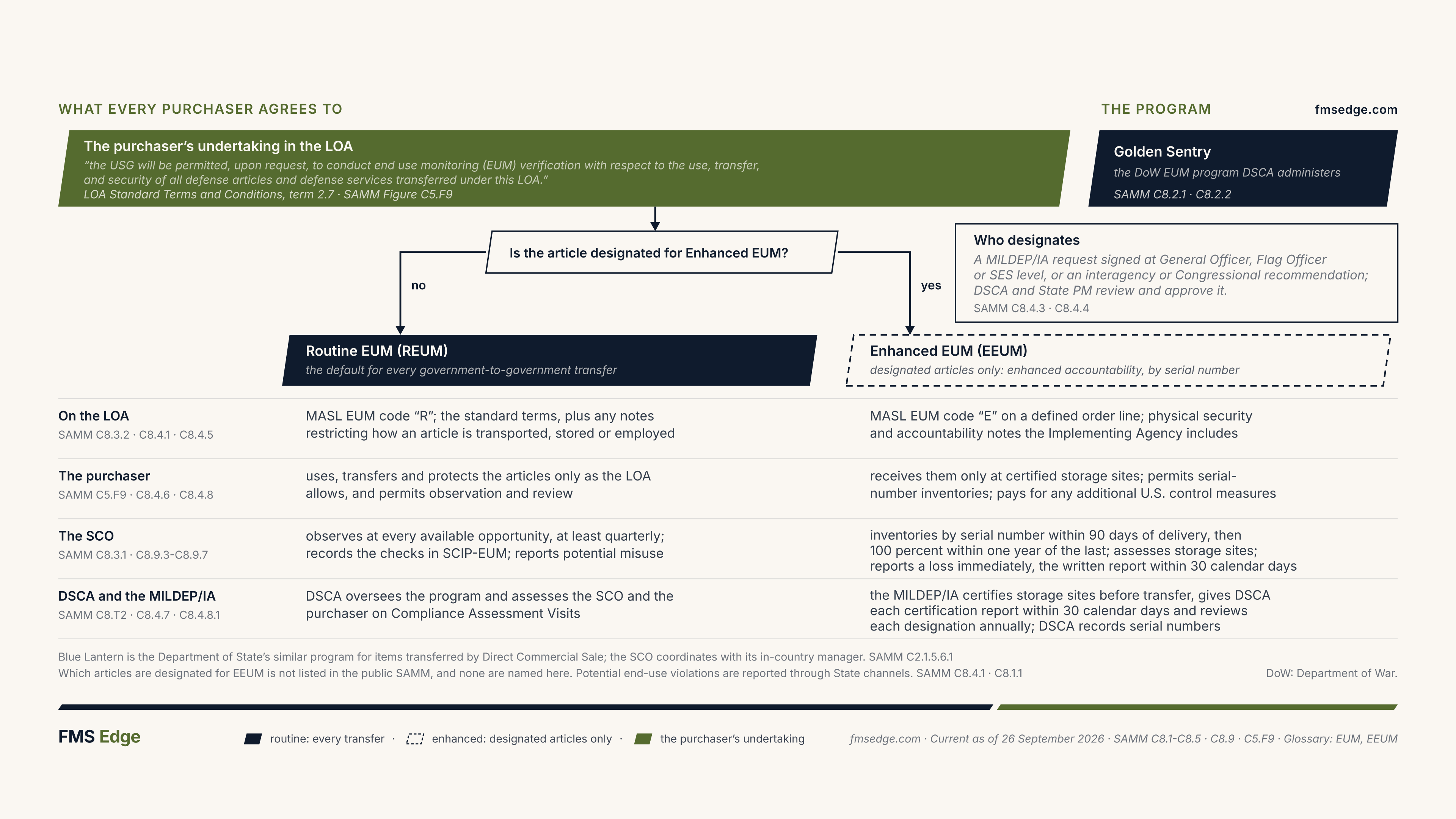
Section 2.7 states the retains the right to conduct end-use monitoring () verification of articles and services transferred under the case. The international partner agrees to permit scheduled inspections or physical inventories upon request and make accountability records available to personnel [SAMM ]. This implements Section 40A, [SAMM ] [].
2.8 Offset arrangements
2.8 Any offset arrangement is strictly between the Purchaser and the U.S. . The U.S. Government is not a party to any that may be required by the Purchaser in relation to the sales made in this . The assumes no obligation to administer or satisfy any offset requirements or bear any of the associated costs. Although offsets, as defined in the Defense Supplement, are not within the scope of the DoW contracts entered into to fulfill the requirements of this , offset costs may be recovered through such contracts. costs may be deemed reasonable without further analysis in accordance with the Defense Supplement. If the Purchaser wishes to obtain information regarding offset costs, the Purchaser should request information directly from the U.S. [SAMM ].
Section 2.8 notifies the international partner that the is not a party to any offset arrangements and assumes no obligation to administer or satisfy any offset requirements. Although offsets are not within the scope of Department of War contracts used to execute the case, offset costs may be recovered through such contracts. Section 2.8 notes that costs may be deemed reasonable without further analysis under the Defense Supplement [SAMM ].
References
SAMM
- SAMM C5.F9: Letter of Offer and Acceptance Standard Terms and Conditions
- SAMM C6.8.1: Purchaser-Requested Case Cancellations.
- SAMM C4.2.3: Proper Use of Materiel and End Use Monitoring.
- SAMM C8.1.1
- SAMM C5.6.5.4.1: Standard Terms and Conditions and Letter of Offer and Acceptance Information.
- SAMM C8.7.1: Third Party Transfer.
Public authorities
- FAA §505: Foreign Assistance Act of 1961, as amended, §505 (22 U.S.C. §2314), Furnishing of defense articles or related training or other defense service on grant basis
- AECA §3: Arms Export Control Act of 1976, as amended, §3 (22 U.S.C. §2753)
- FAA §620C: Foreign Assistance Act of 1961, as amended, §620C (22 U.S.C. §2373), Eastern Mediterranean policy requirements
- AECA §40A: Arms Export Control Act of 1976, as amended, §40A (22 U.S.C. §2785)
Related
Letter of Offer and Acceptance (LOA)
The legal instrument that lists the defense articles and services, including training, that the U.S. Government transfers to a foreign country or international organization, with their estimated costs and the terms and conditions. The benefitting partner does not sign a Building Partner Capacity (BPC) LOA.
The Letter of Offer and Acceptance (LOA) is the instrument the U.S. Government uses to sell under the Arms Export Control Act (AECA); signed LOAs and their later Amendments and Modifications are also called Foreign Military Sales (FMS) cases [SAMM C5.6.1].
FMS Edge glossary, as of 10 October 2026
Glossary entry →Open the manual’s entry → (opens in new tab)
Defense Contractor
Any individual, firm, corporation, partnership, association, or other legal non-Federal entity that enters into a contract directly with the DoD to furnish services, supplies, or construction. Foreign governments, representatives of foreign governments, or foreign corporations wholly owned by foreign governments that have entered into contracts with the DoD are not defense contractors.
SAMM Glossary, as of 12 September 2026
Glossary entry →Open the manual’s entry → (opens in new tab)
DSCA: Defense Security Cooperation Agency
SAMM Acronyms, as of 12 September 2026
Glossary entry →Defense Security Cooperation Agency (DSCA) →
LOA: Letter of Offer and Acceptance
SAMM Acronyms, as of 12 September 2026
Internal Security
The state of law and order prevailing within a nation.
SAMM Glossary, as of 12 September 2026
Glossary entry →Open the manual’s entry → (opens in new tab)
Arms Export Control Act (AECA)
The basic U.S. law providing the authority and general rules for the conduct of Foreign Military Sales and commercial sales of defense articles, defense services, and training. The Arms Export Control Act (AECA) came into existence with the passage of the Foreign Military Sales Act (FMSA) of 1968. An amendment in the International Security Assistance and AECA of 1976 changed the name of FMSA to the AECA.
SAMM Glossary, as of 12 September 2026
Glossary entry →Open the manual’s entry → (opens in new tab)
AECA: Arms Export Control Act
SAMM Acronyms, as of 12 September 2026
Foreign Military Sales (FMS)
The part of U.S. security assistance, authorized by the Arms Export Control Act (AECA), in which eligible foreign governments and international organizations buy defense articles, services and training from the U.S. Government under formal government-to-government agreements.
The articles come either from Department of War stocks or from new procurement under contracts the Department manages [22 U.S.C. 2761, 22 U.S.C. 2762]. A sale is FMS whatever the source of the purchaser's financing.
FMS Edge glossary, as of 10 October 2026
Glossary entry →Open the manual’s entry → (opens in new tab)
Defense Article (Foreign Assistance Act; Arms Export Control Act, not including commercial sales subject to the International Traffic in Arms Regulation)
Any weapon, weapon system, munition, aircraft, vessel or other implement of war, together with the property, equipment, tooling, components and parts used to furnish military assistance or sales or to make, maintain or use such items; the International Traffic in Arms Regulations (ITAR) define the term separately for commercial exports.
Section 47 of the Arms Export Control Act (AECA) defines the term, and the U.S. Munitions List designates the specific items that fall within it [SAMM C4.4] [22 U.S.C. 2794].
FMS Edge glossary, as of 10 October 2026
Glossary entry →Open the manual’s entry → (opens in new tab)
Freight Forwarder
A commercial import/export company registered with the Department of State, Bureau of Political-Military Affairs, Directorate of Defense Trade Controls and under contract to the Foreign Military Sales customer which arranges transportation of materiel from a point specified in the Letter of Offer and Acceptance to the final destination.
SAMM Glossary, as of 12 September 2026
Glossary entry →Open the manual’s entry → (opens in new tab)
Security Cooperation
Activities by which the Department of War encourages and enables international partners to cooperate with the United States toward strategic objectives, spanning every interaction with foreign defense and security establishments and every security assistance program the Department administers.
Under chapter 16 of Title 10, their purposes are to develop allied and friendly security capabilities for self-defense and multinational operations, to give U.S. forces peacetime and contingency access, and to build relationships promoting specific U.S. security interests [10 U.S.C. 301(7)].
FMS Edge glossary, as of 10 October 2026
Glossary entry →Open the manual’s entry → (opens in new tab)
SCO: Security Cooperation Organization
SAMM Acronyms, as of 12 September 2026
Defense Security Cooperation Agency (DSCA)
The Department of War agency that directs, administers and provides guidance to the Department's components and its representatives at U.S. missions for the execution of the security cooperation programs for which it is responsible [SAMM C1.3.2.2]. The agency also provides financial and technical assistance, arranges the transfer of defense materiel, training and services to international partners, and promotes military-to-military contacts.
FMS Edge glossary, as of 10 October 2026
Glossary entry →Open the manual’s entry → (opens in new tab)
Technical Data
Recorded information of a scientific or technical nature, regardless of form or characteristic. Examples of technical data packages include research and engineering drawings and associated lists, specifications, standards, process sheets, manuals, technical reports, catalog item identifications, and related information and computer software documentation.
SAMM Glossary, as of 12 September 2026
Glossary entry →Open the manual’s entry → (opens in new tab)
End Use Monitoring (EUM)
Mandated by Section 40A of the Arms Export Control Act (AECA) (22 U.S.C. 2785), activities undertaken by the U.S. Government to ensure that defense articles and defense services transferred to foreign partners under security assistance/cooperation authorities are monitored and used according to the terms and conditions specified in Letters of Offer and Acceptance and other transfer agreements, and as required by the AECA or the Foreign Assistance Act of 1961.
SAMM Glossary, as of 12 September 2026
Glossary entry →Open the manual’s entry → (opens in new tab)
EUM: End Use Monitoring
SAMM Acronyms, as of 12 September 2026
Offset Agreement
An agreement, arrangement, or understanding between a U.S. supplier of defense articles or services and a foreign country under which the supplier agrees to purchase or acquire, to promote the purchase or acquisition by other U.S. persons, of goods or services produced, manufactured, grown, or extracted, in whole or in part, in that foreign country in consideration for the purchase by the country of defense articles or services from the supplier [Sec. 39A(d)(1), Arms Export Control Act]. See also direct offset and indirect offset.
SAMM Glossary, as of 12 September 2026
Glossary entry →Open the manual’s entry → (opens in new tab)
Federal Acquisition Regulation (FAR)
The FAR is the primary regulation for use by federal executive agencies for the acquisition of supplies and services with appropriated funds. The document, published in 1984, consolidated the major procurement regulations of various departments and agencies. The intent of the FAR is to standardize the content, decrease the volume of documents, and to achieve consistency throughout government. The principal agencies involved in putting together the FAR were DoD, the General Services Administration, and the National Aeronautics and Space Administration, the three largest buyers. The FAR is broader than just contracting and applies to all goods and services. It directs the defense program manager in many ways, including contract award procedures, acquisition planning, warranties, and establishing guidelines for competition. Besides the FAR, each agency has its supplement to describe its own particular way of doing business. The DoD supplement is called Defense FAR Supplement.
SAMM Glossary, as of 12 September 2026
Glossary entry →Open the manual’s entry → (opens in new tab)
Indirect Offset
Industrial or commercial compensation, not directly related to the items bought, that a purchasing government sets as a condition of buying defense articles or services, such as the contractor buying or marketing goods produced in the purchasing country.
U.S. Government agencies may not enter into any offset agreement or commit U.S. firms to one [SAMM C6.3.9].
FMS Edge glossary, as of 10 October 2026
Glossary entry →Open the manual’s entry → (opens in new tab)
SAMM C5.F9: Letter of Offer and Acceptance Standard Terms and Conditions
“… 2.2. The purchaser notes its obligations under International Humanitarian Law and Human Rights Law. The Purchaser agrees, except as may otherwise be mutually agreed in writing by the Purchaser and the USG, to use the defense articles sold hereunder only: 2.2.1. for internal security; 2.2.2. for legitimate self-defense; 2.2.3. for preventing or hindering the proliferation of weapons of mass destruction …”
Security Assistance Management Manual, as of 11 September 2026
SAMM C5.F9: Letter of Offer and Acceptance Standard Terms and Conditions
“… 2.4. The Purchaser will not transfer title to, or possession of, the defense articles, components and associated support materiel, related training or other defense services (including plans, specifications, or information), or technology furnished under this LOA to anyone who is not an officer, employee, or agent of the Purchaser (excluding transportation agencies) or of the USG, and shall not use …”
Security Assistance Management Manual, as of 11 September 2026
SAMM C5.F9: Letter of Offer and Acceptance Standard Terms and Conditions
“… 2.1. The Purchaser may cancel this LOA or delete items at any time prior to delivery of defense articles or performance of defense services. The Purchaser is responsible for all costs resulting from cancellation under this section.”
Security Assistance Management Manual, as of 11 September 2026
SAMM C6.8.1: Purchaser-Requested Case Cancellations.
“Purchasers may request that their Foreign Military Sales (FMS) cases be cancelled. After a case has been implemented, cancellations are processed as a closure of the case. The purchaser is responsible for any termination costs as well as any estimated administrative costs associated with the case. The minimum, non-refundable amount of administrative costs will be: the value when combining the …”
Security Assistance Management Manual, as of 11 September 2026
SAMM C4.2.3: Proper Use of Materiel and End Use Monitoring.
“Sales and assistance may be made to countries only for purposes of internal security, legitimate self-defense, for preventing or hindering the proliferation of weapons of mass destruction and of the means of delivering such weapons, civic action, or to permit the recipient country to participate in regional or collective arrangements consistent with the United Nations (UN) Charter, or requested by …”
Security Assistance Management Manual, as of 26 October 2026
SAMM C5.F9: Letter of Offer and Acceptance Standard Terms and Conditions
“… 2.3. The Purchaser agrees that the USG retains the right to verify reports that defense articles and services have been used for purposes not authorized or for uses not consented to by the USG.”
Security Assistance Management Manual, as of 11 September 2026
SAMM C8.1.1
“End Use Monitoring (EUM) is the process of verifying that defense articles and services transferred from the U.S. to our partners are being used, stored, and disposed of in accordance with the terms and conditions of the transfer agreements. It is a critical and mandatory component of U.S. security cooperation policy, helping to ensure defense articles and services are used …”
Security Assistance Management Manual, as of 11 September 2026
Foreign Assistance Act of 1961, as amended, §505 (22 U.S.C. §2314), Furnishing of defense articles or related training or other defense service on grant basis
FAA §505 · Statute
SAMM C8.7.1: Third Party Transfer.
“In accordance with the Foreign Assistance Act (FAA), Section 505 (22 U.S.C. 2314); Arms Export Control Act (AECA) Section 3 (22 U.S.C. 2753); and the Letter of Offer and Acceptance (LOA) Standard Terms and Conditions (See Figure C5.F8.), foreign governments may not transfer title to or possession of any defense articles or services to anyone not an officer, employee, or …”
Security Assistance Management Manual, as of 26 October 2026
Foreign Assistance Act of 1961, as amended, §620C (22 U.S.C. §2373), Eastern Mediterranean policy requirements
FAA §620C · Statute
SAMM C5.F9: Letter of Offer and Acceptance Standard Terms and Conditions
“… The USG has the right to take action under AECA, Section 73(a) (22 U.S.C. 2797b(a)) in the case of any export or transfer of any Missile Technology Control Regime (MTCR) equipment or technology that contributes to the acquisition, design, development or production of missiles in a country that is not an MTCR adherent.”
Security Assistance Management Manual, as of 11 September 2026
SAMM C5.F9: Letter of Offer and Acceptance Standard Terms and Conditions
“… 2.6. The Purchaser will maintain the security of such article or service and will provide substantially the same degree of security protection afforded to such article or service by the United States Government. To the extent that items, including plans, designs, specifications, technical data, or information, furnished in connection with this LOA may be classified by the USG for security …”
Security Assistance Management Manual, as of 11 September 2026
SAMM C5.F9: Letter of Offer and Acceptance Standard Terms and Conditions
“… 2.7. Pursuant to Foreign Assistance Act (FAA) of 1961, Section 505, as amended (22 U.S.C. 2314), and section 40A of the AECA AECA, Section 40A (22 U.S.C. 2785), the USG will be permitted, upon request, to conduct end use monitoring (EUM) verification with respect to the use, transfer, and security of all defense articles and defense services transferred under this …”
Security Assistance Management Manual, as of 11 September 2026
Arms Export Control Act of 1976, as amended, §40A (22 U.S.C. §2785)
AECA §40A · Statute
SAMM C5.F9: Letter of Offer and Acceptance Standard Terms and Conditions
“… 2.8. Any offset arrangement is strictly between the Purchaser and the U.S. defense contractor. The U.S. Government is not a party to any offset agreement that may be required by the Purchaser in relation to the sales made in this LOA. The USG assumes no obligation to administer or satisfy any offset requirements or bear any of the associated costs. …”
Security Assistance Management Manual, as of 11 September 2026