
Guide
How does a Foreign Military Sales purchaser dispose of U.S.-origin equipment?
Disposing of U.S.-provided defense articles is a change of end use and requires Department authorization first. The office should plan the demilitarization with the partner, and it must ensure the partner follows Department of War procedures unless the Department has authorized or required another disposition. A partner can instead transfer equipment that still has military capability to another country, with Department approval.
Every purchaser agrees in the LOA not to transfer title to or possession of what it bought, or use it for other purposes, without the U.S. Government's prior written consent. State's Office of Regional Security and Arms Transfers decides each request case by case.
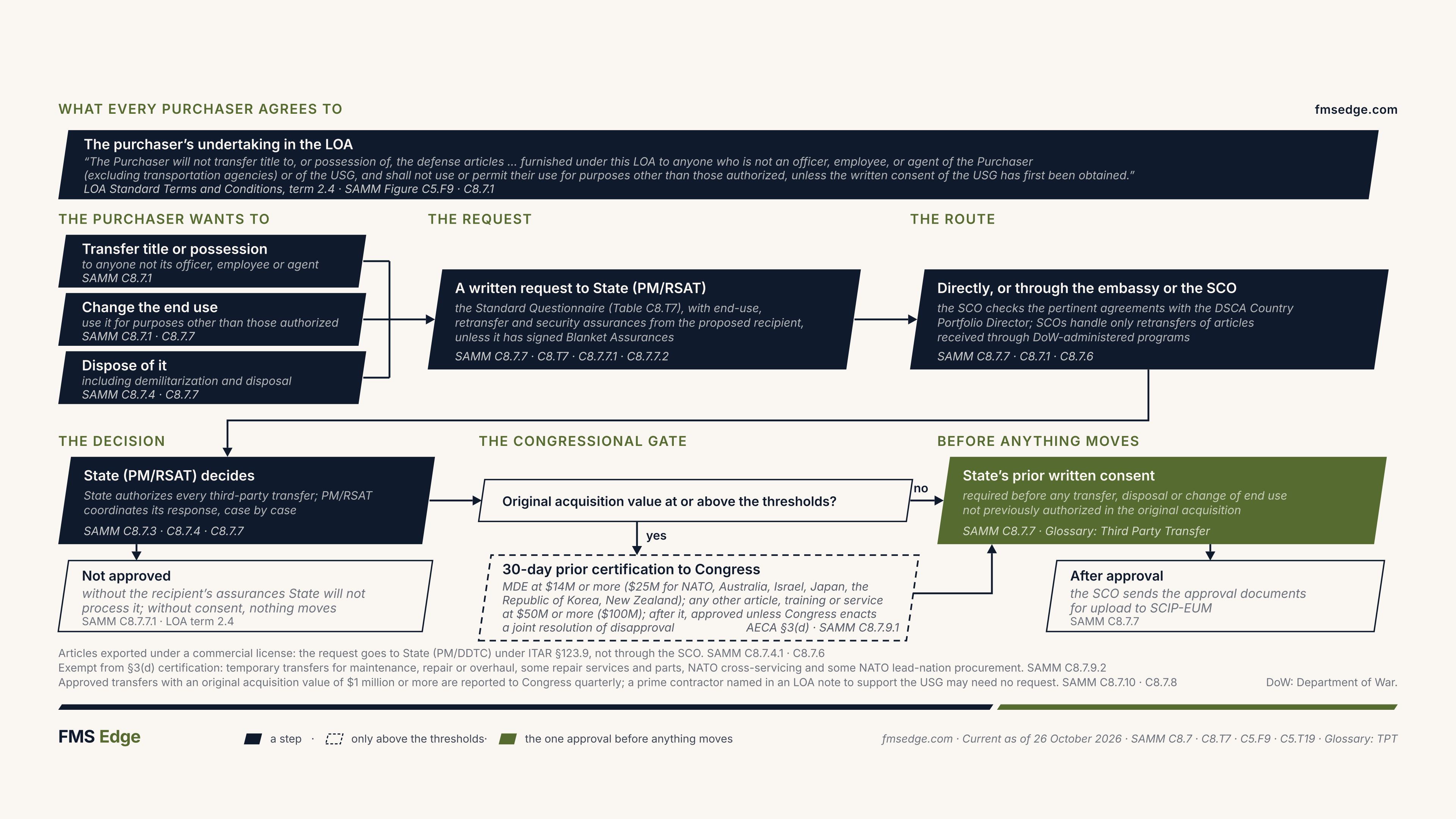
How does a Foreign Military Sales purchaser dispose of U.S.-origin equipment?
Disposing of U.S.-provided defense articles is a change of end use, so a purchaser's request to dispose of them requires the Department of State's authorization [SAMM ]. Once the partner asks for that approval, the should begin working with it on a demilitarization plan that ensures compliance with Department of War demilitarization requirements [SAMM ].
The disposal phase begins when an international partner has a need to dispose of all or part of a .
A request to change the end use of defense articles provided by the United States requires authorization from the Department of State's Office of Regional Security and , in its Bureau of Political-Military Affairs. Changes of end use for non-defense purposes may include demilitarization by the partner for museum display, conversion to commercial applications, and disposal. Articles kept for static display may require demilitarization. Removing parts from an article (cannibalization) counts as disposal when those parts will no longer be controlled by the owning ministry or agency, or will be put to purposes other than national defense [SAMM ].
Demilitarization eliminates the functional capabilities and inherent military design features of an item, to prevent its use for its originally intended purpose [SAMM ]. If a needs to be demilitarized, the procedures are described in Manual (DoDM) 4160.28, Volume 2, or can be obtained from the appropriate demilitarization program administrator [SAMM ]. Organizations () must ensure that partners follow Department of War (DoW) demilitarization procedures unless the Department of State, Office of Regional Security and (PM/RSAT), has specifically authorized or required some other disposition [SAMM ]. Classified features and those that pose physical or environmental hazards should be neutralized prior to or during the disposal process.
The DoW Demilitarization Program is managed by the DoW Demilitarization Program Office (), which makes sure that the program's policy, procedures, implementation and operational performance are in line with DoW interests, U.S. foreign policy and national security objectives. Demilitarization removes the functional capabilities, the inherent military design features, or both, from DoW personal property. The procedure is required to keep property from being used for its originally intended purpose. It also prevents unauthorized use of the property and unauthorized release of its design information, which could be used against the United States and its allies. Its methods and degree range from removing and destroying critical features to destroying the item entirely [SAMM ].
When the partner asks to approve the disposal of defense articles, the should begin working with its partner counterparts on a demilitarization plan that ensures compliance with DoW demilitarization requirements. The determines an article's demilitarization code from DoDM 4160.28, Volume 2. Alternatively, the takes the article's from the , the 1000 Report or the partner's equipment manual and looks the code up in the Defense Logistics Agency's WebFLIS or Pub Log. Online training for the Certifier and Verifier course is on the Defense Logistics Agency's Training webpage [SAMM ].
Transferring unwanted materiel to another country is another means of disposal, and the partner must obtain written consent from the Department of State (PM/RSAT) before the transfer [SAMM ]. This is typically done with items that still have military capability. The transferring country locates a recipient that meets the approval of the United States.
Both the Department of State and the DoW have set up end-use monitoring () programs to ensure that defense articles are used according to agreements with the U.S. from receipt to final disposal.
When the recipient government no longer requires an item and there is no other partner or entity that wants it, disposal may be in order. Disposal is a change of end use and requires authorization from the Department of State (PM/RSAT) [SAMM ]. For equipment acquired through a grant program, such as or , title passes to the recipient country. However, the U.S. retains reversionary rights to certain kinds of grant items, depending on the transfer program and authorities used. If required by these programs or authorities, the recipient must agree in advance and in writing to return the equipment to the U.S. Government () when it is no longer required for its intended purpose [SAMM , ].
When the 's review of the screening shows that excess materiel will not be redistributed, the recipient requests approval for its disposal [SAMM ]. Under Section 505(f) of the Foreign Assistance Act (), no shall be furnished on a grant basis unless the country has agreed to pay the net proceeds of sale to the U.S. Government. The agreement covers any weapon, munition, aircraft, vessel or other implement of war received under Part II of the . The President may waive the payment for items delivered before the cut-off date the statute sets; that authority is delegated to the Secretary of [SAMM ] []. For items acquired through , whether with a country’s own funds or with Foreign Military Financing (), the has no reversionary rights [SAMM ]. Proceeds of approved sales or transfers of such items go to the partner.
Requests to transfer defense articles originally acquired by Direct Commercial Sales (), under a commercial export license or other commercial authorization, are processed by the Department of State Directorate of Defense Trade Controls (PM/) [SAMM ]. Partners make such requests directly to through their embassies in Washington, D.C. [SAMM ]. Title to -acquired, U.S.-origin defense articles passes to the recipient country upon shipment. All proceeds of approved sales/transfers go to the host nation.
If the international partner has been granted the right to dispose of U.S. defense materiel or articles, its disposal procedures should follow, in form and content, those used by the Defense Logistics Agency () Disposition Services, though local methods and channels may be used when deemed to be appropriate by the . The following areas of attention are those deemed most important for ensuring U.S. trade control requirements:
- Determination of demilitarization requirements
- Conduct of sale
- Bidder screening
- End-use and retransfer assurance
- Import certificate/delivery verification (as required)
In some instances, materiel can only be disposed of as scrap, but this does not negate the requirement to follow appropriate security procedures. The demilitarization procedures for local disposal are described in DoDM 4160.28, Volume 2 [SAMM ]. will witness the demilitarization and disposal of every classified and of every designated for Enhanced End-Use Monitoring (). For any other , will either witness its demilitarization and disposal or confirm them through partner reports or other legitimate documentation. should record each demilitarization action by uploading a copy of the completed Demilitarization Certificate to the database in the [SAMM ].
References
SAMM
- SAMM C8.8.2: End Use Monitoring and the Disposal/Destruction Process.
- SAMM C8.7.7: Third Party Transfer Requests: Government-To-Government.
- SAMM AP8.MAP.6.3: Title Transfer of Items.
- SAMM AP8.MAP.6.5.1: End Use of Provided Articles and/or Services.
- SAMM AP8.MAP.T1: End Use and Disposal Processes
- SAMM AP8.MAP.6.5.2.2: Proceeds from Disposal of Military Assistance Program Items.
- SAMM C8.7.4.1: Directorate of Defense Trade Controls.
- SAMM C8.7.6: Department of War – United States Military Group.
- SAMM C8.8.1: Changes to End Use.
- SAMM C8.8.2.1: Department of War Demilitarization Program Office.
- SAMM C8.8.3: United States Military Group Involvement.
Public authorities
- FAA §505: Foreign Assistance Act of 1961, as amended, §505 (22 U.S.C. §2314), Furnishing of defense articles or related training or other defense service on grant basis
Related
Security Cooperation
Activities by which the Department of War encourages and enables international partners to cooperate with the United States toward strategic objectives, spanning every interaction with foreign defense and security establishments and every security assistance program the Department administers.
Under chapter 16 of Title 10, their purposes are to develop allied and friendly security capabilities for self-defense and multinational operations, to give U.S. forces peacetime and contingency access, and to build relationships promoting specific U.S. security interests [10 U.S.C. 301(7)].
FMS Edge glossary, as of 10 October 2026
Glossary entry →Open the manual’s entry → (opens in new tab)
Foreign Military Sales (FMS)
The part of U.S. security assistance, authorized by the Arms Export Control Act (AECA), in which eligible foreign governments and international organizations buy defense articles, services and training from the U.S. Government under formal government-to-government agreements.
The articles come either from Department of War stocks or from new procurement under contracts the Department manages [22 U.S.C. 2761, 22 U.S.C. 2762]. A sale is FMS whatever the source of the purchaser's financing.
FMS Edge glossary, as of 10 October 2026
Glossary entry →Open the manual’s entry → (opens in new tab)
Security Cooperation Organization (SCO)
A Department of Defense element that is part of the United States Diplomatic mission located in a foreign country to carry out security assistance and security cooperation management functions under the supervision and coordination authority of the senior defense official/defense attaché.
SAMM Glossary, as of 12 September 2026
Glossary entry →Open the manual’s entry → (opens in new tab)
Weapon System
A combination of one or more weapons with all related equipment, materials, services, personnel, and means of delivery and deployment (if applicable) required for self-sufficiency.
SAMM Glossary, as of 12 September 2026
Glossary entry →Open the manual’s entry → (opens in new tab)
Arms Transfers
The sale, lease, loan, or other transfer of defense articles and defense services such as arms, ammunition, and implements of war, including components thereof, and the training, manufacturing licenses, technical assistance, and technical data related thereto, provided by the USG under the authority of the Foreign Assistance Act of 1961, as amended, or the Arms Export Control Act, as amended, or other statutory authority, or directly by commercial firms to foreign countries, foreign private firms, or to international organizations. See also conventional arms transfers.
SAMM Glossary, as of 12 September 2026
Glossary entry →Open the manual’s entry → (opens in new tab)
Defense Article (Foreign Assistance Act; Arms Export Control Act, not including commercial sales subject to the International Traffic in Arms Regulation)
Any weapon, weapon system, munition, aircraft, vessel or other implement of war, together with the property, equipment, tooling, components and parts used to furnish military assistance or sales or to make, maintain or use such items; the International Traffic in Arms Regulations (ITAR) define the term separately for commercial exports.
Section 47 of the Arms Export Control Act (AECA) defines the term, and the U.S. Munitions List designates the specific items that fall within it [SAMM C4.4] [22 U.S.C. 2794].
FMS Edge glossary, as of 10 October 2026
Glossary entry →Open the manual’s entry → (opens in new tab)
Military Department (MILDEP)
One of the departments within the DoD created by the National Security Act of 1947, as amended. The Military Departments are: the Department of the Air Force, the Department of the Army, and the Department of the Navy.
SAMM Glossary, as of 12 September 2026
Glossary entry →Open the manual’s entry → (opens in new tab)
SCO: Security Cooperation Organization
SAMM Acronyms, as of 12 September 2026
State (PM/RSAT): Department of State Bureau of Political-Military Affairs, Office of Regional Security and Arms Transfers
SAMM Acronyms, as of 12 September 2026
National Stock Number (NSN)
The thirteen-digit code given to each item of supply that the federal supply system repeatedly stocks, stores and issues, made up of the item's four-digit Federal Supply Classification code and its nine-digit National Item Identification Number.
FMS Edge glossary, as of 10 October 2026
Glossary entry →Open the manual’s entry → (opens in new tab)
Letter of Offer and Acceptance (LOA)
The legal instrument that lists the defense articles and services, including training, that the U.S. Government transfers to a foreign country or international organization, with their estimated costs and the terms and conditions. The benefitting partner does not sign a Building Partner Capacity (BPC) LOA.
The Letter of Offer and Acceptance (LOA) is the instrument the U.S. Government uses to sell under the Arms Export Control Act (AECA); signed LOAs and their later Amendments and Modifications are also called Foreign Military Sales (FMS) cases [SAMM C5.6.1].
FMS Edge glossary, as of 10 October 2026
Glossary entry →Open the manual’s entry → (opens in new tab)
EUM: End Use Monitoring
SAMM Acronyms, as of 12 September 2026
Military Assistance Program (MAP)
That portion of the United States Security Assistance program authorized by the Foreign Assistance Act of 1961, as amended, which once provided defense articles and services to recipients on a nonreimbursable (grant) basis. Funding for MAP was consolidated under the Foreign Military Financing program beginning in Fiscal Year 1990.
SAMM Glossary, as of 12 September 2026
Glossary entry →Open the manual’s entry → (opens in new tab)
Excess Defense Articles (EDA)
Defense articles owned by the USG which are neither procured in anticipation of military assistance or sales requirements, nor procured pursuant to a military assistance or sales order. EDA are items (except construction equipment) that are in excess of the Approved Force Acquisition Objective and Approved Force Retention Stock of all DoD components at the time such articles are dropped from inventory by the supplying agency for delivery to countries or international organizations.
SAMM Glossary, as of 12 September 2026
Glossary entry →Open the manual’s entry → (opens in new tab)
Implementing Agency (IA)
The military department or defense agency responsible for the execution of military assistance programs. With respect to FMS, the military department or defense agency assigned responsibility by the Defense Security Cooperation Agency to prepare an LOA and to implement an FMS case. The implementing agency is responsible for the overall management of the actions that will result in delivery of the materials or services set forth in the LOA that was accepted by a foreign country or international organization.
SAMM Glossary, as of 12 September 2026
Glossary entry →Open the manual’s entry → (opens in new tab)
DCS: Direct Commercial Sales
SAMM Acronyms, as of 12 September 2026
DDTC: Directorate of Defense Trade Controls
Defense Logistics Agency
The Department of War agency that is the item manager for consumable, stock-funded secondary items. Its supply centers work with the military departments to fill Foreign Military Sales (FMS) requisitions, process supply discrepancy reports and repair and return items, and close cases when supply is complete, and it prepares FMS cases for cataloging services and excess defense articles [SAMM C1.3.2.6.2.3.2].
FMS Edge glossary, as of 10 October 2026
Security Cooperation Information Portal (SCIP)
A web-based tool, managed by the Defense Security Cooperation Agency (DSCA), that gives international purchasers, their agents such as freight forwarders, and authorized U.S. Government personnel information on Foreign Military Sales (FMS) cases and other security cooperation programs.
It covers case, line, requisition and supply data, supply transactions and end-use monitoring information, drawn from the Defense Security Assistance Management System (DSAMS) and the Military Departments' case execution systems.
FMS Edge glossary, as of 10 October 2026
Glossary entry →Open the manual’s entry → (opens in new tab)
SAMM C8.8.1: Changes to End Use.
“Requests to change the end use of U.S.-provided defense articles require Department of State, Bureau of Political-Military Affairs, Office of Regional Security and Arms Transfers (State (PM/RSAT)) authorization. Changes in end use for non-defense purposes may include partner demilitarization for museum display, conversion to commercial applications, and disposal. Defense articles used for purposes of static display may require demilitarization. Cannibalization …”
Security Assistance Management Manual, as of 11 September 2026
SAMM C8.8.3: United States Military Group Involvement.
“At the time the partner requests State (PM/RSAT) approval to dispose defense articles, the MILGP should begin working with partner counterparts to develop a demilitarization plan to ensure compliance with DoW demilitarization requirements. The MILGP determines the appropriate demilitarization coding assignment in the DoDM 4160.28 Volume 2 or by obtaining the National Stock Number (NSN) from the Letter of Offer …”
Security Assistance Management Manual, as of 26 October 2026
SAMM C8.8.2.1: Department of War Demilitarization Program Office.
“The DoW Demilitarization Program Office (DDPO) manages the DoW Demilitarization Program to ensure that policy, procedures, program implementation, and operational performance are consistent with U.S. Foreign Policy, National Security objectives and DoW interests. Demilitarization involves eliminating the functional capabilities and/or inherent military design features from DoW personal property. This procedure is required to prevent property from being used for its …”
Security Assistance Management Manual, as of 11 September 2026
SAMM C8.8.2: End Use Monitoring and the Disposal/Destruction Process.
“End Use Monitoring (EUM) of demilitarization is a key aspect of disposal activities due to the potential for unauthorized disclosure of classified or sensitive information, safety concerns, and other factors. During disposal, defense articles often move from operating units to holding areas, where personnel may not be aware of classified features, potential lethality, or other sensitivities. MILGPs are responsible for …”
Security Assistance Management Manual, as of 26 October 2026
SAMM C8.7.7: Third Party Transfer Requests: Government-To-Government.
“The USG requires partners to obtain written consent from State (PM/RSAT) prior to transfer, disposal, or change of end use of its U.S.-provided articles, services, or technical data unless previously authorized by State. This includes defense articles and technical data obtained through FMS, MAP, or EDA programs. TPT decisions are made on a case-by-case basis and are guided by general …”
Security Assistance Management Manual, as of 26 October 2026
SAMM AP8.MAP.6.3: Title Transfer of Items.
“Title transfer for items transferred under the Foreign Assistance Act (FAA) 22 U.S.C. Chapter 32 is the same as for items transferred under the Arms Export Control Act (AECA) (22 U.S.C. 2751). See Letter of Offer and Acceptance (LOA) Standard Terms and Conditions, Figure C5.F9. Reversionary title rights do not accrue to the United States on any defense article sold …”
Security Assistance Management Manual, as of 30 September 2026
SAMM AP8.MAP.6.5.1: End Use of Provided Articles and/or Services.
“This section applies to materiel furnished under: the Foreign Assistance Act (FAA) of 1961, as amended (22 U.S.C. Chapter 32)), (materiel furnished under MAP orders prior to FY 1982). It does not apply to materiel purchased as a result of transfer of MAP funds to the FMS trust fund. MAP recipients must use articles and/or services provided under this program …”
Security Assistance Management Manual, as of 9 November 2026
SAMM AP8.MAP.T1: End Use and Disposal Processes
“Table MAP.T1. End Use and Disposal Processes # Step Action(s) 1 Establish End Use Processes In-Country Each U.S. Military Group (MILGP) works with the country to ensure that a process exists for end use, including technical inspection and disposal, of U.S.-origin defense articles. The SCO ensures these processes specifically identify aircraft, ships, radars, armored vehicles, general purpose vehicles, artillery, mortars, …”
Security Assistance Management Manual, as of 9 November 2026
SAMM AP8.MAP.6.5.2.2: Proceeds from Disposal of Military Assistance Program Items.
“FAA, Section 505(f) (22 U.S.C. 2314(f)) requires net proceeds from MAP disposal to be paid to the USG. In the case of items that were delivered prior to 1985, the President may waive the requirement that such net proceeds be paid to the USG if he or she determines that to do so is in the national interest of the …”
Security Assistance Management Manual, as of 9 November 2026
Foreign Assistance Act of 1961, as amended, §505 (22 U.S.C. §2314), Furnishing of defense articles or related training or other defense service on grant basis
FAA §505 · Statute
SAMM C8.7.4.1: Directorate of Defense Trade Controls.
“Department of State Directorate of Defense Trade Controls (State (PM/DDTC)) Pursuant to AECA, Section 38 (22 U.S.C. 2778) and the International Traffic In Arms Regulations (ITAR) (22 C.F.R. 120-130), State (PM/DDTC) is responsible for processing requests to transfer defense articles or services originally acquired under a commercial export license or other commercial authorization (such as manufacturing license or technical assistance …”
Security Assistance Management Manual, as of 26 October 2026
SAMM C8.7.6: Department of War – United States Military Group.
“MILGPs are directly involved only in actions related to retransfers of defense articles received through DoW-administered programs. They do not process requests for retransfers of defense articles procured by commercial means. Partners make such requests directly to State (PM/DDTC) through their embassies in Washington, D.C. MILGPs should refer partners to State on inquiries related to TPTs.”
Security Assistance Management Manual, as of 26 October 2026