
Guide
What is a third-party transfer in Foreign Military Sales?
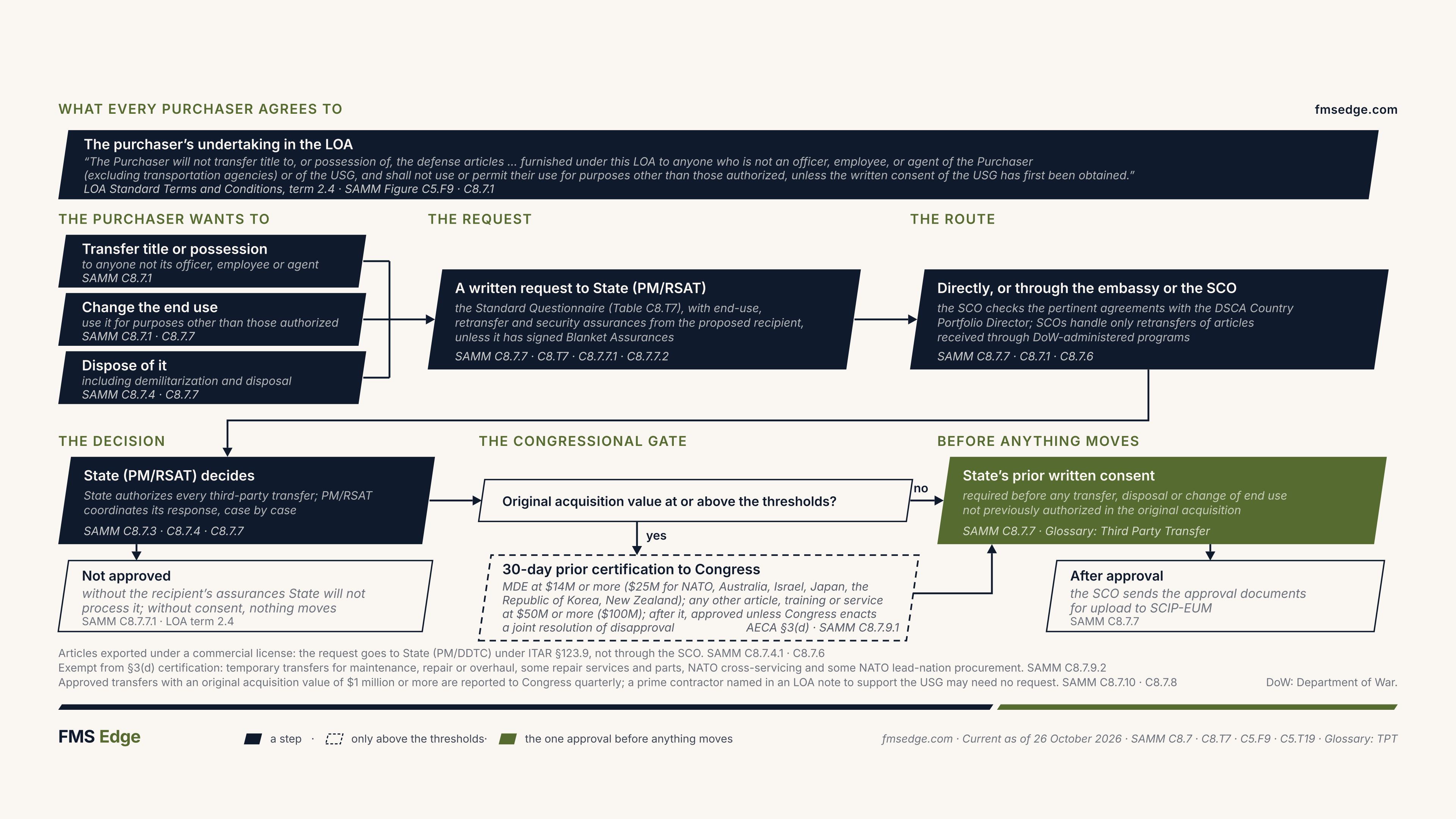
A purchaser may not transfer U.S. defense articles bought through to a third party, or use them for a different purpose, without prior written consent from the U.S. Government. The Department of State authorizes every third-party transfer, and a transfer above set values is certified to Congress first.
Every purchaser agrees in the LOA not to transfer title to or possession of what it bought, or use it for other purposes, without the U.S. Government's prior written consent. State's Office of Regional Security and Arms Transfers decides each request case by case.
What is a third-party transfer in Foreign Military Sales?
A third-party transfer () moves title to, or possession of, U.S.-provided defense articles or services from the recipient country to anyone other than its own officers, employees or agents or those of the U.S. Government (). Under Section 505, Foreign Assistance Act (), Section 3, , and the Standard Terms and Conditions of the , the recipient may not make a without prior written consent from the . Nor may it use the articles or services for purposes other than those for which they were furnished without that consent [SAMM ].
The consent requirement covers articles and obtained through , the and . It applies to a disposal or a change of end use as well as a transfer [SAMM ]. The Department of State () authorizes every [SAMM ]. Its Office of Regional Security and (RSAT) handles articles originally acquired through or a grant program [SAMM ]. Its Directorate of Defense Trade Controls () handles articles originally exported under a commercial license, the route known as Direct Commercial Sales () [SAMM ].
The only agent the rule recognizes is a . The Standard Terms and Conditions are Figure C5.F9. Organizations () should know every agreement with the recipient country that applies to the defense articles involved, including any special diplomatic notes. They should check with their Country Portfolio Director () that they hold all of those agreements [SAMM ].
Any deviation from the transfer, use, and protection requirements of the U.S. Government requires permission from the U.S. President (which, as an authority, is delegated to 's Political-Military (PM) directorates: RSAT for material transfers; for material transfers) [SAMM , , , ].
A third-party transfer () is any retransfer of title, physical possession or control of defense articles, training or acquired under authorized transfer programs from the original authorized recipient to any person or organization not an employee, officer or agent of that recipient country (or international organization). Note that a change in end use is considered a third-party transfer. While it is the receiving partner's responsibility to properly request a third-party transfer, the Organizations () routinely assist in processing these requests.
What counts as a change in end use?
A change of end use is any use of transferred defense articles, services or technology for purposes other than those for which they were furnished [SAMM ]. Since is a “cradle-to-grave” activity, disposal, like a change in end use, requires prior written consent from the Department of State [SAMM , , ]. Cannibalization is viewed as disposal only if the parts being removed will no longer be under the control of the ministry or agency that received them from the , or will be used for purposes other than for national defense [SAMM ]. Examples of possible changes (not an exhaustive list) of end use include:
- Withdrawal of military end items from the operational inventory for display at a government- run museum
- Use of unserviceable/non-repairable vehicles as targets on a firing range
- Transfer of demilitarized military end items or machinery from the armed forces to civil government or educational institutions
- Transfer of a U.S.-origin military vehicle from an operational military unit to be used as a police vehicle assigned to a non-military law enforcement agency
- Demilitarization and redistribution of defense articles among several host government agencies outside of the military/ministry of defense
- Scrapping U.S.-origin end items in order to reclaim and sell their components (e.g., copper wires, titanium)
Who approves a third-party transfer?
The Department of State is responsible for authorizing every third-party transfer [SAMM ]. Each decision is made case by case, guided by general criteria and by the specific requirements of arms transfer law, regulations and policies [SAMM ]. is responsible for coordinating the response to a request to transfer an article originally acquired through or a grant program, including its components, , training and services, and to a request to demilitarize or dispose of it [SAMM ]. The is directly involved only in retransfers of articles received through programs the Department of War (DoW) administers, and it should refer partners to on inquiries [SAMM ].
Under Section 3(a), , and Section 505(e), , the President shall not consent to the transfer of any weapon, weapons system, munitions, aircraft, military boat, military vessel or other implement of war to another country unless the United States itself would transfer the under consideration to that country. In addition, the President shall not consent to the transfer of any significant on the United States () unless one of two conditions is met. Either the requesting country agrees to demilitarize the article before the transfer, or the proposed recipient country commits in writing to the that it will not transfer the article, if not demilitarized, to any other foreign country or person without first obtaining the President’s consent [, ].
do not process requests to retransfer defense articles bought commercially. A partner sends such a request directly to through its embassy in Washington, D.C. [SAMM ].
The Team supports PM/RSAT in the process, as required, by providing additional information related to the original transfer of the U.S. , service, or in question. The Team also supports PM/RSAT efforts by allowing requests to be formally submitted through the module. To ensure SCIP-EUM is properly accounting for the Enhanced () articles, Program Managers should regularly monitor the baseline in SCIP-EUM for each country involved in the . Regular coordination with the SCIP-EUM Helpdesk further enhances accountability for -designated defense articles involved in the third-party transfer.
How does a purchaser ask for approval?
The transferring government must obtain written consent from the Department of State's Office of Regional Security and (PM/RSAT) before the transfer. It may send its request to the PM/RSAT Team directly, through its embassy, or through the . The information required for the request's Standard Questionnaire is listed in Table C8.T7 [SAMM ].
For articles exported commercially, the request goes to 's Directorate of Defense Trade Controls (PM/) under Section 123.9 of the International Traffic in Arms Regulations ().
requires end-use, retransfer and security assurances from the proposed recipient’s Ministry of Foreign Affairs (), unless the proposed recipient is a member of the Blanket Assurance Program. The divesting partner must obtain the assurances and submit them with the retransfer request [SAMM ]. The request indicates whether an intermediary, such as a broker or , is involved in the transfer, and describes its role [SAMM ]. A person who engages in brokering activities is required to register with PM/ unless an exemption applies [].
These assurances are mandatory and generally non-negotiable, and must receive them before it can consider the transfer for approval [SAMM ]. They must be in English, typed, and signed by an official of the proposed recipient nation who has the legal power to bind its whole government, usually someone in the [SAMM ].
If an official of another ministry, such as the Ministry of Defense, signs the assurances, the U.S. Embassy there must confirm in writing that the signature is binding [SAMM ]. When the wording supplied seems to fall short of U.S. requirements, the team at works with 's legal counsel to decide whether it will be accepted. If the wording is found unacceptable, will not process the case [SAMM ].
A partner may instead sign blanket end-use, retransfer and security assurances, which then meet the legislative requirements for later government-to-government retransfers [SAMM ].
A partner that has signed blanket end-use, retransfer and security assurances is not required to sign individual assurances to receive -provided defense articles from other partners [SAMM ].
Does Congress review a third-party transfer?
A 30-day prior certification to Congress under Section 3(d), , is required for a whose original acquisition value meets a certification threshold [SAMM ]. The thresholds are set separately for and for other articles and services, with higher values for members of the North Atlantic Treaty Organization (), Australia, Israel, Japan, the Republic of Korea and New Zealand. Approval is granted for every recipient once the 30-day period expires unless Congress enacts a of disapproval [SAMM ]. Every approved with an original acquisition value of $1 million or more is also listed in a quarterly report to Congress [SAMM ].
The certification requirement covers of defense articles and services first acquired through or grant programs. Its thresholds are similar to the ones for notifications under Section 36(b), , and the manual points to Table C5.T19 and Table C5.T23 for them [SAMM ].
The recipient country, as a condition of sale, must agree not to transfer title to, or possession of, defense articles or services (including training) to anyone not an officer, employee, or agent of that country, unless the consent of the President has first been obtained [SAMM ]. This authority to transfer is normally provided in writing from [SAMM ].
Congress has a 30 calendar day review period for proposed third-party transfers of defense articles or services valued (in terms of original acquisition cost) at $14M or more for or $50M or more for other defense articles, services, or training. The thresholds for members of , Australia, Israel, Japan, the Republic of Korea and New Zealand are $25M and $100M respectively. Congress can adopt a of disapproval of the proposed transfer during the review period. The manual states this 30-day period for all recipients [SAMM ]. Section 3(d)(2)(B), , provides a shorter period of 15 calendar days when the recipient is , a member country, Japan, Australia, the Republic of Korea, Israel or New Zealand []. Where the President states in the certification that an emergency exists which requires that consent to the proposed transfer become effective immediately in the national security interests of the United States, the waiting period does not apply [].
The certification requirement of Section 3(d), , does not apply to the following transfers [SAMM ]:
- Transfers of maintenance, repairs, or overhaul defense services or repair parts if such transfers will not result in any increase in military capabilities
- Temporary transfers of defense articles for the sole purpose of receiving maintenance, repair, or overhaul
- Transfers under arrangements among members for cooperative cross-servicing, and transfers for lead-nation procurement among members or between and its member countries, where the article was originally purchased from the United States and the transferee on whose behalf the procurement was proposed was identified to Congress in a Section 36(b) notification
References
SAMM
- SAMM C8.7.7: Third Party Transfer Requests: Government-To-Government.
- SAMM C8.7.4: Office of Regional Security and Arms Transfer.
- SAMM C8.7.4.1: Directorate of Defense Trade Controls.
- SAMM C4.T1: Presidential Determination Criteria for Foreign Military Sales Eligibility
- SAMM C8.2.2: Department of War Golden Sentry Program.
- SAMM C8.8.1: Changes to End Use.
- SAMM C8.7.6: Department of War – United States Military Group.
- SAMM C8.7.7.1: End Use, Retransfer, and Security Assurances.
- SAMM C8.T7: Required Information for Third Party Transfer Standard Questionnaire
- SAMM C8.7.7.2: Blanket Assurances.
- SAMM C8.7.10: Congressional Reporting.
- SAMM C8.7.9.2
- SAMM C8.7.1: Third Party Transfer.
- SAMM C8.7.3: Department of State.
- SAMM C8.7.9.1: Congressional Notification.
Public authorities
- AECA §3: Arms Export Control Act of 1976, as amended, §3 (22 U.S.C. §2753)
- FAA §505: Foreign Assistance Act of 1961, as amended, §505 (22 U.S.C. §2314), Furnishing of defense articles or related training or other defense service on grant basis
- 22 CFR Part 129: International Traffic in Arms Regulations, 22 CFR Part 129, Registration and licensing of brokers
Facts referenced
- Prior congressional certification period, in calendar days, required for a Third Party Transfer request at or above the AECA section 3(d) thresholds (for all recipients, approval follows once the period expires, unless Congress enacts a joint resolution of disapproval): 30 days (as of 11 September 2026; SAMM C8.7.9.1)
- Original acquisition value at or above which an approved Third Party Transfer is included in the quarterly report to Congress (AECA section 36(a)(9)): $1 million (as of 11 September 2026; SAMM C8.7.10)
- AECA section 3(d) Third Party Transfer certification threshold, Major Defense Equipment, original acquisition value, non-NATO recipients: $14M (as of 11 September 2026; SAMM C8.7.9.1)
- AECA section 3(d) Third Party Transfer certification threshold, any other defense article or related training or defense service, original acquisition value, non-NATO recipients: $50M (as of 11 September 2026; SAMM C8.7.9.1)
- AECA section 3(d) Third Party Transfer certification threshold, Major Defense Equipment, original acquisition value, NATO members, Australia, Israel, Japan, the Republic of Korea or New Zealand: $25M (as of 11 September 2026; SAMM C8.7.9.1)
- AECA section 3(d) Third Party Transfer certification threshold, any other defense article or related training or defense service, original acquisition value, NATO members, Australia, Israel, Japan, the Republic of Korea or New Zealand: $100M (as of 11 September 2026; SAMM C8.7.9.1)
Related
Foreign Military Sales (FMS)
The part of U.S. security assistance, authorized by the Arms Export Control Act (AECA), in which eligible foreign governments and international organizations buy defense articles, services and training from the U.S. Government under formal government-to-government agreements.
The articles come either from Department of War stocks or from new procurement under contracts the Department manages [22 U.S.C. 2761, 22 U.S.C. 2762]. A sale is FMS whatever the source of the purchaser's financing.
FMS Edge glossary, as of 10 October 2026
Glossary entry →Open the manual’s entry → (opens in new tab)
Third Party Transfer (TPT)
The transfer, by the foreign government or international organization that acquired them, of defense articles, services, training or technical data of U.S. origin to any other government, organization or private entity, including a change in their end use or disposal.
Under Section 505, FAA and Section 3, AECA, foreign governments may not transfer title to or possession of them to anyone but their own or U.S. Government officers, employees or agents (freight forwarders only) without prior written U.S. Government consent [SAMM C8.7.1] [22 U.S.C. 2314, 22 U.S.C. 2753].
FMS Edge glossary, as of 10 October 2026
Glossary entry →Open the manual’s entry → (opens in new tab)
Arms Export Control Act (AECA)
The basic U.S. law providing the authority and general rules for the conduct of Foreign Military Sales and commercial sales of defense articles, defense services, and training. The Arms Export Control Act (AECA) came into existence with the passage of the Foreign Military Sales Act (FMSA) of 1968. An amendment in the International Security Assistance and AECA of 1976 changed the name of FMSA to the AECA.
SAMM Glossary, as of 12 September 2026
Glossary entry →Open the manual’s entry → (opens in new tab)
Letter of Offer and Acceptance (LOA)
The legal instrument that lists the defense articles and services, including training, that the U.S. Government transfers to a foreign country or international organization, with their estimated costs and the terms and conditions. The benefitting partner does not sign a Building Partner Capacity (BPC) LOA.
The Letter of Offer and Acceptance (LOA) is the instrument the U.S. Government uses to sell under the Arms Export Control Act (AECA); signed LOAs and their later Amendments and Modifications are also called Foreign Military Sales (FMS) cases [SAMM C5.6.1].
FMS Edge glossary, as of 10 October 2026
Glossary entry →Open the manual’s entry → (opens in new tab)
Technical Data
Recorded information of a scientific or technical nature, regardless of form or characteristic. Examples of technical data packages include research and engineering drawings and associated lists, specifications, standards, process sheets, manuals, technical reports, catalog item identifications, and related information and computer software documentation.
SAMM Glossary, as of 12 September 2026
Glossary entry →Open the manual’s entry → (opens in new tab)
Military Assistance Program (MAP)
That portion of the United States Security Assistance program authorized by the Foreign Assistance Act of 1961, as amended, which once provided defense articles and services to recipients on a nonreimbursable (grant) basis. Funding for MAP was consolidated under the Foreign Military Financing program beginning in Fiscal Year 1990.
SAMM Glossary, as of 12 September 2026
Glossary entry →Open the manual’s entry → (opens in new tab)
Excess Defense Articles (EDA)
Defense articles owned by the USG which are neither procured in anticipation of military assistance or sales requirements, nor procured pursuant to a military assistance or sales order. EDA are items (except construction equipment) that are in excess of the Approved Force Acquisition Objective and Approved Force Retention Stock of all DoD components at the time such articles are dropped from inventory by the supplying agency for delivery to countries or international organizations.
SAMM Glossary, as of 12 September 2026
Glossary entry →Open the manual’s entry → (opens in new tab)
Arms Transfers
The sale, lease, loan, or other transfer of defense articles and defense services such as arms, ammunition, and implements of war, including components thereof, and the training, manufacturing licenses, technical assistance, and technical data related thereto, provided by the USG under the authority of the Foreign Assistance Act of 1961, as amended, or the Arms Export Control Act, as amended, or other statutory authority, or directly by commercial firms to foreign countries, foreign private firms, or to international organizations. See also conventional arms transfers.
SAMM Glossary, as of 12 September 2026
Glossary entry →Open the manual’s entry → (opens in new tab)
FMS: Foreign Military Sale
SAMM Acronyms, as of 12 September 2026
DDTC: Directorate of Defense Trade Controls
DCS: Direct Commercial Sales
SAMM Acronyms, as of 12 September 2026
Freight Forwarder
A commercial import/export company registered with the Department of State, Bureau of Political-Military Affairs, Directorate of Defense Trade Controls and under contract to the Foreign Military Sales customer which arranges transportation of materiel from a point specified in the Letter of Offer and Acceptance to the final destination.
SAMM Glossary, as of 12 September 2026
Glossary entry →Open the manual’s entry → (opens in new tab)
LOA: Letter of Offer and Acceptance
SAMM Acronyms, as of 12 September 2026
Security Cooperation
Activities by which the Department of War encourages and enables international partners to cooperate with the United States toward strategic objectives, spanning every interaction with foreign defense and security establishments and every security assistance program the Department administers.
Under chapter 16 of Title 10, their purposes are to develop allied and friendly security capabilities for self-defense and multinational operations, to give U.S. forces peacetime and contingency access, and to build relationships promoting specific U.S. security interests [10 U.S.C. 301(7)].
FMS Edge glossary, as of 10 October 2026
Glossary entry →Open the manual’s entry → (opens in new tab)
SCO: Security Cooperation Organization
SAMM Acronyms, as of 12 September 2026
Defense Security Cooperation Agency (DSCA)
The Department of War agency that directs, administers and provides guidance to the Department's components and its representatives at U.S. missions for the execution of the security cooperation programs for which it is responsible [SAMM C1.3.2.2]. The agency also provides financial and technical assistance, arranges the transfer of defense materiel, training and services to international partners, and promotes military-to-military contacts.
FMS Edge glossary, as of 10 October 2026
Glossary entry →Open the manual’s entry → (opens in new tab)
End Use Monitoring (EUM)
Mandated by Section 40A of the Arms Export Control Act (AECA) (22 U.S.C. 2785), activities undertaken by the U.S. Government to ensure that defense articles and defense services transferred to foreign partners under security assistance/cooperation authorities are monitored and used according to the terms and conditions specified in Letters of Offer and Acceptance and other transfer agreements, and as required by the AECA or the Foreign Assistance Act of 1961.
SAMM Glossary, as of 12 September 2026
Glossary entry →Open the manual’s entry → (opens in new tab)
State (PM/RSAT): Department of State Bureau of Political-Military Affairs, Office of Regional Security and Arms Transfers
SAMM Acronyms, as of 12 September 2026
AECA: Arms Export Control Act
SAMM Acronyms, as of 12 September 2026
Defense Article (Foreign Assistance Act; Arms Export Control Act, not including commercial sales subject to the International Traffic in Arms Regulation)
Any weapon, weapon system, munition, aircraft, vessel or other implement of war, together with the property, equipment, tooling, components and parts used to furnish military assistance or sales or to make, maintain or use such items; the International Traffic in Arms Regulations (ITAR) define the term separately for commercial exports.
Section 47 of the Arms Export Control Act (AECA) defines the term, and the U.S. Munitions List designates the specific items that fall within it [SAMM C4.4] [22 U.S.C. 2794].
FMS Edge glossary, as of 10 October 2026
Glossary entry →Open the manual’s entry → (opens in new tab)
Munitions List
The list, in Part 121 of the International Traffic in Arms Regulations (ITAR), of the defense articles and defense services, related technical data included, that the Department of State controls for export and temporary import.
The U.S. Munitions List (USML) designates the specific items that are defense articles and defense services under Section 47 of the Arms Export Control Act (AECA), and marks Significant Military Equipment (SME) with an asterisk [SAMM C4.4] [22 U.S.C. 2794].
FMS Edge glossary, as of 10 October 2026
Glossary entry →Open the manual’s entry → (opens in new tab)
State (PM/DDTC): Department of State, Bureau of Political-Military Affairs, Directorate of Defense Trade Controls
SAMM Acronyms, as of 12 September 2026
EUM: End Use Monitoring
SAMM Acronyms, as of 12 September 2026
Technical Data Package (TDP)
Normally includes technical design and manufacturing information sufficient to enable the construction or manufacture of a defense item component modification, or to enable the performance of certain maintenance or production processes. It may include blueprints, drawings, plans, or instructions that can be used or adapted for use in the design, production, manufacture, or maintenance of defense items or technology.
SAMM Glossary, as of 12 September 2026
Glossary entry →Open the manual’s entry → (opens in new tab)
DSCA: Defense Security Cooperation Agency
SAMM Acronyms, as of 12 September 2026
Glossary entry →Defense Security Cooperation Agency (DSCA) →
Security Cooperation Information Portal (SCIP)
A web-based tool, managed by the Defense Security Cooperation Agency (DSCA), that gives international purchasers, their agents such as freight forwarders, and authorized U.S. Government personnel information on Foreign Military Sales (FMS) cases and other security cooperation programs.
It covers case, line, requisition and supply data, supply transactions and end-use monitoring information, drawn from the Defense Security Assistance Management System (DSAMS) and the Military Departments' case execution systems.
FMS Edge glossary, as of 10 October 2026
Glossary entry →Open the manual’s entry → (opens in new tab)
SAMM: Security Assistance Management Manual
SAMM Acronyms, as of 12 September 2026
Glossary entry →Security Assistance Management Manual (SAMM) →
ITAR: International Traffic in Arms Regulations
SAMM Acronyms, as of 12 September 2026
Glossary entry →International Traffic in Arms Regulation (ITAR) →
Major Defense Equipment (MDE)
Any item of Significant Military Equipment on the U.S. Munitions List having a nonrecurring research and development cost of more than $50 million or a total production cost of more than $200 million. Also defined in section 47 (6), Arms Export Control Act.
SAMM Glossary, as of 12 September 2026
Glossary entry →Open the manual’s entry → (opens in new tab)
Joint Resolution
A legislative resolution, designated H J Res (House) or S J Res (Senate) which requires the approval of both houses and the signature of the President, just as a bill does, and which has the force of law if approved. There is no practical difference between a bill and a joint resolution. A joint resolution generally is used to deal with a limited matter such as a single appropriation. Congressional rejection of a proposed arms transfer, lease, third country transfer, or a proposed international cooperative project takes the form of a joint resolution of disapproval.
SAMM Glossary, as of 12 September 2026
Glossary entry →Open the manual’s entry → (opens in new tab)
MDE: Major Defense Equipment
SAMM Acronyms, as of 12 September 2026
SAMM C8.7.1: Third Party Transfer.
“In accordance with the Foreign Assistance Act (FAA), Section 505 (22 U.S.C. 2314); Arms Export Control Act (AECA) Section 3 (22 U.S.C. 2753); and the Letter of Offer and Acceptance (LOA) Standard Terms and Conditions (See Figure C5.F8.), foreign governments may not transfer title to or possession of any defense articles or services to anyone not an officer, employee, or …”
Security Assistance Management Manual, as of 26 October 2026
SAMM C8.7.7: Third Party Transfer Requests: Government-To-Government.
“The USG requires partners to obtain written consent from State (PM/RSAT) prior to transfer, disposal, or change of end use of its U.S.-provided articles, services, or technical data unless previously authorized by State. This includes defense articles and technical data obtained through FMS, MAP, or EDA programs. TPT decisions are made on a case-by-case basis and are guided by general …”
Security Assistance Management Manual, as of 26 October 2026
SAMM C8.7.3: Department of State.
“The Department of State (State) is responsible for authorizing all Third Party Transfers (TPTs) of U.S.-provided defense articles and/or services worldwide.”
Security Assistance Management Manual, as of 11 September 2026
SAMM C8.7.4: Office of Regional Security and Arms Transfer.
“Department of State, Bureau of Political-Military Affairs, Office of Regional Security and Arms Transfers (State (PM/RSAT)) is responsible for coordinating State’s response for requests to transfer defense articles to a third party, including all associated components, technical data, training, and services originally acquired via Foreign Military Sales (FMS) or grant programs (e.g., Foreign Military Financing (FMF), P.L. 109-163, Military Assistance …”
Security Assistance Management Manual, as of 11 September 2026
SAMM C8.7.4.1: Directorate of Defense Trade Controls.
“Department of State Directorate of Defense Trade Controls (State (PM/DDTC)) Pursuant to AECA, Section 38 (22 U.S.C. 2778) and the International Traffic In Arms Regulations (ITAR) (22 C.F.R. 120-130), State (PM/DDTC) is responsible for processing requests to transfer defense articles or services originally acquired under a commercial export license or other commercial authorization (such as manufacturing license or technical assistance …”
Security Assistance Management Manual, as of 26 October 2026
SAMM C4.T1: Presidential Determination Criteria for Foreign Military Sales Eligibility
“Table C4.T1. Presidential Determination Criteria for Foreign Military Sales Eligibility # Eligibility Criteria 1 The President finds that the furnishing of defense articles and defense services to such country or international organization will strengthen the security of the United States and promote world peace; 2 The country or international organization has agreed not to transfer title to, or possession of, …”
Security Assistance Management Manual, as of 26 October 2026
SAMM C8.2.2: Department of War Golden Sentry Program.
“Golden Sentry is DSCA’s comprehensive EUM program for FMS and other government-to government transfers. It includes policies, procedures, tools, and a global network of EUM professionals who work with our partners to maintain accountability of U.S.-provided items throughout their life cycle. Golden Sentry promotes transparency, strengthens partner trust, and helps protect U.S. national security interests. Golden Sentry’s objective is to …”
Security Assistance Management Manual, as of 26 October 2026
SAMM C8.8.1: Changes to End Use.
“Requests to change the end use of U.S.-provided defense articles require Department of State, Bureau of Political-Military Affairs, Office of Regional Security and Arms Transfers (State (PM/RSAT)) authorization. Changes in end use for non-defense purposes may include partner demilitarization for museum display, conversion to commercial applications, and disposal. Defense articles used for purposes of static display may require demilitarization. Cannibalization …”
Security Assistance Management Manual, as of 11 September 2026
SAMM C8.7.6: Department of War – United States Military Group.
“MILGPs are directly involved only in actions related to retransfers of defense articles received through DoW-administered programs. They do not process requests for retransfers of defense articles procured by commercial means. Partners make such requests directly to State (PM/DDTC) through their embassies in Washington, D.C. MILGPs should refer partners to State on inquiries related to TPTs.”
Security Assistance Management Manual, as of 26 October 2026
Foreign Assistance Act of 1961, as amended, §505 (22 U.S.C. §2314), Furnishing of defense articles or related training or other defense service on grant basis
FAA §505 · Statute
SAMM C8.7.7.1: End Use, Retransfer, and Security Assurances.
“State requires end use, retransfer, and security assurances from the proposed recipient’s Ministry of Foreign Affairs (MFA) unless the proposed recipient is a member of the Blanket Assurance Program. See Section C8.7.7.2. The assurances must be obtained by the divesting partner and submitted with the retransfer request. These assurances are mandatory, generally non-negotiable, and must be received by State before …”
Security Assistance Management Manual, as of 11 September 2026
SAMM C8.T7: Required Information for Third Party Transfer Standard Questionnaire
“Table C8.T7. Required Information for Third Party Transfer Standard Questionnaire # Required Information 1 The name of the divesting government. 2 A clear description of the articles, services, technical data, or training being transferred including quantity, model, any associated equipment, spare parts and/or classified components or data. Also, where possible, indicate whether equipment is Significant Military Equipment (SME) or non-SME …”
Security Assistance Management Manual, as of 26 October 2026
International Traffic in Arms Regulations, 22 CFR Part 129, Registration and licensing of brokers
22 CFR Part 129 · Regulation
SAMM C8.7.7.2: Blanket Assurances.
“Partners may sign blanket end use, retransfer, and security assurances to satisfy legislative requirements for future government-to-government retransfers. Partners that sign Blanket Assurances are not required to sign individual assurances to receive USG-provided defense articles from other U.S. partners.”
Security Assistance Management Manual, as of 11 September 2026
SAMM C8.7.9.1: Congressional Notification.
“TPTs of defense articles and services originally acquired via FMS or grant programs are subject to requirements for congressional certification pursuant to AECA, Section 3(d) (22 U.S.C. 2753(d)) using certification thresholds similar to those for AECA, Section 36(b) (22 U.S.C. 2776(b)) notifications. See Table C5.T18. and Table C5.T22. A 30-day prior congressional certification is required for TPT requests that involve …”
Security Assistance Management Manual, as of 11 September 2026
SAMM C8.7.10: Congressional Reporting.
“All approved TPTs involving defense articles and services with an original acquisition value of $1 million or more are submitted in a quarterly report to Congress (AECA, Section 36(a)(9) (22 U.S.C. 2776)).”
Security Assistance Management Manual, as of 11 September 2026
SAMM C8.7.9.2
“Transfers pursuant to arrangements among NATO members, or between NATO and any of its member countries for lead-nation procurement are exempt from AECA, Section 3(d) (22 U.S.C. 2753(d)) certification requirements if the defense article to be transferred was originally purchased from the United States, and the transferee on whose behalf the lead-nation procurement was proposed identified to Congress in a …”
Security Assistance Management Manual, as of 11 September 2026