
Guide
What is the difference between Golden Sentry and Blue Lantern end-use monitoring?
Both programs check that U.S. defense articles are used, secured and transferred as agreed. Golden Sentry, run by the , covers and other government-to-government transfers. Blue Lantern, run by the Department, covers direct commercial sales licensed under the International Traffic in Arms Regulations, with pre-license, post-license and post-shipment checks.
Every purchaser agrees in the LOA that the U.S. Government may verify how the articles it buys are used, transferred and secured. Golden Sentry, the Department of War end-use monitoring program DSCA administers, carries out that verification. Which articles are designated for Enhanced End-Use Monitoring is not listed in the public SAMM, and none are named here.
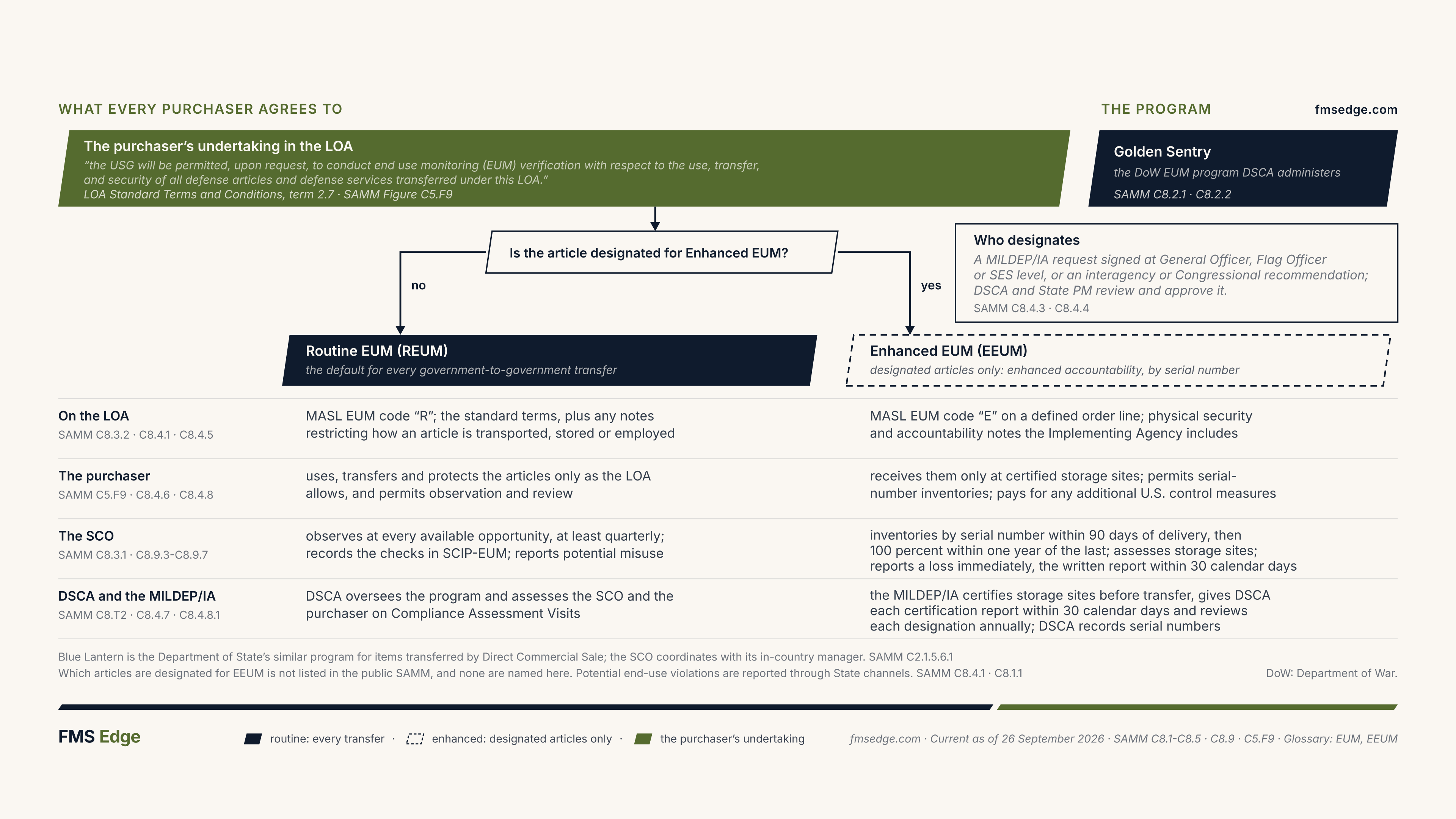
What is the difference between Golden Sentry and Blue Lantern?
The Department of War (DoW) implements the requirements of the with an end-use monitoring () program known as “Golden Sentry.” The Director of the administers Golden Sentry under authority delegated by the Secretary of War and the Under Secretary of War for Policy [SAMM ] []. provides policy guidance for the program in Chapter 8 of the [SAMM ].
Responsibility for in-country activities in support of Golden Sentry, the DoW program, is normally assigned to the . manages a similar program, Blue Lantern, for items transferred through direct commercial sales. work with partner nation counterparts to ensure that requirements are complied with, and coordinate their activities with the in-country Blue Lantern program manager in the embassy. should be ready for an in-country Compliance Assessment Visit, led by , every 18 to 24 months. Table C8.T2 gives a comprehensive list of responsibilities [SAMM ].
Golden Sentry is 's comprehensive program for and other government-to-government transfers. It brings together policies, procedures, tools and a worldwide network of professionals who work with partners to keep U.S.-provided items accounted for throughout their life cycle. Golden Sentry builds transparency and partner trust, and it helps to protect the national security interests of the United States [SAMM ].
The program's objective is to ensure compliance with technology control requirements, so as to minimize security risks to the United States, its partners and Allies. covers every action, from title transfer until disposal, that mitigates the misuse or unauthorized transfer of defense articles [SAMM ].
The type of generally determines the level of monitoring it requires. The Director of may also determine that the physical security and accountability monitoring of an article may need to change. The Director does so after weighing the specific and an assessment of the security threat in the area, or for other compelling reasons. That determination follows consultation at General Officer, Flag Officer or Senior Executive Service level [SAMM ].
When changing events or other unusual circumstances raise concern about how U.S.-provided defense articles are used and secured, should contact 's Division (/GEX/) for further guidance. An request to modify physical security and accountability monitoring must be submitted formally in writing, and endorsed by the geographic , before it is forwarded to [SAMM ].
The Blue Lantern Program fulfills requirements stipulated in Section 40A of the concerning the transfer of defense articles and technologies via commercial channels []. More specifically, the program monitors the end use of defense articles, , services, and brokering activities concerning such exports through commercial channels and subject to Department of State licenses or other approvals under Section 38 of the and the International Traffic in Arms Regulations () (22 CFR Parts 120-130), which implement Section 38 of the [].
Blue Lantern’s mission is to help ensure the security and integrity of U.S. defense trade. Blue Lantern prevents the diversion and unauthorized use of U.S. defense articles, combats gray arms trafficking, uncovers violations of the , and builds confidence and cooperation among defense trade partners.
Blue Lantern end-use monitoring includes pre-license, post-license, and post-shipment checks to verify the bona fides of foreign consignees and end-users, confirm the legitimacy of proposed transactions, and provide reasonable assurance that the following is true:
- The recipient is complying with the requirements imposed by the United States Government with respect to the use, transfer, and security of defense articles and defense services.
- Such articles and services are being used for the purposes for which provided.
The conducts Blue Lantern end-use checks on commercially exported defense articles when the U.S. directs, or on a case-by-case basis [SAMM ].
The includes the costs of performing Blue Lantern checks in its annual Foreign Military Financing () Administrative budget submission [SAMM ].
References
SAMM
- SAMM C8.2.1: End Use Monitoring Legislative Requirement.
- SAMM C8.T2: Department of War End Use Monitoring Responsibilities
- SAMM C2.1.5.6.1: Golden Sentry.
- SAMM C8.2.2: Department of War Golden Sentry Program.
Public authorities
- AECA §40A: Arms Export Control Act of 1976, as amended, §40A (22 U.S.C. §2785)
- SecWar memo, 7 Nov 2025: Secretary of War memorandum, 7 November 2025, "Unifying the Department's Arms Transfer and Security Cooperation Enterprise to Improve Efficiency and Enable Burden-Sharing"
- DoW release, 10 Feb 2026: Department of War release, 10 February 2026, "Department of War Finalizes Realignment of the Defense Security Cooperation Agency and the Defense Technology Security Administration"
- AECA §38: Arms Export Control Act of 1976, as amended, §38 (22 U.S.C. §2778)
Facts referenced
- Shorter end of the interval at which a Security Cooperation Organization should be prepared for a DSCA-led in-country Compliance Assessment Visit (CAV): 18 months (as of 26 October 2026; SAMM C2.1.5.6.1)
- Longer end of the interval at which a Security Cooperation Organization should be prepared for a DSCA-led in-country Compliance Assessment Visit (CAV): 24 months (as of 26 October 2026; SAMM C2.1.5.6.1)
Related
Defense Security Cooperation Agency (DSCA)
The Department of War agency that directs, administers and provides guidance to the Department's components and its representatives at U.S. missions for the execution of the security cooperation programs for which it is responsible [SAMM C1.3.2.2]. The agency also provides financial and technical assistance, arranges the transfer of defense materiel, training and services to international partners, and promotes military-to-military contacts.
FMS Edge glossary, as of 10 October 2026
Glossary entry →Open the manual’s entry → (opens in new tab)
Foreign Military Sales (FMS)
The part of U.S. security assistance, authorized by the Arms Export Control Act (AECA), in which eligible foreign governments and international organizations buy defense articles, services and training from the U.S. Government under formal government-to-government agreements.
The articles come either from Department of War stocks or from new procurement under contracts the Department manages [22 U.S.C. 2761, 22 U.S.C. 2762]. A sale is FMS whatever the source of the purchaser's financing.
FMS Edge glossary, as of 10 October 2026
Glossary entry →Open the manual’s entry → (opens in new tab)
Arms Export Control Act (AECA)
The basic U.S. law providing the authority and general rules for the conduct of Foreign Military Sales and commercial sales of defense articles, defense services, and training. The Arms Export Control Act (AECA) came into existence with the passage of the Foreign Military Sales Act (FMSA) of 1968. An amendment in the International Security Assistance and AECA of 1976 changed the name of FMSA to the AECA.
SAMM Glossary, as of 12 September 2026
Glossary entry →Open the manual’s entry → (opens in new tab)
EUM: End Use Monitoring
SAMM Acronyms, as of 12 September 2026
DSCA: Defense Security Cooperation Agency
SAMM Acronyms, as of 12 September 2026
Glossary entry →Defense Security Cooperation Agency (DSCA) →
Security Assistance Management Manual (SAMM)
DSCA Manual 5105.38-M required under DoD Directive 5105.65, "Defense Security Cooperation Agency" mandatory for use by all DoD Components. The SAMM provides DoD-wide guidance to the Office of the Secretary of Defense (OSD), the Military Departments (MILDEPs), the Office of the Chairman of the Joint Chiefs of Staff and the Joint Staff, the Combatant Commands, the Defense Agencies, the DoD Field Activities, the Security Cooperation Organizations (SCOs), and all other organizational entities within the DoD engaged in the management or implementation of DoD Security Assistance and Security Cooperation programs over which DSCA has responsibility.
SAMM Glossary, as of 12 September 2026
Glossary entry →Open the manual’s entry → (opens in new tab)
Technology Security
The comprehensive framework of policies, practices, and procedures designed to protect U.S. military and dual-use technologies from unauthorized access, transfer, or exploitation by adversaries.
SAMM Glossary, as of 26 October 2026
Security Cooperation Organization (SCO)
A Department of Defense element that is part of the United States Diplomatic mission located in a foreign country to carry out security assistance and security cooperation management functions under the supervision and coordination authority of the senior defense official/defense attaché.
SAMM Glossary, as of 12 September 2026
Glossary entry →Open the manual’s entry → (opens in new tab)
SCO: Security Cooperation Organization
SAMM Acronyms, as of 12 September 2026
Defense Article (Foreign Assistance Act; Arms Export Control Act, not including commercial sales subject to the International Traffic in Arms Regulation)
Any weapon, weapon system, munition, aircraft, vessel or other implement of war, together with the property, equipment, tooling, components and parts used to furnish military assistance or sales or to make, maintain or use such items; the International Traffic in Arms Regulations (ITAR) define the term separately for commercial exports.
Section 47 of the Arms Export Control Act (AECA) defines the term, and the U.S. Munitions List designates the specific items that fall within it [SAMM C4.4] [22 U.S.C. 2794].
FMS Edge glossary, as of 10 October 2026
Glossary entry →Open the manual’s entry → (opens in new tab)
End Use Monitoring (EUM)
Mandated by Section 40A of the Arms Export Control Act (AECA) (22 U.S.C. 2785), activities undertaken by the U.S. Government to ensure that defense articles and defense services transferred to foreign partners under security assistance/cooperation authorities are monitored and used according to the terms and conditions specified in Letters of Offer and Acceptance and other transfer agreements, and as required by the AECA or the Foreign Assistance Act of 1961.
SAMM Glossary, as of 12 September 2026
Glossary entry →Open the manual’s entry → (opens in new tab)
Combatant Command (CCMD)
A unified or specified command with a broad continuing mission under a single commander established and so designated by the President, through the Secretary of Defense and with the advice and assistance of the Chairman of the Joint Chiefs of Staff. Also called CCMD.
SAMM Glossary, as of 12 September 2026
Glossary entry →Open the manual’s entry → (opens in new tab)
AECA: Arms Export Control Act
SAMM Acronyms, as of 12 September 2026
Technical Data
Recorded information of a scientific or technical nature, regardless of form or characteristic. Examples of technical data packages include research and engineering drawings and associated lists, specifications, standards, process sheets, manuals, technical reports, catalog item identifications, and related information and computer software documentation.
SAMM Glossary, as of 12 September 2026
Glossary entry →Open the manual’s entry → (opens in new tab)
ITAR: International Traffic in Arms Regulations
SAMM Acronyms, as of 12 September 2026
Glossary entry →International Traffic in Arms Regulation (ITAR) →
Chief of Mission (COM)
The principal officer in charge of a diplomatic facility of the United States, including any individual temporarily assigned to be in charge of such a facility.
SAMM Glossary, as of 12 September 2026
Glossary entry →Open the manual’s entry → (opens in new tab)
SAMM C8.2.1: End Use Monitoring Legislative Requirement.
“Arms Export Control Act (AECA), Section 40A (22 U.S.C 2785) requires the President to establish an End Use Monitoring (EUM) program to improve accountability with respect to defense articles sold, leased, or exported under the AECA or Foreign Assistance Act (FAA). The Director of DSCA has the delegated authority from the Secretary of War (SECWAR) and Under Secretary of War …”
Security Assistance Management Manual, as of 11 September 2026
Arms Export Control Act of 1976, as amended, §40A (22 U.S.C. §2785)
AECA §40A · Statute
SAMM C8.T2: Department of War End Use Monitoring Responsibilities
“Table C8.T2. Department of War End Use Monitoring Responsibilities Organization Responsibility DSCA (IOPS/GEX/EUM) Manage and provide oversight to the DoW's Golden Sentry EUM program and provide subject matter expertise for all EUM-related issues. Develop and promulgate EUM policy guidance within DoW and the interagency. Draft and submit an annual report to Congress through the Department of State (State) describing the …”
Security Assistance Management Manual, as of 26 October 2026
SAMM C2.1.5.6.1: Golden Sentry.
“The MILGP is normally assigned responsibility for in-country activities in support of the DoW EUM program, called Golden Sentry. State manages a similar program, called Blue Lantern, for items transferred through the DCS process. MILGPs work with partner nation counterparts to ensure compliance with EUM requirements and coordinates activities with the in-country Blue Lantern program manager within the Embassy. MILGPs …”
Security Assistance Management Manual, as of 26 October 2026
SAMM C8.2.2: Department of War Golden Sentry Program.
“Golden Sentry is DSCA’s comprehensive EUM program for FMS and other government-to government transfers. It includes policies, procedures, tools, and a global network of EUM professionals who work with our partners to maintain accountability of U.S.-provided items throughout their life cycle. Golden Sentry promotes transparency, strengthens partner trust, and helps protect U.S. national security interests. Golden Sentry’s objective is to …”
Security Assistance Management Manual, as of 26 October 2026
Arms Export Control Act of 1976, as amended, §38 (22 U.S.C. §2778)
AECA §38 · Statute