
Guide
How is classified materiel shipped in a Foreign Military Sale?
Classified materiel moves through official government-to-government channels, or by another method the two governments' Designated Security Authorities agree in writing. Before it ships, the and the purchaser agree on a that names who safeguards it at every point, and custody passes only when the purchaser's accepts it.
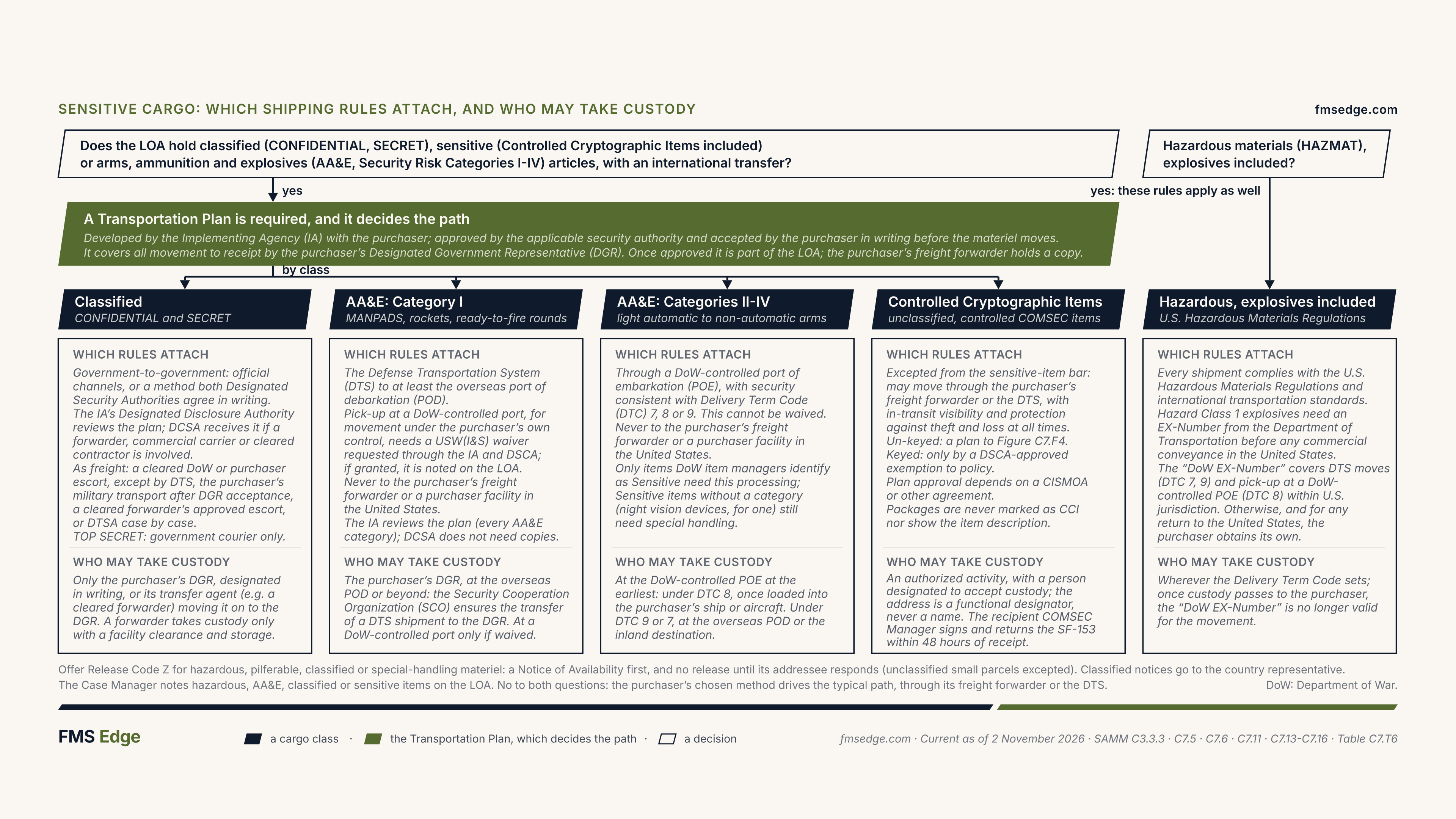
For ordinary cargo the purchaser's chosen method drives the typical path. Classified, sensitive or arms, ammunition and explosives (AA&E) cargo moving internationally needs a Transportation Plan, approved and accepted in writing before anything moves, and the plan decides the path.
How is classified materiel shipped in a Foreign Military Sale?
Classified shipments of materiel may be made via the , which provides the required security; when using the , the U.S. Government () generally maintains control and custody of the materiel until delivery to the purchaser [SAMM , , ]. Under Manual 5200.01, Volume 3, Program: Protection of Classified Information, classified materiel or data is moved under security safeguards appropriate to the transportation mode employed.
Case Managers are required to note in the any items that are classified or [SAMM ]. Classified and is also identifiable through the Controlled Inventory Item Code () listed in the catalog data for that item.
Commercial transportation may be used for the movement of classified or protected materiel provided the , which the approves before delivery, describes the transfer arrangements and the nationality of the freight forwarders and carriers to be used [SAMM ].
Classified materiel is transferred government to government, through official government channels between authorized representatives of each government, or by other methods agreed in writing by the Designated Security Authorities of the sending and receiving governments [SAMM , ].
Some freight forwarders are cleared to receive classified shipments. A that is expected to handle classified materiel must maintain the appropriate security clearances and facility authorizations with the Defense Counterintelligence and Security Agency (). Only a forwarder with a valid facility clearance and approved storage at the appropriate level may take custody of classified materiel for delivery as freight [SAMM ]. A foreign government, embassy or country representative requests a security clearance through the facility clearance branch, and grants the clearance after inspecting the facility; a copy of the clearance approval letter goes to the Defense Logistics Agency () Logistics Management Standards Office.
The Logistics Management Standards Office will update the to identify that the is cleared to handle classified freight.
The manual names the Director, Defense Administration, International Engagement Directorate ( (IED)) as the Designated Security Authority on the U.S. side. Classified consignments shipped internationally as freight must travel with a Department of War (DoW) or purchasing-government escort who holds a personnel security clearance at the level of the materiel [SAMM ]. The escort policy has these exceptions [SAMM ]:
- Shipments by the
- Shipments by the purchasing government's own military transportation, once its has accepted the materiel
- Shipments by cleared freight forwarders that provide an escort with the required clearance approved by
- Shipments the Director, (IED) approves case by case
The release of a shipment to a does not constitute transfer of custody and security responsibility to the recipient foreign government; this occurs only when the receiving government’s assumes custody of the consignment. The acts only as a transfer agent [SAMM ].
Classified materiel may be released only to a person the purchasing government has designated in writing as its or as its transfer agent, such as a cleared [SAMM ].
At the start of negotiations, or during the pre-Letter of Request phase, the will consult DoW transportation authorities. The aim is to determine whether a secure shipment is feasible from the point of origin in the to the final foreign destination. The 's security staff will also be consulted, to help make sure the security side of the transportation meets the prescribed standards [SAMM ].
DoW security regulations require a that covers the movement of classified materiel from its point of origin to its final destination [SAMM ]. The that prepares the for this materiel will therefore make sure the plan addresses every security procedure to be followed while the materiel is in the [SAMM ].
A is required for every that covers classified defense articles and involves an international transfer. The that prepares the develops the plan in coordination with the purchaser [SAMM , ]. Figure C7.F1 lists twelve provisions that the will include as a minimum. Among them are the individual responsible for safeguarding the classified materiel, the methods of transport, the locations of transfer and delivery, the location of storage or processing facilities, and the security clearances of all personnel and facilities involved in the transfer [SAMM ].
Before any classified materiel moves, the must be finalized, approved by the applicable security authority and accepted in writing by the purchaser [SAMM ]. For a plan that includes classified materiel, the ensures that its component Designated Disclosure Authority () reviews and approves or disapproves it [SAMM ]. Once approved, the becomes an integral part of the . It must also be made available to U.S. Customs and Border Protection and other security officials when classified materiel is exported [SAMM ].
If an or commercial carrier takes part in moving classified materiel, or a classified consignment leaves a cleared contractor facility, the appropriate Field Activity must be given a copy of the . Only cleared carriers that the United States Army Transportation Command or the Protective Security Service has qualified will be used for international shipments. An international transfer of classified materiel should be made only by a ship, aircraft or other carrier of one of three kinds: a carrier the wholly owns or charters, or one under U.S. registry; a carrier the recipient government owns or charters, or one under its registry; or any other carrier that the foreign government's security authorities and the Director, (IED), have expressly authorized in writing for the purpose [SAMM ].
The transfer of custody on the sample Transportation Plan for a classified and sensitive shipment. Bandaria is the manual's fictional training country; the figure is a training example, not a real case. Custody passes when the purchaser's Designated Government Representative signs.
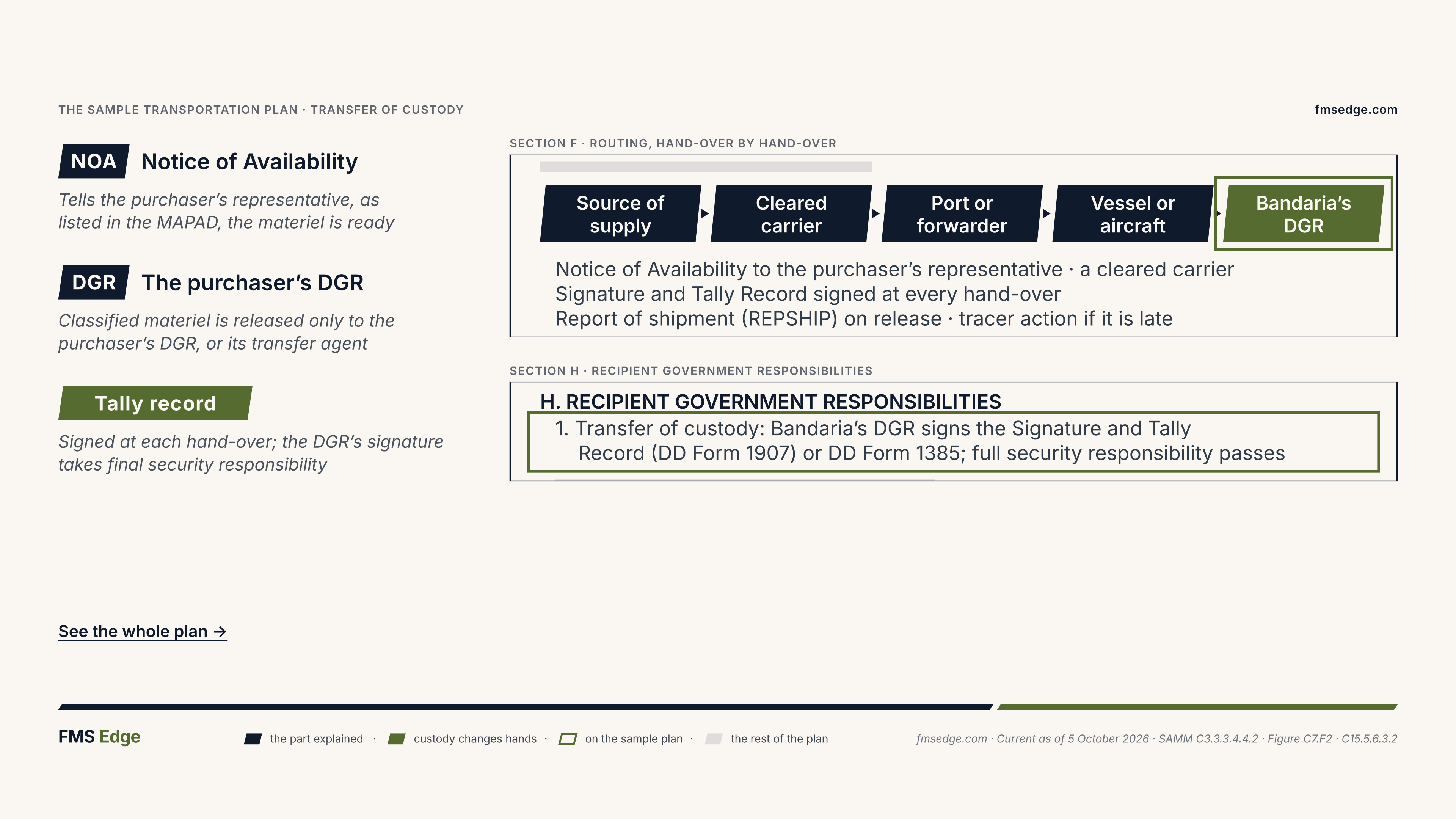
Before the materiel moves, the is to go to the applicable security authority for approval, and the purchaser is to accept it in writing. Where (R&R) items are involved, the plan must cover every aspect of their return, including the functions the sending and receiving entities perform and the notification requirements [SAMM ]. A is a living document that must be updated continually [SAMM ].
Movement of sensitive Arms, Ammunition and Explosives () for customers requires a , which the develops in coordination with the customer. The will be coordinated following the same procedure as for classified shipments [SAMM , , ].
Classified, sensitive and hazardous shipments require the shipper to notify the customer representative or of the intent to ship the materiel. This notification is known as a . The may be submitted on a DD Form 1348-5, [SAMM ]. For classified materiel, the shipping activity sends the to the country representative listed in the , not to a [SAMM ]. For classified shipments, the or the identifies the transfer agent, the carrier and the recipient government’s [SAMM ]. Under Offer Release Code Z, the shipper is not permitted to ship the materiel until the response has been received [SAMM ]. Storage or staging charges may accrue when an response, or a failure to respond, requires the materiel to be held for more than 30 calendar days, and any storage costs are charged to the case [SAMM ].
The can also be sent by commercial fax, e-mail, letter or another traceable document, and the shipper mails it or sends it electronically. It tells the or country representative that a shipment is ready for movement, that steps are to be taken to protect the materiel, and, for classified items, that the transfer is made government to government. The or country representative responds to the to confirm readiness to receive the materiel, and the response gives the shipper the packaging and documentation instructions for the appropriate mode of shipment.
For a classified shipment, the country representative who receives the is the one listed in the Special Instructions of the appropriate address [SAMM ].
Try the tool: Delivery Term Code picker
References
SAMM
- SAMM C7.6.2.7: Shipments by the U.S. Government to a Freight Forwarder or Embassy (DTC 5).
- SAMM C7.6.3.3: Annotation of Transportation Documents When Department of War Retains Custody.
- SAMM C7.15: Transportation of Arms, Ammunition and Explosives and Sensitive Materiel.
- SAMM C3.3.3.4.4.1: Transportation Plan for Purchaser-Sponsored Shipments.
- SAMM C7.14.1: Transfer of Classified Information or Materiel.
- SAMM C7.5.3.3
- SAMM C3.3.3.4.4.2: Foreign Government Representative.
- SAMM C7.13.1: General.
- SAMM C7.F1: Transportation Plan Requirements
- SAMM C7.13.3: Transportation Plan Review.
- SAMM C7.13.4: Transportation Plan Usage.
- SAMM C7.13.3.1: Classified Requirements.
- SAMM C7.11.1: Notice of Availability.
- SAMM C7.T6: Offer Release Codes
- SAMM C7.14.1.1
- SAMM C7.14.1.2
- SAMM C7.13.2: Transportation Plan Preparation.
- SAMM C7.11.1.2: Classified Shipments.
Facts referenced
- Calendar days an item may be held on a Notice of Availability response (or failure to respond) before storage or staging charges may accrue to the FMS case: 30 calendar days (as of 26 October 2026; SAMM C7.11.1)
Related
Foreign Military Sales (FMS)
The part of U.S. security assistance, authorized by the Arms Export Control Act (AECA), in which eligible foreign governments and international organizations buy defense articles, services and training from the U.S. Government under formal government-to-government agreements.
The articles come either from Department of War stocks or from new procurement under contracts the Department manages [22 U.S.C. 2761, 22 U.S.C. 2762]. A sale is FMS whatever the source of the purchaser's financing.
FMS Edge glossary, as of 10 October 2026
Glossary entry →Open the manual’s entry → (opens in new tab)
Implementing Agency (IA)
The military department or defense agency responsible for the execution of military assistance programs. With respect to FMS, the military department or defense agency assigned responsibility by the Defense Security Cooperation Agency to prepare an LOA and to implement an FMS case. The implementing agency is responsible for the overall management of the actions that will result in delivery of the materials or services set forth in the LOA that was accepted by a foreign country or international organization.
SAMM Glossary, as of 12 September 2026
Glossary entry →Open the manual’s entry → (opens in new tab)
Transportation Plan
A document that details the transportation and security arrangements for moving classified or sensitive material, and identifies individuals responsible for providing security at various points during transportation.
SAMM Glossary, as of 12 September 2026
Glossary entry →Open the manual’s entry → (opens in new tab)
Designated Government Representative (DGR)
A person or persons duly authorized by a foreign government to act on behalf of that government to negotiate, commit, sign contractual agreements, and/or accept delivery of materiel.
SAMM Glossary, as of 12 September 2026
Glossary entry →Open the manual’s entry → (opens in new tab)
Defense Transportation System (DTS)
The part of the worldwide transportation infrastructure that supports Department of War transportation needs in peace and war, made up of military (organic) and commercial resources that are organic to the Department, under contract to it or controlled by it [SAMM C7.6.1].
It takes in organic and commercial aircraft and ships, commercial small-package services under Department contract, and U.S. military air and ocean terminals in and outside the United States.
FMS Edge glossary, as of 10 October 2026
Glossary entry →Open the manual’s entry → (opens in new tab)
DTS: Defense Transportation System
SAMM Acronyms, as of 12 September 2026
Information Security (INFOSEC)
The protection of information systems against unauthorized access to or modification of information, whether in storage, processing, or transit, and against the denial of service to authorized users, including those measures necessary to detect, document and counter such threat. INFOSEC is applied through the application of Cybersecurity and Communications Security (COMSEC).
SAMM Glossary, as of 12 September 2026
Glossary entry →Open the manual’s entry → (opens in new tab)
Letter of Offer and Acceptance (LOA)
The legal instrument that lists the defense articles and services, including training, that the U.S. Government transfers to a foreign country or international organization, with their estimated costs and the terms and conditions. The benefitting partner does not sign a Building Partner Capacity (BPC) LOA.
The Letter of Offer and Acceptance (LOA) is the instrument the U.S. Government uses to sell under the Arms Export Control Act (AECA); signed LOAs and their later Amendments and Modifications are also called Foreign Military Sales (FMS) cases [SAMM C5.6.1].
FMS Edge glossary, as of 10 October 2026
Glossary entry →Open the manual’s entry → (opens in new tab)
Sensitive Materiel
Volatile and dangerous explosives which require special handling and transportation arrangements. The term sensitive also applies to highly desirable selected technologies which are not explosive, but which require special security procedures for transportation.
SAMM Glossary, as of 12 September 2026
Glossary entry →Open the manual’s entry → (opens in new tab)
CIIC: Controlled Inventory Item Code
Freight Forwarder
A commercial import/export company registered with the Department of State, Bureau of Political-Military Affairs, Directorate of Defense Trade Controls and under contract to the Foreign Military Sales customer which arranges transportation of materiel from a point specified in the Letter of Offer and Acceptance to the final destination.
SAMM Glossary, as of 12 September 2026
Glossary entry →Open the manual’s entry → (opens in new tab)
Defense Logistics Agency
The Department of War agency that is the item manager for consumable, stock-funded secondary items. Its supply centers work with the military departments to fill Foreign Military Sales (FMS) requisitions, process supply discrepancy reports and repair and return items, and close cases when supply is complete, and it prepares FMS cases for cataloging services and excess defense articles [SAMM C1.3.2.6.2.3.2].
FMS Edge glossary, as of 10 October 2026
Military Assistance Program Address Directory (MAPAD)
The directory of clear-text addresses of country representatives, freight forwarders and in-country customers used to release Foreign Military Sales (FMS) and grant aid shipments processed under Military Standard Requisitioning and Issue Procedures (MILSTRIP), and to send their shipping documents.
The Military Assistance Program Address Directory (MAPAD) is available to Department of War activities, the General Services Administration (GSA), commercial firms, foreign governments and international organizations taking part in FMS or grant aid programs [SAMM C7.7.1].
FMS Edge glossary, as of 10 October 2026
Glossary entry →Open the manual’s entry → (opens in new tab)
Technology Security
The comprehensive framework of policies, practices, and procedures designed to protect U.S. military and dual-use technologies from unauthorized access, transfer, or exploitation by adversaries.
SAMM Glossary, as of 26 October 2026
DTSA: Defense Technology Security Administration
SAMM Acronyms, as of 12 September 2026
DGR: Designated Government Representative
SAMM Acronyms, as of 12 September 2026
Glossary entry →Designated Government Representative (DGR) →
Continental United States (CONUS)
U.S. territory, including the adjacent territorial waters, located within the North American continent between Canada and Mexico. Does not include Hawaii or Alaska.
SAMM Glossary, as of 12 September 2026
Glossary entry →Open the manual’s entry → (opens in new tab)
LOA: Letter of Offer and Acceptance
SAMM Acronyms, as of 12 September 2026
FMS: Foreign Military Sale
SAMM Acronyms, as of 12 September 2026
Repair and Return
A service where eligible foreign countries return unserviceable repairable items for entry into the U.S. Military Department repair cycle. Upon completion of repairs, the same item is returned to the country and the actual cost of the repair is billed to the country.
SAMM Glossary, as of 12 September 2026
Glossary entry →Open the manual’s entry → (opens in new tab)
Notice of Availability (NOA)
Notice, on DD Form 1348-5, from a shipping activity to a Foreign Military Sales (FMS) purchaser or its freight forwarder that materiel is ready for shipment, in time for the recipient to prepare for receipt and respond with delivery instructions.
The Notice of Availability (NOA) goes to the appropriate address in the Military Assistance Program Address Directory (MAPAD) and coordinates the release of materiel requiring special receipt, export processing or special storage procedures [SAMM C7.11.1].
FMS Edge glossary, as of 10 October 2026
Glossary entry →Open the manual’s entry → (opens in new tab)
NOA: Notice of Availability
SAMM Acronyms, as of 12 September 2026
MAPAD: Military Assistance Program Address Directory
SAMM Acronyms, as of 12 September 2026
Glossary entry →Military Assistance Program Address Directory (MAPAD) →
SAMM C7.14.1.2
“The transfer of classified materiel occurs through official government channels between authorized representatives of each government or pursuant to other methods agreed to in writing by the Designated Security Authorities of the sending and receiving government (Director, Defense Technology Security Administration, International Engagement Directorate (DTSA (IED)). Classified consignments shipped as freight must be accompanied by a DoW or purchasing government …”
Security Assistance Management Manual, as of 26 October 2026
SAMM C7.6.2.7: Shipments by the U.S. Government to a Freight Forwarder or Embassy (DTC 5).
“USG Shipments to U.S.-located Foreign Military Sales (FMS) freight forwarders or country representatives located at embassies in the United States are DTS shipments until the consignee unloads the materiel from the carrier.”
Security Assistance Management Manual, as of 11 September 2026
SAMM C7.6.3.3: Annotation of Transportation Documents When Department of War Retains Custody.
“When DoW retains custody and transportation responsibility of FMS shipments its arrival at the Port of Debarkation (POD) in the destination country, the BLs for these DTS shipments are annotated with statements to comply with U.S. Customs requirements. See Section C7.6.3.3.1. and Section C7.6.3.3.2. The signature of the issuing officer on the BL serves as certification of these statements. Neither …”
Security Assistance Management Manual, as of 26 October 2026
SAMM C7.15: Transportation of Arms, Ammunition and Explosives and Sensitive Materiel.
“Arms, Ammunition, & Explosives (AA&E) and Sensitive materiel include items such as small arms, various types of ammunition, explosives, and special items, such as night vision devices and Controlled Cryptographic Items (CCI), that pose special concern if they fall into the wrong hands. AA&E materiel is broken down into four Security Risk Categories (SRC). Sensitive materiel, to include CCI, may …”
Security Assistance Management Manual, as of 26 October 2026
SAMM C3.3.3.4.4.1: Transportation Plan for Purchaser-Sponsored Shipments.
“The LOA must contain the requirement for, and describe the specific responsibilities for preparing, the Transportation Plan. The Transportation Plan must provide a specific description of the transfer arrangements and nationality of freight forwarders and carriers to be used, all of which shall be consistent with DoD Manual (DoDM) 5200.01 Vol. 1, Directive-Type Memorandum (DTM)-04-009, DTM-04-010, and 32 CFR 117. …”
Security Assistance Management Manual, as of 5 October 2026
SAMM C7.14.1: Transfer of Classified Information or Materiel.
“Classified information or materiel approved for release to a foreign government or international organization will be executed as a government-to-government transfer.”
Security Assistance Management Manual, as of 11 September 2026
SAMM C7.5.3.3
“If the FMS freight forwarder is expected to handle classified materials, it must maintain appropriate security clearances and facility authorizations with the Defense Counterintelligence and Security Agency (DCSA). Only FMS freight forwarders that have a valid facility clearance and approved storage capabilities at the appropriate level are eligible to take custody of classified material for delivery as freight. FMS freight …”
Security Assistance Management Manual, as of 11 September 2026
SAMM C3.3.3.4.4.2: Foreign Government Representative.
“Classified materiel may be released only to a person who has been designated by the purchasing government in writing as its Designated Government Representative (DGR) or as its transfer agent (e.g., a cleared freight forwarder) that is used for onward movement to the point where custody of the shipment is assumed by the government’s DGR. The Military Assistance Program Address …”
Security Assistance Management Manual, as of 5 October 2026
SAMM C7.14.1.1
“At the outset of negotiations or during the pre-Letter of Request (LOR) phase, the Implementing Agency (IA) will consult with DoW Transportation authorities to determine whether secure shipment from the Continental United States (CONUS) point of origin to the ultimate foreign destination is feasible. The IA security staff also will be consulted to assist in assuring that the security aspects …”
Security Assistance Management Manual, as of 26 October 2026
SAMM C7.13.1: General.
“A Transportation Plan is required for each Letter of Offer and Acceptance (LOA) containing defense articles that are Classified (CONFIDENTIAL and SECRET), Sensitive (including Controlled Cryptographic Items (CCI), or Arms, Ammunition, & Explosives (AA&E) (Security Risk Categories (SRC) I - IV) and in which an international transfer occurs. The plan covers all movement including receipt at final destination by the …”
Security Assistance Management Manual, as of 11 September 2026
SAMM C7.13.2: Transportation Plan Preparation.
“The Transportation Plan is developed by the Implementing Agency (IA) that prepares the LOA in coordination with the Foreign Military Sales (FMS) purchaser. It is to be submitted to, and approved by, the applicable security authority and accepted by the FMS purchaser, in writing, prior to the movement of the materiel. If Repair and Return (R&R) items are involved, the …”
Security Assistance Management Manual, as of 11 September 2026
SAMM C7.F1: Transportation Plan Requirements
“… As a minimum, the Transportation Plan will include the following provisions: A description of the materiel together with a brief narrative as to where and under what circumstances transfer of custody occurs; Identification, by name or title, of the Designated Government Representative (DGR) of the foreign recipient government or international organization who will receive and assume responsibility for the materiel …”
Security Assistance Management Manual, as of 5 November 2026
SAMM C7.13.3: Transportation Plan Review.
“Regardless of custody transfers location, the IA ensures its component Designated Disclosure Authority (DDA) reviews and approves/disapproves the Transportation Plan if it includes classified materiel. An information copy of the Transportation Plan should be provided to DSCA (Office of International Operations (IOPS)).”
Security Assistance Management Manual, as of 11 September 2026
SAMM C7.13.4: Transportation Plan Usage.
“Once approved, a Transportation Plan becomes an integral part of the LOA and is available for review by U.S. Customs and security officials when exported. A Transportation Plan must be updated regularly. FMS purchasers are responsible for ensuring that their FMS freight forwarders have copies when involved with exports. When possible, the details of the Transportation Plan should be included …”
Security Assistance Management Manual, as of 5 November 2026
SAMM C7.13.3.1: Classified Requirements.
“If an FMS freight forwarder or commercial carrier is involved in the transfer of classified materiel, or if classified consignments emanate from a cleared contractor facility, the Transportation Plan must be provided to the appropriate DCSA Field Activity. The Defense Counterintelligence and Security Agency (DCSA) verifies the security clearance of FMS freight forwarders, as well as any industry appointed courier …”
Security Assistance Management Manual, as of 26 October 2026
SAMM C7.11.1: Notice of Availability.
“A Defense Department (DD) Form 1348-5 “Notice of Availability (NOA)” is sent by Shipping Activities to the appropriate Military Assistance Program Address Directory (MAPAD) address to notify a purchaser or Foreign Military Sales (FMS) freight forwarder that an item is ready for shipment. The purpose of the NOA is to coordinate release of materiel requiring special receipt, export processing, or …”
Security Assistance Management Manual, as of 26 October 2026
SAMM C7.11.1.2: Classified Shipments.
“Shipping activities send NOAs for classified shipments to the country representative listed in the Special Instructions of the appropriate MAPAD address and not to a FMS freight forwarder.”
Security Assistance Management Manual, as of 11 September 2026
SAMM C7.T6: Offer Release Codes
“Table C7.T6. Offer Release Codes Code Explanation A Shipments are to be released automatically by the shipping activity without advance notice. Note that this code is not to be used if the materiel is oversize, overweight, hazardous, perishable, pilferable, classified, or requires any special handling. X Materiel with an ORC X must have a corresponding X in MILSTRIP record position …”
Security Assistance Management Manual, as of 11 September 2026