
Guide
How does repair and return work in Foreign Military Sales?
A purchaser can have unserviceable repairable items fixed in the U.S. repair system instead of building its own depot. Under it gets its own item back and pays the cost of the repair. Under direct exchange it receives a serviceable item from U.S. stocks for an eligible , and under a Supply Support Arrangement customer is charged the estimated repair cost, adjusted to the actual cost.
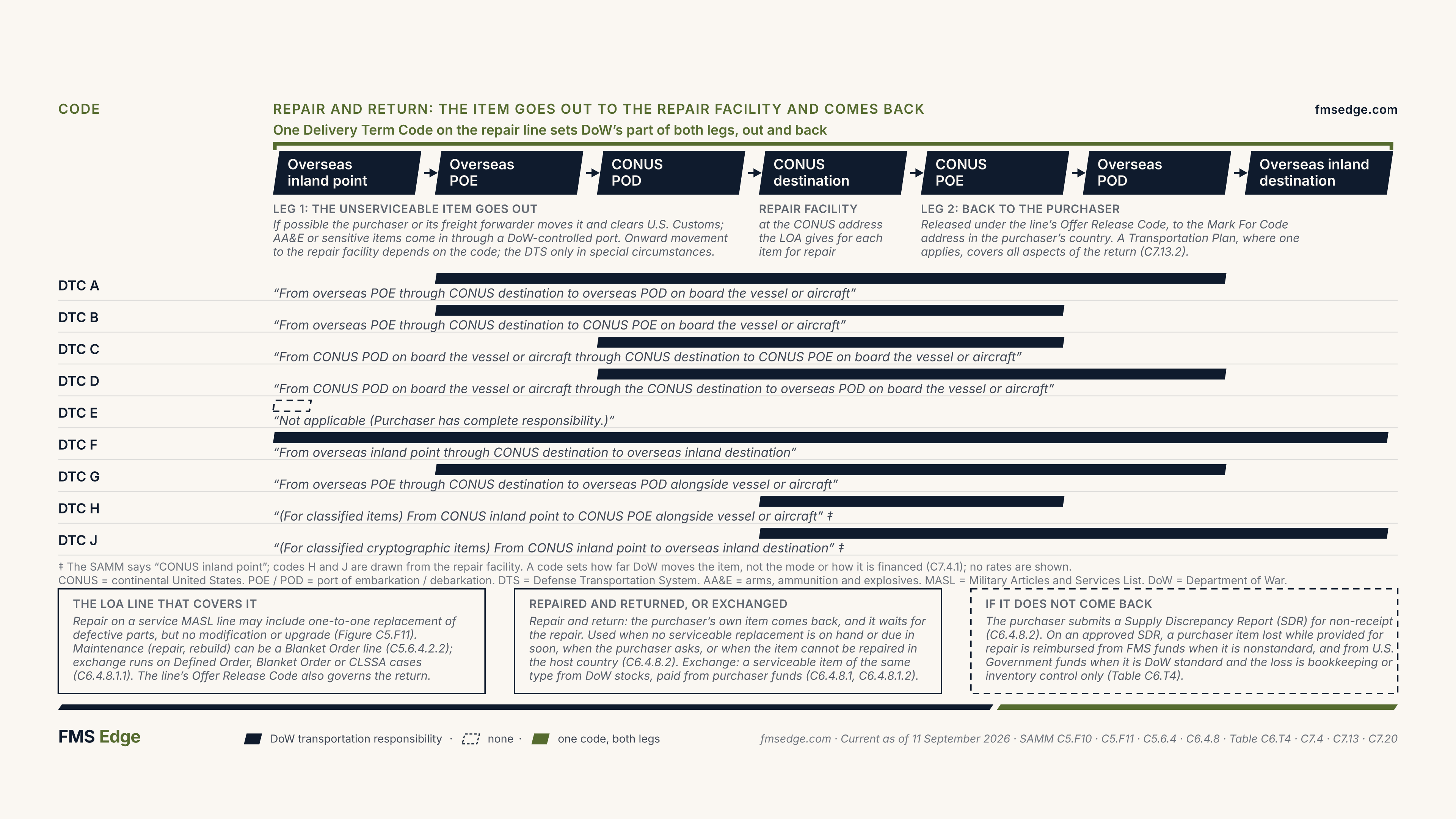
Repair and return, drawn unfolded as the trip out to the repair facility in the United States and the trip back. The repair line's Delivery Term Code sets how much of that loop the Department of War carries, from nothing at all (code E) to the whole loop (code F).
How does repair and return work in Foreign Military Sales?
The repairable program provides a country the means of obtaining repair services without the necessity of establishing an in-country capability. When an in-country capability does exist, the repairable program can supplement this capability when necessary.
The scope of work performed under the repairable program is usually referred to as “depot-level repairs.” Depot-level repair is the repair, overhaul, or rebuild of unserviceable assets that need maintenance beyond the capability (equipment and/or skills) available in field- or organization-level activities. The repairs are accomplished by the service depots or by commercial firms under contract to the depots. The maintenance facility can determine when the item should be returned and estimate the cost of repairs. The coordinates repair services and instructs the international partner to send the item to the appropriate depot repair facility. The is responsible for procuring the needed repair parts, and for getting them to the depot assigned the overhaul/rebuilding task.
The country has certain basic responsibilities under the repairable program. The country needs an case that covers the repair, and the repairable article must be returned under the terms of the [SAMM ].
The country should only return economically repairable items to the U.S. If the repair facility deems an item not economically repairable, it will not be repaired without specific authorization from the country.
If possible, the country should move the item to the United States itself or through its ; onward movement to the repair facility depends on the , and the can be used in special circumstances. Materiel being returned to the U.S. for repair, regardless of the type of repair program, must clear U.S. customs [SAMM ]. To bring unclassified materiel in under the temporary import exemption of the International Traffic in Arms Regulations (), 22 CFR 123.4(a), the purchaser or its agent must annotate the U.S. Customs and Border Protection entry document to cite the exemption [SAMM ]. The exemption lasts up to 4 years and covers items imported for servicing and returned, and items approved for import under an executed [].
Where a applies, it holds the details of the transfer, in accordance with Section C7.13. Arms, Ammunition and Explosives () and sensitive items come back through a Department of War (DoW)-controlled ocean or aerial port, as their Security Risk Category () indicates. Clearance through U.S. Customs and through the purchaser's own customs, and any other documentation needed, are the responsibility of the purchaser and its . They should also make sure that these shipments travel with the appropriate shipping documents, and that the import and export documents are done correctly as the items enter and leave the . Every Hazard Class (HC) 1 article returning to must have a country-specific EX-Number (Section C7.16) [SAMM ].
Repairs under the repairable program take more than one route: , direct exchange, and .
is used when no serviceable replacement is in stock or due in within a reasonable time, when the purchaser requests it for a specific item, or when the item cannot be repaired in the purchaser’s country. Repairing an article the purchaser owns requires that it be returned under the terms and conditions the lists, and the purchaser must wait for the repair [SAMM ]. The case for the repair may be a blanket order or a . Under the concept, the country enters its unserviceable item into the U.S. repair cycle, and, upon completion of repairs, the same item is returned to the country. The U.S. Air Force and U.S. Army call this program “.” The U.S. Navy calls this program “Repair of Repairables” (RoR).
The repair program is normally limited to items for which the has established a depot-level repair program. The international partner requests approval for repair through the from the inventory manager (IM) before shipping materiel to the U.S. for repair. After receiving approval and shipping instructions from the IM, the international partner ships the materiel to the designated repair facility where it is entered into the repair queue. After repairs are completed, the item is shipped back to the international partner.
In the or RoR program, the cost to the country is the actual or estimated cost of the repair, priced in accordance with 7000.14-R, Financial Management Regulation (), Volume 15, Chapter 7 [].
The Army's Commercial Program lets the Army meet its repair commitments to a partner through commercial firms. A partner that chooses the program will incur a Program Support Charge, carried on its case line [SAMM ].
Under direct exchange (), the unserviceable item is returned to the repair activity and, if it can be economically repaired or overhauled, a replacement item is issued from the U.S. military service’s stocks. The country’s unserviceable item is repaired or overhauled and returned to the U.S. military service’s stocks [SAMM ]. The program may be executed under defined line, blanket order, or Supply Support Arrangement () cases [SAMM ].
For a direct exchange, the must have been obtained under the , it must not be an , and DoW must have requirements for it [SAMM ]. The purchaser's funds must be available to pay for the serviceable replacement, and the requisition for the replacement is generally filled under normal supply procedures [SAMM ].
An eligible customer can use to return a repairable carcass to the United States and receive a serviceable item without waiting for the normal repair cycle. The exchange swaps customer-owned stock in the customer's hands for customer-owned stock in the U.S. Government inventory. The customer is first charged the estimated repair cost, which is adjusted to the actual repair cost once the carcass is repaired.
The U.S. Navy’s program is called the replacement option. Under this program, international partners can draw directly from the U.S. Navy stock system (through a ) for specifically identified weapons replaceable assemblies, system replaceable assemblies, and other designated repairable spares that are managed and have been approved by Weapon Systems Support in conjunction with the U.S. Navy’s systems commands. If the requested materiel is available in the U.S. Navy’s stock system, it is shipped immediately upon request. Then, the international partner sends the failed item to a U.S. Navy designated receiving point for further transfer to a depot for repair. Upon completion of repairs to the returned item, it is returned to U.S. Navy stock.
Under the U.S. Air Force () program, international partners can draw directly from sources of supply (through a or ) for items listed on a preauthorized materiel repair requirements list (). International partners send their failed items to a designated receiving depot. Upon receipt at the depot, a replacement requisition is generated.
References
SAMM
- SAMM C6.4.8.2: Repair and Return.
- SAMM C3.3.4.4: Temporary Import of Defense Articles for Repair.
- SAMM C9.18.1: Commercial Repair and Return.
- SAMM C6.4.8.1: Direct Exchange.
- SAMM C6.4.8.1.1
- SAMM C6.4.8.1.2
- SAMM C7.20.1
Public authorities
- 22 CFR 123.4: International Traffic in Arms Regulations, 22 CFR 123.4, Temporary import license exemptions
- DoD FMR Vol 15: DoD Financial Management Regulation 7000.14-R, Volume 15 (Security Cooperation Policy)
Facts referenced
- Maximum period of a temporary import without a license under ITAR Section 123.4(a): 4 years (as of 24 October 2026)
Related
Foreign Military Sales (FMS)
The part of U.S. security assistance, authorized by the Arms Export Control Act (AECA), in which eligible foreign governments and international organizations buy defense articles, services and training from the U.S. Government under formal government-to-government agreements.
The articles come either from Department of War stocks or from new procurement under contracts the Department manages [22 U.S.C. 2761, 22 U.S.C. 2762]. A sale is FMS whatever the source of the purchaser's financing.
FMS Edge glossary, as of 10 October 2026
Glossary entry →Open the manual’s entry → (opens in new tab)
Repair and Return
A service where eligible foreign countries return unserviceable repairable items for entry into the U.S. Military Department repair cycle. Upon completion of repairs, the same item is returned to the country and the actual cost of the repair is billed to the country.
SAMM Glossary, as of 12 September 2026
Glossary entry →Open the manual’s entry → (opens in new tab)
Repairable Item
An item of a durable nature that has been determined by the application of engineering, economic, and other factors to be the type of item feasible for restoration to a serviceable condition through regular repair procedures.
SAMM Glossary, as of 12 September 2026
Glossary entry →Open the manual’s entry → (opens in new tab)
Repair and Replace (FMS)
Programs by which eligible Cooperative Logistics Supply Support Arrangement (CLSSA) customers return repairable carcasses to the United States and receive a serviceable item without awaiting the normal repair cycle time frame. The concept is that the replacement involves an exchange of CLSSA customer-owned stocks in the customer's hands and the CLSSA customer-owned stocks in the U.S. government inventory in the United States. Countries are initially charged the estimated repair cost, with adjustment to the actual repair cost upon completion of repair of the carcass.
SAMM Glossary, as of 12 September 2026
Glossary entry →Open the manual’s entry → (opens in new tab)
Cooperative Logistics
The logistics support provided a foreign government/agency through its participation in a U.S. DoD logistics system, with reimbursement paid to the USG for the support provided.
SAMM Glossary, as of 12 September 2026
Glossary entry →Open the manual’s entry → (opens in new tab)
FMS: Foreign Military Sale
SAMM Acronyms, as of 12 September 2026
International Logistics Control Office (ILCO)
The office in each Military Department that manages the logistics support programs and transactions of Foreign Military Sales (FMS) and other security cooperation programs, and the central point in the continental United States for monitoring purchasers' requisitions.
A purchaser reports a valid supply discrepancy to the International Logistics Control Office (ILCO) of the Military Department concerned [SAMM C2.1.5.4.3].
FMS Edge glossary, as of 10 October 2026
Glossary entry →Open the manual’s entry → (opens in new tab)
Inventory Control Point (ICP)
The organization within a Department of War supply system that manages a group of items for one Military Service or for the whole Department, computing requirements, starting procurement or disposal actions, managing distribution and directing rebuild.
The inventory control point that processes a standard requisition generally issues the assets down to the item's reorder point level [SAMM C6.4.3.1].
FMS Edge glossary, as of 10 October 2026
Glossary entry →Open the manual’s entry → (opens in new tab)
Letter of Offer and Acceptance (LOA)
The legal instrument that lists the defense articles and services, including training, that the U.S. Government transfers to a foreign country or international organization, with their estimated costs and the terms and conditions. The benefitting partner does not sign a Building Partner Capacity (BPC) LOA.
The Letter of Offer and Acceptance (LOA) is the instrument the U.S. Government uses to sell under the Arms Export Control Act (AECA); signed LOAs and their later Amendments and Modifications are also called Foreign Military Sales (FMS) cases [SAMM C5.6.1].
FMS Edge glossary, as of 10 October 2026
Glossary entry →Open the manual’s entry → (opens in new tab)
Freight Forwarder
A commercial import/export company registered with the Department of State, Bureau of Political-Military Affairs, Directorate of Defense Trade Controls and under contract to the Foreign Military Sales customer which arranges transportation of materiel from a point specified in the Letter of Offer and Acceptance to the final destination.
SAMM Glossary, as of 12 September 2026
Glossary entry →Open the manual’s entry → (opens in new tab)
Delivery Term Code (DTC)
A single-character logistics code that shows how far, from the source of supply to the final destination, the Department of War is responsible for transporting a shipment; it does not set the mode of transportation or how the movement is financed [SAMM C7.4.1].
FMS Edge glossary, as of 10 October 2026
Glossary entry →Open the manual’s entry → (opens in new tab)
Defense Transportation System (DTS)
The part of the worldwide transportation infrastructure that supports Department of War transportation needs in peace and war, made up of military (organic) and commercial resources that are organic to the Department, under contract to it or controlled by it [SAMM C7.6.1].
It takes in organic and commercial aircraft and ships, commercial small-package services under Department contract, and U.S. military air and ocean terminals in and outside the United States.
FMS Edge glossary, as of 10 October 2026
Glossary entry →Open the manual’s entry → (opens in new tab)
ITAR: International Traffic in Arms Regulations
SAMM Acronyms, as of 12 September 2026
Glossary entry →International Traffic in Arms Regulation (ITAR) →
LOA: Letter of Offer and Acceptance
SAMM Acronyms, as of 12 September 2026
Transportation Plan
A document that details the transportation and security arrangements for moving classified or sensitive material, and identifies individuals responsible for providing security at various points during transportation.
SAMM Glossary, as of 12 September 2026
Glossary entry →Open the manual’s entry → (opens in new tab)
Continental United States (CONUS)
U.S. territory, including the adjacent territorial waters, located within the North American continent between Canada and Mexico. Does not include Hawaii or Alaska.
SAMM Glossary, as of 12 September 2026
Glossary entry →Open the manual’s entry → (opens in new tab)
CONUS: Continental United States
SAMM Acronyms, as of 12 September 2026
Defined Order Case
A Letter of Offer and Acceptance (LOA) that provides specific defense articles and/or defense services with definitive items, quantities, and/or Months of anticipated materiel delivery or performance of services on the LOA lines.
SAMM Glossary, as of 12 September 2026
Glossary entry →Open the manual’s entry → (opens in new tab)
Military Department (MILDEP)
One of the departments within the DoD created by the National Security Act of 1947, as amended. The Military Departments are: the Department of the Air Force, the Department of the Army, and the Department of the Navy.
SAMM Glossary, as of 12 September 2026
Glossary entry →Open the manual’s entry → (opens in new tab)
ILCO: International Logistics Control Office
SAMM Acronyms, as of 12 September 2026
Glossary entry →International Logistics Control Office (ILCO) →
CLSSA: Cooperative Logistics Supply Support Arrangement
SAMM Acronyms, as of 12 September 2026
Glossary entry →Cooperative Logistics Supply Support Arrangements (CLSSA) →
Arms Export Control Act (AECA)
The basic U.S. law providing the authority and general rules for the conduct of Foreign Military Sales and commercial sales of defense articles, defense services, and training. The Arms Export Control Act (AECA) came into existence with the passage of the Foreign Military Sales Act (FMSA) of 1968. An amendment in the International Security Assistance and AECA of 1976 changed the name of FMSA to the AECA.
SAMM Glossary, as of 12 September 2026
Glossary entry →Open the manual’s entry → (opens in new tab)
End Item
A finished combination of end products, component parts or materials, assembled or completed and ready for its intended use, issue or deployment, such as an aircraft, a truck, a mobile generator or a rifle.
FMS Edge glossary, as of 10 October 2026
Glossary entry →Open the manual’s entry → (opens in new tab)
Blanket Order Case (Foreign Military Sales)
A Foreign Military Sales (FMS) case for a category of defense articles or services, training included, with no definitive list of items or quantities, written against a dollar ceiling.
A Blanket Order case remains in effect until the purchaser has requisitioned articles or services up to the funds available on it [SAMM C5.6.13.4].
FMS Edge glossary, as of 10 October 2026
Glossary entry →Open the manual’s entry → (opens in new tab)
MRRL: Materiel Repair Requirements List
SAMM C6.4.8.2: Repair and Return.
“Repair and Return (R&R) is used when a serviceable replacement is not available from stock on hand or due in within a reasonable time, if the FMS purchaser requests R&R of a specific item, or if the item cannot be repaired in the host country. Repair of a purchaser-owned article requires the repairable article be returned in accordance with the …”
Security Assistance Management Manual, as of 26 October 2026
SAMM C7.20.1
“If possible, items returned to the United States for servicing should be moved by a purchaser or a purchaser’s Foreign Military Sales (FMS) freight forwarder. The details of the transfer are included in a Transportation Plan, if applicable, in accordance with Section C7.13. Arms, Ammunition, & Explosives (AA&E) or Sensitive items are returned through a DoW-controlled ocean or aerial port …”
Security Assistance Management Manual, as of 26 October 2026
SAMM C3.3.4.4: Temporary Import of Defense Articles for Repair.
“Articles temporarily imported into the United States for overhaul, repair, modification, calibration, etc., are subject to the State (PM/DDTC) license approval requirements listed in 22 CFR 123.1 unless the temporary import and subsequent re-export qualifies for an exemption located in 22 CFR 120 to 130, such as in 22 CFR 123.4, 22 CFR 123.19, 22 CFR 126.5 or 22 CFR …”
Security Assistance Management Manual, as of 11 September 2026
International Traffic in Arms Regulations, 22 CFR 123.4, Temporary import license exemptions
22 CFR 123.4 · Regulation
DoD Financial Management Regulation 7000.14-R, Volume 15 (Security Cooperation Policy)
DoD FMR Vol 15 · Regulation
SAMM C9.18.1: Commercial Repair and Return.
“The Commercial Repair and Return (CR&R) Program allows the Army to fulfill repair commitments to the foreign partner via commercial entities. Partner nations who choose to take advantage of the Army's CR&R program will incur a Program Support Charge (PSC). The case line will include Primary Category Code (PCC) 746 and the appropriate Indirect Pricing Components (IPC) for the PSC …”
Security Assistance Management Manual, as of 11 September 2026
SAMM C6.4.8.1: Direct Exchange.
“A repairable item may be exchanged for the same type serviceable item in DoW stocks under certain conditions.”
Security Assistance Management Manual, as of 26 October 2026
SAMM C6.4.8.1.1
“The repairable item must have been obtained under the AECA, must not be an end item, and the DoW must have requirements for the repairable item. Programs may be executed under defined line, blanket order, or CLSSA cases.”
Security Assistance Management Manual, as of 26 October 2026
SAMM C6.4.8.1.2
“Purchaser funds must be available for the cost of the serviceable replacement. The requisition for the replacement is generally filled according to normal supply procedures.”
Security Assistance Management Manual, as of 26 October 2026