
Guide
What is a Cooperative Logistics Supply Support Arrangement in Foreign Military Sales?
A Supply Support Arrangement lets a purchaser buy into the U.S. supply system for the spare and repair parts of systems it shares with U.S. forces. It runs on two cases, a that invests in U.S. stocks and a that the purchaser requisitions against to replenish its own stocks. Items qualify by their , and some, such as and classified materiel, are not provided on these cases.
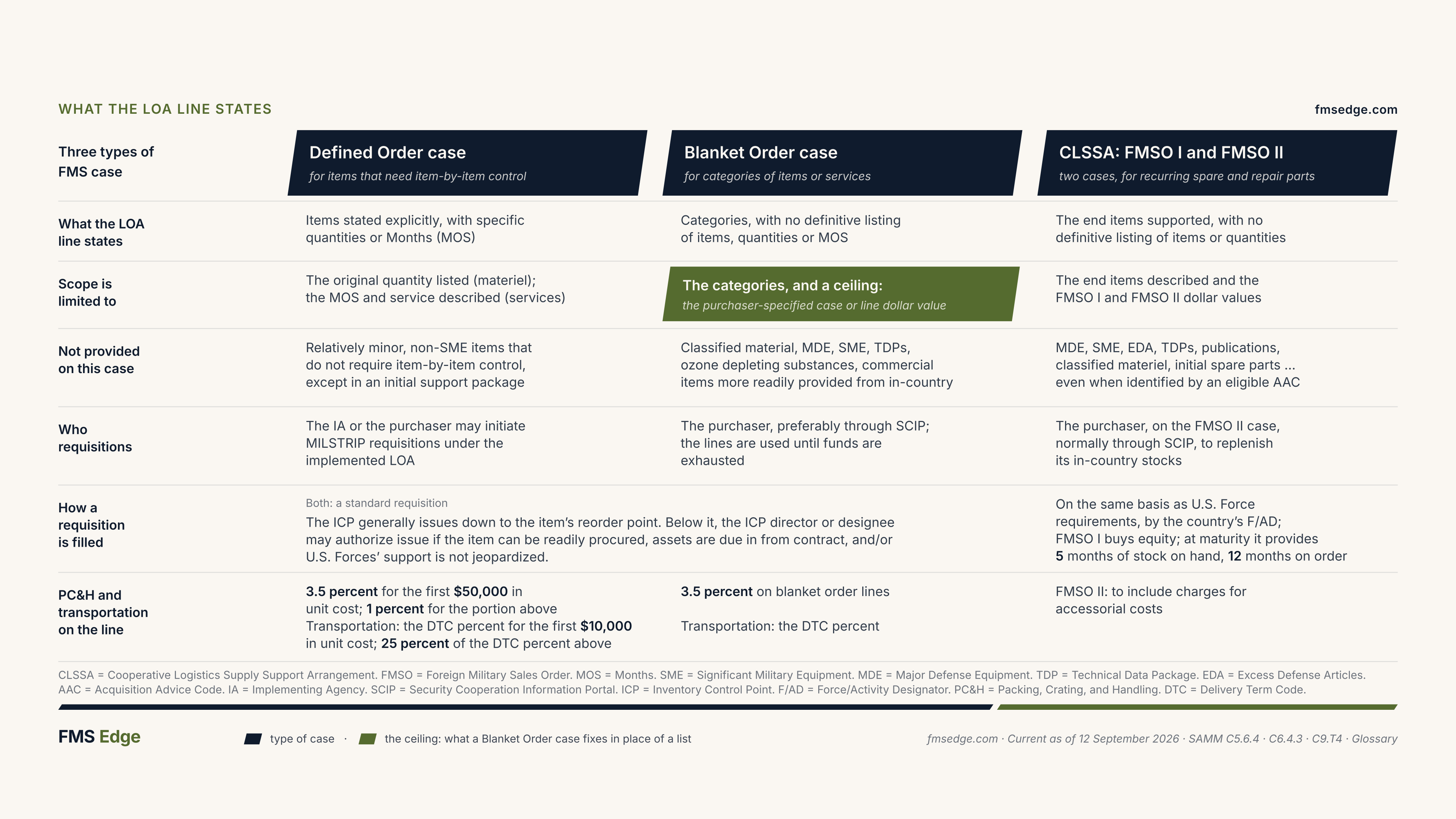
What the LOA line states decides the type of case. A Defined Order case states the items explicitly, line by line, and a Blanket Order case only categories and a dollar ceiling. A Cooperative Logistics Supply Support Arrangement is two cases, the FMSO I, which buys equity in the U.S. supply system, and the FMSO II, which the purchaser requisitions against.
What is a Cooperative Logistics Supply Support Arrangement?
The Department of War (DoW) offers the Supply Support Arrangement () as an effective means of replenishing the in-country stocks of spares and repair parts, which were initially furnished with end items of equipment. The is a arrangement for the furnishing of secondary items from the U.S. logistics system to a country in support of specific /systems [SAMM ]. Under the arrangement, the country makes a financial investment in the DoW logistics system to fund its anticipated support requirements [SAMM ]. The describes the end items supported rather than a definitive list of items or quantities, although items and quantities may be negotiated [SAMM ]. The investment permits the to augment its stocks in anticipation of the country’s actual demands [SAMM ]. The is used for replenishment of consumables or for replacement of repairable components [SAMM ]. The is not intended for initial support, but, rather, as a mechanism to resupply the initial support package [SAMM , ].
The materiel purchased with the country’s cash investment is commingled with DoW stocks and is not physically separated or otherwise identified in the ’s inventory records. In return for this investment, the country is entitled to support from DoW stocks equal to that provided to U.S. forces assigned the same .
Once an investment has been used to augment DoW stocks and a country desires to withdraw materiel for use, the country’s payment for those items provides funds for restoring U.S. Government stock levels. This allows for further support to that particular country in the future under the arrangement.
Due to the two-step nature of the arrangement, the consists of two separate cases where the case designator’s first character is “K”: one for DoW stock augmentation and another for materiel withdrawal. Each in the arrangement is referred to as a I and II respectively.
Whether an item can be provided on a case depends on its (), with the exceptions that follow [SAMM ]. Some items are not provided on cases even when an eligible identifies them. They are , , , classified materiel, cryptographic equipment, explosive ordnance items, parachutes, initial spare parts, controlled medical items, modification kits, tool sets, publications, ozone depleting substances, commercial items of materiel that can more readily be provided from in-country, and packages or similar documentation that conveys manufacturing process information [SAMM ].
The provides centrally stocked or centrally managed spare and repair parts of defense systems common to the purchaser and U.S. forces [SAMM ]. requirements are satisfied on the same basis as U.S. force requirements, in accordance with the country’s [SAMM ]. The result is faster stock replenishment, which keeps the international partner’s equipment operating at full capability.
The effectiveness of can be influenced by a variety of factors. is predicated on adequate inventories of stocked materiel in the purchasing country. effectiveness depends on the orderly and timely replenishment of this in-country stock. The participating country should submit replenishment requisitions in a routine manner, as needed, and should avoid ordering large quantities infrequently. In addition, are not intended as the vehicle for large quantity augmentation of in-country stocks. Such augmentation may be required because of an increase in stock levels due to changes in mission, operational levels, maintenance philosophy, or the introduction of additional end items. These requirements should be satisfied through a defined order or . The investment levels of the should then be adjusted accordingly to support the replenishment of these increased levels of in-country stock.
Factors that normally preclude the use of a for follow-on support or drastically reduce its utility are the international partner’s requirements for sole-source procurement, the international partner’s desire for single-vendor integrity, or the need for nonstandard items.
A sole-source procurement is one in which supplies or services can be obtained from only one specific person or firm. The program relies on the availability of depot stock. Because DoW procedures do not provide for segregation or identification of stocked materiel by manufacturer, a does not support a requirement for a sole source.
A country’s use of single-vendor integrity () can also affect the follow-on support provided by the DoW. If a country requires , this precludes the use of a , since normal DoW procedures do not provide for segregation or identification of stocked materiel by manufacturer or by funding source. is the international partner’s specification that all of the spares needed to support a particular be furnished by the original manufacturer. Spares are typically bought by agencies other than the agency that buys the itself. For example, the Defense Logistics Agency () typically procures and stocks aviation spares that are used on aircraft managed by the Army, Air Force, Navy, and Marine Corps. Thus, to ensure that the installed equipment and the spares come from the same manufacturer, an international partner invokes in the .
The purpose of is to ensure that the spares match the installed equipment and will function within the when installed as replacement equipment and that configuration adaptation of intermediate and/or depot-level support equipment and parts will not be required. The concept is more restrictive than sole source in that it stipulates that subsequent procurements use the same subcontractor and suppliers as the initial purchase.
Single-vendor integrity has many appealing features for the international partner. It simplifies their in-country repair and rebuild program because it needs less inventory. Training and publications are also easier to maintain, and the requirements for test equipment are reduced.
Despite these benefits to the international partner, also calls for extra effort by the U.S. to manage follow-on support, beyond the level funded by the Administrative Surcharge. Other disadvantages include certain inherent risks that are also associated with sole-source procurement, e.g., the source may go out of business, may become nonresponsive to requests for changes, and prices may be higher.
References
SAMM
- SAMM C5.6.4.3: Cooperative Logistics Supply Support Arrangements.
- SAMM C6.4.3.2.1
- SAMM C6.4.3.2.2
- SAMM C6.4.3.2: Cooperative Logistics Supply Support Arrangements.
- SAMM C6.4.3.2.9
- SAMM C5.6.4.3.2: Items Provided on Cooperative Logistics Supply Support Arrangement Cases.
- SAMM C5.6.4.3.3: Items Not Provided on Cooperative Logistics Supply Support Arrangement Cases.
Related
Cooperative Logistics
The logistics support provided a foreign government/agency through its participation in a U.S. DoD logistics system, with reimbursement paid to the USG for the support provided.
SAMM Glossary, as of 12 September 2026
Glossary entry →Open the manual’s entry → (opens in new tab)
Foreign Military Sales (FMS)
The part of U.S. security assistance, authorized by the Arms Export Control Act (AECA), in which eligible foreign governments and international organizations buy defense articles, services and training from the U.S. Government under formal government-to-government agreements.
The articles come either from Department of War stocks or from new procurement under contracts the Department manages [22 U.S.C. 2761, 22 U.S.C. 2762]. A sale is FMS whatever the source of the purchaser's financing.
FMS Edge glossary, as of 10 October 2026
Glossary entry →Open the manual’s entry → (opens in new tab)
Foreign Military Sales Order I (FMSO I)
Provides for the pipeline capitalization of a cooperative logistics support arrangement, which consists of stocks on hand and replenishment of stocks on order in which the participating country buys equity in the U.S. supply system for the support of a specific weapons system. Even though stocks are not moved to a foreign country, delivery (equity) does in effect take place when the country pays for the case.
SAMM Glossary, as of 12 September 2026
Glossary entry →Open the manual’s entry → (opens in new tab)
Foreign Military Sales Order II (FMSO II)
The case, tied to a Foreign Military Sales Order (FMSO) I case, through which a purchaser in a cooperative logistics supply support arrangement orders consumable items, mainly repair parts, and pays for replenishing what it draws from Department of War stock.
The purchaser uses its FMSO II case to requisition the spare and repair parts that replenish its own in-country stock [SAMM C5.6.4.3].
FMS Edge glossary, as of 10 October 2026
Glossary entry →Open the manual’s entry → (opens in new tab)
Acquisition Advice Code
Materiel management codes, listed in Table 58, Volume 10 of the Cataloging Data and Transaction Standards used to specify requirements, restrictions, and methods for acquiring an item.
SAMM Glossary, as of 12 September 2026
Glossary entry →Open the manual’s entry → (opens in new tab)
Major Defense Equipment (MDE)
Any item of Significant Military Equipment on the U.S. Munitions List having a nonrecurring research and development cost of more than $50 million or a total production cost of more than $200 million. Also defined in section 47 (6), Arms Export Control Act.
SAMM Glossary, as of 12 September 2026
Glossary entry →Open the manual’s entry → (opens in new tab)
CLSSA: Cooperative Logistics Supply Support Arrangement
SAMM Acronyms, as of 12 September 2026
Glossary entry →Cooperative Logistics Supply Support Arrangements (CLSSA) →
Major End Items
Any end item that is Significant Military Equipment or Major Defense Equipment or where control over the programming of these items is required. See also "end item."
SAMM Glossary, as of 12 September 2026
Glossary entry →Open the manual’s entry → (opens in new tab)
Letter of Offer and Acceptance (LOA)
The legal instrument that lists the defense articles and services, including training, that the U.S. Government transfers to a foreign country or international organization, with their estimated costs and the terms and conditions. The benefitting partner does not sign a Building Partner Capacity (BPC) LOA.
The Letter of Offer and Acceptance (LOA) is the instrument the U.S. Government uses to sell under the Arms Export Control Act (AECA); signed LOAs and their later Amendments and Modifications are also called Foreign Military Sales (FMS) cases [SAMM C5.6.1].
FMS Edge glossary, as of 10 October 2026
Glossary entry →Open the manual’s entry → (opens in new tab)
Military Department (MILDEP)
One of the departments within the DoD created by the National Security Act of 1947, as amended. The Military Departments are: the Department of the Air Force, the Department of the Army, and the Department of the Navy.
SAMM Glossary, as of 12 September 2026
Glossary entry →Open the manual’s entry → (opens in new tab)
Inventory Control Point (ICP)
The organization within a Department of War supply system that manages a group of items for one Military Service or for the whole Department, computing requirements, starting procurement or disposal actions, managing distribution and directing rebuild.
The inventory control point that processes a standard requisition generally issues the assets down to the item's reorder point level [SAMM C6.4.3.1].
FMS Edge glossary, as of 10 October 2026
Glossary entry →Open the manual’s entry → (opens in new tab)
Force Activity Designator (F/AD)
An assignment of a Roman numeral designator between I and V to international partner countries, and to U.S. defense organizations, which determines the supply priorities that the requisitioner can use to order materiel from the DoD supply system.
SAMM Glossary, as of 12 September 2026
Glossary entry →Open the manual’s entry → (opens in new tab)
FMS: Foreign Military Sale
SAMM Acronyms, as of 12 September 2026
LOA: Letter of Offer and Acceptance
SAMM Acronyms, as of 12 September 2026
Foreign Military Sales Order (FMSO)
A term used to describe Letters of Offer and Acceptance (LOAs) that implement Cooperative Logistics Supply Support Arrangements. Two LOAs are written: a FMSO I and a FMSO II.
SAMM Glossary, as of 12 September 2026
Glossary entry →Open the manual’s entry → (opens in new tab)
AAC: Acquisition Advice Code
SAMM Acronyms, as of 12 September 2026
Significant Military Equipment (SME)
Defense articles for which special export controls are warranted because of the capacity of such articles for substantial military utility or capability. These items are identified on the U.S. Munitions List in the International Traffic in Arms Regulations by an asterisk preceding the item category listing.
SAMM Glossary, as of 12 September 2026
Glossary entry →Open the manual’s entry → (opens in new tab)
Excess Defense Articles (EDA)
Defense articles owned by the USG which are neither procured in anticipation of military assistance or sales requirements, nor procured pursuant to a military assistance or sales order. EDA are items (except construction equipment) that are in excess of the Approved Force Acquisition Objective and Approved Force Retention Stock of all DoD components at the time such articles are dropped from inventory by the supplying agency for delivery to countries or international organizations.
SAMM Glossary, as of 12 September 2026
Glossary entry →Open the manual’s entry → (opens in new tab)
Technical Data
Recorded information of a scientific or technical nature, regardless of form or characteristic. Examples of technical data packages include research and engineering drawings and associated lists, specifications, standards, process sheets, manuals, technical reports, catalog item identifications, and related information and computer software documentation.
SAMM Glossary, as of 12 September 2026
Glossary entry →Open the manual’s entry → (opens in new tab)
Blanket Order Case (Foreign Military Sales)
A Foreign Military Sales (FMS) case for a category of defense articles or services, training included, with no definitive list of items or quantities, written against a dollar ceiling.
A Blanket Order case remains in effect until the purchaser has requisitioned articles or services up to the funds available on it [SAMM C5.6.13.4].
FMS Edge glossary, as of 10 October 2026
Glossary entry →Open the manual’s entry → (opens in new tab)
Single Vendor Integrity
A requirement or condition, meant to assure the quality, cost or availability of an item, service or material, under which a customer relies on one specific supplier or manufacturer.
FMS Edge glossary, as of 10 October 2026
Weapon System
A combination of one or more weapons with all related equipment, materials, services, personnel, and means of delivery and deployment (if applicable) required for self-sufficiency.
SAMM Glossary, as of 12 September 2026
Glossary entry →Open the manual’s entry → (opens in new tab)
Defense Logistics Agency
The Department of War agency that is the item manager for consumable, stock-funded secondary items. Its supply centers work with the military departments to fill Foreign Military Sales (FMS) requisitions, process supply discrepancy reports and repair and return items, and close cases when supply is complete, and it prepares FMS cases for cataloging services and excess defense articles [SAMM C1.3.2.6.2.3.2].
FMS Edge glossary, as of 10 October 2026
Implementing Agency (IA)
The military department or defense agency responsible for the execution of military assistance programs. With respect to FMS, the military department or defense agency assigned responsibility by the Defense Security Cooperation Agency to prepare an LOA and to implement an FMS case. The implementing agency is responsible for the overall management of the actions that will result in delivery of the materials or services set forth in the LOA that was accepted by a foreign country or international organization.
SAMM Glossary, as of 12 September 2026
Glossary entry →Open the manual’s entry → (opens in new tab)
FMSO: Foreign Military Sales Order
SAMM Acronyms, as of 12 September 2026
Trust Fund
A fund or account that law designates as a trust fund, credited with receipts that law earmarks and that the government holds in trust, in a fiduciary capacity, for specific purposes and programs under an agreement.
A trust fund account is usually a receipt account, an expenditure account or a revolving fund account.
FMS Edge glossary, as of 10 October 2026
Glossary entry →Open the manual’s entry → (opens in new tab)
SAMM C5.6.4.3: Cooperative Logistics Supply Support Arrangements.
“CLSSAs provide for pre-stock and storage of DoW-stocked non-SME items that are needed and used by the FMS purchaser on a recurring basis. CLSSA LOAs reflect support for end items with no definitive listing of items or quantities, although items and quantities may be negotiated with the FMS purchaser as part of the CLSSA management process. CLSSA programs consist of …”
Security Assistance Management Manual, as of 5 October 2026
SAMM C6.4.3.2.1
“The Foreign Military Sales Order (FMSO) I case provides for the purchase and sustainment of equity in the DoW inventory and pipeline. Following the receipt of adequate stocks to sustain the fill of incoming requisitions, which is referred to as FMSO I maturity, the FMSO I provides for 5 months of on hand stock (FMSO I Part A) and 12 …”
Security Assistance Management Manual, as of 26 October 2026
SAMM C6.4.3.2.2
“The FMSO II case is used by the purchaser to requisition spare and repair parts that are needed to replenish in-country stocks.”
Security Assistance Management Manual, as of 26 October 2026
SAMM C5.6.4.3.3: Items Not Provided on Cooperative Logistics Supply Support Arrangement Cases.
“MDE, SME, EDA, parachutes, explosive ordnance items, commercial items of materiel more readily provided from in-country, controlled medical items, modification kits, ozone depleting substances, TDPs or other similar documentation that conveys manufacturing process information, publications, tool sets, cryptographic equipment, classified materiel, and initial spare parts are not provided on CLSSA cases even when they are identified by an eligible AAC.”
Security Assistance Management Manual, as of 5 October 2026
SAMM C5.6.4.3.2: Items Provided on Cooperative Logistics Supply Support Arrangement Cases.
“Centrally stocked or centrally managed spare and repair parts of defense systems common to FMS purchaser and U.S. forces are provided on CLSSA cases. CLSSA item eligibility is based on the Acquisition Advice Code (AAC), except as noted in Section C5.6.4.3.3.”
Security Assistance Management Manual, as of 5 October 2026
SAMM C6.4.3.2: Cooperative Logistics Supply Support Arrangements.
“CLSSA requirements are satisfied on the same basis as U.S. Force requirements in accordance with the country’s F/AD and Uniform Material Movement and Issue Priority System (UMMIPS). The F/AD identifies the priority that is given to a purchaser’s request. For information on what items can be provided on CLSSA cases see Section C5.5.3.3.”
Security Assistance Management Manual, as of 26 October 2026