
Guide
What does logistics support mean in Foreign Military Sales?
Logistics is the planning and execution of the movement and support of forces. For a purchaser it comes down to three elements: supply, transportation and maintenance. The Department of War has no separate logistics system for its partners; their requirements are met through the same supply system that supports U.S. forces. The purchaser runs its own retail supply system in country and replenishes its in-country wholesale stock from the U.S. system.
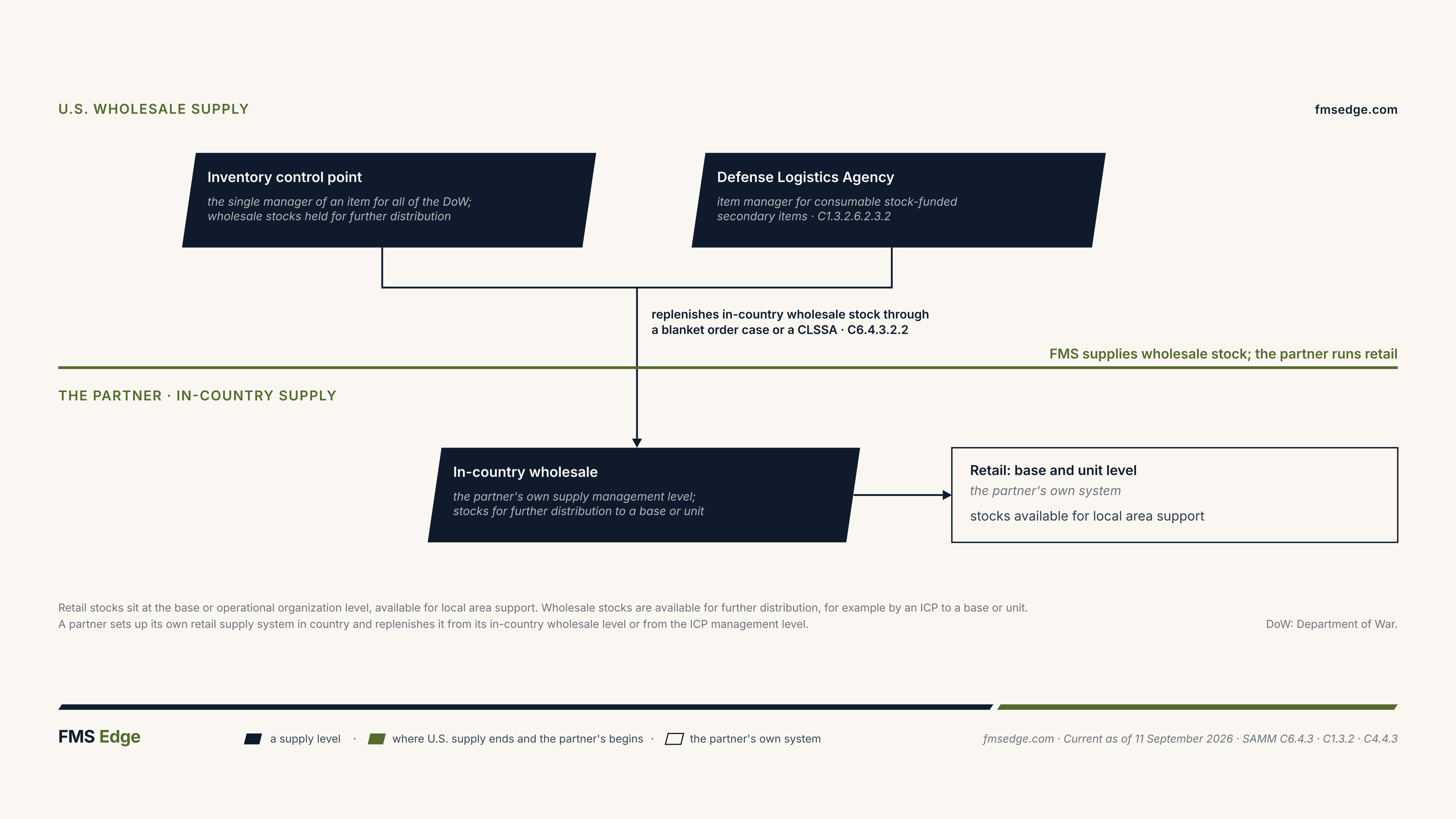
The U.S. supply system manages stock at the wholesale level, and a partner runs its own retail supply system in country. The partner replenishes its in-country wholesale stock from the U.S. system through a blanket order case or a Cooperative Logistics Supply Support Arrangement.
Supply, transportation and maintenance
The Dictionary of Military and Associated Terms defines logistics as planning and executing the movement and support of forces.
Logistics is a full system, an integrated whole, which involves four elements: acquisition, distribution, sustainment, and disposal.
Supply is a term that has a variety of meanings. Often, the term “supply” is used in a collective sense, much like logistics, to include acquiring, managing, receiving, storing, and issuing materiel to required forces. Logistics support to cases potentially encompasses all of these functions. Within the Military Departments () and the Defense Logistics Agency () are the organizations responsible for acquiring/managing supplies and for the functions of receiving, storing, and distributing items.
The Department of War will take reasonable steps to support systems that U.S. forces do not use, including items U.S. forces never adopted. Support for these items is provided when the arrangements made with the country involved are mutually satisfactory and sources of supply are available. An effort is made to support non-standard items, whether bought commercially or through , when doing so serves U.S. interests [SAMM ].
Major and secondary items
There are several ways to classify and manage items in the Department of War (DoW) supply system. Primary items, also called major items, are a final combination of end products, component parts, and/or materials, which are ready for their intended use, e.g., aircraft, ships, tanks, and weapon systems. Each of the military services manages its own major items. Due to the high acquisition costs involved and the attendant absence of available stocks, major items acquired through are usually a procurement lead-time away.
Secondary items are all items not defined as primary or major items. These include repairable components, sub-systems and assemblies, consumable repair parts, bulk items and materiel, subsistence, and expendable end items (including clothing and other personal gear). Secondary items generally fall into two categories: repairable and consumable items. Repairable items are generally higher cost, non-expendable items, e.g., radios, generators, etc., that can be economically repaired when they fail. Consumable items are usually low-cost and expendable items, such as gears, bearings, and gaskets that cannot be economically repaired.
Integrated materiel management
One objective of integrated is to minimize or eliminate duplication of item management. The wholesale management of a given item for all of the DoW is assigned to a single .
is the for consumable stock-funded secondary items and manages them through its supply centers [SAMM ]. However, the in the also serve as single item managers. Most of the items that remain under management are peculiar to the individual service, directly related to the operation of a particular , or are identified as high-cost items worthy of management.
Retail and wholesale
The term “retail” item refers to those stocks at the base or operational organization level that are available for local area support. Wholesale items are those stocks that are available for resale, e.g., for further distribution by an to a base or unit. International partners are expected to establish their own retail supply system in-country and replenish their retail stocks from the in-country wholesale or management level.
A Supply Support Arrangement () replenishes in-country stocks: the purchaser uses its II case to requisition the spare and repair parts it needs [SAMM ]. Spare and repair parts can also be provided on an or line [SAMM ].
Transportation
Transportation involves the movement of equipment from point of origin to final destination. DoW policy makes the purchaser responsible for transportation and delivery of its purchased materiel. A purchaser may instead use DoW distribution capabilities on a reimbursable basis through the , or employ a as its agent [SAMM ]. To help accomplish these tasks, the procedures prescribed in the United States Transportation Command (USTRANSCOM) Defense Transportation Regulation (), 4500.9-R Part II, Cargo Movement, are applied [SAMM ]. These procedures standardize and automate document flow. The United States Army Transportation Command () administers the procedures prescribed by the , which uses to create and exchange standard shipping data for recording and reporting shipping status and to control materiel movements in the .
Maintenance
Each military service is delegated the responsibility for defining tasks to be performed at the various levels of the maintenance organization chain to ensure effective and economic support of weapons and equipment. An analytical system is used to identify the maintenance level at which an item will be replaced, repaired, or thrown away based on economic considerations and operational readiness requirements. This level of repair analysis is usually performed by a prime contractor or original equipment manufacturer () and is subsequently approved by the program manager.
There are two generic levels of maintenance in the DoW: field maintenance and depot maintenance. The level of maintenance employed by each of the U.S. military services is dependent upon the being maintained. Not all international partners employ these levels for all their equipment. Each sale takes into consideration the international partner’s operating requirements, maintenance capabilities, and investment costs in developing a tailored maintenance plan for the specific international partner.
Field maintenance consists of organizational and intermediate maintenance. Organizational maintenance is performed by individual operational organizations on their own equipment. Organizational maintenance duties include inspecting, servicing, lubricating, adjusting, and replacing parts, minor assemblies, and subassemblies.
Intermediate maintenance is performed by separate maintenance activities to support operational users. Intermediate maintenance is normally accomplished in fixed or mobile shops, tenders, shore-based repair facilities or by mobile teams. Intermediate maintenance’s phases include: calibration, repair or replacement of damaged or unserviceable parts, components, assemblies, manufacturing critical non-available parts, and providing technical assistance.
Depot maintenance is performed by designated activities to support organizational and intermediate maintenance. It employs more extensive shop facilities, equipment, and personnel of higher technical skill than are available at the lower levels of maintenance. Its phases include inspection, test, repair, modification, alteration, modernization, conversion, overhaul, reclamation or rebuild of parts, assemblies, subassemblies, components, equipment end items, and weapon systems. It is normally accomplished in fixed shops, shipyards, and other shore-based facilities, or by depot field teams. It can be performed by DoW personnel or by commercial contractors.
Purchasing countries can establish cases to get items repaired, most commonly at the depot level. International partner country repair requirements are integrated with the repair programs of the DoW military services and are accomplished by organic military repair facilities (i.e., Army maintenance depots, U.S. Air Force () Air Logistics Complexes, Navy Fleet Readiness Centers (FRCs), shipyards, etc.), or civilian contractors.
Once a system is due to be phased out of the DoW inventory, countries that acquired it through are given the opportunity to determine item requirements and place final orders. Those orders are designed to keep the system capable through its service life, and they are consolidated so that the buys are economical. Section C6.4.7 covers this [SAMM ].
References
SAMM
- SAMM C1.3.2.6.2.3.2: Roles.
- SAMM C6.4.3.2.2
- SAMM C5.6.4.2.2: Items Provided on Blanket Order Cases or Case Lines.
- SAMM C7.1.1
- SAMM C7.T1: Transportation Responsibilities
- SAMM C4.4.3.2
- SAMM C4.4.3.1
Related
Foreign Military Sales (FMS)
The part of U.S. security assistance, authorized by the Arms Export Control Act (AECA), in which eligible foreign governments and international organizations buy defense articles, services and training from the U.S. Government under formal government-to-government agreements.
The articles come either from Department of War stocks or from new procurement under contracts the Department manages [22 U.S.C. 2761, 22 U.S.C. 2762]. A sale is FMS whatever the source of the purchaser's financing.
FMS Edge glossary, as of 10 October 2026
Glossary entry →Open the manual’s entry → (opens in new tab)
Military Department (MILDEP)
One of the departments within the DoD created by the National Security Act of 1947, as amended. The Military Departments are: the Department of the Air Force, the Department of the Army, and the Department of the Navy.
SAMM Glossary, as of 12 September 2026
Glossary entry →Open the manual’s entry → (opens in new tab)
Defense Logistics Agency
The Department of War agency that is the item manager for consumable, stock-funded secondary items. Its supply centers work with the military departments to fill Foreign Military Sales (FMS) requisitions, process supply discrepancy reports and repair and return items, and close cases when supply is complete, and it prepares FMS cases for cataloging services and excess defense articles [SAMM C1.3.2.6.2.3.2].
FMS Edge glossary, as of 10 October 2026
Materiel Management
Direction and control of those aspects of logistics which deal with materiel, including the functions of identification, cataloging, standardization, requirements determination, procurement, inspection, quality control, packaging, storage, distribution, disposal, maintenance, mobilization planning, industrial readiness planning, and item management classification; encompasses materiel control, inventory control, inventory management, and supply management.
SAMM Glossary, as of 12 September 2026
Glossary entry →Open the manual’s entry → (opens in new tab)
FMS: Foreign Military Sale
SAMM Acronyms, as of 12 September 2026
Inventory Control Point (ICP)
The organization within a Department of War supply system that manages a group of items for one Military Service or for the whole Department, computing requirements, starting procurement or disposal actions, managing distribution and directing rebuild.
The inventory control point that processes a standard requisition generally issues the assets down to the item's reorder point level [SAMM C6.4.3.1].
FMS Edge glossary, as of 10 October 2026
Glossary entry →Open the manual’s entry → (opens in new tab)
Item Manager (IM)
An individual within the organization of an inventory control point or other such organization assigned management responsibility for one or more specific items of materiel.
SAMM Glossary, as of 12 September 2026
Glossary entry →Open the manual’s entry → (opens in new tab)
ICP: Inventory Control Point
SAMM Acronyms, as of 12 September 2026
Weapon System
A combination of one or more weapons with all related equipment, materials, services, personnel, and means of delivery and deployment (if applicable) required for self-sufficiency.
SAMM Glossary, as of 12 September 2026
Glossary entry →Open the manual’s entry → (opens in new tab)
Cooperative Logistics
The logistics support provided a foreign government/agency through its participation in a U.S. DoD logistics system, with reimbursement paid to the USG for the support provided.
SAMM Glossary, as of 12 September 2026
Glossary entry →Open the manual’s entry → (opens in new tab)
CLSSA: Cooperative Logistics Supply Support Arrangement
SAMM Acronyms, as of 12 September 2026
Glossary entry →Cooperative Logistics Supply Support Arrangements (CLSSA) →
Foreign Military Sales Order (FMSO)
A term used to describe Letters of Offer and Acceptance (LOAs) that implement Cooperative Logistics Supply Support Arrangements. Two LOAs are written: a FMSO I and a FMSO II.
SAMM Glossary, as of 12 September 2026
Glossary entry →Open the manual’s entry → (opens in new tab)
Blanket Order Case (Foreign Military Sales)
A Foreign Military Sales (FMS) case for a category of defense articles or services, training included, with no definitive list of items or quantities, written against a dollar ceiling.
A Blanket Order case remains in effect until the purchaser has requisitioned articles or services up to the funds available on it [SAMM C5.6.13.4].
FMS Edge glossary, as of 10 October 2026
Glossary entry →Open the manual’s entry → (opens in new tab)
Defense Transportation System (DTS)
The part of the worldwide transportation infrastructure that supports Department of War transportation needs in peace and war, made up of military (organic) and commercial resources that are organic to the Department, under contract to it or controlled by it [SAMM C7.6.1].
It takes in organic and commercial aircraft and ships, commercial small-package services under Department contract, and U.S. military air and ocean terminals in and outside the United States.
FMS Edge glossary, as of 10 October 2026
Glossary entry →Open the manual’s entry → (opens in new tab)
Freight Forwarder
A commercial import/export company registered with the Department of State, Bureau of Political-Military Affairs, Directorate of Defense Trade Controls and under contract to the Foreign Military Sales customer which arranges transportation of materiel from a point specified in the Letter of Offer and Acceptance to the final destination.
SAMM Glossary, as of 12 September 2026
Glossary entry →Open the manual’s entry → (opens in new tab)
U.S. Army Transportation Command
The U.S. Army command, formerly the Military Surface Deployment and Distribution Command (SDDC), that is the Army service component command of U.S. Transportation Command (USTRANSCOM) and a major subordinate command of Army Materiel Command.
Its assets form part of the Defense Transportation System (DTS), and it processes claims against ocean carriers for transportation the Department of War furnishes or contracts [SAMM C7.6.2.1, C7.21.2].
FMS Edge glossary, as of 10 October 2026
Military Standard Requisitioning And Issue Procedures (MILSTRIP)
The uniform Department of War procedures for requisitioning and issuing materiel within standardized priorities, using standard data elements, codes, forms and transaction formats that foreign governments and international organizations also use by agreement.
The Implementing Agency (IA) or the purchaser may initiate MILSTRIP requisitions under implemented Letters of Offer and Acceptance (LOAs) [SAMM C6.4.3].
FMS Edge glossary, as of 10 October 2026
Glossary entry →Open the manual’s entry → (opens in new tab)
DTS: Defense Transportation System
SAMM Acronyms, as of 12 September 2026
OEM: Original Equipment Manufacturer
System Support Buyout
An opportunity for international partners to make a final purchase of major items and associated spares and support equipment of a major system that is being terminated in the DoD inventory, prior to the contracts or production being discontinued.
SAMM Glossary, as of 12 September 2026
Glossary entry →Open the manual’s entry → (opens in new tab)
SAMM C4.4.3.2
“DoW will take reasonable steps to support systems that are not used by U.S. Forces including items that were never adopted by U.S. Forces. Support is provided for these items when mutually satisfactory arrangements are made with the country involved and supply sources are available. Effort is made to support non-standard items, whether acquired commercially or through FMS, when this …”
Security Assistance Management Manual, as of 26 October 2026
SAMM C1.3.2.6.2.3.2: Roles.
“The Director, DLA, advises the SECWAR on all SC matters impacting DLA and acts for the SECWAR when responsibility is delegated. DLA prepares FMS cases for cataloging services at the DLA Logistics Information Services and Excess Defense Articles (EDA) at the DLA Disposition Services. DLA coordinates on MILDEP SC cases exclusively for medical equipment and supplies (except for U.S. Army …”
Security Assistance Management Manual, as of 26 October 2026
SAMM C6.4.3.2.2
“The FMSO II case is used by the purchaser to requisition spare and repair parts that are needed to replenish in-country stocks.”
Security Assistance Management Manual, as of 26 October 2026
SAMM C5.6.4.2.2: Items Provided on Blanket Order Cases or Case Lines.
“Types of unclassified, non-SME items or services that can be provided on Blanket Order cases or lines include spares and repair parts (consumables and repairables), support equipment (tools, test equipment), supplies (fuel, personnel items, commercial consumable items), maintenance (repair, rebuild, minor modifications or alterations), technical assistance (specialist advice or actions, system integration, item checkout, systems evaluation, study groups to develop …”
Security Assistance Management Manual, as of 26 October 2026
SAMM C7.1.1
“The United States Government and the purchaser's advanced planning for transportation of materiel is critical for case development and execution. It is DoW policy that the purchaser is responsible for transportation and delivery of its purchased materiel. DoW encourages purchasers to be self-sufficient by making informed decisions regarding transportation arrangements. Purchasers can use DoW distribution capabilities on a reimbursable basis …”
Security Assistance Management Manual, as of 26 October 2026
SAMM C7.T1: Transportation Responsibilities
“Table C7.T1. Transportation Responsibilities Organization Responsibility Under Secretary of War for Acquisition and Sustainment (USW(A&S), Deputy Assistant Secretary of War for Logistics (DASW(LOG)), Transportation Directorate Sets policy for the movement of materiel. Defense Security Cooperation Agency Ensures that Foreign Military Sales (FMS) transportation policies are kept current; issues revised policy as needed. Interprets transportation policy as requested; requests clarification as …”
Security Assistance Management Manual, as of 26 October 2026
SAMM C4.4.3.1
“When a system is to be phased out of the DoW inventory, countries that have acquired the system under FMS are given the opportunity to determine item requirements and to place final orders designed to maintain system capability through its service life. These orders are consolidated to ensure economic buys. See Section C6.4.7.”
Security Assistance Management Manual, as of 26 October 2026