
Guide
What is an inventory control point (ICP)?
An is the part of a Department of War supply system that manages the materiel for a group of items. Its item managers determine requirements, set stock levels, start procurements and provide distribution. For , points supply pricing for Letters of Offer and Acceptance and fill the purchaser's requisitions, from stock or by procurement.
The Department of War buys what a Foreign Military Sales case orders through the organization that buys the same kind of item for U.S. forces. There is no separate FMS buying system.
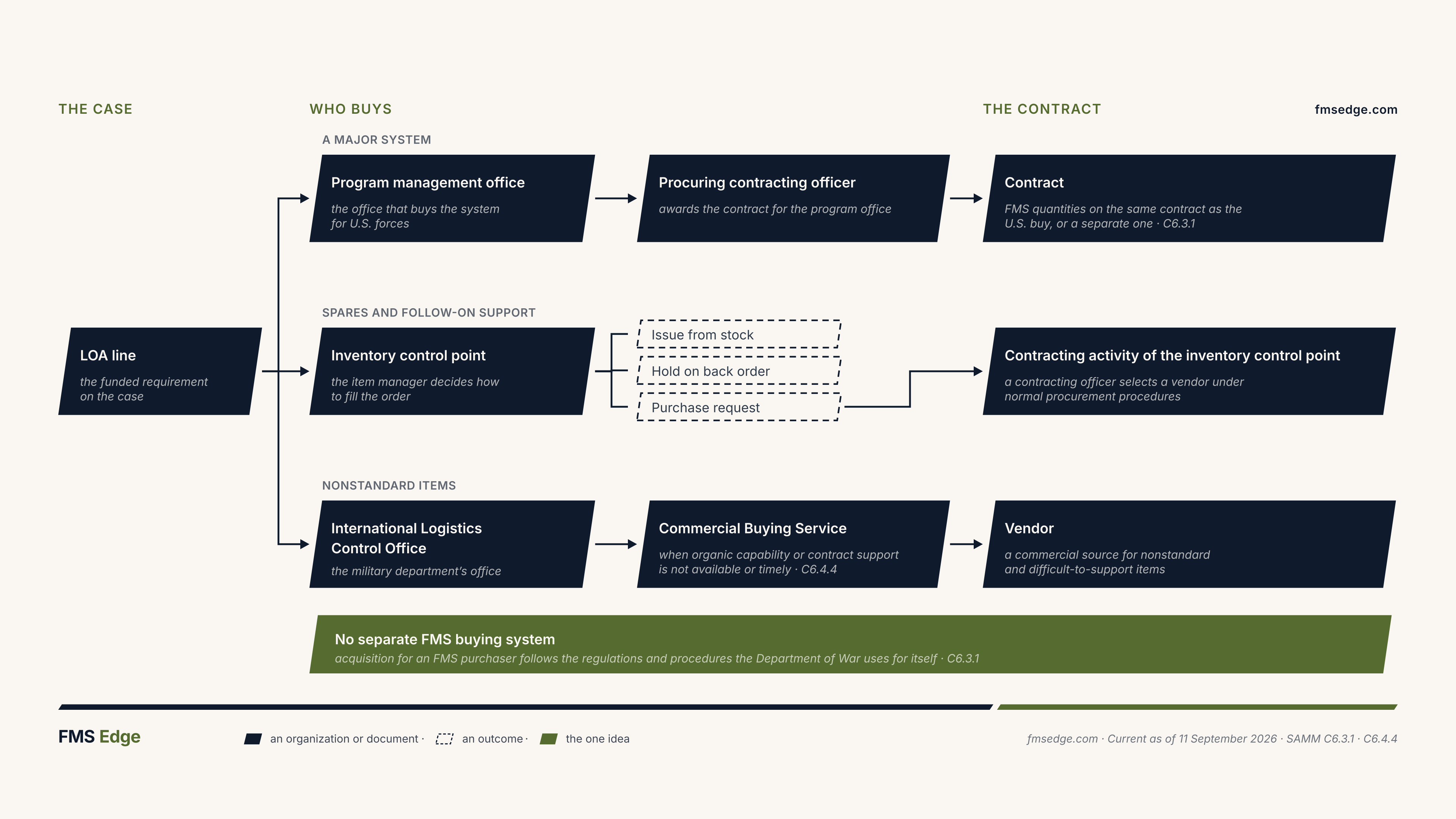
What is an inventory control point?
An is the organizational element of a Department of War (DoW) system that is assigned responsibility for managing the materiel of a group of items. That management includes computing requirements, starting procurement or disposal actions, managing distribution and directing rebuilds.
The primary organizations in the DoW wholesale system are the Points (), i.e., Army Life Cycle Management Commands (), the Air Force Life Cycle Management Center and Air Force Sustainment Center, the Navy and Marine Corps and systems commands, and the various Defense Logistics Agency () supply centers and depots. play a major role in satisfying both the U.S. and foreign military requirements placed on the DoW logistics system.
Each stock numbered item is controlled by an , usually located at the . The IM’s functions include: determining requirements, establishing stock levels, initiating procurements, and providing distribution. For secondary items, IMs also manage overhauls and disposals. While the participate in the management of /systems, i.e., tanks, aircraft, ships, etc., they do not have primary responsibility for determining the quantities for these items.
An ’s role in and () begins with the receipt of taskings from agencies that write Letters of Offer and Acceptance () for those items managed by the . help develop by providing pricing information for items sold on defined order cases/lines, such as ammunition and support equipment.
sales cases usually include the repair parts required to support the for an initial period. Those repair parts are considered “initial support” or “” (CSP). The are responsible for recommending the range and quantity of repair parts to be included for initial support, based upon operational use factors provided by the international partner.
() need a recommended list of repair parts to be stocked in support of the purchasing country. The ’ develop the list which includes recommended quantities and the cost for each item.
Upon acceptance and implementation of the , the and the supply centers are the supply activities responsible for satisfying the international partner’s requisitions for items that they manage. Within guidelines established by the DoW, they may either issue items directly from available stocks or, when necessary, procure the materiel.
Navy inventory control points
Within the Department of the Navy (), there are five systems commands that serve as . They manage primary and secondary Navy or Marine Corps assets.
1. The Naval Supply Systems Command () provides materiel support needs of the , such as supply management policies and methods. A subordinate activity of is the Weapon Systems Support, which serves as the from two locations. The activity located in Mechanicsburg, Pennsylvania, manages ship spares, and the activity located in Philadelphia, Pennsylvania, manages aircraft spares.
2. The Naval Air Systems Command () located in Patuxent River, Maryland, manages naval aircraft and air-to-air missiles as well as their associated support equipment and repair depots.
3. The Naval Sea Systems Command () located in Washington, D.C., manages Navy ships, boats and submarines as well as surface-to-air missiles and their associated support equipment and repair depots.
4. The Naval Information Warfare Systems Command () located in San Diego, California, manages the Navy’s communications and electronic systems.
5. The single for Marine Corps managed items is the Marine Corps Logistics Base (MCLB) in Albany, Georgia. It performs the same types of functions as the other services’ . Stocks under its control are stored in three MCLB depots located in Jacksonville, Florida; Barstow, California; and Albany, Georgia.
Army inventory control points
Within the Army structure, each life cycle management command has an Management Directorate ().
- The Tank-automotive and Armaments Command (), located in Warren, Michigan, manages soldier and ground systems (tracked and wheeled vehicles, and associated support equipment).
- The Aviation and Missile Command (), located in Huntsville, Alabama, manages missiles, helicopters, and associated equipment.
- The Communications-Electronics Command (), located at Aberdeen Proving Ground, Maryland, is responsible for the Army’s communications and electronic equipment, as well as cryptography.
- The Joint Munitions Command (JMC), located at Rock Island Arsenal, Illinois, is the single manager of munitions for the DoW.
- Although not a life cycle management command, the Program Executive Office for Simulation, Training, and Instrumentation (), located in Orlando, Florida, provides simulation, training and products and services to U.S. and foreign forces worldwide.
These all belong to the Army Materiel Command (). The Army manage not only the primary (major) end items, but also the secondary and support equipment and repair facilities for their respective major items.
Air Force inventory control points
Within the Air Force, responsibility belongs to the Air Force Materiel Command (), which includes the Air Force Life Cycle Management Center () and the Air Force Sustainment Center (). Primary items are managed by Program Executive Offices (PEOs) while depot repairables and secondary support items are managed by the following Air Logistics Complexes that report to the Air Force Sustainment Center:
- The Warner Robins Air Logistics Complex (), Robins AFB, Georgia, performs depot maintenance for Air Force weapons systems.
- The Oklahoma City , Tinker AFB, Oklahoma, performs depot maintenance on various aircraft and overhaul and repair on numerous jet engines. Additionally, the complex is responsible for the maintenance, repair, and overhaul of many Air Force and Navy airborne accessory components and the development and sustainment of operational flight programs, test program sets, automatic test equipment, and industrial automation software.
- The Ogden , Hill AFB, Utah, performs depot level overhaul and repair for all types of landing gear, wheels, brakes, and tires.
Related
Inventory Control Point (ICP)
The organization within a Department of War supply system that manages a group of items for one Military Service or for the whole Department, computing requirements, starting procurement or disposal actions, managing distribution and directing rebuild.
The inventory control point that processes a standard requisition generally issues the assets down to the item's reorder point level [SAMM C6.4.3.1].
FMS Edge glossary, as of 10 October 2026
Glossary entry →Open the manual’s entry → (opens in new tab)
Foreign Military Sales (FMS)
The part of U.S. security assistance, authorized by the Arms Export Control Act (AECA), in which eligible foreign governments and international organizations buy defense articles, services and training from the U.S. Government under formal government-to-government agreements.
The articles come either from Department of War stocks or from new procurement under contracts the Department manages [22 U.S.C. 2761, 22 U.S.C. 2762]. A sale is FMS whatever the source of the purchaser's financing.
FMS Edge glossary, as of 10 October 2026
Glossary entry →Open the manual’s entry → (opens in new tab)
Inventory Control
That phase of military logistics which includes managing, cataloging, requirements determinations, procurement, distribution, overhaul, and disposal of materiel.
SAMM Glossary, as of 12 September 2026
Glossary entry →Open the manual’s entry → (opens in new tab)
ICP: Inventory Control Point
SAMM Acronyms, as of 12 September 2026
LCMC: Life Cycle Management Command
Defense Logistics Agency
The Department of War agency that is the item manager for consumable, stock-funded secondary items. Its supply centers work with the military departments to fill Foreign Military Sales (FMS) requisitions, process supply discrepancy reports and repair and return items, and close cases when supply is complete, and it prepares FMS cases for cataloging services and excess defense articles [SAMM C1.3.2.6.2.3.2].
FMS Edge glossary, as of 10 October 2026
Item Manager (IM)
An individual within the organization of an inventory control point or other such organization assigned management responsibility for one or more specific items of materiel.
SAMM Glossary, as of 12 September 2026
Glossary entry →Open the manual’s entry → (opens in new tab)
Major End Items
Any end item that is Significant Military Equipment or Major Defense Equipment or where control over the programming of these items is required. See also "end item."
SAMM Glossary, as of 12 September 2026
Glossary entry →Open the manual’s entry → (opens in new tab)
Military Department (MILDEP)
One of the departments within the DoD created by the National Security Act of 1947, as amended. The Military Departments are: the Department of the Air Force, the Department of the Army, and the Department of the Navy.
SAMM Glossary, as of 12 September 2026
Glossary entry →Open the manual’s entry → (opens in new tab)
Security Assistance (SA)
A group of programs authorized by federal statutes by which the United States provides defense articles, military training, and other defense-related services by grant, lease, loan, credit, or cash sales in furtherance of national policies and objectives, and those that are funded and authorized through the Department of State to be administered by Department of Defense/Defense Security Cooperation Agency, which are considered part of security cooperation.
SAMM Glossary, as of 12 September 2026
Glossary entry →Open the manual’s entry → (opens in new tab)
Security Cooperation
Activities by which the Department of War encourages and enables international partners to cooperate with the United States toward strategic objectives, spanning every interaction with foreign defense and security establishments and every security assistance program the Department administers.
Under chapter 16 of Title 10, their purposes are to develop allied and friendly security capabilities for self-defense and multinational operations, to give U.S. forces peacetime and contingency access, and to build relationships promoting specific U.S. security interests [10 U.S.C. 301(7)].
FMS Edge glossary, as of 10 October 2026
Glossary entry →Open the manual’s entry → (opens in new tab)
LOA: Letter of Offer and Acceptance
SAMM Acronyms, as of 12 September 2026
Major Item
Defense articles identified in the Military Articles and Services List (MASL) with a unit of issue other than "XX" (dollar lines)." Control over the programming of these items is required.
SAMM Glossary, as of 12 September 2026
Glossary entry →Open the manual’s entry → (opens in new tab)
Concurrent Spare Parts (CSP)
These are spare parts programmed as an initial stockage related to the acquisition of a major item or system. CSPs are normally shipped in advance of the release of the major item or system.
SAMM Glossary, as of 12 September 2026
Glossary entry →Open the manual’s entry → (opens in new tab)
Cooperative Logistics Supply Support Arrangements (CLSSA)
Military logistics support arrangements designed to provide responsive and continuous supply support at the depot level for U.S.-made military materiel possessed by foreign countries and international organizations. The CLSSA is normally the most effective means for providing common repair parts and secondary item support for equipment of U.S. origin that is in allied and friendly country inventories.
SAMM Glossary, as of 12 September 2026
Glossary entry →Open the manual’s entry → (opens in new tab)
CLSSA: Cooperative Logistics Supply Support Arrangement
SAMM Acronyms, as of 12 September 2026
Glossary entry →Cooperative Logistics Supply Support Arrangements (CLSSA) →
TACOM: Tank-Automotive and Armaments Command
AMCOM: Aviation and Missile Command
CECOM: Communications-Electronics Command
PEO-STRI: Program Executive Office for Simulation, Training, and Instrumentation
AMC: Army Materiel Command
Materiel Management
Direction and control of those aspects of logistics which deal with materiel, including the functions of identification, cataloging, standardization, requirements determination, procurement, inspection, quality control, packaging, storage, distribution, disposal, maintenance, mobilization planning, industrial readiness planning, and item management classification; encompasses materiel control, inventory control, inventory management, and supply management.
SAMM Glossary, as of 12 September 2026
Glossary entry →Open the manual’s entry → (opens in new tab)
AFSC: Air Force Sustainment Center
ALC: Air Logistics Complex