
Guide
How can a partner sustain a U.S. system outside Foreign Military Sales?
Follow-on support does not have to come through . A partner can build its own in-country capability, use support available in a third country under U.S. approval, or buy support from commercial contractors, and Foreign Military Financing can fund a direct commercial contract only for an eligible partner. Systems in use with U.S. forces are supported through the Department of War procurement system, and the department will take reasonable steps to support systems U.S. forces do not use.
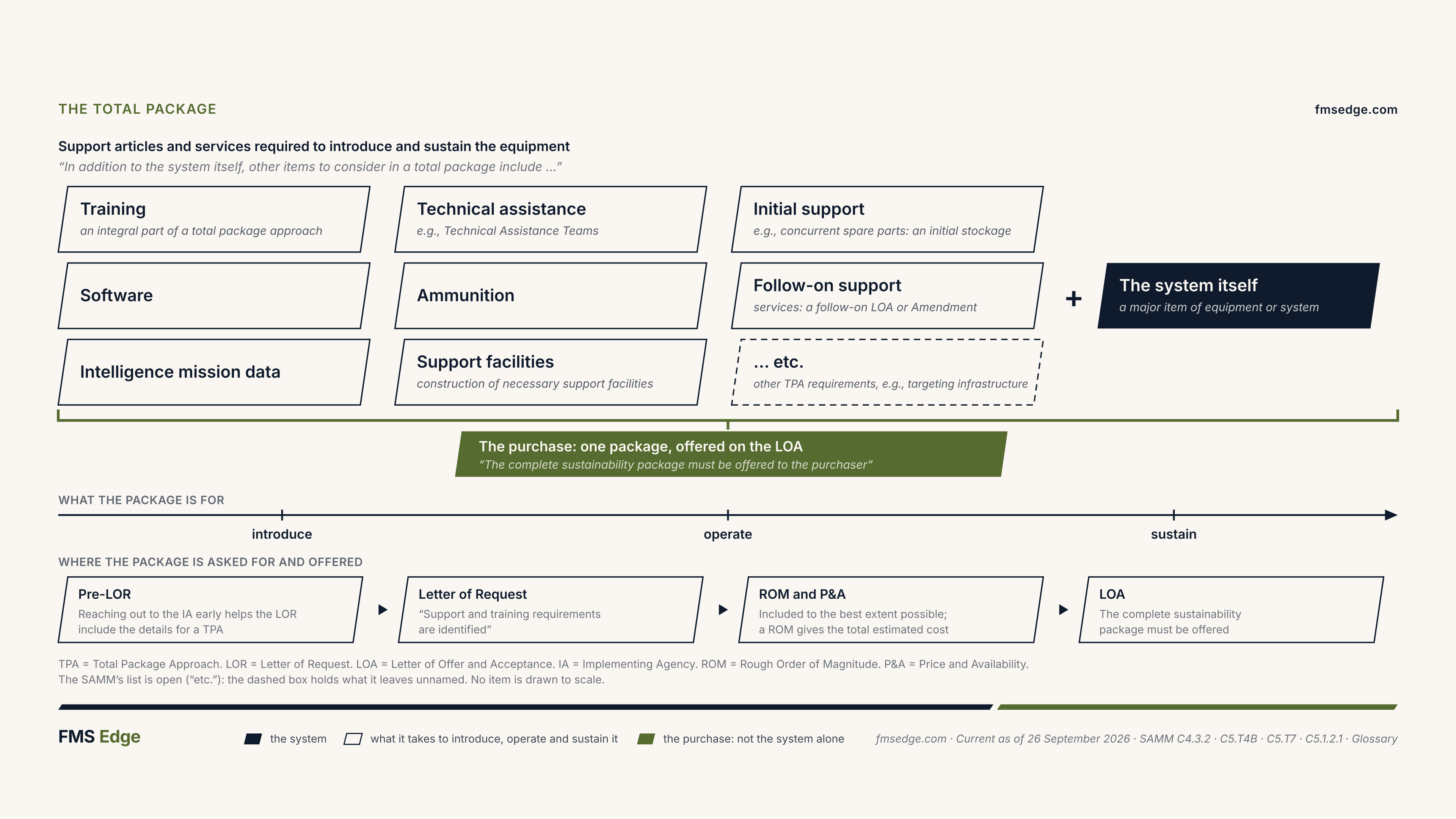
The system itself is the smallest part of the purchase. Under the Total Package Approach the complete sustainability package must be offered on the LOA, and the Letter of Request must identify support and training requirements.
Options for follow-on support other than Foreign Military Sales
Supply support is often considered to be synonymous with follow-on support; however, spares and repair parts are only one important aspect of a complete follow-on support program. Spares and repair parts will be of no value to the international partner if they cannot be identified or installed properly to maintain and operate applicable systems.
A system sale, including all associated training, support equipment, and /repair parts, is normally processed as a single case, or as a series of related cases, with a program manager/lead command being assigned to coordinate the overall effort. There are usually several options, other than an agreement with the U.S. Government (), from which an international partner can choose to support the system. These other options involve in-country resources, third-country support, and private contractor support.
In-country resources
The capability of a country to provide follow-on support from its own in-country resources should not be overlooked. The use of this method varies from country to country and from system to system. For various reasons, e.g., costs or self-sufficiency, a country may decide to establish in-country capabilities for follow-on support, particularly in areas such as training and maintenance.
Third-country support
Third-country support may be available. Section 3(a)(2), , restricts third-country transfers []. However, this method may be available as a result of previous licensing arrangements, or coproduction agreements. For example, there are many instances where third-country personnel have conducted training on U.S. equipment in an international partner country. -approved maintenance facilities may be available in a third country that have been established under U.S. license and are managed by U.S. personnel. These facilities, typically for aviation or tracked vehicle maintenance, are used by other -purchasing countries in the region to reduce the transportation time and the logistics tail associated with normally sending materiel back to the U.S. for depot-level repair.
Commercial contractor support
The international partner may use commercial contractors for follow-on support [SAMM ]. The contractor may have a continuing support plan available to offer the country. If such a plan is not readily available, in many cases, the contractor may be willing to develop one for a price.
A partner may use its Foreign Military Financing () allocation to fund a Direct Commercial Contract () only if it meets the eligibility criteria and the conditions of the annual Department of State appropriations language. Eligibility extends to all North Atlantic Treaty Organization () members and Major Non- Allies [SAMM ].
Why partners still prefer Foreign Military Sales support
The above methods of support may be available and are often used in varying degrees. Systems in use with U.S. forces are supported through the Department of War (DoW) procurement system [SAMM ]. International partner countries are aware that the DoW normally sells materiel only when there are plans to assure logistics support for the expected life of the equipment. managers have developed options to provide a reasonable level of follow-on support through a combination of government and commercial resources. Many aspects of the DoW logistics system serve the international partners well. These include the following:
- Quality products delivered through the defense acquisition system
- Government shelf stock that can reduce pipeline costs
- Access to ongoing product updates on common items
- Ongoing supply chain management initiatives
- Program managers and item managers dedicated to reducing costs for their international partners and effective problem solving
- A surge capability in the event of a national emergency
The DoW will take reasonable steps to support systems that U.S. forces do not use, including items they never adopted. Support for such items is provided when mutually satisfactory arrangements have been made with the country concerned and sources of supply are available. An effort is also made to support non-standard items bought commercially or through , when that effort serves U.S. interests [SAMM ].
References
SAMM
- SAMM C4.3.4: Neutrality.
- SAMM C9.7.3: Foreign Military Financing of Direct Commercial Contracts.
- SAMM C4.3.6.3: Price and Availability or Letter of Offer Acceptance Requests.
- SAMM C4.4.3: Logistics Support.
- SAMM C4.4.3.2
Public authorities
- AECA §3: Arms Export Control Act of 1976, as amended, §3 (22 U.S.C. §2753)
Related
Foreign Military Sales (FMS)
The part of U.S. security assistance, authorized by the Arms Export Control Act (AECA), in which eligible foreign governments and international organizations buy defense articles, services and training from the U.S. Government under formal government-to-government agreements.
The articles come either from Department of War stocks or from new procurement under contracts the Department manages [22 U.S.C. 2761, 22 U.S.C. 2762]. A sale is FMS whatever the source of the purchaser's financing.
FMS Edge glossary, as of 10 October 2026
Glossary entry →Open the manual’s entry → (opens in new tab)
Initial Spares
Components and related materiel bought to replace parts that wear out, are lost or are damaged during a system's initial period of operation, as part of its logistics support.
FMS Edge glossary, as of 10 October 2026
Glossary entry →Open the manual’s entry → (opens in new tab)
FMS: Foreign Military Sale
SAMM Acronyms, as of 12 September 2026
Arms Export Control Act (AECA)
The basic U.S. law providing the authority and general rules for the conduct of Foreign Military Sales and commercial sales of defense articles, defense services, and training. The Arms Export Control Act (AECA) came into existence with the passage of the Foreign Military Sales Act (FMSA) of 1968. An amendment in the International Security Assistance and AECA of 1976 changed the name of FMSA to the AECA.
SAMM Glossary, as of 12 September 2026
Glossary entry →Open the manual’s entry → (opens in new tab)
DCS: Direct Commercial Sales
SAMM Acronyms, as of 12 September 2026
Implementing Agency (IA)
The military department or defense agency responsible for the execution of military assistance programs. With respect to FMS, the military department or defense agency assigned responsibility by the Defense Security Cooperation Agency to prepare an LOA and to implement an FMS case. The implementing agency is responsible for the overall management of the actions that will result in delivery of the materials or services set forth in the LOA that was accepted by a foreign country or international organization.
SAMM Glossary, as of 12 September 2026
Glossary entry →Open the manual’s entry → (opens in new tab)
SAMM C4.3.4: Neutrality.
“As a matter of policy, the USG is generally neutral as to whether a partner purchases U.S.-origin defense articles or services commercially or through Government-to-Government (G2G) channels (e.g. FMS). However, by exception the USG may determine that select defense articles, services, or technology be transferred on a G2G basis in order to protect its most sensitive and sophisticated technologies.”
Security Assistance Management Manual, as of 11 September 2026
SAMM C9.7.3: Foreign Military Financing of Direct Commercial Contracts.
“DCCs are contracts where the purchaser enters into a contract directly with a vendor, and the USG is not a party to the contract. A foreign partner’s FMF allocation from an approved year may be used to fund a DCC, but only if the partner meets specific eligibility criteria, and the conditions laid out in the annual Department of State …”
Security Assistance Management Manual, as of 5 October 2026
SAMM C4.4.3: Logistics Support.
“The DoW considers the support of U.S. origin defense articles critical to the success of the security assistance (SA) program. Systems in use with U.S. Forces are supported through the DoW procurement system. Support items that are stocked, stored, and issued due to common application with end items in use should be provided even though the end items may have …”
Security Assistance Management Manual, as of 26 October 2026
SAMM C4.4.3.2
“DoW will take reasonable steps to support systems that are not used by U.S. Forces including items that were never adopted by U.S. Forces. Support is provided for these items when mutually satisfactory arrangements are made with the country involved and supply sources are available. Effort is made to support non-standard items, whether acquired commercially or through FMS, when this …”
Security Assistance Management Manual, as of 26 October 2026