
Guide
How is military training bought through Foreign Military Sales?
A partner nation buys U.S. military training through a case, either on a training line of the case for the equipment it supports or on a separate training case. It pays with its own funds or with Foreign Military Financing. Every case that involves training has a separate training line, and the tuition rate depends on how the training is funded.
An international military student reaches a U.S. course through a chain of plans and paperwork, from the Security Cooperation Organization's requirement to a seat confirmed by the Military Department's training activity. The student travels on an Invitational Travel Order.
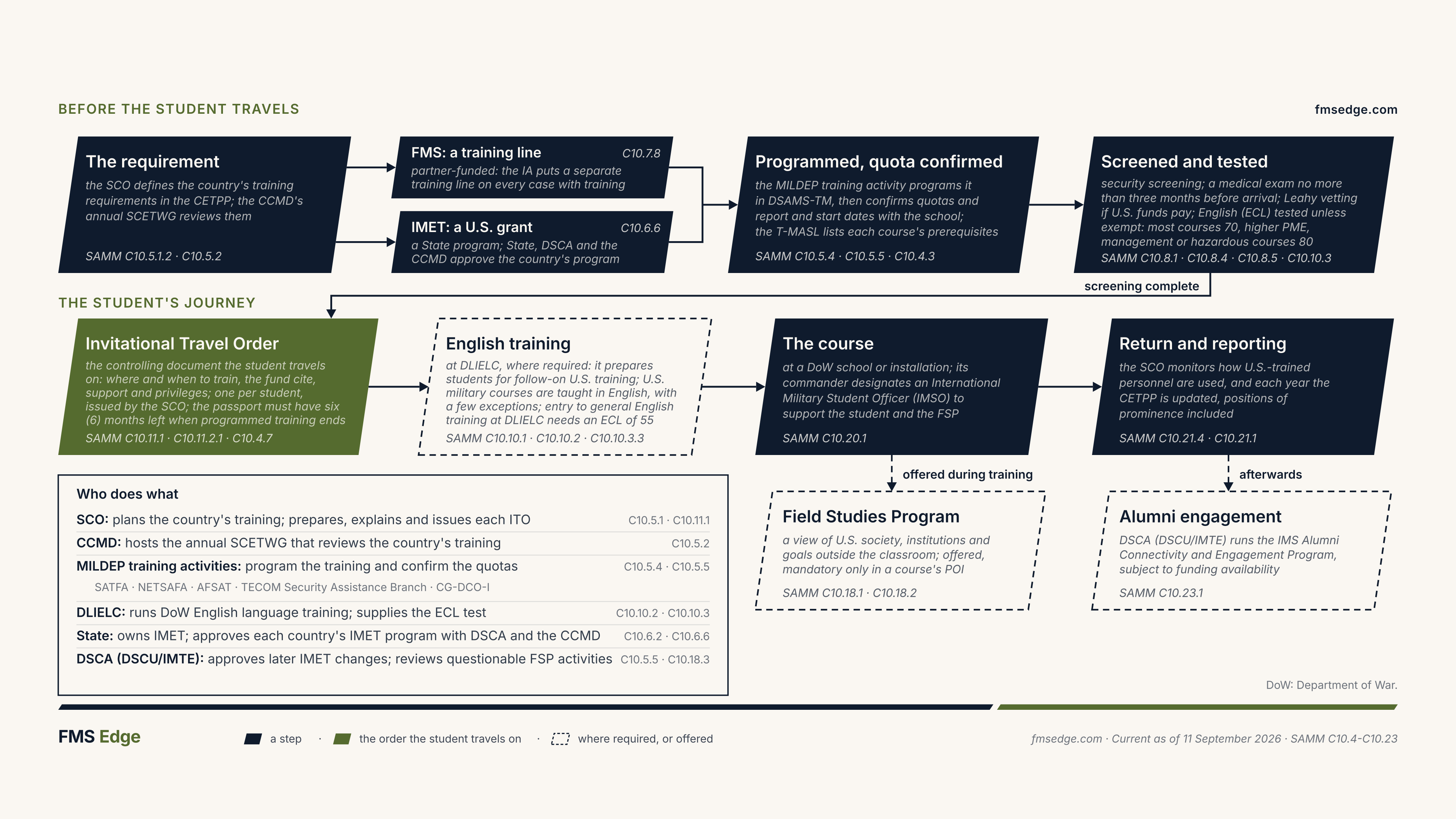
How is military training bought through Foreign Military Sales?
Training can be purchased via a , funded by either host nation funds or U.S. Government () funds such as the Foreign Military Financing Program () [SAMM ].
training cases are developed between the Military Departments () and country representatives, with coordination by the .
Once defined, -funded training requests are entered into the by the military service training activity. training on the carries a Worksheet Control Number (), such as BN-D-YCY989-2004 [SAMM , ]. The implementation procedures are similar to those for International Military Education and Training (). cases normally do not include , as those are the responsibility of the country and are provided to the directly without U.S. involvement. training cases may include a medical services line to cover medical costs incurred by the . Alternatively, the country may decide to not include medical coverage in the case and, instead, have the bills for such services sent to the country’s embassy for payment, or the may obtain health insurance [SAMM , ].
If the country wants the case to pay for or medical care, this must be annotated in the and subsequently written into the [SAMM , ]. Arrangements must be made in advance to cover associated costs such as special clothing and personal equipment either by including such items in the case or having the or ’s government pay for them upon issuance at the training installation [SAMM , ].
The purchaser must make a written request to include on an case or a case funded by Foreign Military Financing. The must make sure that the case holds enough funding for it. If the case funding falls short, the purchaser needs to submit a adding the funds for to the case [SAMM ].
The will make sure that every case involving training has a separate training line. That includes a materiel-only case whose training cost is embedded in the materiel contract. Training lines of minimal dollar value are authorized on Building Partner Capacity () and cases so that students can be accounted for in the Defense Management System () Training Module (DSAMS-TM), for reporting to Congress. The will create in the training tracks that go with each training line, including those for regional programs and for contractor training given at contractor facilities. In a regional program, each participating country requires its own training line on the case [SAMM ].
Training is an integral part of a to building partner capability or capacity. Countries that purchase or otherwise receive U.S. military equipment are encouraged to consider the training requirements while planning to integrate the new equipment or weapon systems into their inventory. Training must be considered when estimating delivery dates of equipment, and deliveries may be adjusted so that foreign personnel have the training and skills to meet operational requirements [SAMM ].
Training programs must consider the absorption capacity of the host nation; the availability of qualified personnel; the skills to be developed, to include English language training; and the time required to plan, implement, and complete any additional individual and unit training once equipment is delivered [SAMM ].
training is provided through the normal process either on a training line of the case for the system sale or on a separate training case, written as a Defined Order or a Blanket Order. Blanket Order cases give more flexibility for a major system purchase or an annual training program, and the manual prefers a for training [SAMM , , ].
A Defined Order should include a confirmed schedule that places personnel in specific training courses. Where that is not feasible, the should set out training plans and schedules in general terms and show that the training needs are to be defined later. A Blanket Order for training includes notes explaining what it covers and how courses are to be definitized and requested. Every must specify the purchaser's responsibilities, such as providing housing, insurance, pay and allowances, medical expenses, qualified students and any required supervision of them [SAMM ].
Students may be trained at Department of War (DoW) schools, at contractor facilities in the , Outside the (), or, by exception, at civilian education institutions. Training at a civilian institution should be arranged through Direct Commercial Sales () between the institution and the purchasing country rather than through . A request for an exception to this policy should go to the , to the International Military Training and Education Division of its Defense University (/IMTE). International military personnel may not use U.S. military facilities to support training that their country has negotiated directly with a vendor through [SAMM ].
Training on a materiel case
Training is also included or embedded in U.S. Army materiel cases managed by the life-cycle management commands of the Army Materiel Command (). The U.S. Army Command (), under , is responsible for non-institutional training in approved materiel programs, and the Training Field Activity (), under the U.S. Army Training and Doctrine Command (), is responsible for approved institutional training [SAMM ].
The three major systems commands of the U.S. Navy (), the Naval Sea Systems Command (), the Naval Air Systems Command () and the Naval Information Warfare Systems Command (), have organic training managers for training associated with each command’s system sales. Their case managers develop data for training provided by the material prime contractor. When training under an case includes resident training or contractor training other than the material prime contractor, the case manager coordinates cost and availability data with the Naval Education and Training Field Activity (). case managers also coordinate with so that all training associated with the case is programmed into the , which allows authorization.
The U.S. Air Force () also includes training in materiel cases managed by its Air Force Life Cycle Management Center () and Air Force Sustainment Center (). These training lines are developed, managed, and implemented by the Air Force Training Squadron () [SAMM ].
Can Foreign Military Financing pay for training?
A blanket order training case can be funded with Foreign Military Financing () program funds [SAMM ]. Some of the constraints and restrictions placed on the program do not apply under [SAMM ]. For example, there is no requirement to obtain a waiver for a funded by [SAMM ].
funds can pay for support items such as training and repair parts as well as for the acquisition of a new .
Implementation of an -funded case mirrors that of host nation-funded cases except that funds are paying for the training.
In exceptional situations, may be included on an -funded case [SAMM ].
If a case is funded by , its training must be provided by U.S. suppliers unless an offshore procurement waiver is granted [SAMM ].
What does training cost under Foreign Military Sales?
The same U.S. military course has five tuition prices, and who pays decides which. Training financed by the IMET appropriation is priced at Rate E, training on a case financed with U.S. appropriated funds at Rate D, and a partner buying with its own funds pays Rate B, Rate C or the full Rate A.
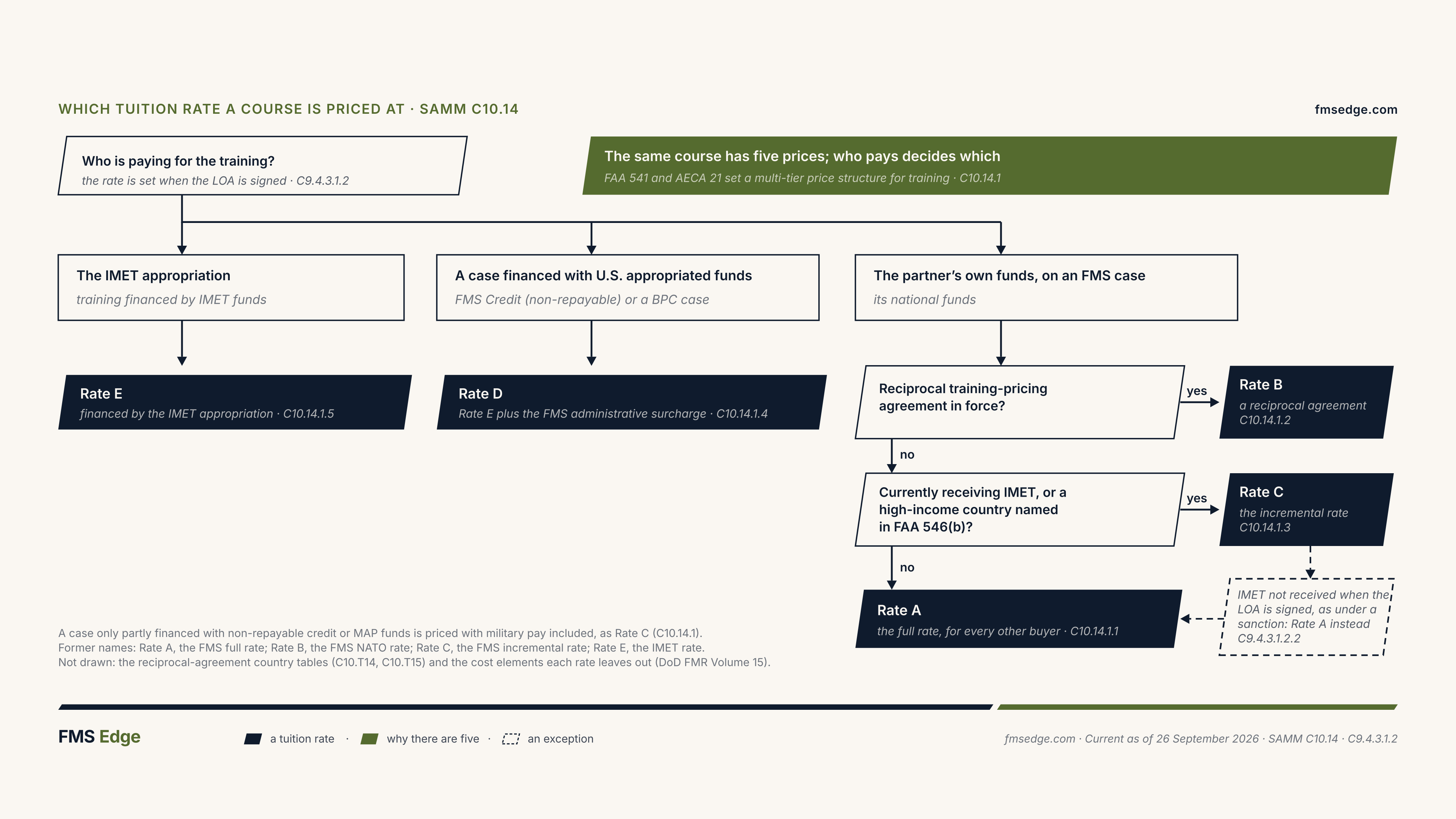
Section 541, Foreign Assistance Act (), and Section 21, , prescribe a multi-tier tuition pricing structure for training. The separate tuition rates for the same course differ because various cost elements have been authorized by law to be excluded or charged at an incremental rate based on various tuition rate categories [SAMM ] [].
DoW policy describing the various tuition rate categories and for developing tuition prices for international students is contained in 7000.14-R, Financial Management Regulation, Volume 15, Chapter 7 [SAMM ]. C10.14 explains the five tuition rate categories:
Rate A is the tuition price charged to countries not eligible for any of the other rate categories. These are full-cost cash customers [SAMM ].
Rate A applies to organizations as well as countries that buy training on an case and are eligible for none of the other pricing categories [SAMM ].
Countries with a ratified reciprocal training pricing agreement with the that are purchasing training via an case are charged Rate B. Tables C10.T14 and C10.T15 list the countries and effective dates of the reciprocal agreements. (Note that some of these countries are also eligible for Rate C.) Rate B does not apply only to North Atlantic Treaty Organization () countries [SAMM ].
Rate C is the tuition price charged to countries that are (1) currently authorized to receive funds and will be using country funds to purchase the training or (2) designated as a high-income foreign country in accordance with the [SAMM ]. A country not in receipt of when its is signed, for example because its program is suspended by sanction, is charged Rate A [SAMM ].
The manual names Austria, Finland, the Republic of Korea, Singapore and Spain as the high-income foreign countries designated under Section 546(b), . Organizations that receive or buy training under Section 607, , also qualify for Rate C. The Allocation Database System (), which 's Office of Business Operations () maintains, identifies the countries receiving . Questions about a country's status go to () [SAMM ].
Training on a case financed with U.S.-appropriated funds receives Rate D. cases funded by U.S.-appropriated funds include cases using Credit (non-repayable) and program authorities. This tuition rate is identical to Rate E except that the administrative surcharge will be applied to it [SAMM ].
Rate E is the tuition price charged when program funds are used [SAMM ].
The total cost of training includes all associated costs to include the Training () tuition price, paid to , medical and dental costs, special clothing, and personal equipment items not included in the tuition, etc. Any of these articles and services to be furnished by the U.S. training facility, which are not included in the tuition price, must be identified and included as specific items to be funded in the training case, or reimbursed in cash by the student or the participating government [SAMM , , ].
References
SAMM
- SAMM C10.1.5
- SAMM C10.4.4: Worksheet Control Number.
- SAMM C10.4.5: Standard Training List.
- SAMM C2.1.6.2.2
- SAMM C10.9.1: Healthcare Coverage While in the United States.
- SAMM C10.13.2.1
- SAMM C10.20.2: Uniforms and Personal Clothing.
- SAMM C10.1.3
- SAMM C2.1.6.2.3
- SAMM C10.7.4: Location of Training for Foreign Military Sales Case Students.
- SAMM C1.3.2.6.1.1.3: Responsibilities.
- SAMM C1.3.2.6.1.3.3.1
- SAMM C10.6.5: Types of Training that May Not Be Provided under the International Military Education and Training Program.
- SAMM C10.6.3.3: Mobile Training Teams.
- SAMM C10.13.2: Travel and Living Allowance on Foreign Military Sales and Foreign Military Financing Funded Letters of Offer and Acceptance.
- SAMM C10.14.1
- SAMM C10.14.1.2: Rate B (Formerly Foreign Military Sales North Atlantic Treaty Organization Rate).
- SAMM C10.T14: NATO Reciprocal Agreement Participants
- SAMM C10.T15: Other Reciprocal Agreement Participants
- SAMM C10.14.1.3: Rate C (Formerly Foreign Military Sales Incremental Rate).
- SAMM C9.4.3.1.2.2
- SAMM C10.14.1.4: Rate D.
- SAMM C10.14.1.5: Rate E (Formerly International Military Education and Training Rate).
- SAMM C10.7.5: Travel and Living Allowance, Medical Care Requirements, and Other Costs for Foreign Military Sales Case International Military Students.
- SAMM C10.7.8
- SAMM C5.6.5.4.9: Schedule of Personnel Training.
- SAMM C10.7.1: Foreign Military Financing-Funded Training.
- SAMM C10.14.1.1: Rate A (Formerly Foreign Military Sales Full Rate).
Public authorities
- AECA §21: Arms Export Control Act of 1976, as amended, §21 (22 U.S.C. §2761)
Related
Foreign Military Sales (FMS)
The part of U.S. security assistance, authorized by the Arms Export Control Act (AECA), in which eligible foreign governments and international organizations buy defense articles, services and training from the U.S. Government under formal government-to-government agreements.
The articles come either from Department of War stocks or from new procurement under contracts the Department manages [22 U.S.C. 2761, 22 U.S.C. 2762]. A sale is FMS whatever the source of the purchaser's financing.
FMS Edge glossary, as of 10 October 2026
Glossary entry →Open the manual’s entry → (opens in new tab)
Foreign Military Sales (FMS) Case
A Letter of Offer and Acceptance (LOA) that the purchaser has accepted, together with every Amendment and Modification later made to it: the agreement under which the U.S. Government transfers defense articles and services in the Foreign Military Sales (FMS) program.
FMS Edge glossary, as of 10 October 2026
Glossary entry →Open the manual’s entry → (opens in new tab)
FMFP: Foreign Military Financing Program
FMS: Foreign Military Sale
SAMM Acronyms, as of 12 September 2026
Military Department (MILDEP)
One of the departments within the DoD created by the National Security Act of 1947, as amended. The Military Departments are: the Department of the Air Force, the Department of the Army, and the Department of the Navy.
SAMM Glossary, as of 12 September 2026
Glossary entry →Open the manual’s entry → (opens in new tab)
Security Cooperation Organization (SCO)
A Department of Defense element that is part of the United States Diplomatic mission located in a foreign country to carry out security assistance and security cooperation management functions under the supervision and coordination authority of the senior defense official/defense attaché.
SAMM Glossary, as of 12 September 2026
Glossary entry →Open the manual’s entry → (opens in new tab)
Standard Training List (STL)
List of all the Security Cooperation training courses that a country has requested from DoD and the status of the courses.
SAMM Glossary, as of 12 September 2026
Glossary entry →Open the manual’s entry → (opens in new tab)
STL: Standard Training List
SAMM Acronyms, as of 12 September 2026
IMET: International Military Education and Training
SAMM Acronyms, as of 12 September 2026
Travel and Living Allowance (TLA) (International Military Students)
Those costs associated with transportation, baggage, and living allowances of International Military Students, which are authorized for payment under Security Assistance and Security Cooperation training programs. See also "Living Allowance" and "Travel Allowance."
SAMM Glossary, as of 12 September 2026
Glossary entry →Open the manual’s entry → (opens in new tab)
International Military Student (IMS)
A national of a foreign government, with military or civilian status of that government, who is receiving education or training or is touring USG activities under the sponsorship of the security assistance training program.
SAMM Glossary, as of 12 September 2026
Glossary entry →Open the manual’s entry → (opens in new tab)
TLA: Travel and Living Allowance
SAMM Acronyms, as of 12 September 2026
Letter of Request (LOR)
The term used to identify a request from an eligible FMS participant country for the purchase of U.S. defense articles and services. The request may be in message or letter format.
SAMM Glossary, as of 12 September 2026
Glossary entry →Open the manual’s entry → (opens in new tab)
Letter of Offer and Acceptance (LOA)
The legal instrument that lists the defense articles and services, including training, that the U.S. Government transfers to a foreign country or international organization, with their estimated costs and the terms and conditions. The benefitting partner does not sign a Building Partner Capacity (BPC) LOA.
The Letter of Offer and Acceptance (LOA) is the instrument the U.S. Government uses to sell under the Arms Export Control Act (AECA); signed LOAs and their later Amendments and Modifications are also called Foreign Military Sales (FMS) cases [SAMM C5.6.1].
FMS Edge glossary, as of 10 October 2026
Glossary entry →Open the manual’s entry → (opens in new tab)
SCO: Security Cooperation Organization
SAMM Acronyms, as of 12 September 2026
Implementing Agency (IA)
The military department or defense agency responsible for the execution of military assistance programs. With respect to FMS, the military department or defense agency assigned responsibility by the Defense Security Cooperation Agency to prepare an LOA and to implement an FMS case. The implementing agency is responsible for the overall management of the actions that will result in delivery of the materials or services set forth in the LOA that was accepted by a foreign country or international organization.
SAMM Glossary, as of 12 September 2026
Glossary entry →Open the manual’s entry → (opens in new tab)
Security Assistance (SA)
A group of programs authorized by federal statutes by which the United States provides defense articles, military training, and other defense-related services by grant, lease, loan, credit, or cash sales in furtherance of national policies and objectives, and those that are funded and authorized through the Department of State to be administered by Department of Defense/Defense Security Cooperation Agency, which are considered part of security cooperation.
SAMM Glossary, as of 12 September 2026
Glossary entry →Open the manual’s entry → (opens in new tab)
DSAMS: Defense Security Assistance Management System
SAMM Acronyms, as of 12 September 2026
Glossary entry →Defense Security Assistance Management Systems (DSAMS) →
Total Package Approach (TPA)
A means of ensuring that Foreign Military Sales customers are aware of and are given the opportunity to plan for and obtain needed support items, training, and services from the USG contractors, or from within the foreign country's resources which are required to introduce and operationally sustain major items of equipment or systems.
SAMM Glossary, as of 12 September 2026
Glossary entry →Open the manual’s entry → (opens in new tab)
Blanket Order Case (Foreign Military Sales)
A Foreign Military Sales (FMS) case for a category of defense articles or services, training included, with no definitive list of items or quantities, written against a dollar ceiling.
A Blanket Order case remains in effect until the purchaser has requisitioned articles or services up to the funds available on it [SAMM C5.6.13.4].
FMS Edge glossary, as of 10 October 2026
Glossary entry →Open the manual’s entry → (opens in new tab)
LOA: Letter of Offer and Acceptance
SAMM Acronyms, as of 12 September 2026
Continental United States (CONUS)
U.S. territory, including the adjacent territorial waters, located within the North American continent between Canada and Mexico. Does not include Hawaii or Alaska.
SAMM Glossary, as of 12 September 2026
Glossary entry →Open the manual’s entry → (opens in new tab)
DCS: Direct Commercial Sales
SAMM Acronyms, as of 12 September 2026
Defense Security Cooperation Agency (DSCA)
The Department of War agency that directs, administers and provides guidance to the Department's components and its representatives at U.S. missions for the execution of the security cooperation programs for which it is responsible [SAMM C1.3.2.2]. The agency also provides financial and technical assistance, arranges the transfer of defense materiel, training and services to international partners, and promotes military-to-military contacts.
FMS Edge glossary, as of 10 October 2026
Glossary entry →Open the manual’s entry → (opens in new tab)
Security Cooperation
Activities by which the Department of War encourages and enables international partners to cooperate with the United States toward strategic objectives, spanning every interaction with foreign defense and security establishments and every security assistance program the Department administers.
Under chapter 16 of Title 10, their purposes are to develop allied and friendly security capabilities for self-defense and multinational operations, to give U.S. forces peacetime and contingency access, and to build relationships promoting specific U.S. security interests [10 U.S.C. 301(7)].
FMS Edge glossary, as of 10 October 2026
Glossary entry →Open the manual’s entry → (opens in new tab)
AMC: Army Materiel Command
SATFA: Security Assistance Training Field Activity (SATFA)
SAMM Acronyms, as of 12 September 2026
Price and Availability (P&A)
Preliminary pricing and availability estimates for articles or services that an Implementing Agency (IA) prepares at the request of a foreign government or international organization for an international competition, or of a U.S. Government requesting authority for building partner capacity.
Price and Availability (P&A) responses are estimates of cost and availability, not valid for preparing a Letter of Offer and Acceptance (LOA), and furnishing them does not commit the U.S. Government to offer the articles or services for sale [SAMM C5.5.2, C5.5.1].
FMS Edge glossary, as of 10 October 2026
Glossary entry →Open the manual’s entry → (opens in new tab)
NETSAFA: Naval Education and Training Security Assistance Field Activity (NETSAFA)
SAMM Acronyms, as of 12 September 2026
Invitational Travel Order (ITO)
A written authorization (DD Form 2285) for International Military Students to travel to, from, and between U.S. activities for the purpose of training under an approved and funded International Military Education and Training or Foreign Military Sales program.
SAMM Glossary, as of 12 September 2026
Glossary entry →Open the manual’s entry → (opens in new tab)
AFSC: Air Force Sustainment Center
AFSAT: Air Force Security Assistance Training Squadron (AFSAT)
SAMM Acronyms, as of 12 September 2026
Mobile Training Team (MTT)
A team of Department of War personnel on temporary duty in a partner country to train its personnel in skills tied to operating, maintaining or supporting weapon systems, in tactical or operational military skills, or in building a self-training capability.
Mobile Training Teams (MTTs), made up of Department of War personnel, contract personnel or both, train foreign personnel in the operation, maintenance or support of weapon systems and support equipment, or for specific needs beyond in-country U.S. resources [SAMM C10.22.5].
FMS Edge glossary, as of 10 October 2026
Glossary entry →Open the manual’s entry → (opens in new tab)
End Item
A finished combination of end products, component parts or materials, assembled or completed and ready for its intended use, issue or deployment, such as an aircraft, a truck, a mobile generator or a rifle.
FMS Edge glossary, as of 10 October 2026
Glossary entry →Open the manual’s entry → (opens in new tab)
Arms Export Control Act (AECA)
The basic U.S. law providing the authority and general rules for the conduct of Foreign Military Sales and commercial sales of defense articles, defense services, and training. The Arms Export Control Act (AECA) came into existence with the passage of the Foreign Military Sales Act (FMSA) of 1968. An amendment in the International Security Assistance and AECA of 1976 changed the name of FMSA to the AECA.
SAMM Glossary, as of 12 September 2026
Glossary entry →Open the manual’s entry → (opens in new tab)
SAMM: Security Assistance Management Manual
SAMM Acronyms, as of 12 September 2026
Glossary entry →Security Assistance Management Manual (SAMM) →
DSCA: Defense Security Cooperation Agency
SAMM Acronyms, as of 12 September 2026
Glossary entry →Defense Security Cooperation Agency (DSCA) →
Military Articles And Services List (MASL)
A catalogue of materiel, services, and training used in the planning and programming of International Military Education and Training (IMET), and Foreign Military Sales (FMS). Separate MASLs are maintained for IMET and FMS training that provides data on course identification, course availability, price, and duration of training.
SAMM Glossary, as of 12 September 2026
Glossary entry →Open the manual’s entry → (opens in new tab)
Training Military Articles and Services Listing (T-MASL)
The master list of formal training available to the international community. It contains course descriptions, prerequisites, duration (in weeks), location, cost, international notes, special medical and health coverage information (e.g. medical paperwork required for Fast Track countries), dependent authorization, English language prerequisites and a training analysis code signifying the type of training.
SAMM Glossary, as of 12 September 2026
Glossary entry →Open the manual’s entry → (opens in new tab)
SAMM C10.1.5
“Eligible foreign governments or international organizations may purchase training with their national funds through the Foreign Military Sales (FMS) program. They may also obtain training using USG funds provided by SA appropriations such as the International Military Education and Training (IMET) program, Foreign Military Financing (FMF), and Peacekeeping Operations (PKO). SA Programs are further defined in Section C1.1.2.2.”
Security Assistance Management Manual, as of 11 September 2026
SAMM C10.4.4: Worksheet Control Number.
“The Worksheet Control Number (WCN) is a four-digit identifier, used in conjunction with the training analysis codes, to identify each IMS or training team incorporated into a training program. The WCN is assigned when the MILDEP programs a specific course requested by a MILGP for a given country. Sequential training programmed for the same IMS is indicated by an alphabetic …”
Security Assistance Management Manual, as of 26 October 2026
SAMM C10.4.5: Standard Training List.
“The consolidation of requested training for a country is called a Standard Training List (STL). An STL is a list of a country’s training, by program type, by fiscal year for each MILDEP.”
Security Assistance Management Manual, as of 11 September 2026
SAMM C2.1.6.2.2
“As with IMET, FMS-funded training requests are entered into the MILDEP training activities computer system Defense Security Assistance Management System - Training Module (DSAMS-TM). The FMS implementation procedures are similar to those for IMET. However, FMS cases may include Travel and Living Allowance (TLA) only when the purchaser requests it in their LOR as TLA is normally the responsibility of …”
Security Assistance Management Manual, as of 26 October 2026
SAMM C10.9.1: Healthcare Coverage While in the United States.
“IMSs who are not participating in a USG funded program and authorized dependents for all IMSs are required to have foreign government provided healthcare coverage while in the United States. A foreign government must establish healthcare coverage by electing whether to: provide an indemnification letter; arrange for payment of potential healthcare costs though a Foreign Military Sales (FMS) case; or …”
Security Assistance Management Manual, as of 11 September 2026
SAMM C10.13.2.1
“The FMS purchaser must provide a written request to include TLA on a given FMS/FMF case. The U.S. Military Group (MILGP) must ensure there is adequate case funding. If the case does not include adequate case funding, the FMS purchaser needs to provide a Letter of Request (LOR) to include the additional funds for TLA on the FMS/FMF case.”
Security Assistance Management Manual, as of 26 October 2026
SAMM C5.6.5.4.9: Schedule of Personnel Training.
“Defined order LOAs should include a confirmed schedule of personnel into specific training courses. When this is not feasible, LOAs should set forth training plans and schedules in general terms and should show the need to define training needs at a later date. Blanket Order LOAs for training include notes to explain the scope of coverage and methods for definitizing …”
Security Assistance Management Manual, as of 11 September 2026
SAMM C10.20.2: Uniforms and Personal Clothing.
“Uniforms or items of personal clothing, other than special items of training clothing or equipment (such as flying training gear when included in course cost) may not be provided on a grant basis. IMSs and/or countries may purchase such items under a Foreign Military Sales (FMS) case funded with national funds.”
Security Assistance Management Manual, as of 11 September 2026
SAMM C10.7.8
“The IA will ensure there is a separate training line included on every case that involves training, including materiel-only cases where the cost of the training is embedded in the materiel contract. Minimal-dollar value training lines for Building Partner Capacity (BPC) or FMS cases are authorized for the purpose of student accounting in Defense Security Assistance Management System - Training …”
Security Assistance Management Manual, as of 11 September 2026
SAMM C10.1.3
“Training is an integral part of a total package approach (TPA) to building partner capability or capacity, and training must be considered when estimating delivery dates of equipment or resourcing any capacity building programs. Adjustments to deliveries may be necessary to ensure that foreign personnel have the training and skills to meet operational requirements. Training programs must consider the absorption …”
Security Assistance Management Manual, as of 11 September 2026
SAMM C2.1.6.2.3
“A Blanket Order case is the preferred vehicle for providing FMS training because it provides flexibility in defining training requirements, can accommodate the numerous changes that often occur, and does not require a definitive listing of training items or quantities.”
Security Assistance Management Manual, as of 11 September 2026
SAMM C10.7.4: Location of Training for Foreign Military Sales Case Students.
“Students may be trained at DoW schools, contractor facilities in the continental United States (CONUS), or Outside the Continental United States (OCONUS), or civilian education institutions (on an exception basis). Training at civilian education institutions should be on a Direct Commercial Sales (DCS) basis between the civilian institution and the purchasing country vice through the FMS process. Requests for exceptions …”
Security Assistance Management Manual, as of 26 October 2026
SAMM C1.3.2.6.1.1.3: Responsibilities.
“The DASA (DE&C) leads, manages, resources, and directs assigned elements of the Army’s global SC activities, including policy and strategy, for Foreign Military Sales (FMS), foreign military and foreign national training and education, international armaments cooperation, non-special access program (SAP) technology transfer, and export policy. The DASA (DE&C) ensures that all ASA (ALT) managed SC programs are conducted according to …”
Security Assistance Management Manual, as of 26 October 2026
SAMM C1.3.2.6.1.3.3.1
“The DAF further delegates the following responsibilities to accomplish security cooperation objectives. Professional military education (PME), exercises, training and access to airspace and ranges is aligned under the responsibilities of the Air Education and Training Command (AETC) and Air Force Security Assistance Training Squadron (AFSAT). Material and service support to article procurement, operations, maintenance, and sustainment programs are aligned under …”
Security Assistance Management Manual, as of 26 October 2026
SAMM C10.6.5: Types of Training that May Not Be Provided under the International Military Education and Training Program.
“Table C10.T4. illustrates the types of training that cannot be provided under the IMET program. These restrictions apply only to training funded through the IMET program and will be adjusted to reflect the current language in the State IMET Grant-Military Assistance Guide (G-MAG). Any request for exception must be submitted through the CCMD to DSCA (DSCU/IMTE). Table C10.T4. Types of …”
Security Assistance Management Manual, as of 26 October 2026
SAMM C10.6.3.3: Mobile Training Teams.
“The IMET program may provide training that requires U.S. personnel to conduct training in another country when the CCMD and DSCA have approved a policy waiver, or where a waiver exception exists. Training services may be provided in-country on a temporary duty (TDY) basis by a Mobile Training Team (MTT). To include such training under the IMET program, the CCMD …”
Security Assistance Management Manual, as of 11 September 2026
SAMM C10.13.2: Travel and Living Allowance on Foreign Military Sales and Foreign Military Financing Funded Letters of Offer and Acceptance.
“TLA is normally not part of a Foreign Military Sales (FMS)/Foreign Military Financing (FMF) case (See Section C4.5.1.). However, in exceptional situations, it may be included if the IMS’s travel is associated with formal or informal training, instruction, evaluations, or field training exercises that are part of the case and impart military skills to the IMS.”
Security Assistance Management Manual, as of 11 September 2026
SAMM C10.7.1: Foreign Military Financing-Funded Training.
“If the case is Foreign Military Financing (FMF)-funded, training must be by U.S. suppliers unless an offshore procurement waiver is granted.”
Security Assistance Management Manual, as of 11 September 2026
SAMM C10.14.1
“Foreign Assistance Act (FAA), Section 541 (22 U.S.C. 2347) and Arms Export Control Act (AECA), Section 21 (22 U.S.C. 2761), establish the legal basis for a multi-tier pricing structure for training provided under the U.S. security assistance (SA) authorities. Department of War Financial Management Regulation (DoW FMR), DoW 7000.14-R, Volume 15, Chapter 7, addresses training rates and pricing procedures. When …”
Security Assistance Management Manual, as of 26 October 2026
Arms Export Control Act of 1976, as amended, §21 (22 U.S.C. §2761)
AECA §21 · Statute
SAMM C10.14.1.1: Rate A (Formerly Foreign Military Sales Full Rate).
“Countries and organizations purchasing training via an FMS case and not eligible for one of the FMS pricing categories listed below are charged Rate A.”
Security Assistance Management Manual, as of 11 September 2026
SAMM C10.14.1.2: Rate B (Formerly Foreign Military Sales North Atlantic Treaty Organization Rate).
“Countries with a ratified reciprocal pricing agreement with the USG purchasing training via an FMS case are charged Rate B. Table C10.T14. lists the countries and effective dates of the reciprocal agreements. Note that some of these countries are also eligible for Rate C. Table C10.T14. NATO Reciprocal Agreement Participants Country Effective Date Albania (ALB) JAN 2015 Belgium (BEL) MAR …”
Security Assistance Management Manual, as of 26 September 2026
SAMM C10.14.1.3: Rate C (Formerly Foreign Military Sales Incremental Rate).
“Countries currently in receipt of International Military Education and Training (IMET) or designated as a high-income foreign country, in accordance with the FAA, Section 546(b) (22 U.S.C. 2347e(b) (Austria, Finland, the Republic of Korea, Singapore, and Spain) and purchasing training via an FMS case using their own national funds, are eligible for Rate C. DSCA (Office of Business Operations (OBO)) …”
Security Assistance Management Manual, as of 26 October 2026
SAMM C9.4.3.1.2.2
“If a country is not in receipt of IMET funding at the time of LOA acceptance/signature, then the full rate (Rate A) for education and training is to be charged.”
Security Assistance Management Manual, as of 11 September 2026
SAMM C10.14.1.4: Rate D.
“Training on a case financed with U.S. appropriated funds receives Rate D. Training in this category is on cases financed with FMS Credit (non-repayable) or Building Partner Capacity (BPC) programs. This rate is identical to Rate E except that the FMS administrative surcharge will be applied to it.”
Security Assistance Management Manual, as of 26 October 2026
SAMM C10.14.1.5: Rate E (Formerly International Military Education and Training Rate).
“Training financed by the IMET appropriation is priced at Rate E.”
Security Assistance Management Manual, as of 11 September 2026
SAMM C10.7.5: Travel and Living Allowance, Medical Care Requirements, and Other Costs for Foreign Military Sales Case International Military Students.
“The purchaser is responsible for all IMS support costs (Travel and Living Allowance (TLA) (which include meals, lodging, and incidentals) (see Section C10.13.), medical care requirements (see Section C10.9.), transportation, and other costs) while they are in training. The purchaser must ensure that students receive sufficient allowances (30 days) for advanced start up housing costs and personal expenses. U.S. Military …”
Security Assistance Management Manual, as of 26 October 2026