
Guide
How is an international military student screened before training?
Every invited to Department of War training must complete security, medical and other screening before an or U.S. visa is issued. The embassy team runs local security screening, students who need unescorted access to U.S. installations go through Department of War security vetting and sign consent agreements, and a medical examination and a means of paying for healthcare are required. is a separate check for U.S.-funded training.
An international military student reaches a U.S. course through a chain of plans and paperwork, from the Security Cooperation Organization's requirement to a seat confirmed by the Military Department's training activity. The student travels on an Invitational Travel Order.
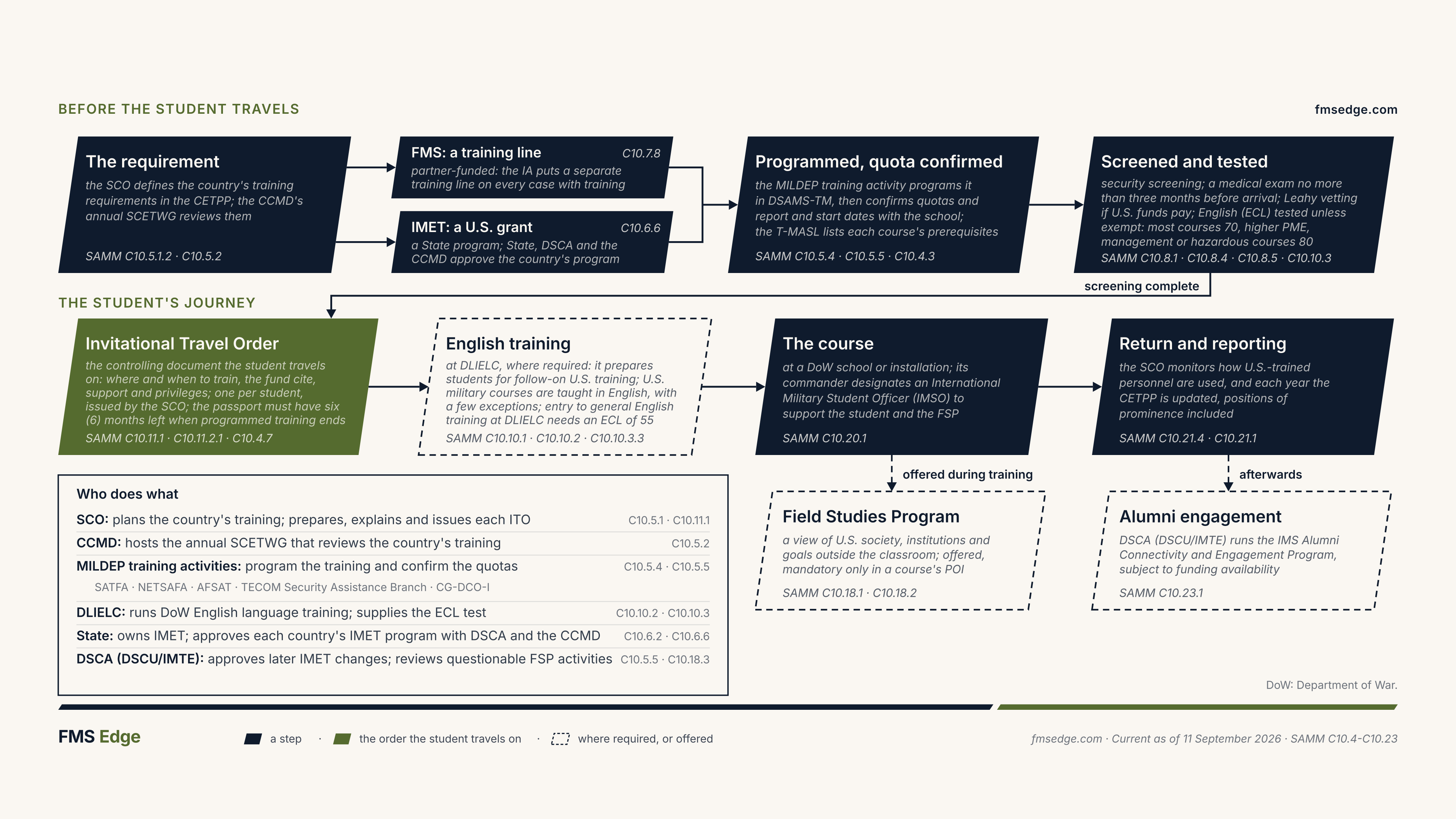
How is an international military student screened before training?
Every invited to Department of War (DoW) training, whatever the program, funding source or security classification of the training, must complete the required security, medical and other screening before a U.S. visa or is issued [SAMM ]. Local security screening applies, as the responsible deems appropriate, to U.S.-based training and to overseas training teams, and DoW security vetting is added for training in the United States. Both aim to keep people with a history of objectionable, unethical or criminal behavior out of U.S.-sponsored training [SAMM , ]. Human rights screening () is a separate requirement for members of foreign security forces nominated for U.S.-funded training, and DoW security vetting does not replace it [SAMM , ].
In most cases, an who does not meet the applicable screening requirements will not be authorized to take part in DoW training or education, and no will be issued. The specific screening may cover security (Section C10.8.3), human rights through (Section C10.8.4) and medical fitness (Section C10.8.5). Some screening factors apply universally, and they include the following [SAMM ]:
- Age: the minimum age for an taking part in training is 18, unless a standard exception waives it (for example, for the Service Academies) [SAMM ]
- Course prerequisites: for all scheduled training, Organizations must make sure that each meets the course prerequisites the Training () gives [SAMM ]
- English language: Organizations must conduct English Comprehension Level () screening and testing for every non-exempt . Choosing qualified candidates who do not need extensive extra English Language Training () significantly cuts training costs and makes the partner nation quicker to respond to training opportunities or personnel substitutions. Each organization should also review in-country programs, if any, so that it can determine and advise how their language labs are used. Section C10.10.3 gives the specific requirements and waiver information [SAMM ]
Who is selected?
Personnel trained under the are selected from career personnel who are likely to hold key positions in the foreign country's defense establishment. The selection rule is mandatory for professional-level schools, for example command and staff schools or their equivalent and higher, and college-level schools. An exception needs authorization from two offices, (/IMTE) and (SPP) [SAMM ]. The must obtain appropriate assurances that -trained personnel are employed properly and effectively in the skill received from the training for long enough to warrant the expense to the United States [SAMM ].
Local security screening
Local security screening is carried out, in coordination with the , by in-country U.S. Government personnel who can search local information sources and official databases, such as the embassy's Regional Security Officer () or Drug Enforcement Administration () personnel. They look for evidence of corruption, drug trafficking, trafficking in persons, criminal conduct, terrorist activity or support, or other activities the United States designates as illegal or objectionable, following a process the embassy team develops and the Ambassador approves [SAMM ]. At each annual review of the , the will update the plan's narrative to describe if and how local screening is built into student selection [SAMM ].
The will not accept a foreign person for any U.S.-sponsored training who does not meet the established local security screening standards, unless the Ambassador or an appropriate Department of State designee approves a waiver in writing [SAMM ].
Department of War security vetting
DoW security vetting is required for an and any accompanying family members (AFMs) who need credentialed recurring access (CRA), that is, unescorted physical access, at a DoW training or education installation in the United States. Unless an exemption applies, it covers courses longer than 14 calendar days, and the installation-owning may also require it for shorter courses [SAMM , ]. The Defense Counterintelligence and Security Agency () conducts the screening and reports on fitness for CRA, and the make the CRA fitness decisions [SAMM ]. Every who requires CRA must sign three consent agreements, covering conduct expectations, privately owned firearms and the monitoring of publicly available electronic information; an adult AFM who requires CRA signs the last two [SAMM ]. The issues an only after confirming that the and AFMs have approved vetting results, or that the has reviewed and accepted the results [SAMM ].
All required DoW security vetting data must be submitted at least 35 days before the report date at the first training location, unless an exemption applies under Section C10.8.3.2.7.5. If the information is not provided in time for the reviews to be completed before the is due to start training, the responsible or may cancel or reschedule the training. Penalty fees may then be collected under the , Volume 15, Chapter 7. An that foresees an exceptional situation that could delay the vetting information must contact the training manager at the geographic to explore contingencies that would avoid a cancellation [SAMM ].
Medical screening and healthcare coverage
The must ensure that the student and any authorized accompanying dependents are medically screened by a qualified physician and dentist to be sure they are physically fit to attend training and have no communicable diseases. The physical examination for the student and every accompanying family member must be completed no more than three months before each person's arrival in the United States [SAMM , , ].
The also must determine how medical coverage will be paid in the event the student and/or accompanying dependents get hurt or sick while in training [SAMM ]. Medical coverage can be paid in the following ways [SAMM , , ]:
1. Foreign Government Indemnification
2.
3. Grant Program (covers the student only)
4. Reciprocal Health Care Agreement (RHCA) or /Partnership for Peace () Status of Forces Agreement () (RHCA and cannot be the only means of coverage. One of the other options must be identified as well in order to cover expenses that are not covered by this option [SAMM ].)
5. Commercial Healthcare Insurance
The will identify, on the student’s , the medical screening date as well as the means of medical coverage for the student and any authorized accompanying dependents [SAMM ].
Before departure
Before the student departs, the will ensure that the student receives a thorough oral pre-departure briefing covering all areas of concern to the student and to any dependents authorized on the , including the and its objectives. The will also provide the receiving training installation with the student's arrival details ahead of the arrival date, with a longer lead time when dependents accompany the student, so that the Officer () can arrange a proper reception [].
References
SAMM
- SAMM C10.8.3.2.1
- SAMM C10.8.3.2.3
- SAMM C10.8.5.2.7: Dental Examination.
- SAMM C10.8.5.8.1.1
- SAMM C10.9.1.3.1
- SAMM C10.9.1.4.1
- SAMM C10.9.7.2
- SAMM C10.8.1: General.
- SAMM C10.8.3: Security Screening and Vetting.
- SAMM C10.8.3.1.1
- SAMM C10.8.3.1.2
- SAMM C10.8.3.1.3
- SAMM C10.8.3.2.2
- SAMM C10.8.3.2.5.2
- SAMM C10.8.3.2.7.2
- SAMM C10.8.3.2.8.1
- SAMM C10.8.3.2.8.6
- SAMM C10.8.4: Human Rights Screening (Leahy Vetting).
- SAMM C10.8.5: Student Medical Examination Screening.
- SAMM C10.9: Healthcare Coverage.
- SAMM C10.9.1: Healthcare Coverage While in the United States.
- SAMM C10.6.4.1: Career Personnel.
- SAMM C10.6.8: Employment of International Military Education and Training Graduates.
Public authorities
- AR 12-15: Joint Security Cooperation Education and Training (JSCET), Army Regulation 12-15, also issued as SECNAVINST 4950.4B and AFI 16-105 (3 January 2011; administrative revision 18 March 2025)
Facts referenced
- Minimum age of an international military student who may participate in security cooperation training, unless waived by standard exception: 18 (as of 26 October 2026; SAMM C10.8.1)
- Course length above which Department of War security vetting is required for an international military student, and accompanying family members, who need credentialed recurring access at a DoW training or education installation in the United States: 14 calendar days (as of 26 October 2026; SAMM C10.8.3.2.2)
- Minimum days before an international military student's report date at the first training location by which all required Department of War security vetting data must be submitted, unless exempted under SAMM C10.8.3.2.7.5: 35 days (as of 26 October 2026; SAMM C10.8.3.2.7.2)
- Latest time before arrival in the United States at which the physical exam for the IMS and every accompanying family member may be completed for an ITO to be issued: three months (as of 11 September 2026; SAMM C10.8.5)
Related
International Military Student (IMS)
A national of a foreign government, with military or civilian status of that government, who is receiving education or training or is touring USG activities under the sponsorship of the security assistance training program.
SAMM Glossary, as of 12 September 2026
Glossary entry →Open the manual’s entry → (opens in new tab)
Invitational Travel Order (ITO)
A written authorization (DD Form 2285) for International Military Students to travel to, from, and between U.S. activities for the purpose of training under an approved and funded International Military Education and Training or Foreign Military Sales program.
SAMM Glossary, as of 12 September 2026
Glossary entry →Open the manual’s entry → (opens in new tab)
Leahy Vetting
The U.S. government process to assess whether there is credible information that a specific individual or a specific security force unit has committed a gross violation of human rights.
SAMM Glossary, as of 12 September 2026
Glossary entry →Open the manual’s entry → (opens in new tab)
Country Team
The senior coordinating and supervising body of a U.S. diplomatic mission, headed by the chief of mission (normally the ambassador) and made up of the senior representative of each U.S. department or agency at the post. Its members meet regularly to coordinate U.S. Government political, economic and military activities and policies in the host country.
FMS Edge glossary, as of 10 October 2026
Glossary entry →Open the manual’s entry → (opens in new tab)
ITO: Invitational Travel Order
SAMM Acronyms, as of 12 September 2026
Security Cooperation
Activities by which the Department of War encourages and enables international partners to cooperate with the United States toward strategic objectives, spanning every interaction with foreign defense and security establishments and every security assistance program the Department administers.
Under chapter 16 of Title 10, their purposes are to develop allied and friendly security capabilities for self-defense and multinational operations, to give U.S. forces peacetime and contingency access, and to build relationships promoting specific U.S. security interests [10 U.S.C. 301(7)].
FMS Edge glossary, as of 10 October 2026
Glossary entry →Open the manual’s entry → (opens in new tab)
Military Articles And Services List (MASL)
A catalogue of materiel, services, and training used in the planning and programming of International Military Education and Training (IMET), and Foreign Military Sales (FMS). Separate MASLs are maintained for IMET and FMS training that provides data on course identification, course availability, price, and duration of training.
SAMM Glossary, as of 12 September 2026
Glossary entry →Open the manual’s entry → (opens in new tab)
Training Military Articles and Services Listing (T-MASL)
The master list of formal training available to the international community. It contains course descriptions, prerequisites, duration (in weeks), location, cost, international notes, special medical and health coverage information (e.g. medical paperwork required for Fast Track countries), dependent authorization, English language prerequisites and a training analysis code signifying the type of training.
SAMM Glossary, as of 12 September 2026
Glossary entry →Open the manual’s entry → (opens in new tab)
International Military Education And Training (IMET) Program
A grant program of the Department of State, carried out by the Department of War under the Foreign Assistance Act (FAA), that funds education and training for foreign military personnel and selected civilian officials in the United States or overseas.
The International Military Education and Training (IMET) program is a Department of State program, jointly managed by the Defense Security Cooperation Agency (DSCA) and the Department of State, whose courses are given mainly at military schoolhouses in the United States [SAMM C10.6.1].
FMS Edge glossary, as of 10 October 2026
Glossary entry →Open the manual’s entry → (opens in new tab)
Defense Security Cooperation Agency (DSCA)
The Department of War agency that directs, administers and provides guidance to the Department's components and its representatives at U.S. missions for the execution of the security cooperation programs for which it is responsible [SAMM C1.3.2.2]. The agency also provides financial and technical assistance, arranges the transfer of defense materiel, training and services to international partners, and promotes military-to-military contacts.
FMS Edge glossary, as of 10 October 2026
Glossary entry →Open the manual’s entry → (opens in new tab)
DSCA: Defense Security Cooperation Agency
SAMM Acronyms, as of 12 September 2026
Glossary entry →Defense Security Cooperation Agency (DSCA) →
Security Cooperation Organization (SCO)
A Department of Defense element that is part of the United States Diplomatic mission located in a foreign country to carry out security assistance and security cooperation management functions under the supervision and coordination authority of the senior defense official/defense attaché.
SAMM Glossary, as of 12 September 2026
Glossary entry →Open the manual’s entry → (opens in new tab)
IMET: International Military Education and Training
SAMM Acronyms, as of 12 September 2026
SCO: Security Cooperation Organization
SAMM Acronyms, as of 12 September 2026
Combined Education and Training Program Plan (CETPP)
A plan each Security Cooperation Organization (SCO) prepares with host-country counterparts that consolidates the partner's training needs, with the program objectives and justifications used to set country allocations of grant-funded training.
It includes all of the SCO's training requirements for a three-year period: the current year, the budget year and the planning year [SAMM C10.22.7.2].
FMS Edge glossary, as of 10 October 2026
Glossary entry →Open the manual’s entry → (opens in new tab)
Military Department (MILDEP)
One of the departments within the DoD created by the National Security Act of 1947, as amended. The Military Departments are: the Department of the Air Force, the Department of the Army, and the Department of the Navy.
SAMM Glossary, as of 12 September 2026
Glossary entry →Open the manual’s entry → (opens in new tab)
Implementing Agency (IA)
The military department or defense agency responsible for the execution of military assistance programs. With respect to FMS, the military department or defense agency assigned responsibility by the Defense Security Cooperation Agency to prepare an LOA and to implement an FMS case. The implementing agency is responsible for the overall management of the actions that will result in delivery of the materials or services set forth in the LOA that was accepted by a foreign country or international organization.
SAMM Glossary, as of 12 September 2026
Glossary entry →Open the manual’s entry → (opens in new tab)
DoD Financial Management Regulation (DoD FMR)
The Department of War's Financial Management Regulation, DoD 7000.14-R, issued under DoD Instruction 7000.14. Its Volume 15 sets the financial policy and procedures for security cooperation: management, accounting, pricing, budgeting for reimbursements to appropriations accounts and revolving funds, auditing and the international balance of payments.
FMS Edge glossary, as of 10 October 2026
Glossary entry →Open the manual’s entry → (opens in new tab)
Combatant Command (CCMD)
A unified or specified command with a broad continuing mission under a single commander established and so designated by the President, through the Secretary of Defense and with the advice and assistance of the Chairman of the Joint Chiefs of Staff. Also called CCMD.
SAMM Glossary, as of 12 September 2026
Glossary entry →Open the manual’s entry → (opens in new tab)
Foreign Military Sales (FMS) Case
A Letter of Offer and Acceptance (LOA) that the purchaser has accepted, together with every Amendment and Modification later made to it: the agreement under which the U.S. Government transfers defense articles and services in the Foreign Military Sales (FMS) program.
FMS Edge glossary, as of 10 October 2026
Glossary entry →Open the manual’s entry → (opens in new tab)
Field Studies Program (FSP)
A program that gives international military students and military-sponsored visitors in the United States a view of U.S. society, institutions and goals outside the classroom, including the U.S. commitment to internationally recognized human rights.
Under DoD Instruction 5410.17, each International Military Student (IMS) attending a formal course in the United States under security cooperation programs is given the opportunity to take part, though participation is not mandatory unless it is part of a course Program of Instruction [SAMM C10.18.1, C10.18.2].
FMS Edge glossary, as of 10 October 2026
Glossary entry →Open the manual’s entry → (opens in new tab)
International Military Student Office/Manager (IMSO)
The office, or the officer, that a U.S. installation designates to give administrative support to international military students training there and to run the Field Studies Program for that installation.
Commanders of U.S. installations with international military students scheduled for training designate an International Military Student Officer (IMSO) for administrative support of the students and the U.S. Field Studies Program (FSP) [SAMM C10.20.1].
FMS Edge glossary, as of 10 October 2026
Glossary entry →Open the manual’s entry → (opens in new tab)
SAMM C10.8.1: General.
“Every International Military Student (IMS) invited to participate in DoW training, regardless of sponsoring program, funding source, or security classification of the training, must satisfactorily complete the required security, medical, and other screening described in this section before a U.S. visa or Invitational Travel Order (ITO) will be issued to the IMS. Specific screening may include Security (see Section C10.8.3.), …”
Security Assistance Management Manual, as of 26 October 2026
SAMM C10.8.3: Security Screening and Vetting.
“Regardless of sponsoring program, funding source, or security classification of the training, every IMS invited to participate in DoW training must satisfy prerequisite security screening or vetting requirements before a training-related ITO or U.S. visa will be issued, or before the IMS will be authorized to participate in overseas SC team-conducted training. This includes any local (in-country) security screening and …”
Security Assistance Management Manual, as of 26 October 2026
SAMM C10.8.3.1.1
“Local security screening will be conducted for both U.S. based training and overseas SC training teams, as deemed appropriate by the responsible country team, in accordance with the process developed by the embassy team and approved by the Ambassador. Local security screening is conducted, in coordination with the MILGP, by in-country USG personnel (e.g., U.S. embassy Regional Security Officer (RSO) …”
Security Assistance Management Manual, as of 26 October 2026
SAMM C10.8.4: Human Rights Screening (Leahy Vetting).
“Individual foreign security force members and/or whole foreign units and their commanders must be screened (Leahy Vetted) for evidence of gross violations of human rights and human trafficking violations if they are nominated for any U.S.-funded resident, non- resident, or SC team training. The MILGP must initiate individual or unit Leahy vetting far enough in advance of the programmed training …”
Security Assistance Management Manual, as of 26 October 2026
SAMM C10.8.3.2.1
“DoW security vetting procedures satisfy the security vetting requirements established by the Office of the Under Secretary of War for Intelligence and Security (OUSW(I&S)). DoW security vetting does not supersede or eliminate the requirements for human rights screening (Leahy Vetting) described in Section C10.8.4. or local security screening described in Section C10.8.3.1.; however, it can be used in lieu of …”
Security Assistance Management Manual, as of 26 October 2026
SAMM C10.6.4.1: Career Personnel.
“Personnel trained under the IMET program are selected from career personnel likely to occupy key positions in the foreign country's defense establishment. This is mandatory for attendance at professional level schools, (e.g., command and staff or equivalent and higher, and college level) except when authorized by DSCA (DSCU/IMTE) and DSCA (SPP).”
Security Assistance Management Manual, as of 11 September 2026
SAMM C10.6.8: Employment of International Military Education and Training Graduates.
“MILGPs must obtain appropriate assurances that personnel trained under the IMET program are properly and effectively employed in the skill received from the training for a period of time sufficient to warrant the expense to the United States. The optimum assignment periods are three years for senior PME training, post graduate programs, and two years for other training, including mid-level …”
Security Assistance Management Manual, as of 26 October 2026
SAMM C10.8.3.1.3
“During the annual Combined Education and Training Program Plan (CETPP) review, the MILGP will update the CETPP narrative describing if and how the local security screening process is incorporated into the student selection process for IMSs, including those who participate in mobile team training. See Section C10.22.5.2. “Security Screening for Security Cooperation Education and Training Teams/Mobile Education Teams, and Mobile …”
Security Assistance Management Manual, as of 26 October 2026
SAMM C10.8.3.1.2
“The MILGP will not accept, for any U.S. sponsored training, any foreign person who does not meet established local security screening standards unless a waiver is approved in writing by the Ambassador or an appropriate Department of State (State) designee.”
Security Assistance Management Manual, as of 26 October 2026
SAMM C10.8.3.2.2
“OUSW(I&S) requires DoW security vetting for unexempted IMSs and their AFMs (see Section C10.8.3.2.6. for exemptions) who require CRA (i.e., unescorted physical access) for courses that last longer than 14 calendar days at a DoW training or education installation or facility in the U.S. This requirement includes Service Academy cadets/midshipmen (full-time and semester exchange) and Senior Service College students including …”
Security Assistance Management Manual, as of 26 October 2026
SAMM C10.8.3.2.3
“The installation-owning MILDEP may also require DoW security vetting for courses or classes scheduled to last 14 calendar days or less. Vetting requirements will be indicated in the applicable T-MASL.”
Security Assistance Management Manual, as of 26 October 2026
SAMM C10.8.3.2.8.1
“The Defense Counterintelligence and Security Agency (DCSA) conducts IMS and AFM security screening, provides screening results on CRA fitness, and, as appropriate, provides information to the MILDEPs that is used for adjudication and CRA fitness determination. MILDEPs make CRA fitness determination decisions and report their determinations to DSCA and DCSA. MILDEPs also provide updated information to DCSA in support of …”
Security Assistance Management Manual, as of 11 September 2026
SAMM C10.8.3.2.5.2
“All IMSs and adult (a person 18 years old or older) AFMs who require CRA must sign one or more consent agreements (available on the Security Assistance Network Web (SANWeb)) acknowledging they were informed about, understand, and agree to comply with DoW security policies. An IMS who requires CRA must sign all three agreements listed below. An adult AFM who …”
Security Assistance Management Manual, as of 26 October 2026
SAMM C10.8.3.2.8.6
“The MILGP works with the purchaser or Benefitting Partner to facilitate DoW security vetting compliance and explains the requirement, purpose, and process as needed. The MILGP: Provides or helps the IMS obtain required biographic data forms; Collects and enters IMS and family member biographic data in SC-TMS, and coordinates or performs in-country biometric data collection and submission; Confirms the IMS …”
Security Assistance Management Manual, as of 26 October 2026
SAMM C10.8.3.2.7.2
“All required DoW security vetting data must be submitted no less than 35 days prior to the IMS report date at the first training location unless exempted per Section C10.8.3.2.7.5. If the required information is not provided in time to facilitate and complete appropriate reviews before the IMS is scheduled to start training, the responsible MILDEP or IA may cancel …”
Security Assistance Management Manual, as of 26 October 2026
SAMM C10.8.5: Student Medical Examination Screening.
“Pre-departure and pre-training medical examinations are required to ensure an IMS meets the health and fitness standards of requested training, and to ensure an IMS and AFMs do not enter the United States while infected with a dangerous communicable disease, such as Tuberculosis, Ebola, Hepatitis, or a Coronavirus. An ITO will not be issued unless a physical exam for the …”
Security Assistance Management Manual, as of 11 September 2026
SAMM C10.8.5.2.7: Dental Examination.
“All IMSs must have a complete dental examination prior to issuance of an ITO, and a partner nation MoD dentist or licensed practicing medical authority identified on the U.S. embassy-maintained list of qualified practitioners must complete and sign DD Form 2808, block 82, certifying the IMS does not require care for cavities, infection, or oral disease. The MILGP must review …”
Security Assistance Management Manual, as of 26 October 2026
SAMM C10.8.5.8.1.1
“Ensure required IMS medical and dental screening is completed in accordance with Section C10.8.5.2. and Section C10.8.5.3. Only accept required IMS exam results, records, and reports through official channels (i.e., from the home country MoD or a certified medical authority), not directly from the IMS.”
Security Assistance Management Manual, as of 11 September 2026
SAMM C10.9: Healthcare Coverage.
“All healthcare services provided to an International Military Student (IMS) or authorized dependent while attending training in the continental United States (CONUS) or Outside the Continental United States (OCONUS), whether at a military treatment facility or at a civilian medical facility incur a cost that must be paid by either the IMS, the foreign country, or the USG. To ensure …”
Security Assistance Management Manual, as of 26 October 2026
SAMM C10.9.1: Healthcare Coverage While in the United States.
“IMSs who are not participating in a USG funded program and authorized dependents for all IMSs are required to have foreign government provided healthcare coverage while in the United States. A foreign government must establish healthcare coverage by electing whether to: provide an indemnification letter; arrange for payment of potential healthcare costs though a Foreign Military Sales (FMS) case; or …”
Security Assistance Management Manual, as of 11 September 2026
SAMM C10.9.1.3.1
“Some USG Title 22 funded programs (e.g. International Military Education and Training (IMET) and Foreign Military Financing (FMF)), and Title 10 funded grant programs (e.g. Regional Defense Fellowship Program (RDFP) and Section 333 programs), may pay for emergency or non/elective medical or dental healthcare costs for the IMS only. Medically necessary or non/elective medical or dental healthcare coverage is further …”
Security Assistance Management Manual, as of 11 September 2026
SAMM C10.9.1.4.1
“To ensure full coverage, the IMSs who are not participating in a USG funded program and all authorized dependents from nations with either a NATO/PfP SOFA and RHCA require supplemental commercial healthcare insurance or indemnification by their government for medical services not covered under the NATO/PfP SOFA and RHCA. See Section C10.9.3. “Healthcare Provisions for International Military Students Covered Under …”
Security Assistance Management Manual, as of 11 September 2026
SAMM C10.9.7.2
“For the IMS and authorized dependents, the MILGP will check the appropriate block of the ITO to indicate how healthcare charges will be paid and ensure the ITO includes the name of a U.S. POC, billing address and telephone number.”
Security Assistance Management Manual, as of 26 October 2026
Joint Security Cooperation Education and Training (JSCET), Army Regulation 12-15, also issued as SECNAVINST 4950.4B and AFI 16-105 (3 January 2011; administrative revision 18 March 2025)
AR 12-15 · Regulation