
Guide
Do international military students need to speak English?
Yes, with exceptions. Training in U.S. military schools is conducted in English, apart from a few Spanish-language schools, and each course sets a minimum English Comprehension Level that students are tested against in country and again at their first U.S. training location. A student who falls short can attend at the Defense Language Institute English Language Center before the follow-on course, and some courses also require once the student meets the course's level.
An international military student reaches a U.S. course through a chain of plans and paperwork, from the Security Cooperation Organization's requirement to a seat confirmed by the Military Department's training activity. The student travels on an Invitational Travel Order.
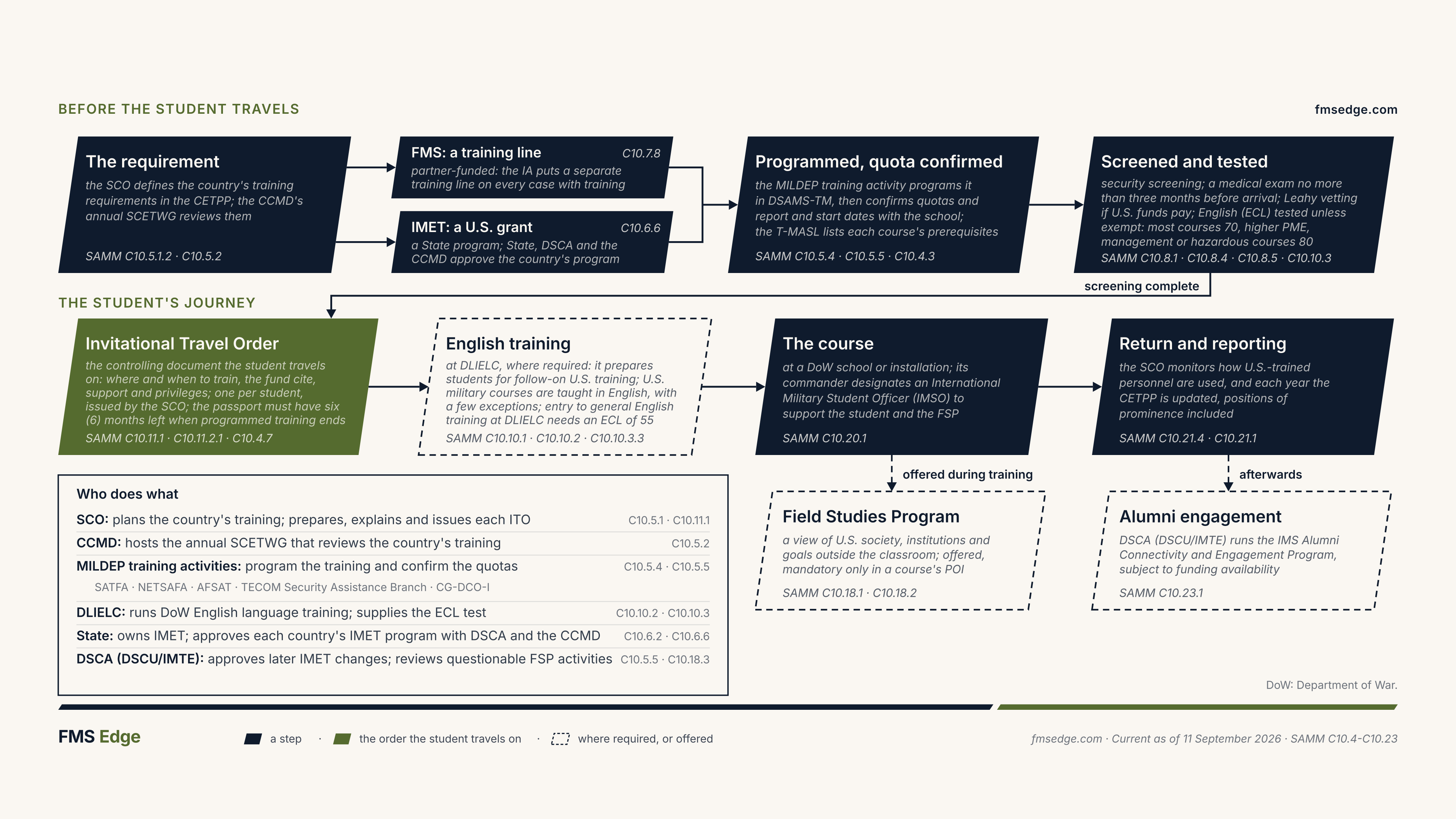
Do international military students need to speak English?
International Military Students () must be able to understand, speak, read, and write English at a level of proficiency that enables them to successfully complete training. Training in U.S. military schools and installations is conducted in English, with exceptions [SAMM ]. The exceptions to this are the Western Hemisphere Institute for , the Inter-American Air Forces Academy, and most programs offered by the Special Boat Training Command, which conduct training in Spanish. Students who have insufficient proficiency with English may attend the Defense Language Institute English Language Center () located at Joint Base San Antonio to improve it before continuing to their follow-on course(s).
The minimum score on the English Comprehension Level () test for entry into general English Language Training () at is 55, regardless of the training’s funding source [SAMM ]. The ( (/IMTE)) may grant a waiver to an score of less than 55 for entry into general at when justified by unusual circumstances, regardless of funding source. (/IMTE) grants the waiver in consultation with the Department of War (DoW) Executive Agent for and , and with the concurrence of the [SAMM ].
The foreign country is responsible for ensuring that meet the minimum the sets for each course, and students must meet the prerequisites for all scheduled training [SAMM , ]. The must ensure that meet the course prerequisites noted in the Training-Military Articles and Services Listing () for all scheduled training [SAMM ]. The must test students from non-exempt countries for the minimum . minimum requirements for all courses are identified in the [SAMM ]. Students who cannot meet the minimum requirement for a course would have great difficulty in successfully completing that course due to inadequate English proficiency.
Prior to attending a U.S. school, must be tested both in-country by personnel and at the first direct-entry training location by the Office () to determine their rating [SAMM ]. from various native English-speaking nations are exempt from both in-country and English language testing. The requirement for in-country testing has also been waived for a number of other countries, although they will still be tested by the first training installation [SAMM , ]. test scores are documented on the .
For in-country testing, the is responsible for appointing a Test Control Officer (TCO) to receive and safeguard the English language testing materials provided by and to administer tests to prospective [SAMM ]. Under Instruction 1025.15, the TCO is a U.S. citizen. Requests for a waiver of a course's minimum prerequisite for or go from the through the to the Military Service, in coordination with the training unit [SAMM ]. Requests for waivers are discouraged, since some degradation of comprehension and retention is bound to occur.
The manual points to section 5-9 of the for these waiver requests [SAMM ].
An additional English language testing requirement has been established, primarily for flight training and public affairs courses among others, for an to be conducted by . This interview takes place via telephonic interview arranged by the between the and . This interview is designed to determine the English speaking and comprehension ability of the prospective . If applicable, the will indicate the minimum score required for a particular course [SAMM ]. As in the case of scores, waivers can be requested but are discouraged.
In those countries where little or no English language training is available, the can program the for (GET) at prior to . The duration of GET depends upon the current score of the and the minimum score required for the training. The primary purpose of GET is to raise the of an who has at least a minimum of 55 to meet the minimum requirement for the course he or she will be attending [SAMM ]. , on its website, provides a tool called the E-Wheel to help estimate the length of time a student will need at in order to meet a specified score.
Training assistance for may be bought under . It may also take the form of instructor training at , where the or another U.S. Government-funded program permits and authorizes it. The assistance may also draw on Language Training Detachments () or English language Mobile Training Teams (), or supply suitable materials and equipment. The website has details of , and [SAMM ].
Besides providing with GET, also has the capability to train language instructors and to assist in developing an in-country English language program. Assistance in support of English language training in-country may be obtained by requesting a survey team or to assist the country’s English language training staff and faculty [SAMM ]. A survey team from can help the determine the status of a country’s English language training program and capabilities and assist in determining English language requirements.
An who meets the requirement specified in the may still be unfamiliar with the specific terminology of certain subjects such as medical, electronics, aviation, and others. To overcome this, conducts () courses to familiarize the with key words, phrases, and terminology that they will encounter during their particular [SAMM ]. Course requirements are expressed in the to reflect the required and whether training is required (R) or advised (A) [SAMM , ].
is required when a student has met the general requirements and the , on the schoolhouse's recommendation, determines that exceptional fluency or a specialized vocabulary is essential to safety or to effective participation in the course. For Senior courses, " Required" is programmed by exception, as needed. Before entering the portion of their courses, students must meet the highest of the their courses require, and any requirement that applies. This holds even where the has waived an or requirement in a specific case. To enter without the required and qualifications, the or the must submit a waiver request to AF/A1DG, with the concurrence of the [SAMM ].
Sponsoring countries, personnel, and work together to address the recurring problems associated with the English language program. These problems include inadequate language training in country, lack of familiarization with technical terminology, and significant differences between the in-country test score and the test score at the first training location. Acquiring an English language laboratory without providing for trained instructors, lab managers, and updated English language materials will not help the country reach its goals. should contact for advice when planning an English language lab acquisition.
The Defense Language Institute English Language Center
The U.S. Air Force is the Department of War’s Executive Agent for the Defense English Language Program and . As the Lead Command for , Air Education and Training Command () manages, operates, funds, and provides personnel for . acculturates and trains international personnel to communicate in English and to instruct English language programs in their countries, trains United States Military personnel in English as a second language, and deploys English language training programs around the world in support of DoW efforts.
has a unique place in the overall scheme of international military training. , although operating under the command and control of , is responsible to all military service training activities for implementation of 5160.41E, Defense Language Program (). This directive describes and defines the , including all foreign language training plus . is responsible for the conduct, supervision, and control of all for international and U.S. service personnel. conducts GET, and Advanced English Training (AET) to prepare for or to be English language instructors. In addition, fields English language teams to meet in-country requirements.
also manages the English Language Testing program, making available several types of English language tests which may be required to take, depending on the course they will be attending and provided an English language waiver has not been granted by . These tests include testing for listening and reading ability; testing for listening and speaking ability; and the American Language Course Placement Test (ALCPT), which can be used by the U.S. or the host nation as a pre-screener for the test (though it is not a replacement for the test).
References
SAMM
- SAMM C10.10.3.6: Waiver to Course Minimum English Comprehension Level Requirement to Attend Defense Language Institute English Language Center.
- SAMM C10.10.3: Minimum English Comprehension Level.
- SAMM C10.10.3.2: Course Prerequisites.
- SAMM C10.8.1: General.
- SAMM C10.10.3.4: Exemptions from all English Comprehension Level Testing Requirements for Education and Training Purposes.
- SAMM C10.10.3.5: Exemptions from In-Country English Comprehension Level Testing for Direct Entry into Training.
- SAMM C10.10.3.1
- SAMM C10.10.1: English Language Training.
- SAMM C10.10.3.3: Minimum English Comprehension Level for Students Entering Defense Language Institute English Language Center.
- SAMM C10.10.3.6.1
- SAMM C10.10.3.8: Specialized English Training.
Facts referenced
- Minimum English Comprehension Level score for entry into general English Language Training at DLIELC, regardless of funding source: 55 (as of 26 October 2026; SAMM C10.10.3.3)
Related
General English Training
Defense Language Institute - English Language Center courses designed to develop the English language capability of International Military Students so they can attend DoD schools.
SAMM Glossary, as of 12 September 2026
Glossary entry →Open the manual’s entry → (opens in new tab)
Specialized English Training
Nine weeks of Specialized English Training at Defense Language Institute English Language Center provides intensive practice in the functional English language skills and technical terminology identified as essential for success in technical training courses and Professional Military Education. Focuses on terminology the International Military Student will need to know in follow on courses.
SAMM Glossary, as of 12 September 2026
Glossary entry →Open the manual’s entry → (opens in new tab)
International Military Student (IMS)
A national of a foreign government, with military or civilian status of that government, who is receiving education or training or is touring USG activities under the sponsorship of the security assistance training program.
SAMM Glossary, as of 12 September 2026
Glossary entry →Open the manual’s entry → (opens in new tab)
Security Cooperation
Activities by which the Department of War encourages and enables international partners to cooperate with the United States toward strategic objectives, spanning every interaction with foreign defense and security establishments and every security assistance program the Department administers.
Under chapter 16 of Title 10, their purposes are to develop allied and friendly security capabilities for self-defense and multinational operations, to give U.S. forces peacetime and contingency access, and to build relationships promoting specific U.S. security interests [10 U.S.C. 301(7)].
FMS Edge glossary, as of 10 October 2026
Glossary entry →Open the manual’s entry → (opens in new tab)
DLIELC: Defense Language Institute English Language Center
SAMM Acronyms, as of 12 September 2026
Defense Security Cooperation Agency (DSCA)
The Department of War agency that directs, administers and provides guidance to the Department's components and its representatives at U.S. missions for the execution of the security cooperation programs for which it is responsible [SAMM C1.3.2.2]. The agency also provides financial and technical assistance, arranges the transfer of defense materiel, training and services to international partners, and promotes military-to-military contacts.
FMS Edge glossary, as of 10 October 2026
Glossary entry →Open the manual’s entry → (opens in new tab)
DSCA: Defense Security Cooperation Agency
SAMM Acronyms, as of 12 September 2026
Glossary entry →Defense Security Cooperation Agency (DSCA) →
Combatant Command (CCMD)
A unified or specified command with a broad continuing mission under a single commander established and so designated by the President, through the Secretary of Defense and with the advice and assistance of the Chairman of the Joint Chiefs of Staff. Also called CCMD.
SAMM Glossary, as of 12 September 2026
Glossary entry →Open the manual’s entry → (opens in new tab)
Implementing Agency (IA)
The military department or defense agency responsible for the execution of military assistance programs. With respect to FMS, the military department or defense agency assigned responsibility by the Defense Security Cooperation Agency to prepare an LOA and to implement an FMS case. The implementing agency is responsible for the overall management of the actions that will result in delivery of the materials or services set forth in the LOA that was accepted by a foreign country or international organization.
SAMM Glossary, as of 12 September 2026
Glossary entry →Open the manual’s entry → (opens in new tab)
Security Cooperation Organization (SCO)
A Department of Defense element that is part of the United States Diplomatic mission located in a foreign country to carry out security assistance and security cooperation management functions under the supervision and coordination authority of the senior defense official/defense attaché.
SAMM Glossary, as of 12 September 2026
Glossary entry →Open the manual’s entry → (opens in new tab)
Training Military Articles and Services Listing (T-MASL)
The master list of formal training available to the international community. It contains course descriptions, prerequisites, duration (in weeks), location, cost, international notes, special medical and health coverage information (e.g. medical paperwork required for Fast Track countries), dependent authorization, English language prerequisites and a training analysis code signifying the type of training.
SAMM Glossary, as of 12 September 2026
Glossary entry →Open the manual’s entry → (opens in new tab)
SCO: Security Cooperation Organization
SAMM Acronyms, as of 12 September 2026
International Military Student Office/Manager (IMSO)
The office, or the officer, that a U.S. installation designates to give administrative support to international military students training there and to run the Field Studies Program for that installation.
Commanders of U.S. installations with international military students scheduled for training designate an International Military Student Officer (IMSO) for administrative support of the students and the U.S. Field Studies Program (FSP) [SAMM C10.20.1].
FMS Edge glossary, as of 10 October 2026
Glossary entry →Open the manual’s entry → (opens in new tab)
Continental United States (CONUS)
U.S. territory, including the adjacent territorial waters, located within the North American continent between Canada and Mexico. Does not include Hawaii or Alaska.
SAMM Glossary, as of 12 September 2026
Glossary entry →Open the manual’s entry → (opens in new tab)
CONUS: Continental United States
SAMM Acronyms, as of 12 September 2026
Invitational Travel Order (ITO)
A written authorization (DD Form 2285) for International Military Students to travel to, from, and between U.S. activities for the purpose of training under an approved and funded International Military Education and Training or Foreign Military Sales program.
SAMM Glossary, as of 12 September 2026
Glossary entry →Open the manual’s entry → (opens in new tab)
OPI: Oral Proficiency Interview
SAMM Acronyms, as of 12 September 2026
Military Articles And Services List (MASL)
A catalogue of materiel, services, and training used in the planning and programming of International Military Education and Training (IMET), and Foreign Military Sales (FMS). Separate MASLs are maintained for IMET and FMS training that provides data on course identification, course availability, price, and duration of training.
SAMM Glossary, as of 12 September 2026
Glossary entry →Open the manual’s entry → (opens in new tab)
Security Assistance Network (SAN)
A web-based system, also called SANweb, that hosts security cooperation applications, chiefly for international training management and its budget, planning and programming data, together with a library for sharing documents and tools to manage user accounts and access.
Its counterpart, the International SAN (ISAN), gives partner countries limited access, and its one application is the Partner Security Cooperation Training Management System.
FMS Edge glossary, as of 10 October 2026
Glossary entry →Open the manual’s entry → (opens in new tab)
Follow-on Training (FOT)
Sequential training following an initial course of training.
SAMM Glossary, as of 12 September 2026
Glossary entry →Open the manual’s entry → (opens in new tab)
Direct Entry Training
A military service training course that is entered directly by an International Military Student without first attending English language training at the Defense Language Institute, English Language Center.
SAMM Glossary, as of 12 September 2026
Glossary entry →Open the manual’s entry → (opens in new tab)
Joint Security Cooperation Education and Training Regulation (JSCET)
Regulation that prescribes policies, responsibilities, procedures, and administration for the education and training of International Military Students by the Departments of the Army, Navy and Air Force as authorized by U.S. Security Assistance legislation. Regulation is also applicable to the Marine Corps and Coast Guard.
SAMM Glossary, as of 12 September 2026
Glossary entry →Open the manual’s entry → (opens in new tab)
Oral Proficiency Interview (OPI)
English language test that rates English language speaking ability for International Military Students (IMS). Certain courses require an OPI test be taken and a specific OPI score to be met before an IMS can attend the course.
SAMM Glossary, as of 12 September 2026
Glossary entry →Open the manual’s entry → (opens in new tab)
Foreign Military Sales (FMS)
The part of U.S. security assistance, authorized by the Arms Export Control Act (AECA), in which eligible foreign governments and international organizations buy defense articles, services and training from the U.S. Government under formal government-to-government agreements.
The articles come either from Department of War stocks or from new procurement under contracts the Department manages [22 U.S.C. 2761, 22 U.S.C. 2762]. A sale is FMS whatever the source of the purchaser's financing.
FMS Edge glossary, as of 10 October 2026
Glossary entry →Open the manual’s entry → (opens in new tab)
International Military Education And Training (IMET) Program
A grant program of the Department of State, carried out by the Department of War under the Foreign Assistance Act (FAA), that funds education and training for foreign military personnel and selected civilian officials in the United States or overseas.
The International Military Education and Training (IMET) program is a Department of State program, jointly managed by the Defense Security Cooperation Agency (DSCA) and the Department of State, whose courses are given mainly at military schoolhouses in the United States [SAMM C10.6.1].
FMS Edge glossary, as of 10 October 2026
Glossary entry →Open the manual’s entry → (opens in new tab)
LTD: Language Training Detachment
SAMM Acronyms, as of 12 September 2026
MTT: Mobile Training Team
SAMM Acronyms, as of 12 September 2026
Language Training Detachment (LTD)
A group of instructors from the Defense Language Institute's English Language Center (DLIELC) who teach English as a second language, and advise on running such programs, in a partner country or at a U.S. installation away from the Center.
Extended training service specialists who are English language instructors, supervisors or advisors on detached duty from DLIELC are referred to as a Language Training Detachment (LTD) [SAMM C10.22.2.1.2].
FMS Edge glossary, as of 10 October 2026
Glossary entry →Open the manual’s entry → (opens in new tab)
FOT: Follow-on Training
SAMM Acronyms, as of 12 September 2026
Professional Military Education (PME)
Career training designed to provide or enhance leadership and the recipient force's capabilities to conduct military planning, programming, management, budgeting, and force development to the level of sophistication appropriate to that force.
SAMM Glossary, as of 12 September 2026
Glossary entry →Open the manual’s entry → (opens in new tab)
Military Department (MILDEP)
One of the departments within the DoD created by the National Security Act of 1947, as amended. The Military Departments are: the Department of the Air Force, the Department of the Army, and the Department of the Navy.
SAMM Glossary, as of 12 September 2026
Glossary entry →Open the manual’s entry → (opens in new tab)
DLP: Defense Language Program
SAMM C10.10.1: English Language Training.
“Training in U.S. military schools and installations is conducted in English, except for the U.S. Army’s Western Hemisphere Institute for Security Cooperation (WHINSEC), the U.S. Air Force’s Inter-American Air Forces Academy (IAAFA), and most programs offered by the Special Boat Training Command (SBTC). International students must be able to understand, speak, read, and write English at a level of proficiency …”
Security Assistance Management Manual, as of 2 November 2026
SAMM C10.10.3.3: Minimum English Comprehension Level for Students Entering Defense Language Institute English Language Center.
“The minimum ECL score for entry into general ELT at DLIELC is 55, regardless of the training’s funding source. Training Assistance for ELT may be purchased under the FMS program, or by the training of instructors at DLIELC if permitted and authorized under the IMET or other USG-funded programs. Training assistance may also utilize English language Mobile Training Teams (MTTs) …”
Security Assistance Management Manual, as of 26 October 2026
SAMM C10.10.3.6: Waiver to Course Minimum English Comprehension Level Requirement to Attend Defense Language Institute English Language Center.
“DSCA (DSCU/IMTE) in consultation with the DoW Executive Agent for ELT and DLIELC, and with the concurrence of the Combatant Command (CCMD), may grant a waiver to an ECL score of less than 55 for entry into general ELT at DLIELC when justified by unusual circumstances, regardless of funding source”
Security Assistance Management Manual, as of 26 October 2026
SAMM C10.10.3: Minimum English Comprehension Level.
“The foreign country is responsible for ensuring that students meet the Implementing Agency (IA)-determined minimum English Comprehension Level (ECL) for attendance at a particular course of instruction. Most courses require a minimum ECL of 70. Higher level Professional Military Education (PME) and management courses, or courses that are hazardous, require an 80 or higher ECL.”
Security Assistance Management Manual, as of 11 September 2026
SAMM C10.10.3.2: Course Prerequisites.
“Students must meet prerequisites for all scheduled training. The prerequisites are usually included in the T-MASL.”
Security Assistance Management Manual, as of 11 September 2026
SAMM C10.8.1: General.
“Every International Military Student (IMS) invited to participate in DoW training, regardless of sponsoring program, funding source, or security classification of the training, must satisfactorily complete the required security, medical, and other screening described in this section before a U.S. visa or Invitational Travel Order (ITO) will be issued to the IMS. Specific screening may include Security (see Section C10.8.3.), …”
Security Assistance Management Manual, as of 26 October 2026
SAMM C10.10.3.1
“U.S. Military Groups (MILGPs) must test students from non-exempt countries for the minimum ECL prescribed by the IA for each course of instruction or for entry into DLIELC. Test materials to determine the ECL of selected candidates for U.S. training are provided annually by DLIELC, together with instructions for administering the test. MILGPs must also schedule oral proficiency interviews (OPI) …”
Security Assistance Management Manual, as of 26 October 2026
SAMM C10.10.3.4: Exemptions from all English Comprehension Level Testing Requirements for Education and Training Purposes.
“Certain countries whose students have consistently demonstrated an English-speaking capability during training are exempt from all ECL testing requirements. This exemption does not apply to ECL testing requirements set for U.S.-sponsored exercises and competitions. An annual review by DLIELC, MILDEP training activities, and DSCA (Defense Security Cooperation University, International Military Training and Education Division (DSCU/IMTE)) determines if the exemption should …”
Security Assistance Management Manual, as of 11 September 2026
SAMM C10.10.3.5: Exemptions from In-Country English Comprehension Level Testing for Direct Entry into Training.
“Certain countries whose students demonstrate an English-speaking capability are exempt from in-country ECL testing prior to direct entry into non-ELT training. Students from exempt countries are ECL tested at the first training installation. An annual review determines if the exemption should continue. DSCA (DSCU/IMTE) confirms the exemption list each year by message. Students from exempt countries must continue to demonstrate …”
Security Assistance Management Manual, as of 11 September 2026
SAMM C10.10.3.6.1
“Requests for waivers to minimum course ECL prerequisites for follow-on training (FOT) or Direct Entry Training are made by the MILGP through the CCMD to the Military Service (See Joint Security Cooperation Education and Training Regulation (JSCET), section 5-9), in coordination with the training unit.”
Security Assistance Management Manual, as of 26 October 2026
SAMM C10.10.3.8: Specialized English Training.
“Attendance at a Specialized English Training (SET) is required when general ECL requirements have been met and the IA determines (based on schoolhouse recommendation) that exceptional fluency or specialized vocabularies are essential to safety or effective participation in the course of instruction. For Senior PME courses, “SET Required” is programmed by exception as needed. Students must meet the highest level …”
Security Assistance Management Manual, as of 26 October 2026