
Guide
What is Leahy vetting of foreign security forces?
is the human rights screening of foreign security force units and members before they receive U.S. assistance. No assistance under the Foreign Assistance Act or the goes to a unit the Secretary of has credible information committed a gross violation of human rights, and a parallel law restricts Department of War training, equipment and other assistance. A student whose training the partner nation funds, or who is a U.S. citizen, need not be vetted.
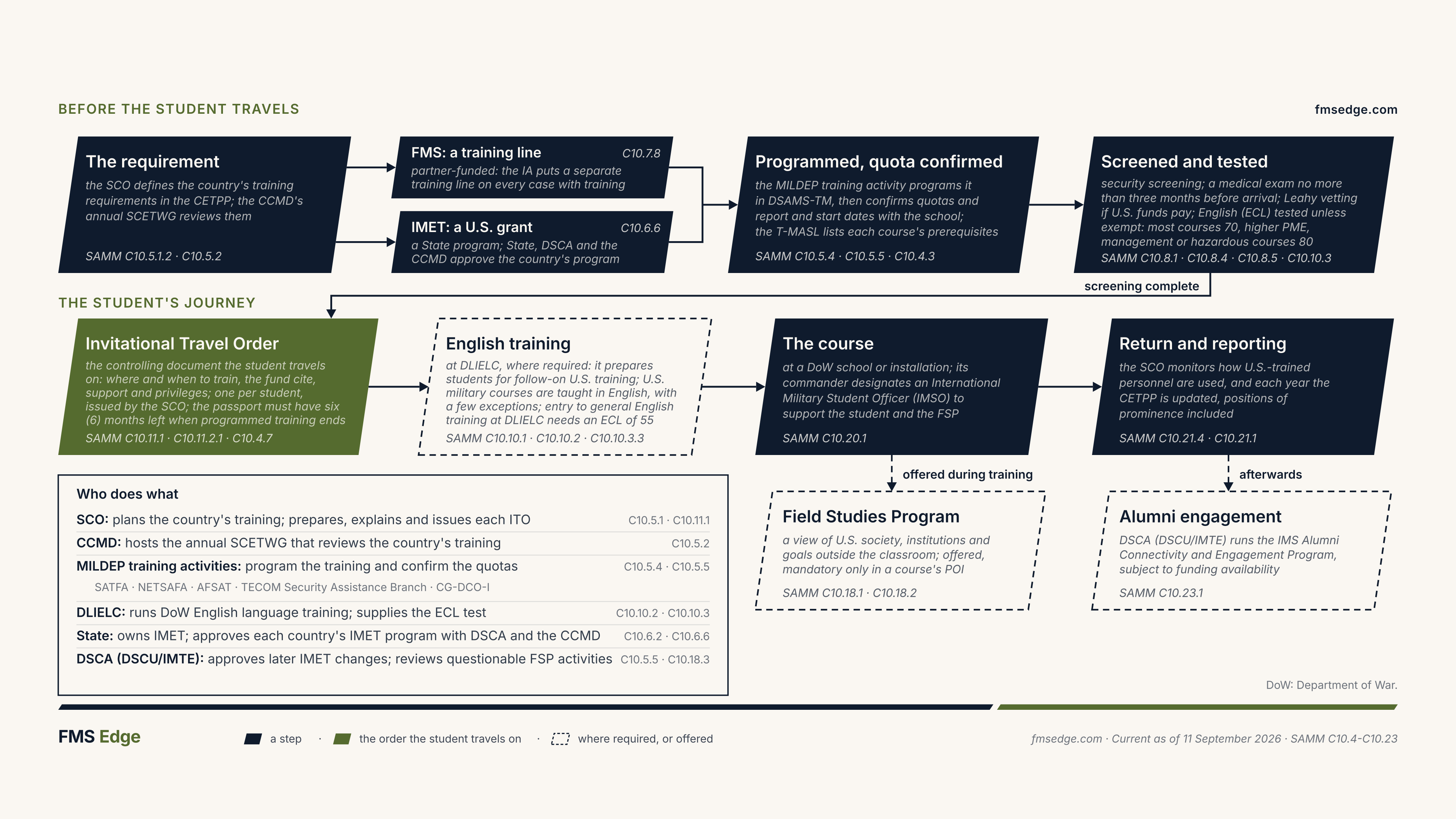
An international military student reaches a U.S. course through a chain of plans and paperwork, from the Security Cooperation Organization's requirement to a seat confirmed by the Military Department's training activity. The student travels on an Invitational Travel Order.
What is Leahy vetting?
is the human rights screening of foreign security force units and members before they receive U.S. assistance. No assistance under the Foreign Assistance Act or the shall be furnished to a unit of a foreign country's security forces about which the Secretary of has credible information that it committed a gross violation of human rights []. Individual members, whole units and their commanders must be screened for evidence of gross violations of human rights and of human trafficking violations if nominated for U.S.-funded training of any kind, whether resident, non-resident or team training [SAMM ].
According to Section 502B of the Foreign Assistance Act (), a principal goal of U.S. foreign policy shall be to promote the increased observance of internationally recognized human rights by all countries. This policy goal is in accordance with both international obligations set forth in the Charter of the United Nations and with the constitutional heritage and tradition of the U.S. to promote and encourage increased respect for human rights and fundamental freedoms throughout the world regardless of race, sex, language or religion. Except under circumstances specified in Section 502B, no may be provided to any country the government of which engages in a consistent pattern of [].
The Secretary of with the assistance of the Assistant Secretary of for Democracy, Human Rights, and Labor and with the Ambassador at Large for International Religious Freedom shall also transmit to Congress a complete report of the practices regarding the observance and respect for internationally recognized human rights for each country proposed as a recipient of programs. This report is to be part of the presentational materials for programs proposed for each fiscal year [].
No assistance (includes both articles and training) authorized by the or the will be made available to any unit of the security forces of a country if the Secretary of has credible information that such unit has committed a gross violation of human rights. Funding may be provided once the Secretary determines and reports to Congress that the affected country is taking effective measures to bring the responsible members of the security forces unit to justice []. This is commonly referred to as the Leahy Amendment with the process entitled . Section 1204 of the National Defense Authorization Act for Fiscal Year 2015, P.L. 113-291, codified a parallel rule: the Department of War may not provide training, equipment or other assistance to a unit when there is credible information that it committed a gross violation of human rights []. Foreign security force members and units nominated for any U.S.-funded training must be screened (Leahy vetted), and the must start the vetting early enough to ensure it is complete before the training starts [SAMM ].
is not required for an whose training the partner nation funds [SAMM ]. Under policy, an who is a U.S. citizen, including one who also holds the citizenship of another country, is not required to be Leahy vetted either [SAMM ].
Medical, security and human rights screening () are required for all participants in orientation tours (OTs) and Distinguished Visitor Orientation Tours (). Human rights screening is not required when the tour is funded with or partner nation funds. OT and participants funded by Foreign Military Financing and International Military Education and Training are covered for emergency medical treatment only. Section C10.8 sets out the specific screening requirements [SAMM ].
What counts as a gross violation of human rights?
The term “” () includes torture or cruel, inhuman, or degrading treatment or punishment, and prolonged detention without charges and trial. It also includes causing the disappearance of persons by the abduction and clandestine detention of those persons, and other flagrant denial of the right to life, liberty, or the security of person [].
Which other programs require human rights vetting?
Section 333 assistance and ()-funded training or equipment for partner security forces are also subject to human rights vetting [SAMM , ]. The provision of Section 333 assistance is subject to the provisions of 10 U.S.C. 362 []. For any -funded project that provides training or equipment to partner or third-party military or security forces, ensure that the Department of State has conducted Human Rights Vetting (HRV), as appropriate. Before training or delivery begins, the project manager verifies that each unit to be trained has been cleared and that every individual to be trained is assigned to a cleared unit. Uncleared units and individuals will not receive training or equipment [SAMM ].
References
SAMM
- SAMM C10.8.4: Human Rights Screening (Leahy Vetting).
- SAMM AP8.S333.2.11.2: Prohibition on Assistance to Units That Have Committed Gross Violations of Human Rights.
- SAMM C12.5.2: Human Rights Vetting.
- SAMM C10.8.4.1
- SAMM C10.8.4.2
- SAMM C10.17.20.3.1.5
Public authorities
- FAA §620M: Foreign Assistance Act of 1961, as amended, §620M (22 U.S.C. §2378d), Limitation on assistance to security forces (the State Leahy law)
- 10 U.S.C. §362: 10 U.S.C. §362, Prohibition on use of funds for assistance to units of foreign security forces that have committed a gross violation of human rights (the DoW Leahy law)
- 10 U.S.C. §333: 10 U.S.C. §333, Foreign security forces: authority to build capacity
- FAA §502B: Foreign Assistance Act of 1961, as amended, §502B (22 U.S.C. §2304)
Related
Leahy Vetting
The U.S. government process to assess whether there is credible information that a specific individual or a specific security force unit has committed a gross violation of human rights.
SAMM Glossary, as of 12 September 2026
Glossary entry →Open the manual’s entry → (opens in new tab)
Arms Export Control Act (AECA)
The basic U.S. law providing the authority and general rules for the conduct of Foreign Military Sales and commercial sales of defense articles, defense services, and training. The Arms Export Control Act (AECA) came into existence with the passage of the Foreign Military Sales Act (FMSA) of 1968. An amendment in the International Security Assistance and AECA of 1976 changed the name of FMSA to the AECA.
SAMM Glossary, as of 12 September 2026
Glossary entry →Open the manual’s entry → (opens in new tab)
Security Cooperation
Activities by which the Department of War encourages and enables international partners to cooperate with the United States toward strategic objectives, spanning every interaction with foreign defense and security establishments and every security assistance program the Department administers.
Under chapter 16 of Title 10, their purposes are to develop allied and friendly security capabilities for self-defense and multinational operations, to give U.S. forces peacetime and contingency access, and to build relationships promoting specific U.S. security interests [10 U.S.C. 301(7)].
FMS Edge glossary, as of 10 October 2026
Glossary entry →Open the manual’s entry → (opens in new tab)
Security Assistance (SA)
A group of programs authorized by federal statutes by which the United States provides defense articles, military training, and other defense-related services by grant, lease, loan, credit, or cash sales in furtherance of national policies and objectives, and those that are funded and authorized through the Department of State to be administered by Department of Defense/Defense Security Cooperation Agency, which are considered part of security cooperation.
SAMM Glossary, as of 12 September 2026
Glossary entry →Open the manual’s entry → (opens in new tab)
Gross Violations of Internationally Recognized Human Rights
Includes torture or cruel, inhuman, or degrading treatment or punishment, prolonged detention without charges and trial, causing the disappearance of persons by the abduction and clandestine detention of those persons, and other flagrant denial of the right to life, liberty, or the security of person.
SAMM Glossary, as of 12 September 2026
Glossary entry →Open the manual’s entry → (opens in new tab)
Security Cooperation Organization (SCO)
A Department of Defense element that is part of the United States Diplomatic mission located in a foreign country to carry out security assistance and security cooperation management functions under the supervision and coordination authority of the senior defense official/defense attaché.
SAMM Glossary, as of 12 September 2026
Glossary entry →Open the manual’s entry → (opens in new tab)
International Military Student (IMS)
A national of a foreign government, with military or civilian status of that government, who is receiving education or training or is touring USG activities under the sponsorship of the security assistance training program.
SAMM Glossary, as of 12 September 2026
Glossary entry →Open the manual’s entry → (opens in new tab)
Foreign Military Sales (FMS)
The part of U.S. security assistance, authorized by the Arms Export Control Act (AECA), in which eligible foreign governments and international organizations buy defense articles, services and training from the U.S. Government under formal government-to-government agreements.
The articles come either from Department of War stocks or from new procurement under contracts the Department manages [22 U.S.C. 2761, 22 U.S.C. 2762]. A sale is FMS whatever the source of the purchaser's financing.
FMS Edge glossary, as of 10 October 2026
Glossary entry →Open the manual’s entry → (opens in new tab)
GVHR: Gross Violation of Human Rights
Overseas Humanitarian, Disaster, and Civic Aid (OHDACA)
An annual appropriation with a two-year period of availability that supports DoD Humanitarian Assistance activities conducted under the following legislative authorities: 10 U.S.C. 402, 10 U.S.C. 404, 10 U.S.C. 407, 10 U.S.C. 2557, and 10 U.S.C. 2561.
SAMM Glossary, as of 12 September 2026
Glossary entry →Open the manual’s entry → (opens in new tab)
OHDACA: Overseas Humanitarian, Disaster and Civic Aid
SAMM Acronyms, as of 12 September 2026
Glossary entry →Overseas Humanitarian, Disaster, and Civic Aid (OHDACA) →
SCO: Security Cooperation Organization
SAMM Acronyms, as of 12 September 2026
Foreign Assistance Act of 1961, as amended, §620M (22 U.S.C. §2378d), Limitation on assistance to security forces (the State Leahy law)
FAA §620M · Statute
SAMM C10.8.4: Human Rights Screening (Leahy Vetting).
“Individual foreign security force members and/or whole foreign units and their commanders must be screened (Leahy Vetted) for evidence of gross violations of human rights and human trafficking violations if they are nominated for any U.S.-funded resident, non- resident, or SC team training. The MILGP must initiate individual or unit Leahy vetting far enough in advance of the programmed training …”
Security Assistance Management Manual, as of 26 October 2026
Foreign Assistance Act of 1961, as amended, §502B (22 U.S.C. §2304)
FAA §502B · Statute
10 U.S.C. §362, Prohibition on use of funds for assistance to units of foreign security forces that have committed a gross violation of human rights (the DoW Leahy law)
10 U.S.C. §362 · Statute
SAMM C10.8.4.1
“Leahy vetting is not required for an IMS whose training is funded with partner nation funds.”
Security Assistance Management Manual, as of 11 September 2026
SAMM C10.8.4.2
“An IMS who is a U.S. Citizen (or holds dual citizenship with another country) is not required to be Leahy vetted, per State policy.”
Security Assistance Management Manual, as of 11 September 2026
SAMM C10.17.20.3.1.5
“Medical Screening, Security screening and Human Rights Screening (Leahy Vetting) are required for all OT and DVOT participants. Human Rights Screening (Leahy Vetting) is not required if the tour is funded with FMS/partner nation Funds. DVOT and OT participants funded by FMF and IMET are covered for emergency medical treatment only. See Section C10.8., for specific screening requirements.”
Security Assistance Management Manual, as of 11 September 2026
SAMM AP8.S333.2.11.2: Prohibition on Assistance to Units That Have Committed Gross Violations of Human Rights.
“The provision of Section 333 assistance will be subject to the provisions of 10 U.S.C. 362 (DoW Leahy Law).”
Security Assistance Management Manual, as of 12 October 2026
SAMM C12.5.2: Human Rights Vetting.
“U.S. Military Groups (MILGPs) ensure that the Department of State (State) has conducted Human Rights Vetting (HRV), as appropriate, for any OHDACA-funded project where training or equipment will be provided to partner or third-party military or security forces (see Section C12.3.4.6.). Prior to beginning any training or delivering equipment to partner military or security forces, the project manager verifies that …”
Security Assistance Management Manual, as of 26 October 2026
10 U.S.C. §333, Foreign security forces: authority to build capacity
10 U.S.C. §333 · Statute