
Guide
How is IMET money managed during the year?
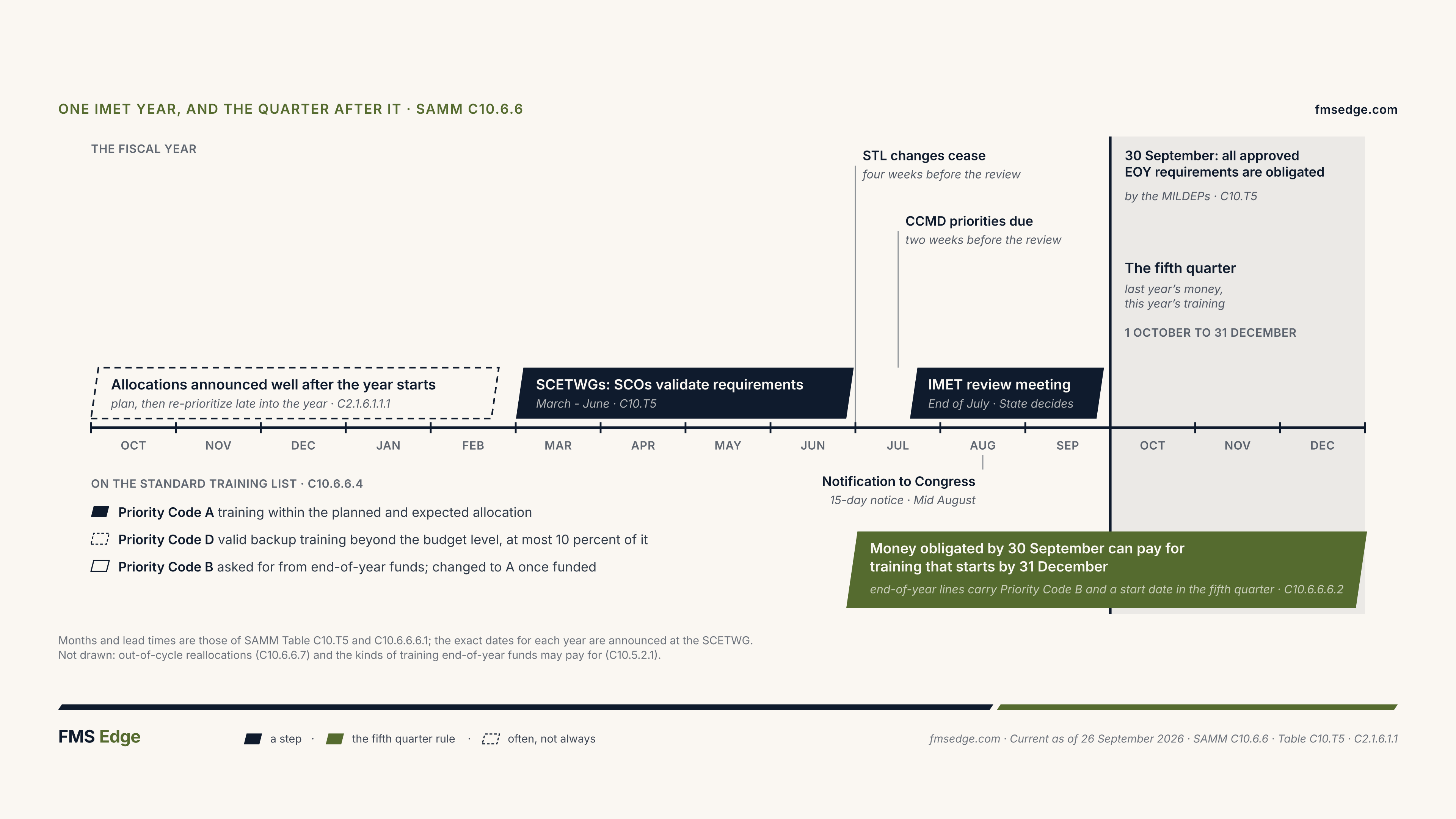
The office assigns a priority code to each International Military Education and Training () training line, because a country's allocation is often smaller than requested and is announced well after the fiscal year starts. An end-of-year review reallocates unused funds to the countries and courses that need them, after a cut-off for program changes. Money obligated by the end of the fiscal year can pay for training that starts in the first quarter of the next one, the "fifth quarter".
An IMET allocation is often announced well after the fiscal year starts, so the security cooperation office programs each course with a priority code and revises the plan through the year. Money obligated by the end of the fiscal year can pay for training that starts in the IMET fifth quarter.
How is IMET money managed during the year?
Training priority codes are critical to how the manages its International Military Education and Training () money and to obtaining training quotas. Actual allocations are often smaller than the organization requested and are announced well after the fiscal year starts, and more money can come from an end-of-year reallocation. These organizations must therefore prioritize training during planning and be ready to revise their plans and re-prioritize training requests late into the fiscal year. Section C10.6.6.4 sets out the priority codes, and Section C10.6.6.6 the end-of-year reallocation process and its timeline [SAMM ].
Each year’s program is identified on the by country code, code, and fiscal year () followed by the letter “I,” indicating the Program Type is (i.e., BN-B-18I).
Priority codes
To assist in the prioritization and management of training requests, the assigns a priority code to each training line [SAMM ]. Priority code “A” indicates the training lines that are within planned and expected funding for the country [SAMM ]. Priority code “D” is assigned to other valid training requirements, taking place after the third quarter, that are in excess of the budget level [SAMM ]. These are lines the Implementing Agencies can accommodate and for which the host nation can provide qualified candidates if funds become available; are encouraged to plan priority “D” lines in the planning-year as backup to priority “A” [SAMM , ]. The Military Services will not obtain quotas for Priority “D” lines []. The total value of all priority “D” training should not exceed 10 percent of the budget level [SAMM ]. Priority code “B” indicates the training lines that will start in the first quarter of the following fiscal year and should be considered in the for End of Year (EOY) reallocation of funds [SAMM ].
For funding, priority “B” marks an event that is not funded through one of the Military Departments. Its money comes from the , which releases it directly to a or a Department of War (DoW) Regional Center. Priority code “C” is not used [SAMM ].
The fifth quarter
Actual allocations are announced well after the start of the fiscal year [SAMM ]. funds must be obligated by the end of the fiscal year [SAMM ]. students who begin training in the from 1 October of a fiscal year through 31 December of the following calendar year may be included in one annual program. This fifth quarter concept was developed to maximize the use of funds at the end of each fiscal year and to take advantage of first-quarter training opportunities []. Hence, the fifth quarter is training in the first quarter of a fiscal year (1 October to 31 December) funded with money from the previous fiscal year’s appropriation [SAMM ].
The end-of-year reallocation
Additional funds can be obtained in the EOY reallocation: at the annual EOY financial review, excess funds are identified and recommendations are made on which countries and courses require funding [SAMM , ]. guidance restricts EOY funding to invitational , and other courses, in that order of preference. will not consider technical or operational training, English language instructor training, or English language labs, books and publications for EOY funding, and mobile training teams are not executable in the fifth quarter [SAMM ]. All EOY funding requirements must have priority code “B” on the and a start date in the fifth quarter, between 1 October and 31 December [SAMM ].
Current-year program changes to stop four weeks before 's annual EOY financial review, held in July. The exact dates, guidance and formats for the review are announced at each . After the cut-off, only a change justified as an urgent requirement is considered. Such a change must be approved by (/IMTE) and () before it is submitted, and approval depends on enough time being left to process it and obligate the funds before the review. priorities for year-end funding must reach , in the format () prescribes, no later than two weeks before the review, so that they can be consolidated and considered by . The results are final once the review ends [SAMM ].
Allowances and medical costs
training lines are implemented once the Military Departments () confirm a quota and fund the line [SAMM ]. Upon receipt of , the will authorize the to prepare the []. A may be paid from the country’s program or paid by the sponsoring country. -recipient countries are encouraged to enter into cost-sharing agreements (also known as “burden sharing”) by paying travel and/or living allowances. This allows funds to be used for higher numbers of to attend training [SAMM , ]. The cost of an ’s medical care is paid from a cost factor assessed on each training line [SAMM ].
Authorized expenditures include tuition, overseas and travel and baggage allowances, living allowances while in training, and emergency medical care. is normally not part of a financed with Foreign Military Financing (), but it may be included in exceptional situations when the student’s travel is tied to training that is part of the case [SAMM ]. costs are normally funded by the other DoW and Department of State grant programs [SAMM ].
References
SAMM
- SAMM C10.6.6.4: Prioritization.
- SAMM C10.6.6.4.1
- SAMM C10.6.6.4.4
- SAMM C10.6.6.4.4.1
- SAMM C10.F2: Security Cooperation Education and Training Working Group Checklist PDF Fillable form is available in SC-TMS.
- SAMM C10.6.6.5: International Military Education and Training Budget Execution.
- SAMM C10.6.6.6.2: International Military Education and Training Reallocation Process.
- SAMM C10.T5: End of Year International Military Education and Training Reallocation Process
- SAMM C10.5.5
- SAMM C10.6.10: Travel for International Military Education and Training Students.
- SAMM C10.9.1.3.1.1
- SAMM C10.13.2: Travel and Living Allowance on Foreign Military Sales and Foreign Military Financing Funded Letters of Offer and Acceptance.
- SAMM C10.13.1.3
- SAMM C2.1.6.1.1.1: Priority Codes.
- SAMM C10.6.6.4.3
- SAMM C10.6.6.6.1
Public authorities
- AR 12-15: Joint Security Cooperation Education and Training (JSCET), Army Regulation 12-15, also issued as SECNAVINST 4950.4B and AFI 16-105 (3 January 2011; administrative revision 18 March 2025)
Facts referenced
- Ceiling on IMET Priority Code D training lines, the valid requirements above the budget level, as a share of the budget level: 10 percent (as of 11 September 2026; SAMM C10.6.6.4.4)
- Cut-off for current-year IMET program changes, counted back from DSCA's annual (July) end-of-year IMET financial review: four weeks (as of 11 September 2026; SAMM C10.6.6.6.1)
- Month of DSCA's annual end-of-year IMET financial review: July (as of 11 September 2026; SAMM C10.6.6.6.1)
- Deadline for combatant command priorities to reach DSCA, counted back from the end-of-year IMET financial review: two weeks (as of 11 September 2026; SAMM C10.6.6.6.1)
Related
Security Cooperation
Activities by which the Department of War encourages and enables international partners to cooperate with the United States toward strategic objectives, spanning every interaction with foreign defense and security establishments and every security assistance program the Department administers.
Under chapter 16 of Title 10, their purposes are to develop allied and friendly security capabilities for self-defense and multinational operations, to give U.S. forces peacetime and contingency access, and to build relationships promoting specific U.S. security interests [10 U.S.C. 301(7)].
FMS Edge glossary, as of 10 October 2026
Glossary entry →Open the manual’s entry → (opens in new tab)
IMET: International Military Education and Training
SAMM Acronyms, as of 12 September 2026
Security Cooperation Organization (SCO)
A Department of Defense element that is part of the United States Diplomatic mission located in a foreign country to carry out security assistance and security cooperation management functions under the supervision and coordination authority of the senior defense official/defense attaché.
SAMM Glossary, as of 12 September 2026
Glossary entry →Open the manual’s entry → (opens in new tab)
Standard Training List (STL)
List of all the Security Cooperation training courses that a country has requested from DoD and the status of the courses.
SAMM Glossary, as of 12 September 2026
Glossary entry →Open the manual’s entry → (opens in new tab)
Implementing Agency (IA)
The military department or defense agency responsible for the execution of military assistance programs. With respect to FMS, the military department or defense agency assigned responsibility by the Defense Security Cooperation Agency to prepare an LOA and to implement an FMS case. The implementing agency is responsible for the overall management of the actions that will result in delivery of the materials or services set forth in the LOA that was accepted by a foreign country or international organization.
SAMM Glossary, as of 12 September 2026
Glossary entry →Open the manual’s entry → (opens in new tab)
Fiscal Year (FY)
The USG’s accounting period. It begins on October 1 and ends on September 30 and is designated by the calendar year in which it ends.
SAMM Glossary, as of 12 September 2026
Glossary entry →Open the manual’s entry → (opens in new tab)
SCO: Security Cooperation Organization
SAMM Acronyms, as of 12 September 2026
STL: Standard Training List
SAMM Acronyms, as of 12 September 2026
Current Fiscal Year
The fiscal year in progress but not yet completed; e.g. between and including 1 October and 30 September.
SAMM Glossary, as of 12 September 2026
Glossary entry →Open the manual’s entry → (opens in new tab)
Regional Defense Fellowship Program (RDFP)
A Department of War security cooperation program that funds education and training in irregular warfare and counterterrorism for partner defense and security officials at the mid and senior levels, earlier known as the Combating Terrorism Fellowship Program (CTFP).
Permanently authorized by 10 U.S.C. 345, it gives a flexible tool for building partner capacity toward a specific combatant command objective [SAMM AP8.S345.1.1] [10 U.S.C. 345].
FMS Edge glossary, as of 11 October 2026
Glossary entry →Open the manual’s entry → (opens in new tab)
Defense Security Cooperation Agency (DSCA)
The Department of War agency that directs, administers and provides guidance to the Department's components and its representatives at U.S. missions for the execution of the security cooperation programs for which it is responsible [SAMM C1.3.2.2]. The agency also provides financial and technical assistance, arranges the transfer of defense materiel, training and services to international partners, and promotes military-to-military contacts.
FMS Edge glossary, as of 10 October 2026
Glossary entry →Open the manual’s entry → (opens in new tab)
Combatant Command (CCMD)
A unified or specified command with a broad continuing mission under a single commander established and so designated by the President, through the Secretary of Defense and with the advice and assistance of the Chairman of the Joint Chiefs of Staff. Also called CCMD.
SAMM Glossary, as of 12 September 2026
Glossary entry →Open the manual’s entry → (opens in new tab)
Continental United States (CONUS)
U.S. territory, including the adjacent territorial waters, located within the North American continent between Canada and Mexico. Does not include Hawaii or Alaska.
SAMM Glossary, as of 12 September 2026
Glossary entry →Open the manual’s entry → (opens in new tab)
Professional Military Education (PME)
Career training designed to provide or enhance leadership and the recipient force's capabilities to conduct military planning, programming, management, budgeting, and force development to the level of sophistication appropriate to that force.
SAMM Glossary, as of 12 September 2026
Glossary entry →Open the manual’s entry → (opens in new tab)
Expanded IMET (E-IMET)
Training funded under the International Military Education and Training (IMET) program to the following four objectives: proper management of defense resources, improving military justice systems in accordance with internationally recognized human rights, understanding the principle of civilian control of the military, and contributing to the cooperation between police and military forces for counternarcotics law enforcement [sec.541, Foreign Assistance Act].
SAMM Glossary, as of 12 September 2026
Glossary entry →Open the manual’s entry → (opens in new tab)
PME: Professional Military Education
SAMM Acronyms, as of 12 September 2026
DSCA: Defense Security Cooperation Agency
SAMM Acronyms, as of 12 September 2026
Glossary entry →Defense Security Cooperation Agency (DSCA) →
Security Cooperation Education and Training Working Group (SCETWG)
An annual combatant command conference that sets the security assistance and security cooperation training program for each eligible partner country in the command's area of responsibility.
Security Cooperation Organizations (SCOs) submit their education and training requests there, drawn from each country's Combined Education and Training Program Plan (CETPP) [SAMM C10.22.7.3].
FMS Edge glossary, as of 10 October 2026
Glossary entry →Open the manual’s entry → (opens in new tab)
SCETWG: Security Cooperation Education and Training Working Group
SAMM Acronyms, as of 12 September 2026
Glossary entry →Security Cooperation Education and Training Working Group (SCETWG) →
Military Department (MILDEP)
One of the departments within the DoD created by the National Security Act of 1947, as amended. The Military Departments are: the Department of the Air Force, the Department of the Army, and the Department of the Navy.
SAMM Glossary, as of 12 September 2026
Glossary entry →Open the manual’s entry → (opens in new tab)
Invitational Travel Order (ITO)
A written authorization (DD Form 2285) for International Military Students to travel to, from, and between U.S. activities for the purpose of training under an approved and funded International Military Education and Training or Foreign Military Sales program.
SAMM Glossary, as of 12 September 2026
Glossary entry →Open the manual’s entry → (opens in new tab)
Travel and Living Allowance (TLA) (International Military Students)
Those costs associated with transportation, baggage, and living allowances of International Military Students, which are authorized for payment under Security Assistance and Security Cooperation training programs. See also "Living Allowance" and "Travel Allowance."
SAMM Glossary, as of 12 September 2026
Glossary entry →Open the manual’s entry → (opens in new tab)
International Military Student (IMS)
A national of a foreign government, with military or civilian status of that government, who is receiving education or training or is touring USG activities under the sponsorship of the security assistance training program.
SAMM Glossary, as of 12 September 2026
Glossary entry →Open the manual’s entry → (opens in new tab)
CONUS: Continental United States
SAMM Acronyms, as of 12 September 2026
TLA: Travel and Living Allowance
SAMM Acronyms, as of 12 September 2026
Foreign Military Sales (FMS) Case
A Letter of Offer and Acceptance (LOA) that the purchaser has accepted, together with every Amendment and Modification later made to it: the agreement under which the U.S. Government transfers defense articles and services in the Foreign Military Sales (FMS) program.
FMS Edge glossary, as of 10 October 2026
Glossary entry →Open the manual’s entry → (opens in new tab)
SAMM C2.1.6.1.1.1: Priority Codes.
“Training priority codes are critical to proper MILGP financial management of the IMET program and in obtaining quotas for training. Because actual IMET allocations are often less than the amount requested by the MILGP and are announced well after the start of the fiscal year, and because additional funds can be obtained in an end-of-year reallocation of funds, MILGPs must …”
Security Assistance Management Manual, as of 26 October 2026
SAMM C10.6.6.4: Prioritization.
“Actual IMET allocations are often less than that requested by the MILGP and are announced well after the start of the fiscal year, and additional funds can be obtained in an End of Year (EOY) reallocation of funds; therefore, MILGPs must prioritize training during planning and be prepared to revise plans and re-prioritize training requests late in the fiscal year. …”
Security Assistance Management Manual, as of 26 October 2026
SAMM C10.6.6.4.1
“Priority Code "A" indicates the lines of training that are within planned and expected funding for that country. This code also applies to the Regional Defense Fellowship Program (RDFP).”
Security Assistance Management Manual, as of 11 September 2026
SAMM C10.6.6.4.4
“Priority Code “‘D” is assigned to other valid training requirements taking place after the third quarter, which are in excess of the budget level. This value should not exceed 10 percent of the budget level.”
Security Assistance Management Manual, as of 11 September 2026
SAMM C10.6.6.4.4.1
“Priority Code “D” is defined as training that is consistent with IMET policies and objectives; and IAs can accommodate, and host nation can provide qualified candidates if funds become available. During the annual SCETWG, all Priority Code “D” in the current year IMET program should either be cancelled or changed to “B” to be considered for EOY reallocation of IMET …”
Security Assistance Management Manual, as of 11 September 2026
SAMM C10.F2: Security Cooperation Education and Training Working Group Checklist PDF Fillable form is available in SC-TMS.
“… State will not consider funding technical or operational training, English language instructor training, or English language labs, books, and publications with EOY IMET funding. Mobile Training Teams (MTTs) are also not executable in the fifth quarter. 4) Are there any priority Ds remaining in the current year STL? Note: For Current FY STL, you must move those courses in Priority …”
Security Assistance Management Manual, as of 26 October 2026
Joint Security Cooperation Education and Training (JSCET), Army Regulation 12-15, also issued as SECNAVINST 4950.4B and AFI 16-105 (3 January 2011; administrative revision 18 March 2025)
AR 12-15 · Regulation
SAMM C10.6.6.4.3
“Priority Code “B” indicates the lines of training that will start in the first quarter of the following fiscal year (October 1st to December 31st) and should be considered in the current fiscal year for EOY reallocation of IMET funds. For RDFP funding, priority “B” indicates an event not funded through one of the MILDEPs but from funding that is …”
Security Assistance Management Manual, as of 26 October 2026
SAMM C10.6.6.5: International Military Education and Training Budget Execution.
“Funds must be obligated by the end of the fiscal year. MILDEPs must coordinate with MILGPs to confirm student quotas and schedule report and/or start dates.”
Security Assistance Management Manual, as of 26 October 2026
SAMM C10.T5: End of Year International Military Education and Training Reallocation Process
“Table C10.T5. End of Year International Military Education and Training Reallocation Process Date* Specific Dates for Each Year are Provided at the Security Cooperation Education and Training Working Group Action March - June CCMDs provide comments and recommendations concerning the status of individual country IMET allocation levels to the DSCA (DSCU/IMTE) and DSCA (OBO) at the annual SCETWGs. MILGPs use …”
Security Assistance Management Manual, as of 26 October 2026
SAMM C10.6.6.6.2: International Military Education and Training Reallocation Process.
“Table C10.T5. shows the steps in the EOY IMET reallocation process. All EOY IMET funding requirements must have a Priority Code of “B” in the Standard Training List (STL) and a start date between October 1st and December 31st. All “B” priority training codes are changed to “A” if, and after, they are funded. Table C10.T5. End of Year International …”
Security Assistance Management Manual, as of 26 October 2026
SAMM C10.6.6.6.1
“The cut-off for current-year program changes to IMET ends four weeks prior to the annual (July) EOY financial review at DSCA. Precise dates, guidance and formats for the financial review are announced at each SCETWG. Only changes justified as an urgent requirement are considered after the cut-off date. These changes must be approved by DSCA (DSCU/IMTE) and DSCA (OBO) prior …”
Security Assistance Management Manual, as of 11 September 2026
SAMM C10.5.5
“Following the SCETWG, MILDEPs will make any necessary adjustments and coordinate the training request with the appropriate schools or training organizations to confirm quotas, schedule, and report and start dates. Any subsequent changes to IMET funded course allocations approved during the SCETWG must be approved by DSCA (DSCU/IMTE), and remain within the country’s IMET allocation, and maintain the required percentage …”
Security Assistance Management Manual, as of 11 September 2026
SAMM C10.6.10: Travel for International Military Education and Training Students.
“IMET funds may be used to pay for IMS travel as specified in this paragraph. Partner nations are encouraged to assume the cost of transportation for their IMS to the maximum extent possible so that IMET funds are used for higher numbers of IMS to attend training.”
Security Assistance Management Manual, as of 11 September 2026
SAMM C10.9.1.3.1.1
“The grant program will authorize a cost factor to be assessed per IMS training line for the payment of IMS medical care received from military and civilian healthcare facilities. For example, the IMET factor of $35 per IMS training line is authorized for programming purposes under generic code N7E (Training Military Articles and Services List (T-MASL) B365003, D365003, and P365003)). …”
Security Assistance Management Manual, as of 11 September 2026
SAMM C10.13.2: Travel and Living Allowance on Foreign Military Sales and Foreign Military Financing Funded Letters of Offer and Acceptance.
“TLA is normally not part of a Foreign Military Sales (FMS)/Foreign Military Financing (FMF) case (See Section C4.5.1.). However, in exceptional situations, it may be included if the IMS’s travel is associated with formal or informal training, instruction, evaluations, or field training exercises that are part of the case and impart military skills to the IMS.”
Security Assistance Management Manual, as of 11 September 2026
SAMM C10.13.1.3
“Table C10.T11. provides TLA rates for students receiving training under all USG funded SC and SA programs. Table C10.T11. Daily Supplemental Living Allowances for International Military Students under United States Government Funded Security Assistance and Security Cooperation Programs # Govt or Contracted Govt Quarters Mess Dependents Encouraged Authorized Dependents Accompany Student Living Allowance Rate Remarks 1 Yes No No Actual …”
Security Assistance Management Manual, as of 2 November 2026