
Guide
Which organizations are the Foreign Military Sales Implementing Agencies?
Each runs through a headquarters element and the commands that prepare and manage cases; the defense agencies listed in Table C5.T3B also receive Letters of Request and manage cases for their own products and services.
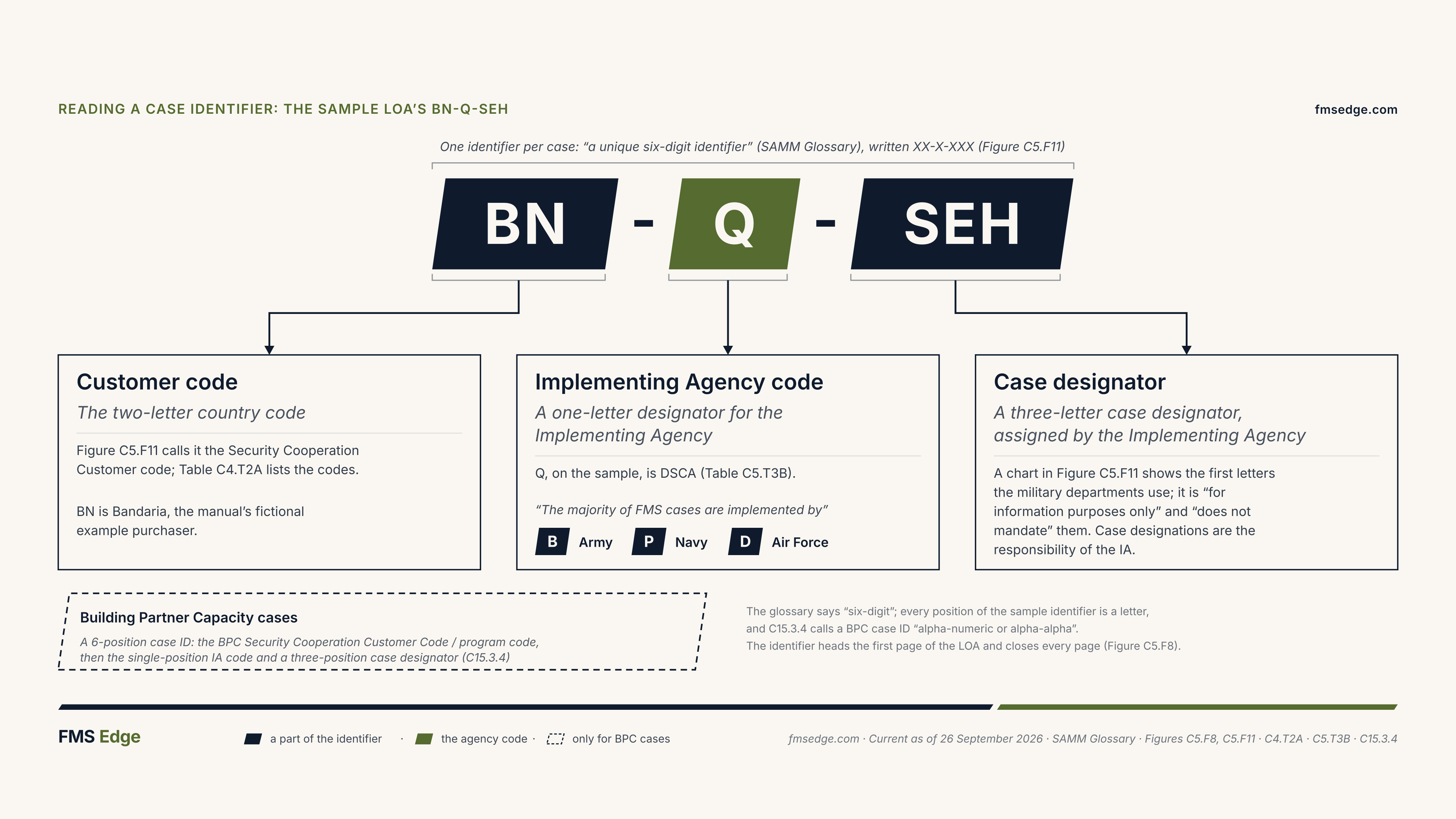
A case identifier read as its three parts, using BN-Q-SEH from the sample LOA in SAMM Figure C5.F8. Bandaria is the manual's fictional training country; the figures are the SAMM's example, not a real case. The parts are a two-letter country code, a one-letter designator for the Implementing Agency and a three-letter case designator.
Which organizations are the Foreign Military Sales Implementing Agencies?
Each leads through one : the Army's Deputy Assistant Secretary for Defense Exports and Cooperation, the Navy International Programs Office and the Deputy Under Secretary of the Air Force for International Affairs [SAMM ]. The defense agencies listed in Table C5.T3B are as well [SAMM ].
Department of the Army
The Deputy Assistant Secretary of the Army for Defense Exports and Cooperation (DASA (DE&C)) is the Army . It directs three designated commands: the U.S. Army Command (), the Training Field Activity () and the U.S. Army Corps of Engineers (USACE) [SAMM ]. Army Letters of Request () go to the Assistant Secretary of the Army (Acquisition, Logistics and Technology) (ASA (ALT))/DASA (DE&C) for action [SAMM ]. DASA (DE&C) also has management oversight for Army policy as well as for , , technology transfer, and munitions export licensing. Headquarters, , located in Huntsville, Alabama (Redstone Arsenal) handles approved materiel programs, including defense articles and services, non-institutional training and technical assistance. has a branch organization in New Cumberland, Pennsylvania (USASAC-NC), that acts as the Army and writes/manages cases for follow-on support. Central case managers for the Army are found at USASAC-NC.
, located at Fort Eustis, Virginia, is the Army organization that writes and manages cases for institutional training, exercises, and non-institutional support. is one of the Army’s three designated commands [SAMM ].
Another U.S. Army organization connected to training is the Training Management Organization () at Fort Bragg, North Carolina. is responsible for selecting, training, and supporting Mobile Training Teams () that deploy overseas to support training requirements. There is no comparable organization in the other two Military Departments (). works closely with and with Organizations ().
The Department of the Army develops the defense and security capabilities and capacity of allies and partners for self-defense and multinational operations. Within Headquarters, Department of the Army, the ASA (ALT) is the single office responsible for setting the strategic direction of Army policies and programs in acquisition, procurement, logistics, technology, the , intellectual property and not otherwise delegated, and for overseeing them. In this sense, includes and armaments cooperation. Subject to the ASA (ALT)'s authority, direction and control, DASA (DE&C) is delegated responsibility for selected activities. As the Army , DASA (DE&C) works closely with two Army Commands, Army Materiel Command and the Army Training and Doctrine Command, and with USACE, a Direct Report Unit to Headquarters, Department of the Army [SAMM ].
USACE in Washington, DC, is the organization responsible for writing/managing cases for Army design and construction services. USACE is one of the Army’s three designated commands [SAMM ].
USACE, headquartered in Washington, D.C., is responsible for development/implementation, and execution of facility infrastructure design and construction for and (), Building Partner Capacity (), and Foreign Assistance Act Section 607 programs using the mechanism. USACE provides services using in-house USACE personnel and contracted services. USACE provides services that include, but are not limited to, planning, design, construction, design/construction management, and technical assistance in the areas of infrastructure, water resource management, environment and sustainability, programs/project management, geospatial/engineering, and sustainment.
USACE is the Army’s principal engineering design, construction, research, and development organization. It is responsible for delivering technical services and infrastructure solutions to a wide range of international partners, including all of the geographic and functional combatant commands, the Department of War (DoW), other U.S. federal agencies, and countries worldwide. The USACE is one of the Army’s designated commands for . The USACE executes missions that support war fighting, disaster relief, and other contingencies as well as providing planning, technical support, acquisition, construction, and capacity development around the globe.
The USACE supports the Combatant Commands () in designing and executing engineering projects and water resource management in countries around the world. Some of the construction and public works projects the USACE has provided under include construction of maintenance and storage facilities in support of major systems and stand-alone projects in support of foreign military capacity improvements. Examples include the construction of piers, seawalls, firing ranges, schools, barracks, water wells, health clinics, simulation and training facilities, munitions storage bunkers, dining facilities, prisons, roads, and runways.
The Army is decentralized in the preparation and management of . involving Army Materiel Command ()-provided materiel and services are managed over their life cycles by Country Program Managers at . The applicable Life Cycle Management Command () Management Directorate develops the before offers and implements it. The U.S. Army Medical Materiel Agency () managed medical after implementation until the Army discontinued it; its remaining functions passed to the U.S. Army Medical Logistics Command (AMLC). and USACE independently develop, implement, and manage for their respective capabilities.
The Commander, U.S. Army Medical Command (MEDCOM), exercises command and control of the U.S. Army’s medical, dental, and veterinary treatment capabilities. AMLC, headquartered at Fort Detrick, MD, was set up to become the Army’s primary medical logistics and sustainment command. In addition, the U.S. Army Medical Research and Development Command in coordination with ASA (ALT), operates as the lead agency for cooperative medical research and development with international partners. Finally, the U.S. Army Medical Center of Excellence is a leading provider of international military medical education and training services.
Department of the Navy
The Navy International Programs Office () is the headquarters element in the U.S. Navy. handles not only , but also other international programs such as and technology transfer. It is also the for U.S. Coast Guard and some U.S. Marine Corps , and receives and tasks for Department of the Navy articles and services [SAMM , ]. Case managers for the Navy are often in the System Commands () and Program Executive Offices (PEOs). The Navy is Naval Supply Systems Command Weapon Systems Support ( WSS). tasks WSS to write cases for follow-on support.
Unlike its Air Force counterpart, the Naval Education and Training Field Activity () is not authorized to receive directly. Instead, for maritime training must go to who will, in turn, task them to [SAMM , ]. , in Pensacola, Florida, is the agency that has oversight for maritime training. Almost every for the sale of a major maritime system will include a training line prepared by .
, WSS, and also work closely with counterpart offices in the U.S. Marine Corps and U.S. Coast Guard to access resources to meet maritime requirements.
The Department of the Navy promotes exportability and the transfer of capabilities that support strategic security interests, and in doing so advances global maritime alliances and partnerships. sits under the Assistant Secretary of the Navy for Research, Development and Acquisition (ASN ()). It is the Department's principal office for developing, implementing and managing its international programs and policies on research, development, acquisition, military training and technology transfer. oversees programs for procurement efforts, in-service support, personnel exchange, comparative test and evaluation, , export licensing and exemptions, and international technology transfer. Program Management Offices () perform the functions of a Case Administering Office, and PEOs, within the structure, manage and execute programs [SAMM ].
Within each system’s command and in , an / coordination office oversees and monitors the command’s / business.
Although the U.S. Marine Corps () is a separate service within the Department of the Navy, is the entry point for all requests for / [SAMM ]. The U.S. Marine Corps Systems Command (International Programs), located at Quantico, VA, executes all for systems and logistics, international procurement matters, international armaments programs, and the facilitation of all exercises involving international forces operating with the or utilizing facilities. The U.S. Marine Corps Group (), located at the Joint Expeditionary Base, Little Creek-Fort Story, VA, coordinates, manages, and implements all / education and training for the . Deployment of training teams is through the appropriate regional component command and forces command.
Although a component of the Department of Homeland Security () and not the DoW, the U.S. Coast Guard () participates in certain programs. The Headquarters, , Directorate of International Affairs and Foreign Policy (), located in Washington, D.C., coordinates / policy and directs the performance of programs on behalf of the Commandant of the . operating units, training centers, and points may provide U.S. defense articles and services to foreign customers through the / program.
Department of the Air Force
The Office of the Deputy Under Secretary of the Air Force for International Affairs () is the Air Force headquarters element for . In addition to headquarters functions performed by Army DASA (DE&C) and , also has extensive political and military responsibilities. receives for major system programs but generally tasks the Air Force and Cooperation () Directorate at Wright-Patterson Air Force Base (AFB), Ohio, to prepare the case. is also the Air Force in that it receives and writes, signs, and manages cases for follow-on support.
The Air Force Training () squadron at Randolph Air Force Base, Texas, receives and writes, signs, and manages cases for Air Force training. Air Force training via may be included as a line on an for a system sale or may be provided via a separate case typically a .
The Secretary of the Air Force delegates responsibility for the and activities of the Department of the Air Force to , which is the functional synchronizer and integrator of the Department's enterprise. advises and supports the officials working on U.S. Air Force international activities, the Office of the Chief of Space Operations, the Office of the Air Force Chief of Staff and the Office of the Secretary of the Air Force. also prepares and disseminates policies, objectives and activities, coordinating them as appropriate with the Department of War, and other departments and agencies [SAMM ].
Air Force directs the management of its business on a line-by-line basis. or , as applicable, assigns line management responsibility to the major command having cognizance over the article or service being provided and a Program Manager () to oversee the development and execution of major system acquisition .
The other implementing agencies
In addition to the three military departments, the defense agencies listed in Table C5.T3B receive Letters of Request and write and manage cases for their own products and services [SAMM , ].
What the military department Secretaries do
The Secretaries of the do the following:
- Provide the Secretary of War recommendations considered appropriate and necessary to ensure the successful conduct of /, including its interface with and support of policies, objectives, plans, and programs
- Provide data, upon request, about price, source, availability, and lead time for use in developing and reviewing / programs, including cases
- Provide to elements of the Office of the Secretary of War (), Joint Staff, , and , as appropriate, technical information as to weapons systems, tactics and doctrine, training, and pertinent logistic support
- Conduct training and acquire and deliver defense articles and services included in approved programs
- Coordinate and establish delivery schedules and necessary internal procedures for follow-up, expediting, and related actions during the implementation of approved programs
- Provide such other technical assistance and facilities to elements of as necessary to promote efficiency and economy in / matters
- Within policies and criteria established by the Under Secretary of War for Policy (USW(P)), and under the direction of the Director, , make sales of defense articles and services to eligible countries and international organizations
- Maintain appropriate records and furnish prescribed reports within the scope of their responsibilities
- Obtain from the and such data as may be needed to carry out assigned responsibilities
- For the area or areas assigned, provide administrative support needed to carry out / functions, subject to the direction and policy guidance of USW(P)
- Per approved tables of distribution and other authorizations, directives, and requests, recommend and provide qualified military personnel to carry out / assignments
- Assist the USW(P) and the Director, , as requested, in government-to-government or interdepartmental discussion involving / policies, plans, and programs
- Assist the USW(P) and the Director, , as requested, in government-to-government negotiations involving / and the Director for International Cooperation, or designee in government-to-government negotiations involving arrangements
References
SAMM
- SAMM C1.3.2.6.1: The Military Departments.
- SAMM C1.3.2.6: Implementing Agencies.
- SAMM C1.3.2.6.1.1.3: Responsibilities.
- SAMM C5.T3A: Military Department Organizations Authorized to Receive Letters of Request
- SAMM C1.3.2.6.1.2.3: Responsibilities.
- SAMM C5.T3B: Other Department of War Implementing Agencies Authorized to Receive Letters of Request
- SAMM C1.3.2.6.1.1.2: Roles.
- SAMM C1.3.2.6.1.2.2: Roles.
- SAMM C1.3.2.6.1.3.2: Roles.
Related
Military Department (MILDEP)
One of the departments within the DoD created by the National Security Act of 1947, as amended. The Military Departments are: the Department of the Air Force, the Department of the Army, and the Department of the Navy.
SAMM Glossary, as of 12 September 2026
Glossary entry →Open the manual’s entry → (opens in new tab)
Foreign Military Sales (FMS)
The part of U.S. security assistance, authorized by the Arms Export Control Act (AECA), in which eligible foreign governments and international organizations buy defense articles, services and training from the U.S. Government under formal government-to-government agreements.
The articles come either from Department of War stocks or from new procurement under contracts the Department manages [22 U.S.C. 2761, 22 U.S.C. 2762]. A sale is FMS whatever the source of the purchaser's financing.
FMS Edge glossary, as of 10 October 2026
Glossary entry →Open the manual’s entry → (opens in new tab)
SAMM: Security Assistance Management Manual
SAMM Acronyms, as of 12 September 2026
Glossary entry →Security Assistance Management Manual (SAMM) →
Implementing Agency (IA)
The military department or defense agency responsible for the execution of military assistance programs. With respect to FMS, the military department or defense agency assigned responsibility by the Defense Security Cooperation Agency to prepare an LOA and to implement an FMS case. The implementing agency is responsible for the overall management of the actions that will result in delivery of the materials or services set forth in the LOA that was accepted by a foreign country or international organization.
SAMM Glossary, as of 12 September 2026
Glossary entry →Open the manual’s entry → (opens in new tab)
Security Assistance (SA)
A group of programs authorized by federal statutes by which the United States provides defense articles, military training, and other defense-related services by grant, lease, loan, credit, or cash sales in furtherance of national policies and objectives, and those that are funded and authorized through the Department of State to be administered by Department of Defense/Defense Security Cooperation Agency, which are considered part of security cooperation.
SAMM Glossary, as of 12 September 2026
Glossary entry →Open the manual’s entry → (opens in new tab)
SATFA: Security Assistance Training Field Activity (SATFA)
SAMM Acronyms, as of 12 September 2026
LOR: Letter of Request
SAMM Acronyms, as of 12 September 2026
International Armaments Cooperation (IAC)
Programs and activities through which the United States works with allied and friendly countries to promote rationalization, standardization and interoperability, usually under written bilateral or multilateral agreements that set each party's responsibilities for shared projects or exchanges.
International Armaments Cooperation (IAC) covers U.S. cooperation with other countries and international organizations to research, develop, acquire and sustain military systems, including the Information Exchange Program, the Engineer and Scientist Exchange Program, foreign comparative testing and cooperative logistics [SAMM C2.1.7.2.1].
FMS Edge glossary, as of 10 October 2026
Glossary entry →Open the manual’s entry → (opens in new tab)
Foreign Disclosure
The authorized release or transfer of classified or controlled unclassified information (CUI) from the U.S. government to foreign governments, international organizations, or foreign nationals. This process is governed by strict policies and procedures to ensure that the release of information aligns with U.S. national security and foreign policy objectives.
SAMM Glossary, as of 26 October 2026
Glossary entry →Open the manual’s entry → (opens in new tab)
International Logistics Control Office (ILCO)
The office in each Military Department that manages the logistics support programs and transactions of Foreign Military Sales (FMS) and other security cooperation programs, and the central point in the continental United States for monitoring purchasers' requisitions.
A purchaser reports a valid supply discrepancy to the International Logistics Control Office (ILCO) of the Military Department concerned [SAMM C2.1.5.4.3].
FMS Edge glossary, as of 10 October 2026
Glossary entry →Open the manual’s entry → (opens in new tab)
Continental United States (CONUS)
U.S. territory, including the adjacent territorial waters, located within the North American continent between Canada and Mexico. Does not include Hawaii or Alaska.
SAMM Glossary, as of 12 September 2026
Glossary entry →Open the manual’s entry → (opens in new tab)
Travel and Living Allowance (TLA) (International Military Students)
Those costs associated with transportation, baggage, and living allowances of International Military Students, which are authorized for payment under Security Assistance and Security Cooperation training programs. See also "Living Allowance" and "Travel Allowance."
SAMM Glossary, as of 12 September 2026
Glossary entry →Open the manual’s entry → (opens in new tab)
MTT: Mobile Training Team
SAMM Acronyms, as of 12 September 2026
Security Cooperation
Activities by which the Department of War encourages and enables international partners to cooperate with the United States toward strategic objectives, spanning every interaction with foreign defense and security establishments and every security assistance program the Department administers.
Under chapter 16 of Title 10, their purposes are to develop allied and friendly security capabilities for self-defense and multinational operations, to give U.S. forces peacetime and contingency access, and to build relationships promoting specific U.S. security interests [10 U.S.C. 301(7)].
FMS Edge glossary, as of 10 October 2026
Glossary entry →Open the manual’s entry → (opens in new tab)
SCO: Security Cooperation Organization
SAMM Acronyms, as of 12 September 2026
Industrial Base
The part of a national economy that manufactures and maintains goods, chiefly through factories, maintenance facilities, processing plants and laboratories, whether privately or government owned. For U.S. defense it is the public facilities, academic institutions and commercial companies that research, develop, produce, deliver and maintain weapon systems and their parts for the U.S. military, together with closely connected capacity in Canada.
FMS Edge glossary, as of 10 October 2026
Glossary entry →Open the manual’s entry → (opens in new tab)
FMS: Foreign Military Sale
SAMM Acronyms, as of 12 September 2026
Letter of Offer and Acceptance (LOA)
The legal instrument that lists the defense articles and services, including training, that the U.S. Government transfers to a foreign country or international organization, with their estimated costs and the terms and conditions. The benefitting partner does not sign a Building Partner Capacity (BPC) LOA.
The Letter of Offer and Acceptance (LOA) is the instrument the U.S. Government uses to sell under the Arms Export Control Act (AECA); signed LOAs and their later Amendments and Modifications are also called Foreign Military Sales (FMS) cases [SAMM C5.6.1].
FMS Edge glossary, as of 10 October 2026
Glossary entry →Open the manual’s entry → (opens in new tab)
Combatant Command (CCMD)
A unified or specified command with a broad continuing mission under a single commander established and so designated by the President, through the Secretary of Defense and with the advice and assistance of the Chairman of the Joint Chiefs of Staff. Also called CCMD.
SAMM Glossary, as of 12 September 2026
Glossary entry →Open the manual’s entry → (opens in new tab)
Security Cooperation Programs
Any program, activity (including an exercise), or interaction of the Department of Defense with the security establishment of a partner or international organization to achieve a purpose as follows:
To build and develop allied and friendly security capabilities for self-defense and multinational operations.
To provide the armed forces with access to the partner or international organization during peacetime or a contingency operation.
To build relationships that promote specific United States security interests.
SAMM Glossary, as of 12 September 2026
Glossary entry →Open the manual’s entry → (opens in new tab)
LOA: Letter of Offer and Acceptance
SAMM Acronyms, as of 12 September 2026
AMC: Army Materiel Command
LCMC: Life Cycle Management Command
ILCO: International Logistics Control Office
SAMM Acronyms, as of 12 September 2026
Glossary entry →International Logistics Control Office (ILCO) →
NETSAFA: Naval Education and Training Security Assistance Field Activity (NETSAFA)
SAMM Acronyms, as of 12 September 2026
CG-DCO-I: U.S. Coast Guard, Directorate of International Affairs and Foreign Policy (CG-DCO-I)
SAMM Acronyms, as of 12 September 2026
Inventory Control
That phase of military logistics which includes managing, cataloging, requirements determinations, procurement, distribution, overhaul, and disposal of materiel.
SAMM Glossary, as of 12 September 2026
Glossary entry →Open the manual’s entry → (opens in new tab)
SAF/IA: Deputy Under Secretary of the Air Force International Affairs
SAMM Acronyms, as of 12 September 2026
AFSAT: Air Force Security Assistance Training Squadron (AFSAT)
SAMM Acronyms, as of 12 September 2026
Blanket Order Case (Foreign Military Sales)
A Foreign Military Sales (FMS) case for a category of defense articles or services, training included, with no definitive list of items or quantities, written against a dollar ceiling.
A Blanket Order case remains in effect until the purchaser has requisitioned articles or services up to the funds available on it [SAMM C5.6.13.4].
FMS Edge glossary, as of 10 October 2026
Glossary entry →Open the manual’s entry → (opens in new tab)
Defense Security Cooperation Agency (DSCA)
The Department of War agency that directs, administers and provides guidance to the Department's components and its representatives at U.S. missions for the execution of the security cooperation programs for which it is responsible [SAMM C1.3.2.2]. The agency also provides financial and technical assistance, arranges the transfer of defense materiel, training and services to international partners, and promotes military-to-military contacts.
FMS Edge glossary, as of 10 October 2026
Glossary entry →Open the manual’s entry → (opens in new tab)
DSCA: Defense Security Cooperation Agency
SAMM Acronyms, as of 12 September 2026
Glossary entry →Defense Security Cooperation Agency (DSCA) →
SAMM C1.3.2.6.1: The Military Departments.
“In addition to authorizing organizations as IAs, with duties as described in Section C1.3.2.6., the MILDEPs also conduct international armaments cooperation with eligible partner nations and international organizations in accordance with policies and criteria established by State and the OUSW(A&S). MILDEPs also authorize certain other organizations to carry out SC duties at the direction of the IAs. The following MILDEP …”
Security Assistance Management Manual, as of 26 October 2026
SAMM C1.3.2.6: Implementing Agencies.
“An Implementing Agency (IA) is the MILDEP organization (See Table C1.T1.) or defense agency (See Table C5.T3B.) responsible for the execution of SC programs. The IA is responsible for the overall management of actions for delivery of the materiel, supporting equipment, or services set forth in the SC programs and activities being provided to a foreign partner. In coordination with …”
Security Assistance Management Manual, as of 26 October 2026
SAMM C1.3.2.6.1.1.3: Responsibilities.
“The DASA (DE&C) leads, manages, resources, and directs assigned elements of the Army’s global SC activities, including policy and strategy, for Foreign Military Sales (FMS), foreign military and foreign national training and education, international armaments cooperation, non-special access program (SAP) technology transfer, and export policy. The DASA (DE&C) ensures that all ASA (ALT) managed SC programs are conducted according to …”
Security Assistance Management Manual, as of 26 October 2026
SAMM C5.T3A: Military Department Organizations Authorized to Receive Letters of Request
“Army Table C5.T3A. Military Department Organizations Authorized to Receive Letters of Request Implementing Agency Code Military Department Organization with Security … Navy Implementing Agency Code Military Department Organization with Security Cooperation Responsibilities Applicability Address for Letter of Request Submission P Navy … Air Force Implementing Agency Code Military Department Organization with Security Cooperation Responsibilities Applicability Address for Letter of Request Submission D …”
Security Assistance Management Manual, as of 2 November 2026
SAMM C1.3.2.6.1.1.2: Roles.
“DA develops allied and partner defense and security capabilities and capacity for self-defense and multinational operations. The ASA (ALT) is the single office in HQDA responsible for setting the strategic direction for and overseeing DA policies and programs related to acquisition, logistics, technology, procurement, intellectual property, the industrial base, and SC not otherwise delegated (including security assistance and armaments cooperation). …”
Security Assistance Management Manual, as of 26 October 2026
SAMM C1.3.2.6.1.2.2: Roles.
“The DoN advances global maritime alliances and partnerships by championing exportability and the transfer of capabilities supporting strategic security interests. NIPO, under the Assistant Secretary of the Navy (Research, Development, and Acquisition) (ASN (RDA)), is the principal office for developing, implementing, and managing DoN international programs and policies concerning research, development, acquisition, military training, and technology transfer for DoN. NIPO …”
Security Assistance Management Manual, as of 26 October 2026
SAMM C1.3.2.6.1.2.3: Responsibilities.
“NIPO is responsible for receipt and tasking of requests for information, Pre-LOR/MOR activities, and LORs/MORs to the SYSCOMS and other organizations as required to develop, coordinate, negotiate, conclude international acquisition agreements and arrangements, and international armaments cooperation agreements. This includes foreign military financing, grant aid, and IMET. NIPO is also the IA responsible for implementing United States Coast Guard (USCG) …”
Security Assistance Management Manual, as of 26 October 2026
SAMM C1.3.2.6.1.3.2: Roles.
“The Secretary of the Air Force delegates responsibility for the DAF’s security cooperation programs and activities to the SAF/IA. SAF/IA serves as the functional synchronizer and integrator of DAF security cooperation enterprise. SAF/IA advises and supports the Office of the Secretary of the Air Force, the Office of the Air Force Chief of Staff, the Office of the Chief of …”
Security Assistance Management Manual, as of 26 October 2026
SAMM C5.T3B: Other Department of War Implementing Agencies Authorized to Receive Letters of Request
“Table C5.T3B. Other Department of War Implementing Agencies Authorized to Receive Letters of Request Defense Contract Management Agency (DCMA) Defense Information Systems Agency (DISA) Defense Logistics Agency (DLA) Defense Security Cooperation Agency (DSCA) Defense Threat Reduction Agency (DTRA) Missile Defense Agency (MDA) National Geospatial-Intelligence Agency (NGA) National Security Agency (NSA)”
Security Assistance Management Manual, as of 2 November 2026