
Guide
Who does end-use monitoring of Controlled Cryptographic Items sold through Foreign Military Sales?
All carry enhanced end-use monitoring, and who performs it depends on who holds them. The U.S. Government or industry does it for items it keeps for testing or integration, and the North Atlantic Treaty Organization, its member nations, Australia and New Zealand do it under their own policies. For other recipients that are parties to a Communications Interoperability and Security or like agreement, U.S. custodians funded through the case do it, and for nations without one the office does, reporting to its .
Who does end-use monitoring of Controlled Cryptographic Items sold through Foreign Military Sales?
All are designated for Enhanced (), and who carries out the assessments and reporting depends on who holds the items. are recorded in management systems rather than in the . Once are transferred, shows them as Routine instead of (unless they are for other reasons), but they keep the and documentation requirements [SAMM ].
A Controlled Cryptographic Item is a U.S. National Security Agency term for secure telecommunications or information handling equipment, associated cryptographic component, or other hardware items that perform a Critical function. Items so designated may be unclassified but are deemed sensitive and, thus, are subject to special accounting controls and transportation security.
Each transfer of moves the item from the authorized shipping Custodian/Manager to the recipient's Custodian/Manager, who signs and returns the SF-153 Material Report to document receipt [SAMM ]. The custodian assumes accountability for the equipment or materiel upon receipt, then controls its dissemination to authorized individuals on job requirements and a need-to-know basis.
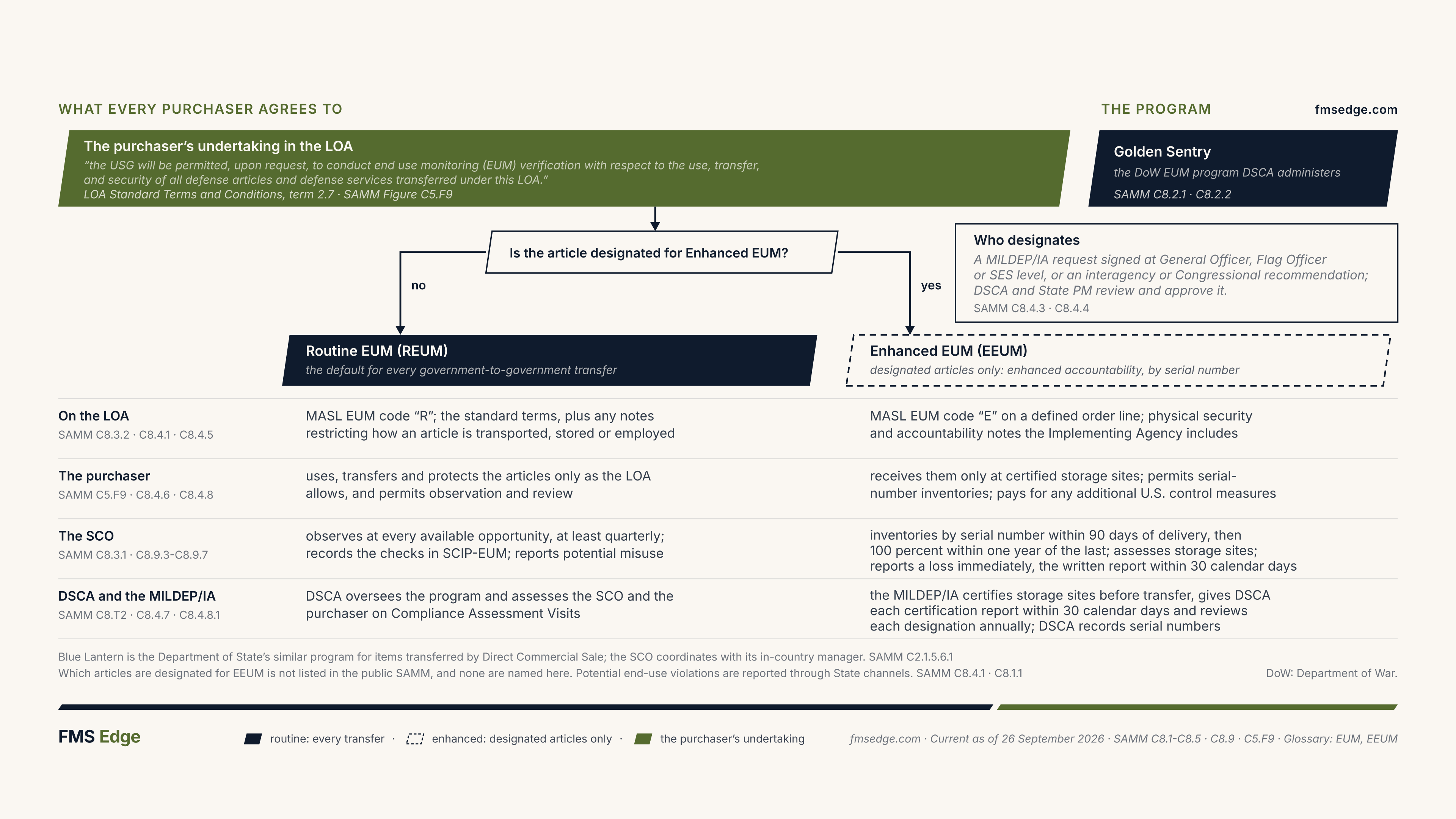
Every purchaser agrees in the LOA that the U.S. Government may verify how the articles it buys are used, transferred and secured. Golden Sentry, the Department of War end-use monitoring program DSCA administers, carries out that verification. Which articles are designated for Enhanced End-Use Monitoring is not listed in the public SAMM, and none are named here.
Where partners or allies buy that the U.S. Government () or industry keeps for testing, integration or similar purposes, the or industry performs the assessments and reporting under its own safeguarding, accountability and reporting procedures [SAMM ].
For transferred to the North Atlantic Treaty Organization (), to member nations, or to Australia or New Zealand, the recipient carries out the assessments and reporting itself, following its own policies and regulations [SAMM ].
For transferred to international organizations other than , or to non- member nations other than Australia and New Zealand, that are parties to a Communications Interoperability and Security () or a like agreement, the U.S. custodians funded through carry out the assessments and reporting [SAMM ]. For transferred to non- member nations that are not parties to a or like agreement, the Organizations () carry them out and report to their theater Theater Account. must ensure that the carry out the required physical security and accountability assessments [SAMM ].
When a nation joins , the Case Writing and Development Division of the ( (/GEX/CWD)) will insert the Member, Australia, and New Zealand note in every future Basic that adds equipment. It will also insert the note in new amendments and modifications of implemented before the nation joined. 's Weapons Directorate (/WPN) is the contact for further information on nations that become members [SAMM ].
How Controlled Cryptographic Items are shipped
The retains title to the equipment it transfers to nations outside other than Australia and New Zealand, and to international organizations other than , in accordance with the bilateral agreements and the release authorization of the Committee on National Security Systems [SAMM ]. The Defense Courier Service is recommended primarily where the retains title to the materiel during transit [SAMM ].
For countries, Australia, and New Zealand, title to the does transfer from the to the purchaser [SAMM ]. recipients may move , including external peripheral and support equipment, through freight forwarders or the , provided in-transit visibility and reasonable protection against theft and loss are maintained at all times; the purchaser may impose more stringent controls outside the United States [SAMM ].
References
SAMM
- SAMM C8.4.5.1: Controlled Cryptographic Items.
- SAMM C7.13.3.3.1
- SAMM C8.4.5.1.1
- SAMM C8.4.5.1.3
- SAMM C8.4.5.1.4
- SAMM C3.7.2.3.2.3: Non-North Atlantic Treaty Organization Member Nations, Except Australia and New Zealand, with Access to Communications Security, Joining the North Atlantic Treaty Organization.
- SAMM C7.3.5.1.3: International Organizations Other Than North Atlantic Treaty Organization, and Non-North Atlantic Treaty Organization Member Nations Except Australia and New Zealand.
- SAMM C7.6.2.6: Defense Courier Service.
- SAMM C7.3.5.1.1: North Atlantic Treaty Organization.
- SAMM C7.15.4: Controlled Cryptographic Item.
- SAMM C8.4.5.1.2
DSCA policy memoranda
- DSCA 24-07: Communications Security Letter of Offer and Acceptance Note Change for Communications and Information Security Memorandum of Agreement Nations Joining North Atlantic Treaty Organization
Related
Controlled Cryptographic Items (CCI)
CCIs are devices that embody cryptographic logic or other cryptographic design, but do not perform the entire Communications Security (COMSEC) function. CCIs are dependent upon host equipment or assemblies to complete and operate COMSEC functions. Un-keyed CCI is unclassified. An item may be designated CCI because its entire component is controlled (e.g. Inline Network Encryptor (INE)), or because the item contains an embedded cryptographic National Security Agency (NSA) Type-1 certified module to encrypt/de-encrypt information (e.g. secure radio).
SAMM Glossary, as of 12 September 2026
Glossary entry →Open the manual’s entry → (opens in new tab)
Memorandum of Agreement (MOA)
In the manual's usage, a written agreement between sovereign states, or between a state and an international organization, signed by authorized representatives and legally binding under international law.
FMS Edge glossary, as of 10 October 2026
Glossary entry →Open the manual’s entry → (opens in new tab)
Security Cooperation
Activities by which the Department of War encourages and enables international partners to cooperate with the United States toward strategic objectives, spanning every interaction with foreign defense and security establishments and every security assistance program the Department administers.
Under chapter 16 of Title 10, their purposes are to develop allied and friendly security capabilities for self-defense and multinational operations, to give U.S. forces peacetime and contingency access, and to build relationships promoting specific U.S. security interests [10 U.S.C. 301(7)].
FMS Edge glossary, as of 10 October 2026
Glossary entry →Open the manual’s entry → (opens in new tab)
Combatant Command (CCMD)
A unified or specified command with a broad continuing mission under a single commander established and so designated by the President, through the Secretary of Defense and with the advice and assistance of the Chairman of the Joint Chiefs of Staff. Also called CCMD.
SAMM Glossary, as of 12 September 2026
Glossary entry →Open the manual’s entry → (opens in new tab)
End Use Monitoring (EUM)
Mandated by Section 40A of the Arms Export Control Act (AECA) (22 U.S.C. 2785), activities undertaken by the U.S. Government to ensure that defense articles and defense services transferred to foreign partners under security assistance/cooperation authorities are monitored and used according to the terms and conditions specified in Letters of Offer and Acceptance and other transfer agreements, and as required by the AECA or the Foreign Assistance Act of 1961.
SAMM Glossary, as of 12 September 2026
Glossary entry →Open the manual’s entry → (opens in new tab)
CCI: Controlled Cryptographic Item
SAMM Acronyms, as of 12 September 2026
Security Cooperation Information Portal (SCIP)
A web-based tool, managed by the Defense Security Cooperation Agency (DSCA), that gives international purchasers, their agents such as freight forwarders, and authorized U.S. Government personnel information on Foreign Military Sales (FMS) cases and other security cooperation programs.
It covers case, line, requisition and supply data, supply transactions and end-use monitoring information, drawn from the Defense Security Assistance Management System (DSAMS) and the Military Departments' case execution systems.
FMS Edge glossary, as of 10 October 2026
Glossary entry →Open the manual’s entry → (opens in new tab)
SCIP: Security Cooperation Information Portal
SAMM Acronyms, as of 12 September 2026
Glossary entry →Security Cooperation Information Portal (SCIP) →
Communications Security (COMSEC)
The measures and controls taken to deny unauthorized persons’ information derived from telecommunications and other information systems, and technologies necessary to ensure the authenticity of such communications. COMSEC includes cryptographic security, transmission security, emissions security, and physical security of COMSEC material. Secure telecommunication or information system cryptographic components are the primary COMSEC products for transmission security and commonly called COMSEC devices or products. COMSEC devices are designated Controlled Cryptographic Items (CCI).
SAMM Glossary, as of 12 September 2026
Glossary entry →Open the manual’s entry → (opens in new tab)
COMSEC: Communications Security
SAMM Acronyms, as of 12 September 2026
CISMOA: Communications Interoperability and Security Memorandum of Agreement
SAMM Acronyms, as of 12 September 2026
Foreign Military Sales (FMS)
The part of U.S. security assistance, authorized by the Arms Export Control Act (AECA), in which eligible foreign governments and international organizations buy defense articles, services and training from the U.S. Government under formal government-to-government agreements.
The articles come either from Department of War stocks or from new procurement under contracts the Department manages [22 U.S.C. 2761, 22 U.S.C. 2762]. A sale is FMS whatever the source of the purchaser's financing.
FMS Edge glossary, as of 10 October 2026
Glossary entry →Open the manual’s entry → (opens in new tab)
SCO: Security Cooperation Organization
SAMM Acronyms, as of 12 September 2026
Defense Security Cooperation Agency (DSCA)
The Department of War agency that directs, administers and provides guidance to the Department's components and its representatives at U.S. missions for the execution of the security cooperation programs for which it is responsible [SAMM C1.3.2.2]. The agency also provides financial and technical assistance, arranges the transfer of defense materiel, training and services to international partners, and promotes military-to-military contacts.
FMS Edge glossary, as of 10 October 2026
Glossary entry →Open the manual’s entry → (opens in new tab)
DSCA: Defense Security Cooperation Agency
SAMM Acronyms, as of 12 September 2026
Glossary entry →Defense Security Cooperation Agency (DSCA) →
Letter of Offer and Acceptance (LOA)
The legal instrument that lists the defense articles and services, including training, that the U.S. Government transfers to a foreign country or international organization, with their estimated costs and the terms and conditions. The benefitting partner does not sign a Building Partner Capacity (BPC) LOA.
The Letter of Offer and Acceptance (LOA) is the instrument the U.S. Government uses to sell under the Arms Export Control Act (AECA); signed LOAs and their later Amendments and Modifications are also called Foreign Military Sales (FMS) cases [SAMM C5.6.1].
FMS Edge glossary, as of 10 October 2026
Glossary entry →Open the manual’s entry → (opens in new tab)
LOA: Letter of Offer and Acceptance
SAMM Acronyms, as of 12 September 2026
FMS: Foreign Military Sale
SAMM Acronyms, as of 12 September 2026
Defense Transportation System (DTS)
The part of the worldwide transportation infrastructure that supports Department of War transportation needs in peace and war, made up of military (organic) and commercial resources that are organic to the Department, under contract to it or controlled by it [SAMM C7.6.1].
It takes in organic and commercial aircraft and ships, commercial small-package services under Department contract, and U.S. military air and ocean terminals in and outside the United States.
FMS Edge glossary, as of 10 October 2026
Glossary entry →Open the manual’s entry → (opens in new tab)
SAMM C8.4.5.1: Controlled Cryptographic Items.
“All Controlled Cryptographic Items (CCI) are designated for EEUM and are documented in CCI management systems other than the Security Cooperation Information Portal (SCIP). Transferred CCI are changed from EEUM to Routine EUM in SCIP (unless it is EEUM for additional reasons) but retain the EEUM and documentation requirements, as follows:”
Security Assistance Management Manual, as of 11 September 2026
SAMM C7.13.3.3.1
“Transportation Plans for CCI must include required information for the initial delivery, returns for repair, and are updated when demilitarization functions are confirmed, all which requires the transfer of the item from the authorized shipping COMSEC Custodian/Manager to the recipient's COMSEC Custodian/Manager. The Standard Form (SF)-153 “COMSEC Material Report” is used by the shipping COMSEC Custodian/Manager to document the transfer …”
Security Assistance Management Manual, as of 26 October 2026
SAMM C8.4.5.1.1
“The assessments and reporting of EEUM for CCI purchased by Partners or Allies and retained by USG or industry for testing, integration, etc., are performed by the USG or industry's respective CCI safeguarding, accountability, and reporting procedures.”
Security Assistance Management Manual, as of 11 September 2026
SAMM C8.4.5.1.2
“The assessments and reporting of EEUM for CCI transferred to the North Atlantic Treaty Organization (NATO), NATO member nations, Australia, and New Zealand are performed by the respective partner in accordance with their CCI policies and regulations.”
Security Assistance Management Manual, as of 11 September 2026
SAMM C8.4.5.1.3
“The assessments and reporting of EEUM for CCI transferred to international organizations other than NATO and non-NATO member nations except Australia and New Zealand who have signed a Communications Interoperability and Security Memorandum of Agreement (CISMOA) or like agreement is accomplished by the FMS-funded U.S. CCI custodians.”
Security Assistance Management Manual, as of 11 September 2026
SAMM C8.4.5.1.4
“The assessments and reporting of EEUM of CCI transferred to non-NATO member nations who have not signed a Communications Interoperability and Security Memorandum of Agreement (CISMOA) or like agreement is accomplished by the MILGPs and reported to their respective theater CCMD Theater CCI Account. CCMDs must ensure MILGPs perform the required CCI physical security and accountability assessments.”
Security Assistance Management Manual, as of 26 October 2026
SAMM C3.7.2.3.2.3: Non-North Atlantic Treaty Organization Member Nations, Except Australia and New Zealand, with Access to Communications Security, Joining the North Atlantic Treaty Organization.
“When a CISMOA Nation joins the North Atlantic Treaty Organization (NATO), for all future Basic LOAs that add COMSEC equipment and new amendments and modifications to LOAs implemented prior to NATO membership, DSCA (Office of International Operations, Global Execution Directorate, Case Writing and Development Division (IOPS/GEX/CWD)) will add the NATO Member, Australia, and New Zealand COMSEC EEUM note. For additional …”
Security Assistance Management Manual, as of 26 October 2026
SAMM C7.3.5.1.3: International Organizations Other Than North Atlantic Treaty Organization, and Non-North Atlantic Treaty Organization Member Nations Except Australia and New Zealand.
“Prior to physically receiving any U.S. Information Security (INFOSEC) / COMSEC products or services, the FMS purchaser or recipient must have entered into a bilateral Communications Interoperability and Security Memorandum of Agreement (CISMOA) or other INFOSEC agreement with the USG via the Combatant Command (CCMD). It's recommended that this agreement be initiated before or parallel to LOA development to avoid …”
Security Assistance Management Manual, as of 11 September 2026
SAMM C7.6.2.6: Defense Courier Service.
“DCS provides secure, timely, and efficient end-to-end global distribution of classified and sensitive material for the United States and its Partners and Allies. It is an established courier network to transport qualified materiel. DCS is recommended primarily for circumstances where the USG retains title to the materiel during transit. For additional information on the use of DCS, contact USTRANSCOM's Defense …”
Security Assistance Management Manual, as of 26 October 2026
SAMM C7.3.5.1.1: North Atlantic Treaty Organization.
“North Atlantic Treaty Organization (NATO) member nations, Australia and New Zealand. Communications Security (COMSEC) products procured through FMS transfers are titled to those nations.”
Security Assistance Management Manual, as of 11 September 2026
SAMM C7.15.4: Controlled Cryptographic Item.
“CCI recipients are permitted to move CCI (to include external peripheral/support equipment) through FMS freight forwarders or the DTS, provided that in-transit visibility and reasonable protection against theft and loss is maintained at all times. See Figure C7.F4. The FMS purchaser may impose more stringent controls on shipment of CCI when transporting outside the United States.”
Security Assistance Management Manual, as of 11 September 2026