
Guide
What is coproduction of U.S. defense articles?
Coproduction lets a foreign government or firm acquire the know-how to manufacture or assemble a U.S. defense item. There are three routes: cooperative production under an international agreement, where the partners share out production of a system; coproduction, through Letters of Offer and Acceptance and sometimes export licenses; and licensed coproduction, through commercial export licenses issued by the Department of State.
A partner can build a U.S. defense article at home by cooperative production under an international agreement, by coproduction through Foreign Military Sales or by licensed coproduction under a State Department license. In every route the technical data is released only with disclosure approval.
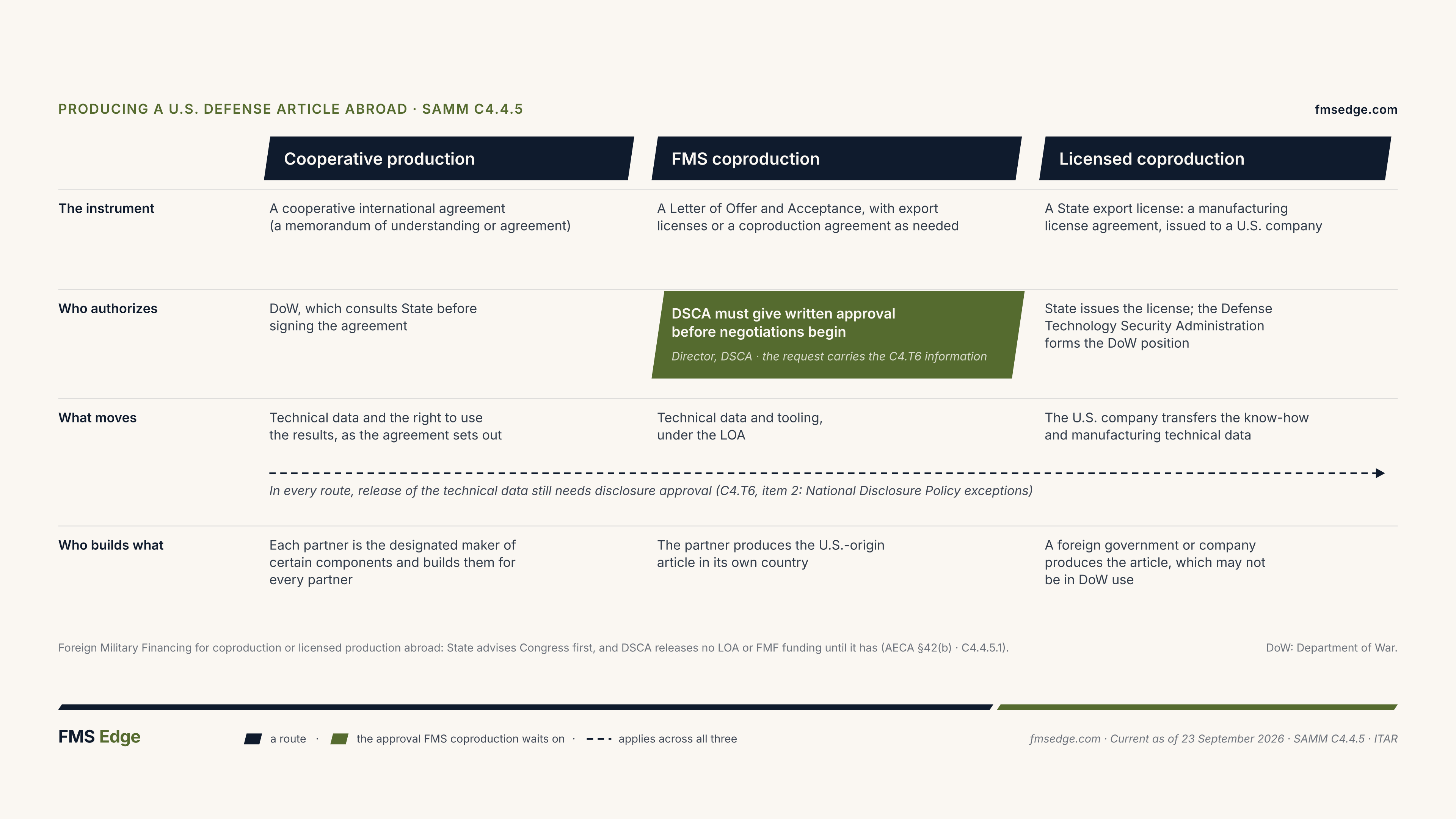
What is coproduction of U.S. defense articles?
Coproduction is a program that gives a foreign government or firm the know-how to manufacture or assemble a defense item, in whole or in part, and to repair, maintain and operate it. The program is put in place through a government-to-government or commercial licensing arrangement.
There are three distinct methods of authorizing foreign production of defense articles.
First, cooperative production is conducted with international partners under a cooperative international agreement and features an allocation of production responsibilities amongst the international partners. Individual international partners will be designated as the manufacturer of certain system components. The designated manufacturer will produce the respective components for the entire production quantity of the system. As such, the designated manufacturer will not only produce components for its own nation but also components for all international partners. Final assembly can be conducted by one or more of the partners. The F-35 Joint Strike Fighter () program is using cooperative production.
A cooperative project agreement under Section 27 of the may provide for the participants to share the costs of joint production of defense articles, including follow-on support. It may also provide for concurrent production in the United States and a partner country of an article developed jointly []. The Under Secretary of War for Acquisition and Sustainment oversees cooperative production programs, and the oversees coproduction.
Cooperative research, development and acquisition programs range in scope from small bilateral agreements to multi-billion dollar, multinational programs such as the program. There are a number of types of agreements the U.S. and its partners use, and a variety of statutes that provide the legal basis for cooperating in defense acquisition.
Second, coproduction involves the use of procedures and commercial licenses to provide a foreign nation the ability to produce U.S.-origin defense articles. Coproduction capabilities may be transferred solely through Letters of Offer and Acceptance (), may involve a combination of and associated munitions export licenses, or may require development of a coproduction international agreement [SAMM ].
Section 42(b), requires the Department of State to advise Congress before Foreign Military Financing () is used to finance coproduction or in a foreign country [SAMM ] []. Memoranda from (Office of International Operations ()) to give the country, the type of transaction proposed (an or a ) and a description of the program. They also give the extent of foreign production and the effect on employment and production in the United States. The approval is normally staffed at the same time as the related Section 36(b), notification. Until has advised Congress, () shall not approve the release of an or of funding [SAMM ].
Third, licensed coproduction involves use of commercial munitions export licenses issued by the Department of State. Licenses that authorize the export of manufacturing are referred to as Manufacturing Licensing Agreements (). enables U.S. companies to transfer to foreign governments or foreign companies the ability to produce U.S. origin defense articles. The U.S. defense articles proposed for licensed coproduction need not be in Department of War (DoW) use, and may be a significantly modified version of DoW equipment. The Defense Administration (), in concert with the other DoW components, agencies, and the Office of the Secretary of War () staff, plays a leading role in formulating the DoW’s position with regard to U.S. industry-licensed coproduction proposals.
References
SAMM
- SAMM C4.4.5
- SAMM C4.4.5.1: Foreign Military Financing Funded Coproduction Program.
Public authorities
- AECA §27: Arms Export Control Act of 1976, as amended, §27 (22 U.S.C. §2767)
- AECA §42: Arms Export Control Act of 1976, as amended, §42 (22 U.S.C. §2791), General provisions
- WarU Acquipedia AINT 004: Warfighting Acquisition University (WarU), Acquipedia AINT 004: International Acquisition - Cooperative Production and Co-Production Programs
Related
Foreign Military Sales (FMS)
The part of U.S. security assistance, authorized by the Arms Export Control Act (AECA), in which eligible foreign governments and international organizations buy defense articles, services and training from the U.S. Government under formal government-to-government agreements.
The articles come either from Department of War stocks or from new procurement under contracts the Department manages [22 U.S.C. 2761, 22 U.S.C. 2762]. A sale is FMS whatever the source of the purchaser's financing.
FMS Edge glossary, as of 10 October 2026
Glossary entry →Open the manual’s entry → (opens in new tab)
JSF: Joint Strike Fighter
Arms Export Control Act (AECA)
The basic U.S. law providing the authority and general rules for the conduct of Foreign Military Sales and commercial sales of defense articles, defense services, and training. The Arms Export Control Act (AECA) came into existence with the passage of the Foreign Military Sales Act (FMSA) of 1968. An amendment in the International Security Assistance and AECA of 1976 changed the name of FMSA to the AECA.
SAMM Glossary, as of 12 September 2026
Glossary entry →Open the manual’s entry → (opens in new tab)
Defense Security Cooperation Agency (DSCA)
The Department of War agency that directs, administers and provides guidance to the Department's components and its representatives at U.S. missions for the execution of the security cooperation programs for which it is responsible [SAMM C1.3.2.2]. The agency also provides financial and technical assistance, arranges the transfer of defense materiel, training and services to international partners, and promotes military-to-military contacts.
FMS Edge glossary, as of 10 October 2026
Glossary entry →Open the manual’s entry → (opens in new tab)
FMS: Foreign Military Sale
SAMM Acronyms, as of 12 September 2026
LOA: Letter of Offer and Acceptance
SAMM Acronyms, as of 12 September 2026
AECA: Arms Export Control Act
SAMM Acronyms, as of 12 September 2026
Licensed Production
Licensed production involves agreements made by U.S. commercial firms with international organizations, foreign governments, or foreign commercial firms to produce weapon systems. USG involvement is limited to the approval by DSCA of any applicable Foreign Military Sales case and approval of applicable type of export license. Such agreements generally establish quantitative limits on production, and prohibit third country transfers of the manufactured items.
SAMM Glossary, as of 12 September 2026
Glossary entry →Open the manual’s entry → (opens in new tab)
DSCA: Defense Security Cooperation Agency
SAMM Acronyms, as of 12 September 2026
Glossary entry →Defense Security Cooperation Agency (DSCA) →
Direct Commercial Sale (DCS)
A sale of defense articles or defense services made under a Department of State issued license by U.S. industry directly to a foreign buyer, and which is not administered by DoD through Foreign Military Sales procedures.
SAMM Glossary, as of 12 September 2026
Glossary entry →Open the manual’s entry → (opens in new tab)
Technical Data
Recorded information of a scientific or technical nature, regardless of form or characteristic. Examples of technical data packages include research and engineering drawings and associated lists, specifications, standards, process sheets, manuals, technical reports, catalog item identifications, and related information and computer software documentation.
SAMM Glossary, as of 12 September 2026
Glossary entry →Open the manual’s entry → (opens in new tab)
Technology Security
The comprehensive framework of policies, practices, and procedures designed to protect U.S. military and dual-use technologies from unauthorized access, transfer, or exploitation by adversaries.
SAMM Glossary, as of 26 October 2026
DTSA: Defense Technology Security Administration
SAMM Acronyms, as of 12 September 2026
Arms Export Control Act of 1976, as amended, §27 (22 U.S.C. §2767)
AECA §27 · Statute
SAMM C4.4.5
“Coproduction policy is provided in DoD Instruction (DoDI) 2010.06. Per DoDI 5530.03, the Director, DSCA must provide written approval to enter into negotiations for coproduction programs pursuant to an LOA. Requests for DSCA authority must include a description of the project as well as fiscal and legal memoranda. Discussions on coproduction programs may be initiated by the IA or by …”
Security Assistance Management Manual, as of 26 October 2026
SAMM C4.4.5.1: Foreign Military Financing Funded Coproduction Program.
“AECA, Section 42(b) (22 U.S.C. 2791(b)) requires the Department of State (State) to advise Congress prior to use of Foreign Military Financing (FMF) to finance coproduction or licensed production in a foreign country. DSCA (Office of International Operations (IOPS)) memoranda to State advises of the country, type of proposed transaction (FMS LOA or Direct Commercial Sales), description of program, the …”
Security Assistance Management Manual, as of 26 October 2026
Arms Export Control Act of 1976, as amended, §42 (22 U.S.C. §2791), General provisions
AECA §42 · Statute