
Guide
How is a Foreign Military Sales contract structured?
A contract that buys articles or services follows the uniform contract format of the , Sections A to J, like any other federal contract. What sets the sale apart is the breakdown. Each requirement sits on its own contract line or sub-line, funded directly from the purchaser's case and line, so that payments, billing and case closure trace back to the .
Who holds a Foreign Military Sales procurement once the LOA is signed. The case manager, the program office, the procuring contracting officer and the administrative contracting officer each hold one lane, and the contract award passes the work from the officer who buys to the officer who administers.
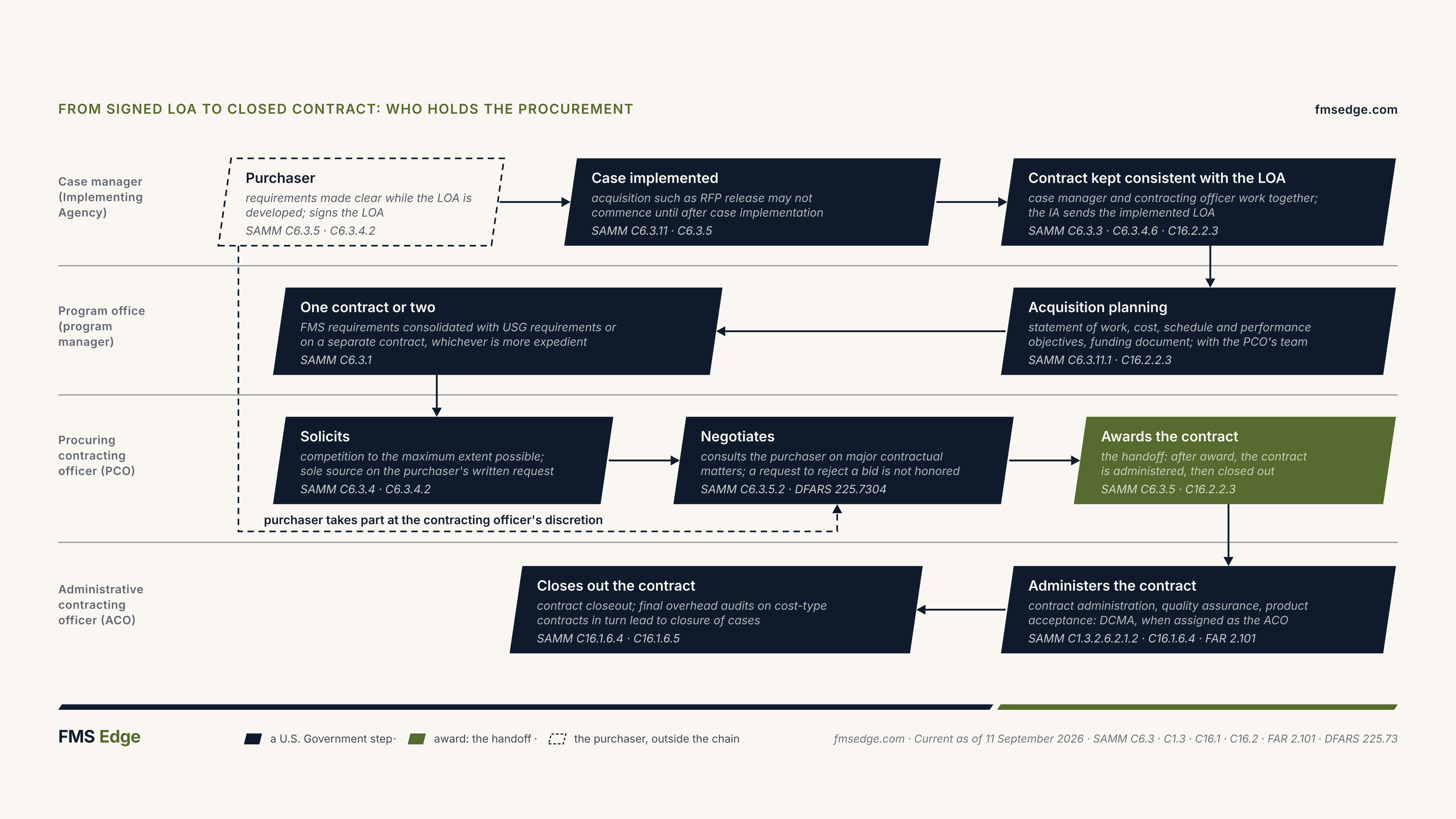
How is a Foreign Military Sales contract structured?
Contracts for the procurement of articles or services will be prepared according to the , the Defense Supplement (), and any applicable agency subordinate supplements [SAMM ]. 15.204-1 outlines a common format or structure to be used in federal contracts. This common contract structure is referred to as the uniform contract format.
The ten core sections of a federal contract are differentiated by use of alphabetic section headings. As a result, federal contracts will be structured into ten sections under the headings of Section A through Section J.
Acquisition for purchasers must follow Department of War (DoW) regulations and the other applicable U.S. Government procedures. This gives the foreign purchaser the same benefits and protection that DoW procurement receives, and it is one of the principal reasons foreign governments and international organizations prefer to buy through channels. requirements may be consolidated with U.S. Government requirements or placed on a separate contract, whichever is more expedient and cost effective [SAMM ].
Section A is titled “Solicitation/Contract Form.” The reason for this dual title is that the federal government may develop a draft or proposed contract that is issued when seeking offers from vendors. When used in this type application, Section A serves as a solicitation to vendors for contract offers. When the is ready to accept a contract offer, Section A further serves as a contract instrument that the can also sign to award the contract. In summary, Section A provides the cover page for the contract. It identifies, among other things, the contract number, the government procuring office, the contractor awarded the contract, and the government entity that will provide . Section A also bears the signatures of both the vendor’s representative, or the party making the offer, and the official from the U.S. Government () that awards the contract (i.e., the ).
Section B is titled “Supplies or Services and Prices/Costs.” This section contains a brief description of the supplies or services that may include item numbers, National Stock Numbers ()/Part Numbers (PNs), article/service nomenclature, and quantities []. Because a variety of different items or services can be purchased on the same contract, Contract Line-Item Numbers () are used to differentiate between various items or services being procured. If there are multiple requirements for the same item or service, a subordinate indenture structure can be used in the contract breaking down the overall requirements into sub- requirements. Use of and sub- enables to differentiate the individual requirements being procured within the same contract []. Implementing separate or separately identified sub-line items helps to avoid billing errors and facilitates case reconciliation and closure. Use of informational sub- for requirements (rather than separately identified, scheduled, or priced sub-) should be avoided as these may increase the probability that payment errors could occur. Additionally, segregating each requirement into its own or sub- may be necessary to reflect different prices, which may result from the provisions of 225.7303, “Pricing Acquisitions for .”
The , at C6.3.1, states that requirements can be procured on the same contract with DoW requirements [SAMM ]. However, under 204.7104-1, separately identified subline items (sub-) shall be used when items bought under one contract line item are to be paid for from more than one accounting classification or have different delivery dates or destinations [].
For contract requirements, the (), Volume 15, Chapter 1, paragraph 3.2, states that new procurements must, to the maximum extent feasible and appropriate, directly cite the as the source of contract funding. This approach is known as funding []. The fund cite code structure used in funding not only identifies the , but also refers specifically to the purchasing country, case, and line. As a result, when payments are made against the contract requirement, the fund source for those payments will be referenced directly back to the applicable country, case, and line that established the requirement. Contract payments for the applicable or sub- will be billed to the respective case and line. This payment information will be reported to the international partner in the quarterly billing statement. In order to facilitate proper billing, financial reconciliation, and eventual case closure, should follow this process of breaking out each individual contract requirement into its own respective or sub-.
Section C is titled “Description/Specifications/.” This is where the can provide any description or specifications needed to elaborate on the Section B information []. When services are being purchased, this section needs to describe them adequately. In some cases, this section may reference a separate that is included in Section J, which is a list of attachments. C5.6.5.4.8 states that major programs may call for a , or Performance Work Statement (), which should be referenced in or attached to the . Generally, the DoW procuring entity will develop a or based on the requirements and then place the or on contract.
Section D is titled “Packaging and Marking.” This section describes packaging, packing, preservation, and marking requirements []. shipments are packed in accordance with C7.8, to not less than Military Level A/B as defined in MIL-STD-129 or in accordance with best commercial practices based on the mode of shipment selected [SAMM ]. requirements will need to be marked according to MILSTD-129 [SAMM ].
Section E is titled “Inspection and Acceptance.” This section covers contract inspection, acceptance, quality assurance, and reliability requirements []. standard term and condition 1.2 states that the DoW will apply the same quality, audit, and inspection procedures for procurements as it applies to internal DoW or U.S. military procurements. Also, standard term and condition 5.1 states that the title to materiel transfers at the initial shipping point [SAMM ]. The DoW will perform inspections according to the requirements in this section of the contract. If the materiel or service meets the contract requirements, a representative, usually from the , will accept contract performance [SAMM ].
Section F is titled “Deliveries or Performance.” This section describes the time, place, and method of delivery or performance []. Delivery schedules for hardware and services may be described in terms of calendar dates or specified periods of time from date. The appropriate regulation clauses from the , , and other agencies' supplements will be selected and inserted into Section F. Any of the international partner's unique delivery requirements will apply.
Section G is titled “ Data.” This section will include accounting and appropriation data and information or instructions []. This may include directions regarding use of Accounting Classification Reference Numbers () and invoicing instructions. identify the source of funds to be used to pay for certain or sub- on the contract. As identified in the discussion concerning Section B of the contract, the overall contract requirements should be broken down using the or sub- structure based on the respective funding sources. As a result, each requirement should be broken out on the contract as its own or sub- that references its own unique . For , the will identify the source of funding to include the applicable country, case, and case line that will directly fund the contract requirement.
Additionally, Section G of the contract will include contract payment instructions. These are instructions selected by the that will be followed by the contract payment office, Defense Finance and Accounting Service (), in making payments to contractors. In the case reconciliation process, these instructions are used to validate how payments should have been made under the contract. Appropriate use of contract payment instructions, especially when multiple requirements with multiple funding sources () are present, will help preclude erroneous payments and avoid the additional work of payment corrections. The follows the procedures at Procedures, Guidance, and Information (PGI) 204.7108 for including payment instructions in contracts []. The payment instructions should be assigned at either the contract line-item level or at the entire contract level, but not at both levels.
Section H is titled “Special Contract Requirements.” This section will include a clear statement of any special contract requirements that are not included in other sections of the uniform contract format [].
Section I is titled "Contract Clauses." Under the , the includes in this section the clauses required by law or by the , and provisions and clauses should be incorporated by reference to the maximum practical extent []. This means the full text of the clause is not included in the contract, which prevents the cumulative length of this section from becoming too extensive. The entire text of the standard clauses may be found in part 52 and part 252. As a result, only the clause reference and title normally appear in the contract.
Section J is the list of attachments. The applicable specifications identified in Section C can be included as attachments to the contract. Section J simply identifies a list of such attachments. The list of attachments will include a title, date, and number of pages for each. The content of Section J may include the specification, , statement of objectives, and a list of addressees for Contract Data Requirements List (CDRL) exhibits.
What is different about a Foreign Military Sales contract?
A contract follows the same and rules as a DoW contract, and Table C6.T1 lists selected sections with unique application to [SAMM ]. The addresses the peculiarities of contracts in a special subpart, 225.73, “Acquisitions for ” [SAMM ] [].
How do contract payments shape the LOA payment schedule?
The DoW pays contractors in accordance with the contract. Procured materiel may require “” to contractors prior to delivery [SAMM ]. These payments are made on the basis of costs incurred by the contractor as work progresses under the contract [].
distributions for procured materiel requiring are based on progress payment schedules or historical cost curves. The international partner’s should include the estimated disbursements to contractors, an appropriate contract hold-back percentage and, where no covers it, [SAMM ].
data and actual contract performance progress need to be kept in balance. The documents the ’s best estimate of cost and delivery information [SAMM , ]. The international partner’s expectations are based on the . If deviations from the estimates become apparent during contract performance, the international partner should be notified and an amendment or modification issued [SAMM , ]. Early notification lets the international partner decide on and exercise any alternate options, or make arrangements to accommodate revised cost or delivery schedules.
Any change from the original commitments may be significant to the international partner.
References
SAMM
- SAMM C7.8.1: Packaging.
- SAMM C7.8.2: Marking.
- SAMM C5.F9: Letter of Offer and Acceptance Standard Terms and Conditions
- SAMM C1.3.2.6.2.1.2: Roles.
- SAMM C6.T1: Selected Federal Acquisition Regulation and Defense Federal Acquisition Regulation Supplement Sections Relevant to Foreign Military Sales Acquisition
- SAMM C9.9.1.5.2.2: Materiel from Procurement.
- SAMM C9.3.8: Use of Estimated Prices.
- SAMM C6.7.1: Overview.
- SAMM C6.3.1: Compliance with Department of War Regulations and Procedures.
Public authorities
- FAR 15.204-2: Federal Acquisition Regulation 15.204-2, Part I, The Schedule (uniform contract format Sections A to H)
- DFARS 204.71: Defense Federal Acquisition Regulation Supplement Subpart 204.71, Uniform Contract Line Item Numbering System
- DoD FMR Vol 15: DoD Financial Management Regulation 7000.14-R, Volume 15 (Security Cooperation Policy)
- FAR 52.102: Federal Acquisition Regulation 52.102, Incorporating provisions and clauses
- DFARS 225.73: Defense Federal Acquisition Regulation Supplement Subpart 225.73, Acquisitions for Foreign Military Sales
- FAR 32.102: Federal Acquisition Regulation 32.102 (48 CFR 32.102), Description of contract financing methods
Related
Foreign Military Sales (FMS)
The part of U.S. security assistance, authorized by the Arms Export Control Act (AECA), in which eligible foreign governments and international organizations buy defense articles, services and training from the U.S. Government under formal government-to-government agreements.
The articles come either from Department of War stocks or from new procurement under contracts the Department manages [22 U.S.C. 2761, 22 U.S.C. 2762]. A sale is FMS whatever the source of the purchaser's financing.
FMS Edge glossary, as of 10 October 2026
Glossary entry →Open the manual’s entry → (opens in new tab)
Federal Acquisition Regulation (FAR)
The FAR is the primary regulation for use by federal executive agencies for the acquisition of supplies and services with appropriated funds. The document, published in 1984, consolidated the major procurement regulations of various departments and agencies. The intent of the FAR is to standardize the content, decrease the volume of documents, and to achieve consistency throughout government. The principal agencies involved in putting together the FAR were DoD, the General Services Administration, and the National Aeronautics and Space Administration, the three largest buyers. The FAR is broader than just contracting and applies to all goods and services. It directs the defense program manager in many ways, including contract award procedures, acquisition planning, warranties, and establishing guidelines for competition. Besides the FAR, each agency has its supplement to describe its own particular way of doing business. The DoD supplement is called Defense FAR Supplement.
SAMM Glossary, as of 12 September 2026
Glossary entry →Open the manual’s entry → (opens in new tab)
Letter of Offer and Acceptance (LOA)
The legal instrument that lists the defense articles and services, including training, that the U.S. Government transfers to a foreign country or international organization, with their estimated costs and the terms and conditions. The benefitting partner does not sign a Building Partner Capacity (BPC) LOA.
The Letter of Offer and Acceptance (LOA) is the instrument the U.S. Government uses to sell under the Arms Export Control Act (AECA); signed LOAs and their later Amendments and Modifications are also called Foreign Military Sales (FMS) cases [SAMM C5.6.1].
FMS Edge glossary, as of 10 October 2026
Glossary entry →Open the manual’s entry → (opens in new tab)
DFARS: Defense Federal Acquisition Regulation Supplement
SAMM Acronyms, as of 12 September 2026
FMS: Foreign Military Sale
SAMM Acronyms, as of 12 September 2026
Procuring Contracting Officer (PCO)
The individual authorized to enter into contracts for supplies and services on behalf of the government by detailed bids or negotiations and who is responsible for overall procurement under such contracts.
SAMM Glossary, as of 12 September 2026
Glossary entry →Open the manual’s entry → (opens in new tab)
Contract Administration
All the activities associated with the performance of a contract, from pre-award to closeout.
SAMM Glossary, as of 12 September 2026
Glossary entry →Open the manual’s entry → (opens in new tab)
NSN: National Stock Number
SAMM Acronyms, as of 12 September 2026
Contract Line Item Number (CLIN)
Part of defense contracts that break the contract down by the commodities being procured (labor hours of services, funding for travel, quantity product A, etc.). They help identify the supplies or services to be acquired as separately identified line items on a contract that provides for accounting traceability.
SAMM Glossary, as of 12 September 2026
Glossary entry →Open the manual’s entry → (opens in new tab)
Security Assistance Management Manual (SAMM)
DSCA Manual 5105.38-M required under DoD Directive 5105.65, "Defense Security Cooperation Agency" mandatory for use by all DoD Components. The SAMM provides DoD-wide guidance to the Office of the Secretary of Defense (OSD), the Military Departments (MILDEPs), the Office of the Chairman of the Joint Chiefs of Staff and the Joint Staff, the Combatant Commands, the Defense Agencies, the DoD Field Activities, the Security Cooperation Organizations (SCOs), and all other organizational entities within the DoD engaged in the management or implementation of DoD Security Assistance and Security Cooperation programs over which DSCA has responsibility.
SAMM Glossary, as of 12 September 2026
Glossary entry →Open the manual’s entry → (opens in new tab)
DoD Financial Management Regulation (DoD FMR)
The Department of War's Financial Management Regulation, DoD 7000.14-R, issued under DoD Instruction 7000.14. Its Volume 15 sets the financial policy and procedures for security cooperation: management, accounting, pricing, budgeting for reimbursements to appropriations accounts and revolving funds, auditing and the international balance of payments.
FMS Edge glossary, as of 10 October 2026
Glossary entry →Open the manual’s entry → (opens in new tab)
Trust Fund
A fund or account that law designates as a trust fund, credited with receipts that law earmarks and that the government holds in trust, in a fiduciary capacity, for specific purposes and programs under an agreement.
A trust fund account is usually a receipt account, an expenditure account or a revolving fund account.
FMS Edge glossary, as of 10 October 2026
Glossary entry →Open the manual’s entry → (opens in new tab)
Direct Cite (Foreign Military Sales)
In Foreign Military Sales (FMS), naming the FMS Trust Fund itself as the source of funds on a document that leaves the Department of War, such as a contract with a commercial firm or an order on the General Services Administration, so that the disbursement goes to a party outside the Department. A reimbursable order placed on a Department appropriation, stock fund or industrial fund is not a direct cite.
FMS Edge glossary, as of 10 October 2026
Glossary entry →Open the manual’s entry → (opens in new tab)
Statement of Work (SOW)
That portion of a contract that establishes and defines all nonspecification requirements for contractor's efforts either directly or with the use of specific cited documents.
SAMM Glossary, as of 12 September 2026
Glossary entry →Open the manual’s entry → (opens in new tab)
SAMM: Security Assistance Management Manual
SAMM Acronyms, as of 12 September 2026
Glossary entry →Security Assistance Management Manual (SAMM) →
Memorandum of Understanding (MOU)
An arrangement between sovereign states or their executive agencies, or international organizations, that is not legally binding under international law.
SAMM Glossary, as of 12 September 2026
Glossary entry →Open the manual’s entry → (opens in new tab)
LOA: Letter of Offer and Acceptance
SAMM Acronyms, as of 12 September 2026
Defense Contract Management Agency (DCMA)
An agency under the direction of the Under Secretary of Defense for Acquisition and Sustainment, which provides contract administration services for the Department of Defense, other federal organizations and international partners, and is an essential part of the acquisition process from pre-award to sustainment and contract closeout.
SAMM Glossary, as of 12 September 2026
Glossary entry →Open the manual’s entry → (opens in new tab)
Contract Award
This occurs when a contracting officer has signed and distributed a contract to a contractor.
SAMM Glossary, as of 12 September 2026
Glossary entry →Open the manual’s entry → (opens in new tab)
Accounting Classification Reference Number (ACRN)
A two position alphanumeric field which identifies a specific line of accounting within a contract or funding document.
SAMM Glossary, as of 12 September 2026
Glossary entry →Open the manual’s entry → (opens in new tab)
Progress Payments
Payments made to a prime contractor during the life of a fixed-price type contract on the basis of a percentage of incurred total costs or total direct labor and material costs.
SAMM Glossary, as of 12 September 2026
Glossary entry →Open the manual’s entry → (opens in new tab)
Payment Schedule
List of dollar amounts and when they are due from the foreign customer. The payment schedule is included in the Letter of Offer and Acceptance (LOA) presented to the customer. After acceptance of the LOA, the payment schedule generally serves as the basis for billing to the customer. Changes in the estimated costs of an Foreign Military Sales case may require changes in the accompanying payment schedule.
SAMM Glossary, as of 12 September 2026
Glossary entry →Open the manual’s entry → (opens in new tab)
Standby Letter of Credit (SBLC) (Credit Assured Payment Schedules (CAPS) Term of Sale)
A legal document that serves as the eligible bank's guarantee to pay DSCA if the Foreign Military Sales (FMS) partner fails to make complete and timely quarterly payments on an FMS Letter of Offer and Acceptance (LOA), in accordance with the DD 645. It is a formal independent undertaking issued by a bank to DSCA, as the "beneficiary," which specifies the responsibilities of the bank and the FMS partner and establishes the ability for DSCA to draw upon the value of the SBLC when the FMS partner does not make a complete and timely payment.
SAMM Glossary, as of 12 September 2026
Glossary entry →Open the manual’s entry → (opens in new tab)
Termination Liability (TL) (Foreign Military Sales)
The potential cost for which the U.S. Government would be liable if a particular Foreign Military Sales case that includes procurement contracts is terminated prior to completion.
SAMM Glossary, as of 12 September 2026
Glossary entry →Open the manual’s entry → (opens in new tab)
SAMM C6.3.1: Compliance with Department of War Regulations and Procedures.
“Acquisition for Foreign Military Sales (FMS) purchasers must be in accordance with DoW regulations and other applicable USG procedures. This affords the foreign purchaser the same benefits and protection that apply to DoW procurement and is one of the principal reasons why foreign governments and international organizations prefer to procure through FMS channels. FMS requirements may be consolidated with USG …”
Security Assistance Management Manual, as of 26 October 2026
Federal Acquisition Regulation 15.204-2, Part I, The Schedule (uniform contract format Sections A to H)
FAR 15.204-2 · Regulation
Defense Federal Acquisition Regulation Supplement Subpart 204.71, Uniform Contract Line Item Numbering System
DFARS 204.71 · Regulation
DoD Financial Management Regulation 7000.14-R, Volume 15 (Security Cooperation Policy)
DoD FMR Vol 15 · Regulation
SAMM C7.8.1: Packaging.
“Packaging includes packing, preservation, and other procedures designed to protect materiel from damage or deterioration while in transit or in storage. Foreign Military Sales (FMS) shipments are packed to not less than Military Level A/B as defined in Military Standard (MILSTD)-129 or in accordance with best commercial practices based on the mode of shipment selected for the purchased items (i.e. …”
Security Assistance Management Manual, as of 26 October 2026
SAMM C7.8.2: Marking.
“Marking identifies the contents along with the shipper and consignee. FMS shipments are marked and labeled with a military shipping label in accordance with MIL-STD-129. As a minimum, these publications require the data shown in Table C7.T3. on a FMS shipment. Table C7.T3. FMS Shipment Marking # FMS Shipment Marking Requirements 1 FMS case identifier 2 Transportation Control Number (TCN) …”
Security Assistance Management Manual, as of 11 September 2026
SAMM C5.F9: Letter of Offer and Acceptance Standard Terms and Conditions
“… 5.1. The USG agrees to deliver and pass title to the Purchaser at the initial point of shipment unless otherwise specified in this LOA. With respect to items procured for sale to the Purchaser, this will normally be at the manufacturer's loading facility; with respect to items furnished from USG stocks, this will normally be at the U.S. depot. Articles …”
Security Assistance Management Manual, as of 11 September 2026
SAMM C1.3.2.6.2.1.2: Roles.
“DCMA performs contract administration and management, quality assurance, product acceptance, and other acquisition services for the DoW, other federal agencies, and foreign partners as authorized in support of SC. DCMA also serves as a Contingency Contract Administration Services (CCAS) force provider to the military service responsible for executing the mission. DCMA prepares FMS cases for services in support of foreign …”
Security Assistance Management Manual, as of 26 October 2026
Federal Acquisition Regulation 52.102, Incorporating provisions and clauses
FAR 52.102 · Regulation
SAMM C6.T1: Selected Federal Acquisition Regulation and Defense Federal Acquisition Regulation Supplement Sections Relevant to Foreign Military Sales Acquisition
“Table C6.T1. Selected Federal Acquisition Regulation and Defense Federal Acquisition Regulation Supplement Sections Relevant to Foreign Military Sales Acquisition Topic Federal Acquisition Regulation Defense Federal Acquisition Regulation Supplement Acquisitions for FMS Subpart 225.73 Contingent Fees (Agent Fees & Commissions) Subpart 3.4 225.7303-4 Options FMS Subpart 217.2 Costs of Doing Business with a Foreign Government 225.7303-2 Selling Costs/Expenses 31.205-38 225.7303-2(a)(1) Other …”
Security Assistance Management Manual, as of 11 September 2026
Defense Federal Acquisition Regulation Supplement Subpart 225.73, Acquisitions for Foreign Military Sales
DFARS 225.73 · Regulation
SAMM C9.9.1.5.2.2: Materiel from Procurement.
“Payment schedule distributions for procured materiel requiring progress payments to contractors are based on progress payment schedules or historical cost curves. Payment schedules should include estimated disbursements to contractors, an appropriate contract hold-back percentage, and TL (if no SBLC exists that covers the amount of the case). See Section C9.9.1.5.3. and Section C9.9.1.5.4. on TL and SBLC, respectively.”
Security Assistance Management Manual, as of 11 September 2026
Federal Acquisition Regulation 32.102 (48 CFR 32.102), Description of contract financing methods
FAR 32.102 · Regulation
SAMM C9.3.8: Use of Estimated Prices.
“To assure that all costs are covered, quotations for defense articles/services are cited as estimated prices, with final adjustments established during case execution or after delivery of articles and/or services. The LOA indicates that prices for articles and/or services are estimates. See DoW FMR, Volume 15, Chapter 7, for details on those instances when firm prices may be quoted on …”
Security Assistance Management Manual, as of 5 October 2026
SAMM C5.F9: Letter of Offer and Acceptance Standard Terms and Conditions
“… 4.1. The prices of items to be procured will be billed at their total cost to the USG. Unless otherwise specified, the cost of items to be procured, availability determination, payment schedule, and delivery projections quoted are estimates based on the best available data. The USG will use its best efforts to advise the Purchaser or its authorized representatives of:”
Security Assistance Management Manual, as of 11 September 2026
SAMM C6.7.1: Overview.
“Foreign Military Sales (FMS) cases may be amended or modified to accommodate certain changes. The Defense Security Assistance Management System (DSAMS) must be used to prepare all Amendments and Modifications [Note: Any portion of a Letter of Offer and Acceptance (LOA) document that is classified cannot be entered into DSAMS and must be prepared using an appropriate classified system/process.] See …”
Security Assistance Management Manual, as of 11 September 2026