
Guide
What is the difference between accelerated and non-accelerated case closure?
Accelerated Case Closure Procedures () let a case close once it is Supply/Services Complete, even while unliquidated obligations remain, and the purchaser's funds for those obligations wait in a until the last invoices are paid. is mandatory for every purchaser with a case financed by Foreign Military Financing and open to any other purchaser that elects it. Non-accelerated procedures serve Building Partner Capacity cases and purchasers that pay entirely with without electing , and those cases close only when no obligations remain and every cost is final charged and collected.
Both procedures first wait out the purchaser's period for supply discrepancy reports. Under Accelerated Case Closure Procedures (ACCP) an eligible case is then interim closed with bills still open, and the Case Closure Suspense Account pays the invoices that arrive later. Outside ACCP a case closes once, when no unliquidated obligations remain.
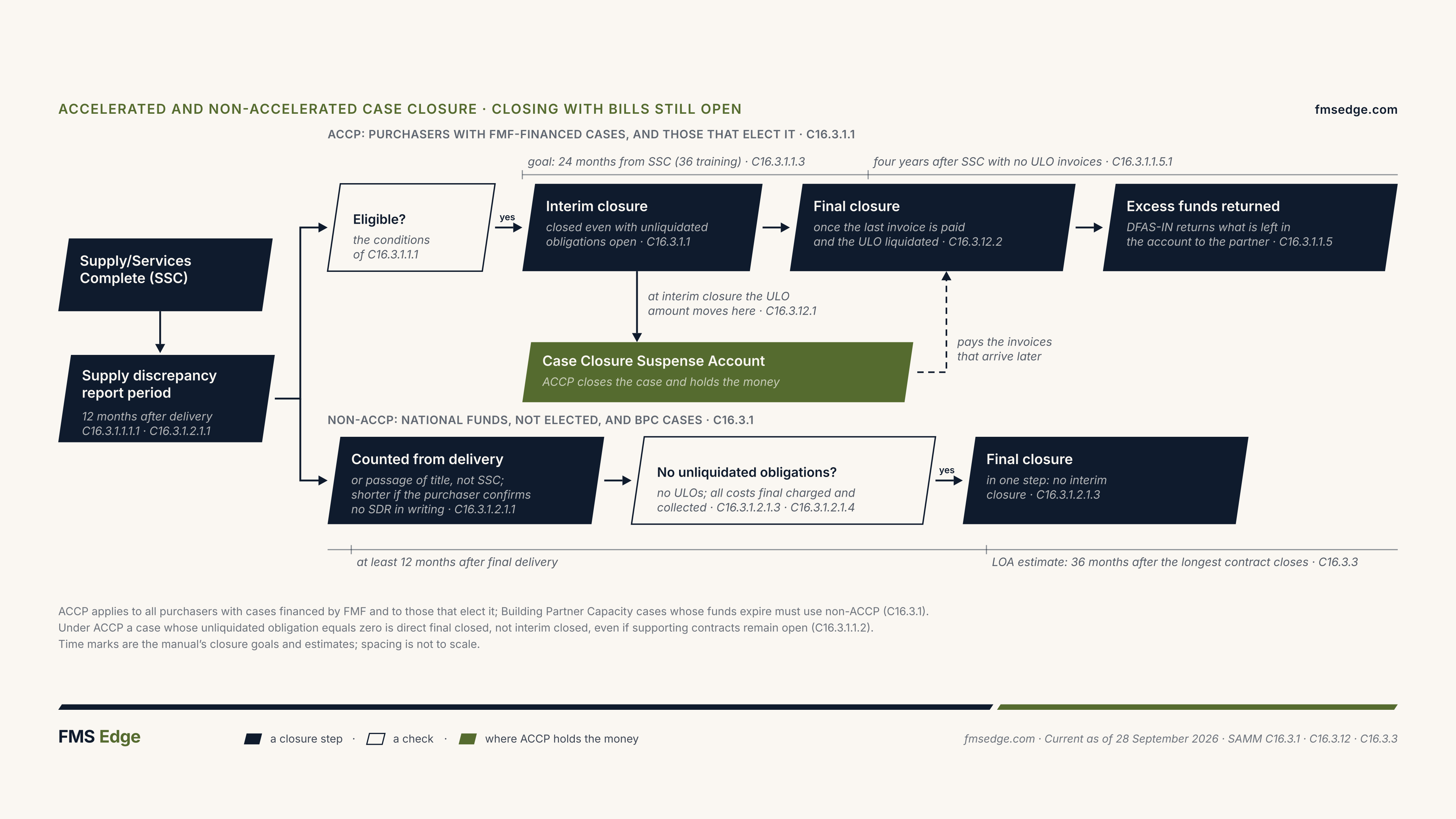
What is accelerated case closure?
Accelerated Case Closure Procedures () allow a to close after it is Supply/Services Complete (), even if Unliquidated Obligations () remain on it [SAMM ]. Only the can approve special arrangements with a purchaser for processing its cases, such as thresholds for unliquidated obligations [SAMM ].
This type of closure allows an case to be closed after , even if there are Unliquidated Obligations () on the case. The required international partner funds to pay the are placed in a pending final resolution of the . This program is voluntary, except for those countries that have cases funded by Foreign Military Financing (), which requires mandatory participation in for all cases regardless of the funding source. Most international partners participate or are automatically included in the process. maintains the master list of international partners that participate in . A list of participants is published in Chapter 3 of the Case Reconciliation and Closure Guide ( Appendix 7) [SAMM ].
For a purchaser participating in , the U.S. Government () goal is to close cases within 24 months of , or 36 months for training cases [SAMM ].
Cases implemented on or after October 1, 2017 ( 2018) are also subject to case closure performance standards, which need to be met at the 85 percent level [SAMM ]. The first runs from the CLOSHOLD milestone until the submits the closure certificate, which the CLOSE milestone shows. That milestone follows the estimated closure dates of 24 months for cases and 36 months for training cases and non- cases [SAMM ]. The second runs from the complete certificate to final closure, and the Defense Finance and Accounting Service () posts the FINCLOSE milestone within 30 days of the certificate [SAMM ].
A case shall be direct final closed, rather than interim closed, when its equals zero, even if the supporting contracts are still open. Direct final closure should be used as fully as possible when a contract associated with the case meets the following criteria [SAMM ]:
- Performance period: the performance period of the contract's and or Subline Item Number (/SLIN) for the case has ended, and the case is Supply/Services Complete [SAMM ]
- Litigation status: the associated contract or contracts must not be tied to any litigation (Section C16.3.1.1.6) [SAMM ]
- Contract type: any of the contract types under 16.101 [SAMM ]
- Mechanization of (MOCAS) status: the contract's MOCAS Contract Status Code must be Section 1, "Active Contracts"; Section 2, "Physically Completed"; or Section 4, "Payment Adjustments" [SAMM ]
Indianapolis () maintains the in the at country level and accounts for it at case level. The establishes the amount and reports it on the closure certificate, and that amount is set aside in the for the financial activity expected after closure [SAMM ].
Payments against the remaining obligations draw down the balance, and once the is fully liquidated or deobligated the case can be submitted for final closure [SAMM ]. If invoices are not received within four years of , the must move the case to final closure status [SAMM ]. After all invoices are paid, returns any excess funds in the to the purchaser [SAMM ].
When can a case close under each procedure?
Under a case can close before its expenditures are final, once all its commitments and obligations are complete and it meets the eligibility conditions [SAMM ]. A non- case can close only when no unliquidated obligations remain on its underlying contracts and all costs are determined, final charged and collected [SAMM , ]. whose funds expire or cancel must use non- procedures [SAMM ].
Non- procedures are used to accommodate those international partners that have not elected to participate in the process and whose programs are completely financed with (vice with ). case closure always has a higher priority, but non- cases with no supporting contracts should be closed as quickly as possible. program cases are also closed under non- procedures [SAMM ].
A case is eligible for closure under when the following conditions are met:
- The case is Supply/Services Complete following final delivery, and the 12-month period in which the purchaser may submit a after delivery has passed [SAMM ]
- No outstanding exist when the case is submitted for closure [SAMM ]
- All , and the estimated to be spent after interim closure, are determined [SAMM ]
- Unless grants an exception, unused has been reduced to zero in the accounting system, and reflects the correct balances [SAMM ]
- The case is paid in full; if it is not, the shall keep processing the case for closure and shall send the closure certificate to [SAMM ]
- Performance reports to for all delivered articles and services are processed, and all estimated billings are converted to actual billings [SAMM ]
- The costs of articles and services are reimbursed from the to Department of War (DoW) appropriations or equity accounts [SAMM ]
- and accounting balances are reconciled, and all performance and disbursements are properly reported and accounted for [SAMM ]
A case is eligible for closure under non- procedures when the following conditions are met:
- The case is Supply/Services Complete, and at least 12 months have passed since final delivery, counted from the delivery date or passage of title rather than the date [SAMM ]
- The case has no outstanding when it is submitted for closure [SAMM ]
- The underlying Accounting Classification Reference Numbers () carry no [SAMM ]
- Every cost has been determined, final charged and collected [SAMM ]
- Every applicable system is fully reconciled within [SAMM ]
- Unless grants an exception, unused OA in the accounting system has been brought to zero and shows the correct balances [SAMM ]
- Performance reports to for all delivered articles and services are processed, and all estimated billings are converted to actual billings [SAMM ]
- The costs of articles and services are reimbursed from the to DoW appropriations or equity accounts [SAMM ]
- The accounting balances of the and are reconciled, and all performance and disbursements are properly reported and accounted for [SAMM ]
The purchaser can shorten the waiting period by confirming in writing, for example in an e-mail or meeting minutes, that it does not expect to submit an . That confirmation does not waive its right to submit one under the Standard Terms and Conditions [SAMM ].
Several sets of closure inhibitors identify the conditions that prevent a case from being certified for closure or from being closed. prescribes a standard set of pre-certification inhibitors, which identify the conditions that keep a case from being certified for closure; Table AP7.C3.T5 of the Case Reconciliation and Closure Guide (RCG) lists them. The ’ automated management systems have corresponding inhibitors, to varying degrees. A separate set of post-certification inhibitors identifies the conditions that keep the case from closing. C16.3.9.1 describes this set of inhibitors [SAMM ].
The ensures the case closure certificate and any other necessary supporting documentation (e.g., closure information for interim closures) are completed in accordance with established procedures. Every case closure certificate is sent to by e-mail, and the RCG shows the certificate in Figure AP7.C4.F4 [SAMM , ].
Which cases close first?
The order of priority for case reconciliation and closure is: (1) focus cases, (2) cases, (3) closure candidates and (4) non- closure candidates [SAMM ]. A focus case is one that the Office of Business Operations, Financial Policy & Regional Execution Directorate, Financial Policy Division (/FPRE/FP) identifies as requiring priority reconciliation and closure action [SAMM ]. Only (/FPRE/FP) can authorize deviations from these priorities for specific cases, countries or closure categories [SAMM ].
References
SAMM
- SAMM C16.3.1.1.4
- SAMM C16.3.1.1.3
- SAMM C16.1.7.1: Case Closure - Posting the Closure Milestone.
- SAMM C16.1.7.2: Preparation for Final Closure.
- SAMM C16.3.1.1.2
- SAMM C16.3.1.1.5.1
- SAMM C16.3.1.1.5: Interim to Final Closure.
- SAMM C16.3.1.2.1.3
- SAMM C16.3.1.2.1.4
- SAMM C16.3.1.2: Non-Accelerated Case Closure Procedure.
- SAMM C16.3.1.1.1.1: Cases are Supply/Services Complete Following Final Delivery.
- SAMM C16.3.1.1.1.2
- SAMM C16.3.1.1.1.3
- SAMM C16.3.1.1.1.4
- SAMM C16.3.1.1.1.5
- SAMM C16.3.1.1.1.6
- SAMM C16.3.1.1.1.7
- SAMM C16.3.1.1.1.8: Foreign Military Sales Accounting Balances.
- SAMM C16.3.1.2.1.1: Case are Supply/Services Complete for at Least 12 Months Following Final Delivery.
- SAMM C16.3.1.2.1.2
- SAMM C16.3.1.2.1.5
- SAMM C16.3.1.2.1.6
- SAMM C16.3.1.2.1.7
- SAMM C16.3.1.2.1.8
- SAMM C16.3.1.2.1.9: Foreign Military Sales Accounting Balances.
- SAMM C16.3.6: Closure Inhibitors.
- SAMM C16.3.8: Case Closure Certificate.
- SAMM AP7.C4.6.1
- SAMM C16.3.2.1: Priorities.
- SAMM C16.3.2.1.1
- SAMM C16.3.2.2: Authorizing officials.
- SAMM C16.3.1: Closure Types.
- SAMM C16.3.1.1: Accelerated Case Closure Procedures.
- SAMM C16.3.12.1: Background/Purpose.
- SAMM C16.3.12.2: Unliquidated Obligation Adjustment Process.
- SAMM C16.1.7: Foreign Military Sales Case Closure Metrics and Performance Standards.
Facts referenced
- ACCP closure goal after Supply/Services Complete, all cases other than training: 24 months (as of 11 September 2026; SAMM C16.3)
- ACCP closure goal after Supply/Services Complete, training cases: 36 months (as of 11 September 2026; SAMM C16.3)
- Implementation date from which FMS cases are subject to the case closure metrics and performance standards (on or after): October 1, 2017 (FY 2018) (as of 26 October 2026; SAMM C16.1.7)
- Case closure performance standards, share of cases that must meet them (cases implemented in FY 2018 and later): 85 percent (as of 26 October 2026; SAMM C16.1.7)
- Case closure metric one, months from CLOSHOLD to the CLOSE milestone, ACCP cases: 24 months (as of 26 October 2026; SAMM C16.1.7.1)
- Case closure metric one, months from CLOSHOLD to the CLOSE milestone, non-ACCP cases and ACCP training cases: 36 months (as of 26 October 2026; SAMM C16.1.7.1)
- Case closure metric two, days from the complete closure certificate within which DFAS posts the FINCLOSE milestone: 30 days (as of 26 October 2026; SAMM C16.1.7.2)
- Time after Supply/Services Complete without unliquidated-obligation invoices after which a case in interim closure must move to final closure: four years (as of 28 September 2026; SAMM C16.3.1.1.5.1)
- Months after delivery during which a partner may submit a Supply Discrepancy Report, after which cases are closed (ACCP eligibility): 12 months (as of 28 September 2026; SAMM C16.3.1.1.1.1)
- Months after final delivery before a non-ACCP case is closed (non-ACCP eligibility; reducible if the purchaser confirms in writing that no SDR is anticipated): 12 months (as of 28 September 2026; SAMM C16.3.1.2.1.1)
DSCA policy memoranda
- DSCA 26-01: Performance Standards for Foreign Military Sales Case Closure
- DSCA 26-75: Foreign Military Sales Metrics Security Assistance Management Manual Update [SAMM E-Change 845]
Related
Foreign Military Sales (FMS)
The part of U.S. security assistance, authorized by the Arms Export Control Act (AECA), in which eligible foreign governments and international organizations buy defense articles, services and training from the U.S. Government under formal government-to-government agreements.
The articles come either from Department of War stocks or from new procurement under contracts the Department manages [22 U.S.C. 2761, 22 U.S.C. 2762]. A sale is FMS whatever the source of the purchaser's financing.
FMS Edge glossary, as of 10 October 2026
Glossary entry →Open the manual’s entry → (opens in new tab)
Case Closure Suspense Account (CCSA)
Country level account maintained by Defense Finance Accounting Service Indianapolis that summarizes disbursement activity and unliquidated obligation balance for each interim closed case.
SAMM Glossary, as of 12 September 2026
Glossary entry →Open the manual’s entry → (opens in new tab)
National Funds
Source of funding that is provided directly from the purchaser.
SAMM Glossary, as of 12 September 2026
Glossary entry →Open the manual’s entry → (opens in new tab)
Foreign Military Sales (FMS) Case
A Letter of Offer and Acceptance (LOA) that the purchaser has accepted, together with every Amendment and Modification later made to it: the agreement under which the U.S. Government transfers defense articles and services in the Foreign Military Sales (FMS) program.
FMS Edge glossary, as of 10 October 2026
Glossary entry →Open the manual’s entry → (opens in new tab)
Unliquidated Obligation (ULO)
The amount of obligations that have not been liquidated by payments (disbursements).
SAMM Glossary, as of 12 September 2026
Glossary entry →Open the manual’s entry → (opens in new tab)
Defense Security Cooperation Agency (DSCA)
The Department of War agency that directs, administers and provides guidance to the Department's components and its representatives at U.S. missions for the execution of the security cooperation programs for which it is responsible [SAMM C1.3.2.2]. The agency also provides financial and technical assistance, arranges the transfer of defense materiel, training and services to international partners, and promotes military-to-military contacts.
FMS Edge glossary, as of 10 October 2026
Glossary entry →Open the manual’s entry → (opens in new tab)
FMS: Foreign Military Sale
SAMM Acronyms, as of 12 September 2026
DSCA: Defense Security Cooperation Agency
SAMM Acronyms, as of 12 September 2026
Glossary entry →Defense Security Cooperation Agency (DSCA) →
SAMM: Security Assistance Management Manual
SAMM Acronyms, as of 12 September 2026
Glossary entry →Security Assistance Management Manual (SAMM) →
Fiscal Year (FY)
The USG’s accounting period. It begins on October 1 and ends on September 30 and is designated by the calendar year in which it ends.
SAMM Glossary, as of 12 September 2026
Glossary entry →Open the manual’s entry → (opens in new tab)
Implementing Agency (IA)
The military department or defense agency responsible for the execution of military assistance programs. With respect to FMS, the military department or defense agency assigned responsibility by the Defense Security Cooperation Agency to prepare an LOA and to implement an FMS case. The implementing agency is responsible for the overall management of the actions that will result in delivery of the materials or services set forth in the LOA that was accepted by a foreign country or international organization.
SAMM Glossary, as of 12 September 2026
Glossary entry →Open the manual’s entry → (opens in new tab)
Accounting Classification Reference Number (ACRN)
A two position alphanumeric field which identifies a specific line of accounting within a contract or funding document.
SAMM Glossary, as of 12 September 2026
Glossary entry →Open the manual’s entry → (opens in new tab)
Contract Line Item Number (CLIN)
Part of defense contracts that break the contract down by the commodities being procured (labor hours of services, funding for travel, quantity product A, etc.). They help identify the supplies or services to be acquired as separately identified line items on a contract that provides for accounting traceability.
SAMM Glossary, as of 12 September 2026
Glossary entry →Open the manual’s entry → (opens in new tab)
Federal Acquisition Regulation (FAR)
The FAR is the primary regulation for use by federal executive agencies for the acquisition of supplies and services with appropriated funds. The document, published in 1984, consolidated the major procurement regulations of various departments and agencies. The intent of the FAR is to standardize the content, decrease the volume of documents, and to achieve consistency throughout government. The principal agencies involved in putting together the FAR were DoD, the General Services Administration, and the National Aeronautics and Space Administration, the three largest buyers. The FAR is broader than just contracting and applies to all goods and services. It directs the defense program manager in many ways, including contract award procedures, acquisition planning, warranties, and establishing guidelines for competition. Besides the FAR, each agency has its supplement to describe its own particular way of doing business. The DoD supplement is called Defense FAR Supplement.
SAMM Glossary, as of 12 September 2026
Glossary entry →Open the manual’s entry → (opens in new tab)
Contract Administration Services (CAS)
All those actions accomplished in or near a contractor's plant for the benefit of the U.S. government which are necessary to the performance of a contract or in support of the buying offices, system/project managers, and other organizations, including quality assurance, engineering support, production surveillance, pre-award surveys, mobilization planning, contract administration, property administration, industrial security, and safety.
SAMM Glossary, as of 12 September 2026
Glossary entry →Open the manual’s entry → (opens in new tab)
DFAS-IN: Defense Finance and Accounting Service - Indianapolis
SAMM Acronyms, as of 12 September 2026
Defense Integrated Financial System (DIFS)
A financial system providing DoD-level financial management functions for the security assistance (SA) program. This includes centralized Foreign Military Sales (FMS) trust fund accounting, foreign customer billing, and financial management reporting. DIFS consolidates FMS data from the Army, Navy, Air Force, and other implementing agencies, and provides efficient accountability for oversight of the financial and program management aspects of SA.
SAMM Glossary, as of 12 September 2026
Glossary entry →Open the manual’s entry → (opens in new tab)
Building Partner Capacity (BPC) Programs
Security cooperation and security assistance activities funded with USG appropriations (not including Foreign Military Sales Credit and Military Assistance Program/Merger).
SAMM Glossary, as of 12 September 2026
Glossary entry →Open the manual’s entry → (opens in new tab)
Supply Discrepancy Report (SDR)
A process for international customers to file a complaint with the DoD for product loss, quality deficiencies, damage, and various other problems associated with the delivery of material under the Foreign Military Sales program.
SAMM Glossary, as of 12 September 2026
Glossary entry →Open the manual’s entry → (opens in new tab)
SDR: Supply Discrepancy Report
SAMM Acronyms, as of 12 September 2026
Accrued Costs
The financial value of delivered articles and services and incurred costs reported to DFAS-IN via Delivery Transactions. Incurred costs represent disbursements for which no physical deliveries have yet occurred. Examples are: progress payments to contractors, GFM/GFE provided to contractors, and nonrecurring costs.
SAMM Glossary, as of 12 September 2026
Glossary entry →Open the manual’s entry → (opens in new tab)
DIFS: Defense Integrated Financial System
SAMM Acronyms, as of 12 September 2026
Glossary entry →Defense Integrated Financial System (DIFS) →
Trust Fund
A fund or account that law designates as a trust fund, credited with receipts that law earmarks and that the government holds in trust, in a fiduciary capacity, for specific purposes and programs under an agreement.
A trust fund account is usually a receipt account, an expenditure account or a revolving fund account.
FMS Edge glossary, as of 10 October 2026
Glossary entry →Open the manual’s entry → (opens in new tab)
Letter of Offer and Acceptance (LOA)
The legal instrument that lists the defense articles and services, including training, that the U.S. Government transfers to a foreign country or international organization, with their estimated costs and the terms and conditions. The benefitting partner does not sign a Building Partner Capacity (BPC) LOA.
The Letter of Offer and Acceptance (LOA) is the instrument the U.S. Government uses to sell under the Arms Export Control Act (AECA); signed LOAs and their later Amendments and Modifications are also called Foreign Military Sales (FMS) cases [SAMM C5.6.1].
FMS Edge glossary, as of 10 October 2026
Glossary entry →Open the manual’s entry → (opens in new tab)
SAMM C16.3.1.1: Accelerated Case Closure Procedures.
“ACCP is the standard or typical closure process. This type of closure allows a case to be closed after SSC, even if there are outstanding Unliquidated Obligations (ULOs) on the case. Purchaser funds are placed in a Case Closure Suspense Account (CCSA) pending final resolution of the ULOs. This program is voluntary, except for those countries that have FMF-funded cases, …”
Security Assistance Management Manual, as of 28 September 2026
SAMM C16.3.1.1.4
“On an exception basis, DSCA may enter into special arrangements with specific purchasers regarding the processing of their ACCP cases (e.g. ULO thresholds). Only DSCA (Office of Business Operations (OBO)) can approve these arrangements. The formal notification on these arrangements is transmitted via a written memorandum signed by the Assistant Director for Business Operations . Refer to RCG Table AP7.C3.T1. …”
Security Assistance Management Manual, as of 28 September 2026
SAMM C16.3.1.1.3
“For purchasers participating in ACCP, the USG goal is to close cases within 36 months of SSC for training cases and 24 months of SSC for all other cases as indicated in the LOA. Should the purchaser want a case to remain open, even though it is SSC, the request must be approved by the IA as outlined in Section …”
Security Assistance Management Manual, as of 28 September 2026
SAMM C16.1.7: Foreign Military Sales Case Closure Metrics and Performance Standards.
“FMS cases are subject to performance standards and metrics for closure in accordance with DoW FMS Reform Efforts. FMS cases implemented on or after October 1, 2017 (FY 2018) are further subject to specific case closure metrics and performance standards. These metrics and performance standards need to be met at the 85 percent level.”
Security Assistance Management Manual, as of 26 October 2026
SAMM C16.1.7.1: Case Closure - Posting the Closure Milestone.
“The first case closure metric spans from when DSCA posts the Supply/Services Complete (SSC) CLOSHOLD milestone to when the Implementing Agency (IA) submits the case closure certificate to the Defense Finance and Accounting Service (DFAS). The case closure milestone “CLOSE” is posted in the Defense Security Assistance Management System (DSAMS) in accordance with estimated closure dates provided in Section C16.3.; …”
Security Assistance Management Manual, as of 26 October 2026
SAMM C16.1.7.2: Preparation for Final Closure.
“The second case closure metric spans from when the IA submits the complete case closure certificate to DFAS to when DFAS final-closes and accepts the “C8” closure transaction. DFAS posts the FINCLOSE milestone within 30 days of closure certificate in accordance with Section C16.3. The FINCLOSE milestone is created when a transaction is received from DIFS indicating that the case …”
Security Assistance Management Manual, as of 26 October 2026
SAMM C16.3.1.1.2
“A case shall be direct final closed (i.e., not interim closed) if the ULO equals zero, even if the supporting contracts remain open. If a contract associated with the case meets the following criteria, direct final closures should be utilized to the fullest extent possible. Performance Period: The performance period of the contract ACRN, CLIN/SLIN of the associated case has …”
Security Assistance Management Manual, as of 28 September 2026
SAMM C16.3.12.1: Background/Purpose.
“The CCSA was established in 1992 with the onset of ACCP to support the closure of cases with ULOs. The account holds funds for all IAs for all participating countries and is maintained by DFAS-IN in DIFS at country level and accounted for at case level. The ULO amount (including CAS, where applicable) is established by the IA and reported …”
Security Assistance Management Manual, as of 11 September 2026
SAMM C16.3.12.2: Unliquidated Obligation Adjustment Process.
“Incoming Expenditure Authority (EA) requests decrease (for debits) or increase (for credits) the CCSA balance. In addition, certain DFAS internal disbursements may affect the CCSA balance. Any unused ULO funds remain in the CCSA for subsequent use or refund. DFAS-IN monitors the account to ensure there are sufficient funds to process additional disbursements. Once the ULO is fully liquidated/deobligated, the …”
Security Assistance Management Manual, as of 11 September 2026
SAMM C16.3.1.1.5.1
“If ULO invoices are not received within four years of Supply / Services Complete (SSC), regardless of the dollar amount, Implementing Agencies (IAs) must move the case to final closure status using the process outlined in Section AP7.C4.6. During this time invoices can be paid by reopening the case as outlined in Section AP7.C4.13.3.”
Security Assistance Management Manual, as of 28 September 2026
SAMM C16.3.1.1.5: Interim to Final Closure.
“The IAs and DFAS-IN should continue to monitor and reconcile cases in interim closure for transition to final closure. This may result in a return of excess funds in the Case Closure Suspense Account (CCSA) maintained at DFAS-IN. After all invoices are paid to satisfy unliquidated obligations (ULO), DFAS-IN is responsible for returning excess funds in the CCSA account to …”
Security Assistance Management Manual, as of 28 September 2026
SAMM C16.3.1: Closure Types.
“Two broad categories of closure exist: Accelerated Case Closure Procedures (ACCP) and non-ACCP. ACCP applies to all countries/programs that have cases financed with Foreign Military Financing (FMF) funds, or those countries that elect to participate. For cases under ACCP all commitments and obligations must be completed, however expenditures do not have to be finalized prior to closure. The non-ACCP category …”
Security Assistance Management Manual, as of 11 September 2026
SAMM C16.3.1.2.1.3
“No ULOs exist on underlying ACRNs.”
Security Assistance Management Manual, as of 11 September 2026
SAMM C16.3.1.2.1.4
“All costs are determined, final charged and collected.”
Security Assistance Management Manual, as of 11 September 2026
SAMM C16.3.1.2: Non-Accelerated Case Closure Procedure.
“Non-ACCP procedures are used to accommodate those countries that have not elected to participate in the ACCP process and whose FMS programs are completely financed with national funds (vice with FMF). While ACCP case closure always has a higher priority, non-ACCP cases with no supporting contracts should be closed as quickly as possible. BPC program cases are also closed under …”
Security Assistance Management Manual, as of 11 September 2026
SAMM C16.3.1.1.1.1: Cases are Supply/Services Complete Following Final Delivery.
“FMS cases are marked as Supply/Services Complete (SSC) following final delivery of defense articles. At this time the Implementing Agencies will accomplish final reconciliation actions and prepare cases for closure. A partner may submit an SDR for 12 months following delivery of defense articles/services and is not restricted from doing so simply because a case entered SSC status. After the …”
Security Assistance Management Manual, as of 28 September 2026
SAMM C16.3.1.1.1.2
“No outstanding SDRs exist when the case is submitted for closure.”
Security Assistance Management Manual, as of 28 September 2026
SAMM C16.3.1.1.1.3
“All accrued costs and the amount of estimated ULO to be expended after interim closure are determined.”
Security Assistance Management Manual, as of 28 September 2026
SAMM C16.3.1.1.1.4
“Unused Obligational Authority (OA) is reduced to zero in the Implementing Agency (IA) accounting system and the correct OA/Obligations (R4/RE transactions) balances are reflected in the Defense Integrated Financial System (DIFS), unless an exception is granted by DSCA.”
Security Assistance Management Manual, as of 28 September 2026
SAMM C16.3.1.1.1.5
“The case is paid in full, i.e., collections equal the expected case closure value. If the case is not yet paid in full, the IA shall continue processing the case for closure and shall forward the closure certificate (and associated 'C1' transaction) to Defense Finance and Accounting Services - Indianapolis (DFAS-IN).”
Security Assistance Management Manual, as of 28 September 2026
SAMM C16.3.1.1.1.6
“Performance reports, submitted to DFAS-IN to report all delivered articles and services, have been processed. All estimated billings have been converted to actual billings.”
Security Assistance Management Manual, as of 28 September 2026
SAMM C16.3.1.1.1.7
“Costs of articles and services have been reimbursed from FMS Trust Funds to DoW appropriations or USG equity accounts.”
Security Assistance Management Manual, as of 28 September 2026
SAMM C16.3.1.1.1.8: Foreign Military Sales Accounting Balances.
“IA and DFAS-IN accounting balances have been reconciled and all performance and disbursements have been properly reported and accounted for.”
Security Assistance Management Manual, as of 28 September 2026
SAMM C16.3.1.2.1.1: Case are Supply/Services Complete for at Least 12 Months Following Final Delivery.
“The period of 12 months following final delivery of defense articles before a case is closed allows for final reconciliation actions and considers the purchaser's right to submit an SDR associated with the final delivery. The 12-month SDR period is calculated using the delivery date or passage of title for defense articles, not SSC status date. A partner’s ability to …”
Security Assistance Management Manual, as of 28 September 2026
SAMM C16.3.1.2.1.2
“No outstanding SDRs exist when the case is submitted for closure.”
Security Assistance Management Manual, as of 11 September 2026
SAMM C16.3.1.2.1.5
“All applicable IA systems are fully reconciled within DIFS.”
Security Assistance Management Manual, as of 11 September 2026
SAMM C16.3.1.2.1.6
“Unused OA is reduced to zero in the IA accounting system and the correct OA/Obligations (R4/RE transactions) balances are reflected in DIFS, unless an exception is granted by DSCA.”
Security Assistance Management Manual, as of 11 September 2026
SAMM C16.3.1.2.1.7
“Performance reports, submitted to DFAS-IN to report all delivered articles and services, have been processed. All estimated billings have been converted to actual billings.”
Security Assistance Management Manual, as of 11 September 2026
SAMM C16.3.1.2.1.8
“Costs of articles and services have been reimbursed from FMS Trust Funds to DoW appropriations or USG equity accounts.”
Security Assistance Management Manual, as of 28 September 2026
SAMM C16.3.1.2.1.9: Foreign Military Sales Accounting Balances.
“IA and DFAS-IN accounting balances have been reconciled, and all performance and disbursements have been properly reported and accounted for.”
Security Assistance Management Manual, as of 11 September 2026
SAMM C16.3.6: Closure Inhibitors.
“Multiple sets of closure inhibitors exist that identify conditions preventing the certification and closure of cases. DSCA prescribes a standard set of pre-certification inhibitors that are used to identify conditions that prevent the certification of cases for closure. These inhibitors are outlined in RCG Table AP7.C3.T5. To varying degrees, the IAs' automated management systems have corresponding inhibitors. In addition, a …”
Security Assistance Management Manual, as of 11 September 2026
SAMM C16.3.8: Case Closure Certificate.
“The IA ensures the case closure certificate and any other necessary supporting documentation (e.g. ULO closure information for ACCP interim closures) are completed in accordance with established procedures. See RCG Figure AP7.C4.F5. All case closure certificates are sent via e-mail to DFAS-IN (dfas.indianapolis-in.jax.mbx.dfas-in-sca-ccci@mail.mil).”
Security Assistance Management Manual, as of 11 September 2026
SAMM AP7.C4.6.1
“With transmittal of the 'C1I' closure transaction (refer to Figure AP7.C4.F5.), the Implementing Agency (IA) submits the closure certificate via (format in Figure AP7.C4.F4.). For interim closures, the Unliquidated Obligation (ULO) supporting documentation attachment must be sent with the case closure certificate. Figure AP7.C4.F3. Accelerated Case Closure Procedure Case Closure Preparation Actions for Cases with Unliquidated Obligations Figure AP7.C4.F4. Foreign …”
Security Assistance Management Manual, as of 30 September 2026
SAMM C16.3.2.1: Priorities.
“The order of priority for case reconciliation and closure is DSCA focus cases, BPC cases, ACCP closure candidates and Non-ACCP closure candidates.”
Security Assistance Management Manual, as of 11 September 2026
SAMM C16.3.2.1.1
“A DSCA focus case is any case identified by DSCA (OBO/FPRE/FP) that requires priority reconciliation and closure action.”
Security Assistance Management Manual, as of 11 September 2026
SAMM C16.3.2.2: Authorizing officials.
“Only DSCA (OBO/FPRE/FP) can authorize deviations to prioritizing closure for specific cases, countries or closure categories.”
Security Assistance Management Manual, as of 11 September 2026