
Guide
What happens to leftover money on a Foreign Military Sales case?
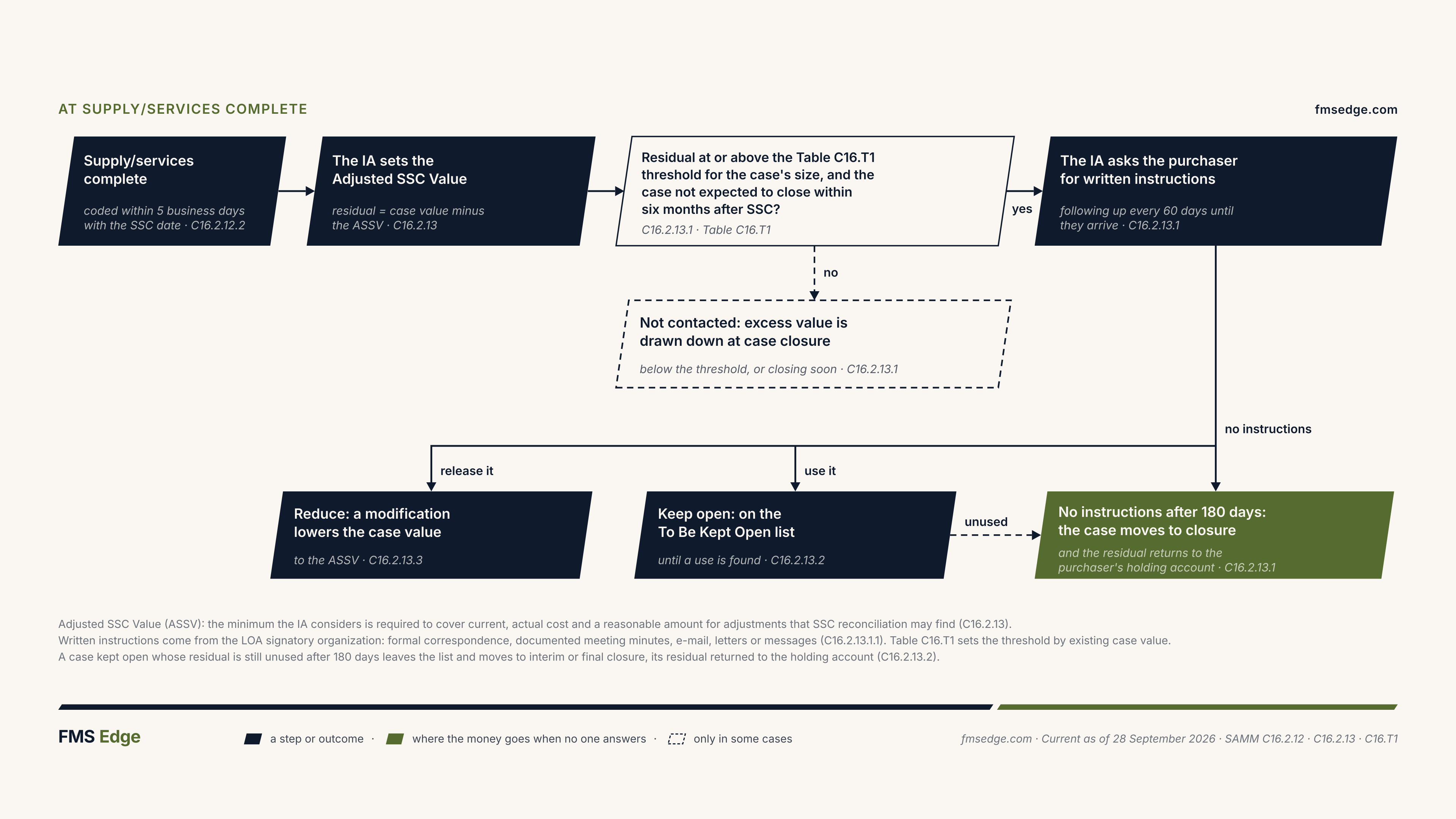
When a case reaches Supply/Services Complete (), the sets an Adjusted Value and subtracts it from the case value; what is left is the residual. If the residual meets the manual's thresholds, the asks the purchaser whether to reduce the case or keep it open to use the money, and follows up every 60 days until it has a written answer. With no instructions after 180 days, the case should move to closure and the residual returns to the purchaser's .
At supply/services complete the Implementing Agency sets the Adjusted SSC Value, and what is left of the case value is the residual. A residual at or above the Table C16.T1 threshold, on a case not about to close, goes to the purchaser for written instructions.
What happens to leftover money on a Foreign Military Sales case?
The money left on a case at Supply/Services Complete, its residual value, is either taken off the case by reducing the case value or kept on the case for the purchaser to use [SAMM ]. A residual below the Table C16.T1 thresholds, or one on a case expected to close within six months after Supply/Services Complete, is instead drawn down at case closure, and the purchaser need not be contacted [SAMM ].
Once the conditions for Supply/Services Complete () are reached, lines and/or cases shall be coded by the with this status and the actual date of within 5 business days in Socium and the appropriate information management systems. This coding shall not be delayed under any circumstance. The management of /line items is generally conducted based on their value. Therefore, the application of status on blanket order cases and/or lines may be accomplished based on the amount of unused value, when appropriate, rather than the absence of open orders, in addition to the purchaser’s concurrence that no further activity will occur. The reconciliation condition of data (other than that which is preventing item delivery or actual completion of services), the allocation of resources (funding and/or manpower), or the distribution/transfer of workload has no application in determining when supply/services completion occurs. To the extent possible, the status of lines and sub-lines should be coded in the Defense Management System () as either completed (CMPLTD) or shipped (SHPD) [SAMM ].
The residual value on a case is found by subtracting the Adjusted Value (ASSV) from the existing case value. Where that residual falls within the Table C16.T1 thresholds, the is required to engage the purchaser to decide whether to reduce the case or to place it on the "To Be Kept Open" list. The signatory organization must provide its disposition instructions in writing [SAMM ].
Every 60 days, the is required to follow up with the purchaser until the has written instructions on what to do with the residual value. If no instructions come after 180 days, the case should move to interim or final closure, as applicable, and at that stage the residual value will go back to the purchaser's in the closure transaction [SAMM ].
The purchaser need not be contacted when the residual value is below the Table C16.T1 amounts, or when closure is expected within six months after , because the excess value will be drawn down at case closure [SAMM ].
Written instructions may come through formal correspondence, discussions documented in meeting minutes, e-mail, letters or messages. No specific format is required, but the instructions must be in writing and submitted by a partner nation representative who has the authority to submit requests for the requesting country or international organization [SAMM ].
If the international partner indicates the intent to execute the residual value of the , the will include it on the “To Be Kept Open” list upon written notification from the signatory organization until requirements are identified to use the residual case value or 180 days pass, whichever comes first [SAMM ]. Where the partner later decides to spend the residual funds, written notice of that decision must reach the . The will then ask the Country Finance Director to remove the CLOSHOLD milestone in , take the case out of status and off the “To Be Kept Open” list, and go on to amend the case [SAMM ]. Until the case is removed from the “To Be Kept Open” list, the is required to follow up every 60 days with the international partner and provide the current status through the quarterly case closure reporting process, including the date the case was placed on the list. If disposition of the residual case value has not occurred after 180 days, the will take the case off the “To Be Kept Open” list and then move it to interim or final closure as applicable; the residual value is then returned to the purchaser’s as part of the closure transaction [SAMM ]. This policy is intended to allow the residual value to be used and is not a blanket endorsement for the addition of funds to the case that will extend the execution phase, which could prolong the reconciliation and closure of the case beyond set standards [SAMM ].
If a purchaser wants the residual case value released once the case reaches status, the will prepare a modification to the that reduces the case value based on the case ASSV. If other case adjustments needing an Amendment are necessary when the reduction is processed, the reduction can be incorporated into that Amendment. As reconciliation progresses, should also consider preparing later modifications to cases that substantially reduce the case ASSV. Completing reconciliation is not expected or required before the case value is reduced under these provisions [SAMM ].
Once a case is in status, a modification to reduce its value should not be prepared if case closure certification is expected within six months of the date the modification would be prepared. Issuing the certificate of closure will bring about the required case reduction. should reassess whether a modification is needed if the expected closure certification date slips [SAMM ].
The can make case-by-case requests for exceptions to the threshold amount, or for disposition actions once the 180-day timeframes have passed, and such requests should be driven by the purchaser. They should be kept to a minimum and sent to the appropriate Country Finance Director () [SAMM ].
References
SAMM
- SAMM C16.2.12.2: Supply/Services Complete Status Application.
- SAMM C16.2.13.1.1: Written Instructions.
- SAMM C16.T1: Thresholds for Supply/Services Complete Case Reductions
- SAMM C16.2.13.2: To Be Kept Open List.
- SAMM C16.2.13.2.1
- SAMM C16.2.13.2.2
- SAMM C16.2.13.2.4
- SAMM C16.2.13: Reduction of Foreign Military Sales Cases at Supply/Services Complete.
- SAMM C16.2.13.1: Thresholds and Purchaser Engagement.
- SAMM C16.2.13.3: Reduction Processing.
- SAMM C16.2.13.4.2
- SAMM C16.2.13.4.3
Facts referenced
- Interval at which the IA follows up with the purchaser for written disposition instructions on a case's residual value at Supply/Services Complete: 60 days (as of 28 September 2026; SAMM C16.2.13.1)
- Days without written disposition instructions on a case's residual value after which the case moves to interim or final closure and the residual returns to the purchaser's holding account: 180 days (as of 28 September 2026; SAMM C16.2.13.1)
- Business days within which the IA codes lines and/or cases Supply/Services Complete, with the actual SSC date, once the SSC conditions are reached: 5 business days (as of 11 September 2026; SAMM C16.2.12.2)
- Months after Supply/Services Complete within which a case expected to close needs no purchaser contact about its residual value (excess value is drawn down at closure): six (as of 28 September 2026; SAMM C16.2.13.1)
- Months within which an anticipated case closure certification means a Supply/Services Complete reduction modification should not be prepared: six (as of 28 September 2026; SAMM C16.2.13.4.2)
Related
Implementing Agency (IA)
The military department or defense agency responsible for the execution of military assistance programs. With respect to FMS, the military department or defense agency assigned responsibility by the Defense Security Cooperation Agency to prepare an LOA and to implement an FMS case. The implementing agency is responsible for the overall management of the actions that will result in delivery of the materials or services set forth in the LOA that was accepted by a foreign country or international organization.
SAMM Glossary, as of 12 September 2026
Glossary entry →Open the manual’s entry → (opens in new tab)
Holding Account
An account established for each Foreign Military Sales country/international organization for the purpose of recording and safeguarding unidentified and certain earmarked funds for future use
SAMM Glossary, as of 12 September 2026
Glossary entry →Open the manual’s entry → (opens in new tab)
Security Cooperation
Activities by which the Department of War encourages and enables international partners to cooperate with the United States toward strategic objectives, spanning every interaction with foreign defense and security establishments and every security assistance program the Department administers.
Under chapter 16 of Title 10, their purposes are to develop allied and friendly security capabilities for self-defense and multinational operations, to give U.S. forces peacetime and contingency access, and to build relationships promoting specific U.S. security interests [10 U.S.C. 301(7)].
FMS Edge glossary, as of 10 October 2026
Glossary entry →Open the manual’s entry → (opens in new tab)
Blanket Order Case (Foreign Military Sales)
A Foreign Military Sales (FMS) case for a category of defense articles or services, training included, with no definitive list of items or quantities, written against a dollar ceiling.
A Blanket Order case remains in effect until the purchaser has requisitioned articles or services up to the funds available on it [SAMM C5.6.13.4].
FMS Edge glossary, as of 10 October 2026
Glossary entry →Open the manual’s entry → (opens in new tab)
Security Assistance (SA)
A group of programs authorized by federal statutes by which the United States provides defense articles, military training, and other defense-related services by grant, lease, loan, credit, or cash sales in furtherance of national policies and objectives, and those that are funded and authorized through the Department of State to be administered by Department of Defense/Defense Security Cooperation Agency, which are considered part of security cooperation.
SAMM Glossary, as of 12 September 2026
Glossary entry →Open the manual’s entry → (opens in new tab)
DSAMS: Defense Security Assistance Management System
SAMM Acronyms, as of 12 September 2026
Glossary entry →Defense Security Assistance Management Systems (DSAMS) →
Letter of Offer and Acceptance (LOA)
The legal instrument that lists the defense articles and services, including training, that the U.S. Government transfers to a foreign country or international organization, with their estimated costs and the terms and conditions. The benefitting partner does not sign a Building Partner Capacity (BPC) LOA.
The Letter of Offer and Acceptance (LOA) is the instrument the U.S. Government uses to sell under the Arms Export Control Act (AECA); signed LOAs and their later Amendments and Modifications are also called Foreign Military Sales (FMS) cases [SAMM C5.6.1].
FMS Edge glossary, as of 10 October 2026
Glossary entry →Open the manual’s entry → (opens in new tab)
Foreign Military Sales (FMS) Case
A Letter of Offer and Acceptance (LOA) that the purchaser has accepted, together with every Amendment and Modification later made to it: the agreement under which the U.S. Government transfers defense articles and services in the Foreign Military Sales (FMS) program.
FMS Edge glossary, as of 10 October 2026
Glossary entry →Open the manual’s entry → (opens in new tab)
LOA: Letter of Offer and Acceptance
SAMM Acronyms, as of 12 September 2026
Defense Security Cooperation Agency (DSCA)
The Department of War agency that directs, administers and provides guidance to the Department's components and its representatives at U.S. missions for the execution of the security cooperation programs for which it is responsible [SAMM C1.3.2.2]. The agency also provides financial and technical assistance, arranges the transfer of defense materiel, training and services to international partners, and promotes military-to-military contacts.
FMS Edge glossary, as of 10 October 2026
Glossary entry →Open the manual’s entry → (opens in new tab)
DSCA: Defense Security Cooperation Agency
SAMM Acronyms, as of 12 September 2026
Glossary entry →Defense Security Cooperation Agency (DSCA) →
SAMM C16.2.13.1: Thresholds and Purchaser Engagement.
“The ASSV is used to determine the residual value on the case by subtracting the ASSV from the existing case value. If the residual case value is within the thresholds in Table C16.T1., then the IA is required to engage the purchaser for either a determination to reduce the case or place it on the "To Be Kept Open" list. …”
Security Assistance Management Manual, as of 28 September 2026
SAMM C16.2.12.2: Supply/Services Complete Status Application.
“Once the conditions for SSC are reached, lines and/or cases shall be coded by the IA with this status and the actual date of SSC within five (5) business days in Socium and the appropriate security cooperation (SC) information management systems. This coding shall not be delayed under any circumstance. The management of blanket order case/line items is generally conducted …”
Security Assistance Management Manual, as of 11 September 2026
SAMM C16.2.13.1.1: Written Instructions.
“Written instructions may be provided through formal correspondence, discussions (i.e. documented meeting minutes), electronic mail (e-mail), letters, or messages. Although no specific format is required, it must be in writing and submitted by a partner national representative with the authority to submit requests on behalf of the requesting country or international organization. Table C16.T1. Thresholds for Supply/Services Complete Case Reductions …”
Security Assistance Management Manual, as of 26 October 2026
SAMM C16.2.13.2: To Be Kept Open List.
“Each IA maintains an IA-specific To Be Kept Open list containing FMS cases in SSC status with residual FMS case funds available for the partner to execute before case closure. The IA will include the case on its To Be Kept Open list upon receiving written notification from the authorized LOA signatory until requirements are identified to use the residual …”
Security Assistance Management Manual, as of 12 October 2026
SAMM C16.2.13.2.1
“In accordance with Section C16.2.12.2., after the IA codes the case SSC, the DSCA CFD posts the CLOSHOLD milestone in DSAMS to prevent the creation of new amendments, modifications, and/or revisions to the case. Upon written notification from the partner of their intent to spend down the residual funds, the IA will add the case to its To Be Kept …”
Security Assistance Management Manual, as of 12 October 2026
SAMM C16.2.13.2.2
“Until the case is removed from the To Be Kept Open list, the IA is required to follow-up every 60 days with the partner and provide DSCA (Office of Business Operations, Financial Policy and Regional Execution Directorate, Financial Analysis and Compliance Division (OBO/FPRE/FAC)) the current status through the quarterly case closure reporting process and must include the date the case …”
Security Assistance Management Manual, as of 12 October 2026
SAMM C16.2.13.2.4
“This policy is intended to allow the residual value to be used and is not a blanket endorsement for the addition of funds to the case that will extend the execution phase, which could prolong the reconciliation and closure of the case beyond set standards. FMS cases may be added to the list for other conditions such as DSCA-approved, purchaser-unique …”
Security Assistance Management Manual, as of 12 October 2026
SAMM C16.2.13.3: Reduction Processing.
“If a purchaser indicates the desire for residual case value to be released once SSC status is reached, the IA will prepare a modification to the LOA to reduce the FMS case value based upon the FMS case ASSV. If other case adjustments are necessary that require the use of an Amendment, at the time the case reduction will be …”
Security Assistance Management Manual, as of 28 September 2026
SAMM C16.2.13.4.2
“If case closure certification is anticipated within six months of the planned preparation of a modification to reduce the case value once the FMS case SSC status is reached, the modification should not be prepared. The issuance of the certificate of closure will result in the required FMS case reduction. IAs should evaluate the need for a modification if the …”
Security Assistance Management Manual, as of 28 September 2026
SAMM C16.2.13.4.3
“Requests by the IA for exceptions to the threshold amount or disposition actions after the 180 day timeframes have been reached, which should be purchaser driven, can be requested on a case-by-case basis. Such requests should be kept to a minimum and directed to the appropriate DSCA Country Finance Director (CFD).”
Security Assistance Management Manual, as of 28 September 2026