
Guide
What reports does Congress get about arms sales?
Besides the notification of individual sales, Congress gets a steady run of reports: every quarter the President reports the offers of not yet accepted, the offers accepted and their value, credit agreements, commercial export licenses and the surveys authorized. Every year the lists the sales expected to be offered that year: major weapons of $7 million or more and other weapons of $25 million or more. Other annual reports cover , end-use monitoring and military training, and fees paid in connection with sales are reported to the Secretary of and open to Congress on request.
Congress hears about arms sales on a calendar as well as when a sale is notified. The Foreign Military Training Report is due by the end of January, the Javits Report arrives with the excess defense articles list (By the first of February), and a quarterly report follows each quarter.
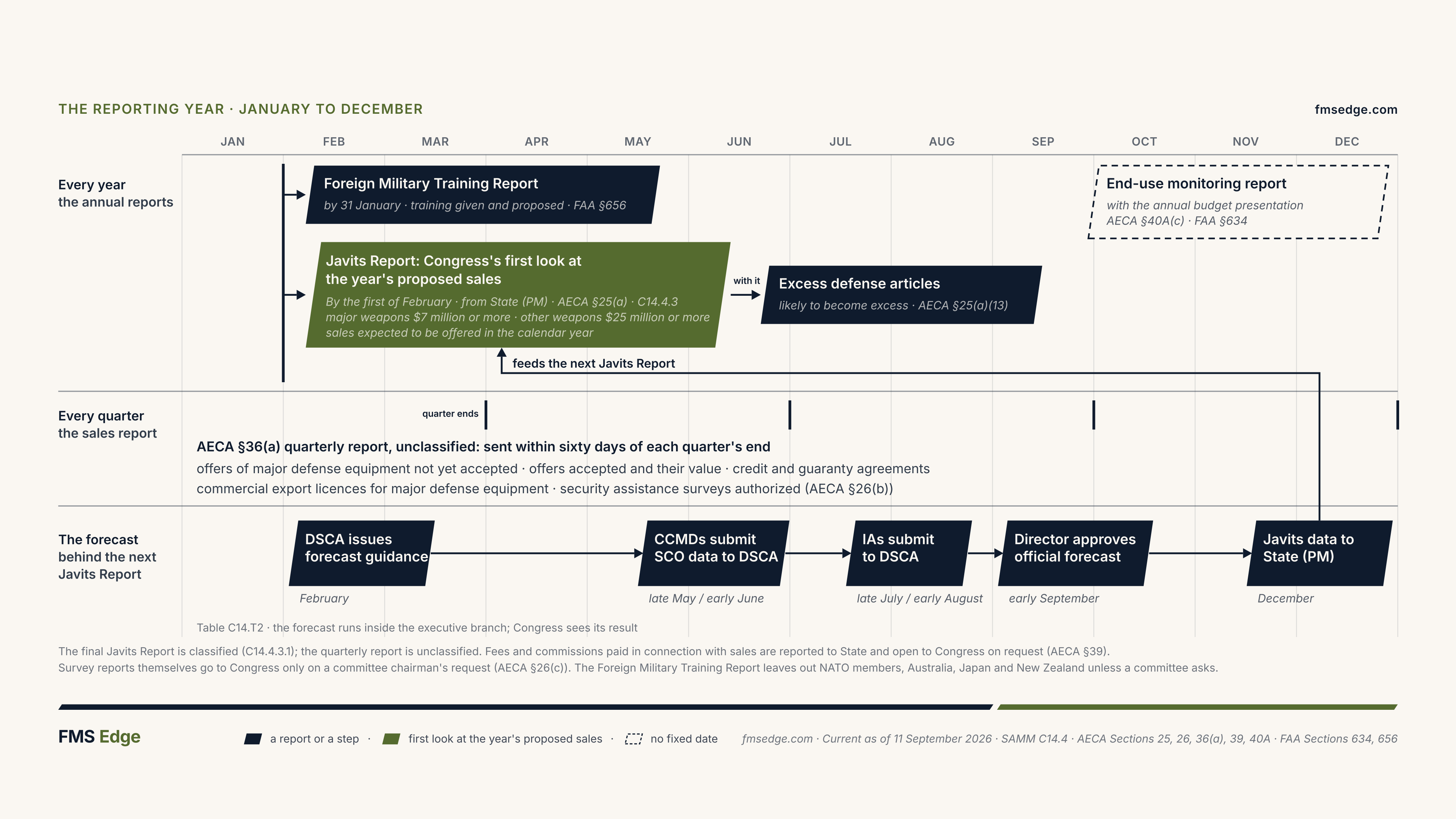
What reports does Congress get about arms sales?
Congress receives a quarterly arms sales report under Section 36(a), , and the annual under Section 25(a), [, ]. The also lists the weapons systems that are believed likely to become available for transfer as []. Congress also receives annual reports on end-use monitoring and on foreign military training [, ].
There are numerous other reports provided to Congress concerning programs. The following list includes some of these reports.
Every quarter
A listing of all unaccepted or not canceled Letters of Offer and Acceptance () by country or international organization for valued at $1,000,000 or more (Section 36(a)(1), ) [].
A listing of all accepted together with a total value of sales to each country or international organization during the fiscal year (Section 36(a)(2), ) [].
The cumulative dollar value of sales credit agreements during the fiscal year (Section 36(a)(3), ) [].
A listing of all commercial export licenses issued during the fiscal year for valued at $1,000,000 or more (Section 36(a)(4), ) [].
A listing of all surveys authorized during the preceding calendar quarter; Congress shall be authorized access to such survey reports upon request (Section 26, ) [].
Every year: the Javits Report
No later than 1 February of each year, the President shall transmit to Congress the annual arms sales proposal under Section 25(a), . It covers all sales, including and Direct Commercial Sales (), that are considered eligible for approval during the current calendar year. The thresholds are major weapons or weapons-related defense equipment of $7 million or more and any other weapons or weapons-related defense equipment of $25 million or more [SAMM ] []. The final is classified [SAMM ]. This report is commonly referred to as the , after Senator Jacob Javits (R-NY).
Organizations provide input to two related sales forecasts: the , which the Department of State leads, and the Forecast Report, which the leads. Section C14.4 has more on both reports [SAMM ].
Other annual reports
No later than 1 February, the President shall transmit to Congress an annual report listing weapons systems that are , and numbers thereof, that are believed likely to become available for transfer as during the next twelve months (Section 25(a)(13), ) [].
This list is part of the same Section 25(a) report [].
A report to Congress regarding the implementation of end-use monitoring (), to include costs and numbers of personnel associated with the program, shall be included with the annual (Section 40A(c), ) [SAMM ] [].
No later than 31 January of each year, a joint Secretary of and Secretary of War report is to be submitted to Congress that includes all training provided to foreign military personnel by the Department of War and Department of State during the previous fiscal year and proposed training for the [SAMM ] [].
Under Section 656, Foreign Assistance Act (), this report is to include a foreign policy justification and purpose plus the number of foreign personnel trained, their units and location for each training activity. In addition, for each country, it is to include an aggregate number of students and costs and the operational benefits to the U.S. and U.S. military units involved in each training activity [SAMM ] []. This reporting requirement does not apply to any North Atlantic Treaty Organization () countries, Australia, Japan or New Zealand unless one of the appropriate congressional committees requests it in writing, for a specific country, not later than ninety calendar days before the report is due [].
Reports on request and before an agreement
The Secretary of shall require reporting on political contributions, gifts, commissions, and fees paid, offered, or agreed to be paid in connection with or ; such information shall be made available to Congress upon request (Section 39, ) [].
Under a cooperative project pursuant to Section 27, , the President may enter into a written agreement with , members, and other eligible countries for a jointly managed program of cooperative Research, Development, Test, and Evaluation () and joint production, including follow-on support or concurrent production []. Congress must receive a certification not less than thirty days prior to U.S. Government () signature of a proposed cooperative project agreement (Section 27(f), ) [].
The anti-boycott determination
The Anti-Economic Discrimination Act of 1994, Section 564, P.L. 103-236, prohibits the sale or lease of any or service to any country or international organization that, as a matter of policy or practice, is known to have “sent letters to United States firms requesting compliance with, or soliciting information regarding compliance with, the Arab League secondary or tertiary boycott of Israel” []. The prohibition took effect on 30 April 1995 [].
The President may waive this transfer prohibition for one year at a time on the basis of national interest and promotion of U.S. objectives to eliminate the Arab boycott, or on the basis of national security interest [].
References
SAMM
- SAMM C14.4.3: Javits Report.
- SAMM C14.4.3.1: Javits Report Process.
- SAMM C14.T2: FMS Forecast Report and Javits Report Process
- SAMM C8.T2: Department of War End Use Monitoring Responsibilities
- SAMM C10.21.2: Foreign Military Training Report.
- SAMM C10.21.2.2: Description of Required Data Inputs.
- SAMM C2.1.3.5: Javits and Foreign Military Sales Forecasting.
Public authorities
- AECA §36(a): Arms Export Control Act of 1976, as amended, §36(a) (22 U.S.C. §2776(a))
- AECA §26: Arms Export Control Act of 1976, as amended, §26 (22 U.S.C. §2766)
- AECA §25: Arms Export Control Act of 1976, as amended, §25 (22 U.S.C. §2765)
- AECA §40A: Arms Export Control Act of 1976, as amended, §40A (22 U.S.C. §2785)
- AECA §39: Arms Export Control Act of 1976, as amended, §39 (22 U.S.C. §2779)
- FAA §656: Foreign Assistance Act of 1961, as amended, §656 (22 U.S.C. §2416)
- §564, P.L. 103-236: Foreign Relations Authorization Act, Fiscal Years 1994 and 1995, Pub. L. 103-236, title V, §564 (Anti-Economic Discrimination Act of 1994), 22 U.S.C. 2751 note, Arab League Boycott of Israel
- AECA §27: Arms Export Control Act of 1976, as amended, §27 (22 U.S.C. §2767)
Facts referenced
- Javits Report threshold at or above which anticipated sales of major weapons and weapons-related defense equipment are included (AECA section 25(a)(1)): $7 million (as of 11 September 2026; SAMM C14.4.3)
- Javits Report threshold at or above which anticipated sales of any other weapons or weapons-related defense equipment are included (AECA section 25(a)(1)): $25 million (as of 11 September 2026; SAMM C14.4.3)
- Value at or above which outstanding letters of offer and commercial licenses for Major Defense Equipment are listed in the AECA section 36(a) quarterly report: $1,000,000 (as of 3 October 2026)
Related
Major Defense Equipment (MDE)
Any item of Significant Military Equipment on the U.S. Munitions List having a nonrecurring research and development cost of more than $50 million or a total production cost of more than $200 million. Also defined in section 47 (6), Arms Export Control Act.
SAMM Glossary, as of 12 September 2026
Glossary entry →Open the manual’s entry → (opens in new tab)
Security Assistance (SA)
A group of programs authorized by federal statutes by which the United States provides defense articles, military training, and other defense-related services by grant, lease, loan, credit, or cash sales in furtherance of national policies and objectives, and those that are funded and authorized through the Department of State to be administered by Department of Defense/Defense Security Cooperation Agency, which are considered part of security cooperation.
SAMM Glossary, as of 12 September 2026
Glossary entry →Open the manual’s entry → (opens in new tab)
Javits Report
The President's estimate to the Congress of potential or proposed arms transfers during a given calendar year required by Arms Export Control Act (AECA), Section 25(a)(1) (22 USC 2765(a)(1)) .
SAMM Glossary, as of 12 September 2026
Glossary entry →Open the manual’s entry → (opens in new tab)
Excess Defense Articles (EDA)
Defense articles owned by the USG which are neither procured in anticipation of military assistance or sales requirements, nor procured pursuant to a military assistance or sales order. EDA are items (except construction equipment) that are in excess of the Approved Force Acquisition Objective and Approved Force Retention Stock of all DoD components at the time such articles are dropped from inventory by the supplying agency for delivery to countries or international organizations.
SAMM Glossary, as of 12 September 2026
Glossary entry →Open the manual’s entry → (opens in new tab)
Arms Export Control Act (AECA)
The basic U.S. law providing the authority and general rules for the conduct of Foreign Military Sales and commercial sales of defense articles, defense services, and training. The Arms Export Control Act (AECA) came into existence with the passage of the Foreign Military Sales Act (FMSA) of 1968. An amendment in the International Security Assistance and AECA of 1976 changed the name of FMSA to the AECA.
SAMM Glossary, as of 12 September 2026
Glossary entry →Open the manual’s entry → (opens in new tab)
AECA: Arms Export Control Act
SAMM Acronyms, as of 12 September 2026
Significant Military Equipment (SME)
Defense articles for which special export controls are warranted because of the capacity of such articles for substantial military utility or capability. These items are identified on the U.S. Munitions List in the International Traffic in Arms Regulations by an asterisk preceding the item category listing.
SAMM Glossary, as of 12 September 2026
Glossary entry →Open the manual’s entry → (opens in new tab)
LOA: Letter of Offer and Acceptance
SAMM Acronyms, as of 12 September 2026
MDE: Major Defense Equipment
SAMM Acronyms, as of 12 September 2026
Foreign Military Sales (FMS)
The part of U.S. security assistance, authorized by the Arms Export Control Act (AECA), in which eligible foreign governments and international organizations buy defense articles, services and training from the U.S. Government under formal government-to-government agreements.
The articles come either from Department of War stocks or from new procurement under contracts the Department manages [22 U.S.C. 2761, 22 U.S.C. 2762]. A sale is FMS whatever the source of the purchaser's financing.
FMS Edge glossary, as of 10 October 2026
Glossary entry →Open the manual’s entry → (opens in new tab)
DCS: Direct Commercial Sales
SAMM Acronyms, as of 12 September 2026
Security Cooperation
Activities by which the Department of War encourages and enables international partners to cooperate with the United States toward strategic objectives, spanning every interaction with foreign defense and security establishments and every security assistance program the Department administers.
Under chapter 16 of Title 10, their purposes are to develop allied and friendly security capabilities for self-defense and multinational operations, to give U.S. forces peacetime and contingency access, and to build relationships promoting specific U.S. security interests [10 U.S.C. 301(7)].
FMS Edge glossary, as of 10 October 2026
Glossary entry →Open the manual’s entry → (opens in new tab)
FMS: Foreign Military Sale
SAMM Acronyms, as of 12 September 2026
Defense Security Cooperation Agency (DSCA)
The Department of War agency that directs, administers and provides guidance to the Department's components and its representatives at U.S. missions for the execution of the security cooperation programs for which it is responsible [SAMM C1.3.2.2]. The agency also provides financial and technical assistance, arranges the transfer of defense materiel, training and services to international partners, and promotes military-to-military contacts.
FMS Edge glossary, as of 10 October 2026
Glossary entry →Open the manual’s entry → (opens in new tab)
DSCA: Defense Security Cooperation Agency
SAMM Acronyms, as of 12 September 2026
Glossary entry →Defense Security Cooperation Agency (DSCA) →
Combatant Command (CCMD)
A unified or specified command with a broad continuing mission under a single commander established and so designated by the President, through the Secretary of Defense and with the advice and assistance of the Chairman of the Joint Chiefs of Staff. Also called CCMD.
SAMM Glossary, as of 12 September 2026
Glossary entry →Open the manual’s entry → (opens in new tab)
Implementing Agency (IA)
The military department or defense agency responsible for the execution of military assistance programs. With respect to FMS, the military department or defense agency assigned responsibility by the Defense Security Cooperation Agency to prepare an LOA and to implement an FMS case. The implementing agency is responsible for the overall management of the actions that will result in delivery of the materials or services set forth in the LOA that was accepted by a foreign country or international organization.
SAMM Glossary, as of 12 September 2026
Glossary entry →Open the manual’s entry → (opens in new tab)
State (PM): Department of State, Bureau of Political-Military Affairs
SAMM Acronyms, as of 12 September 2026
EUM: End Use Monitoring
SAMM Acronyms, as of 12 September 2026
Current Fiscal Year
The fiscal year in progress but not yet completed; e.g. between and including 1 October and 30 September.
SAMM Glossary, as of 12 September 2026
Glossary entry →Open the manual’s entry → (opens in new tab)
RDT&E: Research, Development, Test, and Evaluation
SAMM Acronyms, as of 12 September 2026
Defense Article (Foreign Assistance Act; Arms Export Control Act, not including commercial sales subject to the International Traffic in Arms Regulation)
Any weapon, weapon system, munition, aircraft, vessel or other implement of war, together with the property, equipment, tooling, components and parts used to furnish military assistance or sales or to make, maintain or use such items; the International Traffic in Arms Regulations (ITAR) define the term separately for commercial exports.
Section 47 of the Arms Export Control Act (AECA) defines the term, and the U.S. Munitions List designates the specific items that fall within it [SAMM C4.4] [22 U.S.C. 2794].
FMS Edge glossary, as of 10 October 2026
Glossary entry →Open the manual’s entry → (opens in new tab)
Arms Export Control Act of 1976, as amended, §36(a) (22 U.S.C. §2776(a))
AECA §36(a) · Statute
Arms Export Control Act of 1976, as amended, §25 (22 U.S.C. §2765)
AECA §25 · Statute
Arms Export Control Act of 1976, as amended, §40A (22 U.S.C. §2785)
AECA §40A · Statute
Foreign Assistance Act of 1961, as amended, §656 (22 U.S.C. §2416)
FAA §656 · Statute
Arms Export Control Act of 1976, as amended, §26 (22 U.S.C. §2766)
AECA §26 · Statute
SAMM C14.4.3: Javits Report.
“By the first of February each year, Department of State, Bureau of Political-Military Affairs (State (PM)) prepares and transmits the annual Javits Report to Congress to highlight proposed arms sales expected for offer within the calendar year. This report includes anticipated FMS and Direct Commercial Sales (DCS) of major weapons and weapons-related defense equipment that meets or exceeds $7 million, …”
Security Assistance Management Manual, as of 11 September 2026
SAMM C14.4.3.1: Javits Report Process.
“By December of each year, State solicits from DSCA (IOPS/WPNS) a populated list of anticipated FMS transactions that meet the Javits Report criteria. This list may include a combination of new information and information extracted from the official FMS Forecast. Department of State, Bureau of Political-Military Affairs, Directorate of Defense Trade Controls (Sate (PM/DDTC)) populate the potential DCS transactions. Individual …”
Security Assistance Management Manual, as of 26 October 2026
SAMM C2.1.3.5: Javits and Foreign Military Sales Forecasting.
“MILGPs provide input into two related Foreign Military Sales (FMS) sales forecasts: 1) the Javits Report led by State, and 2) the FMS Forecast Report led by DSCA. See Section C14.4. for more information on these reports.”
Security Assistance Management Manual, as of 26 October 2026
SAMM C8.T2: Department of War End Use Monitoring Responsibilities
“Table C8.T2. Department of War End Use Monitoring Responsibilities Organization Responsibility DSCA (IOPS/GEX/EUM) Manage and provide oversight to the DoW's Golden Sentry EUM program and provide subject matter expertise for all EUM-related issues. Develop and promulgate EUM policy guidance within DoW and the interagency. Draft and submit an annual report to Congress through the Department of State (State) describing the …”
Security Assistance Management Manual, as of 26 October 2026
SAMM C10.21.2: Foreign Military Training Report.
“The Foreign Assistance Act (FAA), Section 656 (22 U.S.C. 2416) and the annual Foreign Operations Appropriations Act require the Secretary of War and Secretary of State to jointly prepare and submit the Foreign Military Training Report (FMTR) to the appropriate Congressional committees a report on all military training provided to foreign military personnel by the DoW and Department of State …”
Security Assistance Management Manual, as of 11 September 2026
SAMM C10.21.2.2: Description of Required Data Inputs.
“For each reportable event, data providers must properly record: the benefiting partner (country or territory name), the number of international military students and their units of operation, the dates and location of training, and the U.S. military units involved in each activity. DSCA may collect additional training data in the annual data call to meet additional reporting requirements.”
Security Assistance Management Manual, as of 11 September 2026
Arms Export Control Act of 1976, as amended, §39 (22 U.S.C. §2779)
AECA §39 · Statute
Arms Export Control Act of 1976, as amended, §27 (22 U.S.C. §2767)
AECA §27 · Statute
Foreign Relations Authorization Act, Fiscal Years 1994 and 1995, Pub. L. 103-236, title V, §564 (Anti-Economic Discrimination Act of 1994), 22 U.S.C. 2751 note, Arab League Boycott of Israel
§564, P.L. 103-236 · Statute