
Guide
What is the U.S. embassy country team?
The is the senior U.S. coordinating and supervising body in a partner country, headed by the ambassador as . The Senior Defense Official/Defense Attaché represents the Department of War on it and is chief of the , which works under the 's direction.
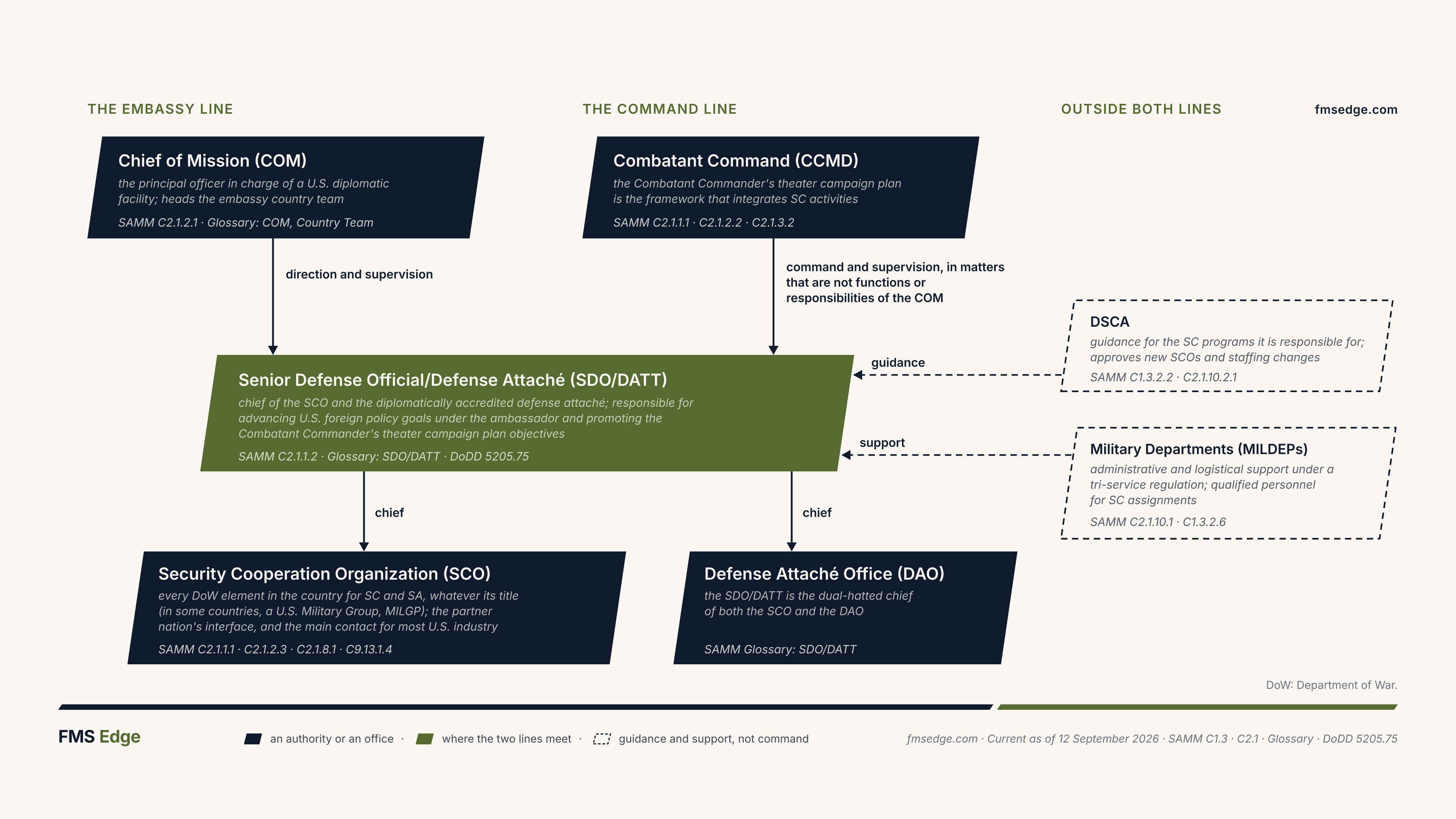
Two lines of authority reach the Security Cooperation Organization. The Chief of Mission directs and supervises it; the Combatant Commander commands and supervises it in matters outside the Chief of Mission's. Both meet at one desk, the Senior Defense Official/Defense Attaché.
What is the U.S. embassy country team?
The is the senior U.S. coordinating and supervising body in a partner country. The chief of the U.S. diplomatic mission heads it. Its members are the senior member of each U.S. department or agency represented there, as the sees fit.
The is the principal organizational instrument used by Chiefs of Mission () to integrate interagency staff functions and achieve the cohesive, coordinated execution of U.S. foreign policy. In its broadest sense, the team includes all elements and all U.S. Government () employees of the American mission in a foreign country. However, this term may also refer more narrowly to a subset of the mission and, more specifically, a select council of senior officers or heads of agencies and major sections in the mission, which meets regularly with the to provide advice, share information, and receive guidance and taskings. The determines the type of team that best suits the needs of the moment.
The U.S. ambassador, as the personal representative of the President, is the sole head of the or, in other words, the . The ambassador uses the team as a tool for assembling information, ideas, and opinions from all officials in country and to execute country-related U.S. foreign policy objectives. The ambassador, or a replacement in his/her absence, manages and supports all U.S. official interests and activities in the host country. The ambassador weighs the proposed courses of action and decides what is best for American interests as a whole.
In practice, the makeup of the embassy varies widely, depending not only on the ambassador’s management style but also on the country situation, the number and type of American programs carried out in the country, and the backgrounds of the senior officers of the different agencies attached to the diplomatic mission. In some posts, there may be no defined membership; team composition may vary according to the kind of problem being considered. The team can include, on a more or less permanent basis, the Ambassador; the deputy (); the chiefs of the political, economic, and management sections of the embassy; the Senior Defense Official/Defense Attaché (/); the regional security officer; and the consul general. The may also include representatives from other embassy agencies as the ambassador desires.
The coordinates with and advises the on the full range of issues and events facing the U.S. mission at any given time. Informal consultation among members occurs frequently and continually on issues and problems as they arise. The Ambassador chairs the team's regular meetings. The is also an executive body that, under the Ambassador’s leadership, divides the tasks to be done, and supervises their accomplishment. It typically sees that jobs are assigned to those agency representatives that can best execute them, based on resources and expertise. Finally, the is the planning body that analyzes the situation in the partner country, formulates plans and strategies for executing U.S. foreign policy (e.g., through an “integrated country strategy” or ICS), and recommends policy to Washington, DC. The formal is thus an advisory body, a forum for consultation, and a means of promoting a coordinated effort.
Organizations () may be called to participate in “modified ” meetings. These are generally held for visiting officials (e.g., congressional delegations). This is an opportunity for the to succinctly enumerate some of the recent successes and ongoing projects in country, ranging from major in progress to recently completed projects.
The works under the direction and supervision of the U.S. . The chief's ability to build good working relationships with the and with the rest of the embassy is critical to Department of War (DoW) success in aligning priorities and efforts with other agencies [SAMM ].
In accordance with Directive () 5205.75, the / is the principal DoW official in the embassy, the diplomatically accredited defense attaché, and the chief of the [SAMM ]. The / represents all of DoW on the , including the , the , and the Defense Intelligence Agency (), and under the directive is the ’s principal advisor on defense issues.
In that role, and working under the ambassador, the / is responsible for advancing the goals of U.S. foreign policy and for promoting the objectives of the Combatant Commander's theater campaign plan. The / is also responsible for complying with 5205.75 and with the instruction that implements it [SAMM ].
normally receive training prior to their assignments from , , and other agencies, and each /, upon completion of training, receives a formal appointment letter from the Secretary of War. The Secretary of War and the Chairman of the Joint Chiefs of Staff also provide letters of introduction, identifying the new / by name to the country or countries to which he/she is accredited. Though the / represents DoW leadership in Washington, DC, and communicates directly with National Capital Region (NCR) entities, the / also keeps leaders aware of developments.
All DoW elements under authority are under the coordinating authority of the /, except for the Marine security guard detachment. Coordinating authority is the power to compel different DoW agencies and activities to keep the / informed on their activities and to consult and coordinate with one another in order to ensure the cohesive planning and execution of DoW operations. All DoW units and personnel in a foreign country who are not specifically under the command of a U.S. area military commander automatically come under authority while operating in a given country. Moreover, the / may be given special, temporary, emergency authority to act directly on behalf of the geographic combatant commander (GCC) during certain crises in a foreign country, especially those requiring evacuation or other force protection measures. also exercise direct and full supervisory authority over the and , directing the operations of these organizations, rating and counseling personnel, etc.
Since the works for the /, the DAO and the should maintain good communication and routine cooperation. The /, in charge of both organizations, should ensure that DoW’s interests and objectives are smoothly integrated under the and effectively and efficiently coordinated with the host nation.
References
SAMM
- SAMM C2.1.2.1
- SAMM C2.1.1.2: Senior Defense Official/Defense Attaché.
Related
Country Team
The senior coordinating and supervising body of a U.S. diplomatic mission, headed by the chief of mission (normally the ambassador) and made up of the senior representative of each U.S. department or agency at the post. Its members meet regularly to coordinate U.S. Government political, economic and military activities and policies in the host country.
FMS Edge glossary, as of 10 October 2026
Glossary entry →Open the manual’s entry → (opens in new tab)
Chief of Mission (COM)
The principal officer in charge of a diplomatic facility of the United States, including any individual temporarily assigned to be in charge of such a facility.
SAMM Glossary, as of 12 September 2026
Glossary entry →Open the manual’s entry → (opens in new tab)
Security Cooperation Organization (SCO)
A Department of Defense element that is part of the United States Diplomatic mission located in a foreign country to carry out security assistance and security cooperation management functions under the supervision and coordination authority of the senior defense official/defense attaché.
SAMM Glossary, as of 12 September 2026
Glossary entry →Open the manual’s entry → (opens in new tab)
DCM: Deputy Chief of Mission
Senior Defense Official (SDO) and Defense Attaché (DATT)
Principal DoD official in a U.S. embassy, as designated by the Secretary of Defense. The SDO or DATT is the Chief of Mission's principal military advisor on defense and national security issues, the senior diplomatically accredited DoD military officer assigned to a diplomatic mission, and the single point of contact for all DoD matters involving the embassy or DoD elements assigned to or working from the embassy. The SDO or DATT is considered the dual-hatted chief of both the Security Cooperation Organization and Defense Attaché Office in the embassy. This position was established by DoDD 5205.75, Department of Defense Operations at U.S. Embassies, December 21, 2007. The same document gives coordinating authority (see glossary definition) to the SDO or DATT for the purpose of ensuring that all DoD elements in a country are working in consonance with each other and under the guidance of the Chief of Mission. The SDO or DATT program replaces the now defunct U.S. Defense Representative model.
SAMM Glossary, as of 12 September 2026
Glossary entry →Open the manual’s entry → (opens in new tab)
Security Cooperation
Activities by which the Department of War encourages and enables international partners to cooperate with the United States toward strategic objectives, spanning every interaction with foreign defense and security establishments and every security assistance program the Department administers.
Under chapter 16 of Title 10, their purposes are to develop allied and friendly security capabilities for self-defense and multinational operations, to give U.S. forces peacetime and contingency access, and to build relationships promoting specific U.S. security interests [10 U.S.C. 301(7)].
FMS Edge glossary, as of 10 October 2026
Glossary entry →Open the manual’s entry → (opens in new tab)
SCO: Security Cooperation Organization
SAMM Acronyms, as of 12 September 2026
Foreign Military Sales (FMS)
The part of U.S. security assistance, authorized by the Arms Export Control Act (AECA), in which eligible foreign governments and international organizations buy defense articles, services and training from the U.S. Government under formal government-to-government agreements.
The articles come either from Department of War stocks or from new procurement under contracts the Department manages [22 U.S.C. 2761, 22 U.S.C. 2762]. A sale is FMS whatever the source of the purchaser's financing.
FMS Edge glossary, as of 10 October 2026
Glossary entry →Open the manual’s entry → (opens in new tab)
Humanitarian Assistance (HA)
DoD security cooperation activities with partner nation civilian government authorities, which support partner nation efforts to provide essential human services to civilian populations or to directly relieve or reduce human privation in support of national security priorities. DoD humanitarian assistance activities may be authorized under 10 U.S.C. 166a, 182, 401, 402, 404, 407, 2557, 2561, the Asia Pacific Regional Initiative, the Pacific Deterrence Initiative, the Ukraine Supplemental Appropriations Act, Presidential Drawdown Authority, certain Defense Health Programs, certain Global Health Engagements, and other DoD programs.
SAMM Glossary, as of 12 September 2026
Glossary entry →Open the manual’s entry → (opens in new tab)
Combatant Command (CCMD)
A unified or specified command with a broad continuing mission under a single commander established and so designated by the President, through the Secretary of Defense and with the advice and assistance of the Chairman of the Joint Chiefs of Staff. Also called CCMD.
SAMM Glossary, as of 12 September 2026
Glossary entry →Open the manual’s entry → (opens in new tab)
Defense Security Cooperation Agency (DSCA)
The Department of War agency that directs, administers and provides guidance to the Department's components and its representatives at U.S. missions for the execution of the security cooperation programs for which it is responsible [SAMM C1.3.2.2]. The agency also provides financial and technical assistance, arranges the transfer of defense materiel, training and services to international partners, and promotes military-to-military contacts.
FMS Edge glossary, as of 10 October 2026
Glossary entry →Open the manual’s entry → (opens in new tab)
SDO/DATTs: Senior Defense Official/Defense Attaché
SAMM Acronyms, as of 12 September 2026
DSCA: Defense Security Cooperation Agency
SAMM Acronyms, as of 12 September 2026
Glossary entry →Defense Security Cooperation Agency (DSCA) →
Defense Attaché Office (DAO)
A DoD organization assigned to a U.S. diplomatic mission overseas for the purposes of overt gathering of military information, representing the U.S. DoD in the conduct of military liaison activities, and performing as a component of the U.S. country team. Several DAO's have been designated by the President as being responsible for security assistance functions in a host country.
SAMM Glossary, as of 12 September 2026
Glossary entry →Open the manual’s entry → (opens in new tab)
SAMM C2.1.2.1
“The MILGP falls under the direction and supervision of the U.S. Chief of Mission (COM). The MILGP chief’s ability to form positive professional relationships with the COM and other members of the embassy country team is critical to DoW success in synchronizing priorities and efforts with other agencies.”
Security Assistance Management Manual, as of 26 October 2026
SAMM C2.1.1.2: Senior Defense Official/Defense Attaché.
“DoD (DoDD) 5205.75, DoW operations at U.S. embassies, creates the position of Senior Defense Official/Defense Attaché (SDO/DATT) as the principal DoW official in U.S. embassies and establishes the SDO/DATT as the diplomatically accredited defense attaché and chief of the MILGP. As such the SDO/DATT is responsible for advancing U.S. foreign policy goals under the ambassador, promoting the Combatant Commander’s (CCDR’s) …”
Security Assistance Management Manual, as of 26 October 2026