
Guide
How does a security cooperation office ask for FMF and IMET money?
Each year the office in a country that receives Foreign Military Financing or International Military Education and Training submits a budget request and justification. The releases the budget call, and the request moves through the , the Joint Staff, and the policy offices to a single Department of War position, which its representatives defend at Department of State budget roundtables. The embassy's Mission Resource Request is tasked separately by , and a proposal that is not consistent with the 's strategy and Mission Resource Request will be at risk of exclusion from the final budget.
Each year the security cooperation office's request for Foreign Military Financing and IMET funds climbs the Department of War chain to one department recommendation. State tasks the embassy's Mission Resource Request separately, so the department and the embassy must arrive with one number.
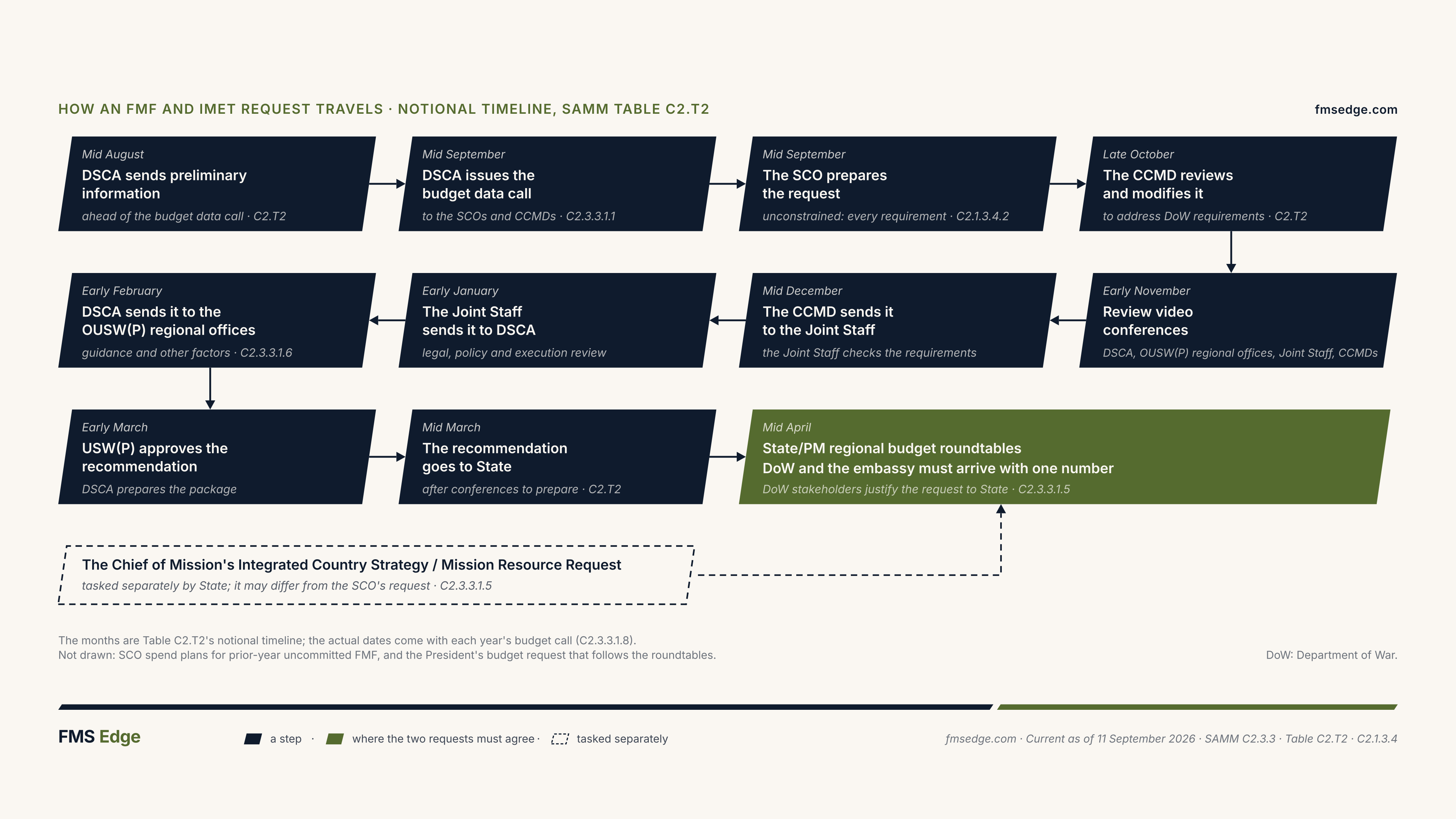
How does a security cooperation office ask for FMF and IMET money?
For partner nations receiving U.S. military grant aid, the will submit annual Foreign Military Financing () and International Military Education and Training () budget requests [SAMM ]. The submits the request electronically through the and Budget Web Tool [SAMM ]. This document is forwarded upward through channels for endorsement and comment, i.e., to the staff, the Joint Staff, the , and Office of the Under Secretary of War for Policy regional offices, where a final Department of War (DoW) position is developed for each country. This position is then used by DoW representatives in round-table discussions with the Department of State () to develop an eventual Congressional Budget Justification () submission by the Secretary of to the relevant committees in Congress [SAMM , , ].
The web tool keeps and budget data in one central online repository, used for budget development and later reporting [SAMM ].
Within the Department of State, the Bureau of Political-Military Affairs () serves as the focal point for the Military Assistance Budget, and it sets the deadline for the Department of War's budget submission. 's Office of Business Operations () is responsible for preparing the budget call and releasing it to the and the geographic [SAMM ].
The Secretary of War's Guidance for the Employment of the Force () is the overarching guidance for developing and budgets, and approved regional Theater Plans are also used to develop the annual budget recommendation. and budget requests should reflect the Secretary of War's strategic priorities and the fiscal guidance issued for the annual budget build [SAMM ].
The submits its request to the on the notional timeline of Table C2.T2, while the Ambassador’s Mission Resource Request () is tasked separately by [SAMM , ]. The should use the data it compiled for the and budget call as the basis for its input to any tasking received for the , in accordance with the guidance [SAMM ]. For countries eligible to receive foreign aid, including military assistance, the annual is the first step in the and U.S. Agency for International Development () budget formulation process [SAMM ]. DoW and proposals that are not consistent with the 's ('s) Integrated Country Strategy (ICS) and will be at risk for exclusion from the final budget [SAMM ]. The Senior Defense Official/Defense Attaché (/) and therefore need a solid relationship with the embassy political section.
The 's and budget requests should reflect the views of the Department of War. The ICS and reflect the 's views on the funding required, which may differ from the 's [SAMM ].
Each annual budget submission must explain why uncommitted funds have built up in the trust account [SAMM ]. Funding requests for a country that keeps high uncommitted balances are closely scrutinized, so the submission must also give a general plan for using those funds and a timeframe for committing them promptly [SAMM ]. The web tool displays all the Foreign Assistance funds received by the partner nation (PN) and indicates the amount of “uncommitted funds.”
grant-aid funding is obligated when it is apportioned, and the funds stay available indefinitely in the country's Trust account. Uncommitted funds can weaken the 's justification for future , so should monitor and manage programs to guard against their accumulation [SAMM ].
References
SAMM
- SAMM C2.1.3.4: Foreign Military Financing and International Military Education and Training Budget Requests.
- SAMM C2.3.3.1.3: Mode of Military Assistance Budget Submissions.
- SAMM C2.1.3.4.1: Consistency with Mission Strategic Resource Plan.
- SAMM C1.3.1: Department of State.
- SAMM C2.T2: Channels and Notional Timeline for Military Assistance Budget Submissions
- SAMM C2.1.3.3.2
- SAMM C2.3.3.1.4: Scope of Military Assistance Budget Submissions.
- SAMM C2.3.3.1.1: Military Assistance Budget Call.
- SAMM C2.3.3.1.2: Strategic/Fiscal Guidance and Priorities.
- SAMM C2.3.3.1.5: Military Assistance Budget Call and the Department of State Integrated Country Strategy/Mission Resource Request.
- SAMM C2.1.3.4.3: Uncommitted Funds.
Related
Security Cooperation
Activities by which the Department of War encourages and enables international partners to cooperate with the United States toward strategic objectives, spanning every interaction with foreign defense and security establishments and every security assistance program the Department administers.
Under chapter 16 of Title 10, their purposes are to develop allied and friendly security capabilities for self-defense and multinational operations, to give U.S. forces peacetime and contingency access, and to build relationships promoting specific U.S. security interests [10 U.S.C. 301(7)].
FMS Edge glossary, as of 10 October 2026
Glossary entry →Open the manual’s entry → (opens in new tab)
Defense Security Cooperation Agency (DSCA)
The Department of War agency that directs, administers and provides guidance to the Department's components and its representatives at U.S. missions for the execution of the security cooperation programs for which it is responsible [SAMM C1.3.2.2]. The agency also provides financial and technical assistance, arranges the transfer of defense materiel, training and services to international partners, and promotes military-to-military contacts.
FMS Edge glossary, as of 10 October 2026
Glossary entry →Open the manual’s entry → (opens in new tab)
Combatant Command (CCMD)
A unified or specified command with a broad continuing mission under a single commander established and so designated by the President, through the Secretary of Defense and with the advice and assistance of the Chairman of the Joint Chiefs of Staff. Also called CCMD.
SAMM Glossary, as of 12 September 2026
Glossary entry →Open the manual’s entry → (opens in new tab)
DSCA: Defense Security Cooperation Agency
SAMM Acronyms, as of 12 September 2026
Glossary entry →Defense Security Cooperation Agency (DSCA) →
Chief of Mission (COM)
The principal officer in charge of a diplomatic facility of the United States, including any individual temporarily assigned to be in charge of such a facility.
SAMM Glossary, as of 12 September 2026
Glossary entry →Open the manual’s entry → (opens in new tab)
Security Cooperation Organization (SCO)
A Department of Defense element that is part of the United States Diplomatic mission located in a foreign country to carry out security assistance and security cooperation management functions under the supervision and coordination authority of the senior defense official/defense attaché.
SAMM Glossary, as of 12 September 2026
Glossary entry →Open the manual’s entry → (opens in new tab)
IMET: International Military Education and Training
SAMM Acronyms, as of 12 September 2026
SCO: Security Cooperation Organization
SAMM Acronyms, as of 12 September 2026
State (PM): Department of State, Bureau of Political-Military Affairs
SAMM Acronyms, as of 12 September 2026
SAMM: Security Assistance Management Manual
SAMM Acronyms, as of 12 September 2026
Glossary entry →Security Assistance Management Manual (SAMM) →
USAID: U.S. Agency for International Development
SAMM Acronyms, as of 12 September 2026
Senior Defense Official (SDO) and Defense Attaché (DATT)
Principal DoD official in a U.S. embassy, as designated by the Secretary of Defense. The SDO or DATT is the Chief of Mission's principal military advisor on defense and national security issues, the senior diplomatically accredited DoD military officer assigned to a diplomatic mission, and the single point of contact for all DoD matters involving the embassy or DoD elements assigned to or working from the embassy. The SDO or DATT is considered the dual-hatted chief of both the Security Cooperation Organization and Defense Attaché Office in the embassy. This position was established by DoDD 5205.75, Department of Defense Operations at U.S. Embassies, December 21, 2007. The same document gives coordinating authority (see glossary definition) to the SDO or DATT for the purpose of ensuring that all DoD elements in a country are working in consonance with each other and under the guidance of the Chief of Mission. The SDO or DATT program replaces the now defunct U.S. Defense Representative model.
SAMM Glossary, as of 12 September 2026
Glossary entry →Open the manual’s entry → (opens in new tab)
Security Assistance (SA)
A group of programs authorized by federal statutes by which the United States provides defense articles, military training, and other defense-related services by grant, lease, loan, credit, or cash sales in furtherance of national policies and objectives, and those that are funded and authorized through the Department of State to be administered by Department of Defense/Defense Security Cooperation Agency, which are considered part of security cooperation.
SAMM Glossary, as of 12 September 2026
Glossary entry →Open the manual’s entry → (opens in new tab)
SAMM C2.1.3.4: Foreign Military Financing and International Military Education and Training Budget Requests.
“For partner nations receiving U.S. military grant aid, the MILGP will submit annual FMF/IMET budget requests. The preparation and submission of these requests is a coordinated effort between MILGP and CCMD staff.”
Security Assistance Management Manual, as of 26 October 2026
SAMM C2.3.3.1.3: Mode of Military Assistance Budget Submissions.
“Budget requests are submitted and maintained using the FMF and IMET Budget Web Tool. The web tool provides a central, on-line repository of FMF and IMET budgetary data that provides a timely, efficient, and visible method for budget development and subsequent reporting.”
Security Assistance Management Manual, as of 11 September 2026
SAMM C2.T2: Channels and Notional Timeline for Military Assistance Budget Submissions
“Table C2.T2. Channels and Notional Timeline for Military Assistance Budget Submissions Date Action Mid August DSCA provides preliminary information to MILGPs in preparation for the annual FMF and IMET Budget data call. Mid September DSCA requests MILGPs to prepare their annual budget submissions. MILGPs formulate their budget requests. Late October MILGPs submit their budget requests to the CCMDs, who review …”
Security Assistance Management Manual, as of 26 October 2026
SAMM C2.1.3.4.1: Consistency with Mission Strategic Resource Plan.
“MILGP FMF/IMET budget requests and justifications are used by DoW representatives in State-led interagency discussions during the final stages of development of the State budget submission. DoW FMF/IMET proposals not consistent with the COM’s ICS/MRR will be at-risk for exclusion from the final budget.”
Security Assistance Management Manual, as of 26 October 2026
SAMM C1.3.1: Department of State.
“Department of State Seal Under the Foreign Assistance Act (FAA), Arms Export Control Act (AECA), and Executive Order (E.O.) 13637 the Secretary of State (SECSTATE) is responsible for continuous supervision and general direction of SA programs. This includes determining whether (and when) there will be a program or sale for a particular country or activity (to include International Military Education …”
Security Assistance Management Manual, as of 26 October 2026
SAMM C2.3.3.1.1: Military Assistance Budget Call.
“Within the State, Bureau of Political and Military Affairs (State (PM)) is the focal point for the Military Assistance Budget. PM sets the deadline for the DoW budget submission. DSCA (Office of Business Operations (OBO)) is responsible for preparing and releasing the budget call to the U.S. Military Groups (MILGPs) and geographic Combatant Commands (CCMDs).”
Security Assistance Management Manual, as of 26 October 2026
SAMM C2.3.3.1.2: Strategic/Fiscal Guidance and Priorities.
“The SECWAR’s Guidance for the Employment of the Force (GEF) serves as the overarching guidance for FMF and IMET Budget development. Approved regional Theater Security Cooperation Plans are also used in developing the annual FMF and IMET Budget recommendation. FMF and IMET Budget requests should reflect the SECWAR’s strategic priorities and fiscal guidance issued for the annual budget build.”
Security Assistance Management Manual, as of 26 October 2026
SAMM C2.3.3.1.5: Military Assistance Budget Call and the Department of State Integrated Country Strategy/Mission Resource Request.
“The MILGP's FMF and IMET Budget requests should reflect the DoW’s views. The Integrated Country Strategy (ICS)/Mission Resource Request (MRR) reflects the Chief of Mission’s (COM’s) views on required funding, which may differ from the MILGP's views. The MRR input is tasked separately by State. The MILGP should use the data it compiled for the DoW FMF and IMET Budget …”
Security Assistance Management Manual, as of 26 October 2026
SAMM C2.1.3.3.2
“For countries eligible to receive foreign aid, including military assistance, the annual MRR is the first step in the State and USAID budget formulation process. Each mission uses the MRR to describe the Diplomatic Engagement and Foreign Assistance resources required to advance the nation’s foreign policy goals and make progress on the mission objectives articulated in their ICS.”
Security Assistance Management Manual, as of 11 September 2026
SAMM C2.1.3.4.3: Uncommitted Funds.
“Funding provided under FMF grant-aid is obligated upon apportionment, and the funds remain available in the country’s FMF Trust account indefinitely. However, annual budget submissions must explain the accumulation of uncommitted funds in the trust account. Uncommitted funds can weaken MILGP justification for future FMF. MILGPs should monitor and manage SA programs to ensure against the accumulation of uncommitted funds.”
Security Assistance Management Manual, as of 26 October 2026
SAMM C2.3.3.1.4: Scope of Military Assistance Budget Submissions.
“Military Assistance funding is a key tool in promoting foreign policy and national security objectives. As such, it is imperative, based on the congressionally mandated National Security Assistance Strategy (NSAS) reporting, that DoW incorporates a long-term strategy into the Military Assistance Budget process. Therefore, budget submissions must incorporate the following elements: out-year program requirements; objective-oriented input detailing what needs to …”
Security Assistance Management Manual, as of 26 October 2026